Tag Archives: Sefer Zerubbabel

Iran in Prophecy

As we witness incredible events in the Middle East, it is worth reviewing and summarizing ancient prophecies that speak of Iran at the End of Days. First is Ezekiel’s prophecy of Gog u’Magog (Ch. 38-39), where he lists Persia (Paras) as the first ally of Gog in the final apocalyptic war against Israel. The Persian regime goes on to be described as the main adversary in many rabbinic prophecies. Nearly two millennia ago, Rabbi Shimon bar Yochai taught that “If you see a Persian horse tied up to the graves of the land of Israel, expect the footsteps of Mashiach.” (Shir haShirim Rabbah 8:9) In other words, when Persian military might is causing deaths in Israel, God forbid, the Final Redemption is near. Tragically, one woman was killed today in Tel-Aviv from an Iranian missile. Let us pray it is the last grave in Israel caused by a “Persian horse”.

In the 7th century Sefer Zerubavel (explored fully and in depth in the recent class on ‘Trump, Iran and the Year of the Horse, Part 2’), Persia again plays a big role. We are told that the king of Persia, referred to as “Seroy”, will launch attacks against Israel: “Seroy the king of Persia will attack Nehemiah ben Hushiel and Israel, and there will be great suffering in Israel.” Here, Nehemiah ben Hushiel is the title given to Mashiach ben Yosef. The suffering won’t last long, though, and Hashem “will place a spirit of confusion upon [the Persian army], and they will kill one another, each (slaying) his companion or his countryman. The wicked one [Seroy] will die.” The Persian king will die early on in the war, perhaps at the very beginning. This is important to keep in mind as we now have reports confirming the death of Supreme Leader Ali Khameini. Meanwhile, Iran’s remaining leadership is in disarray, and some of them are calling for mercy and “de-escalation”. (Incredibly, Sefer Zerubavel begins by stating that the prophecy was relayed on the 11th of Adar—precisely the date on which Khameini was eliminated!)
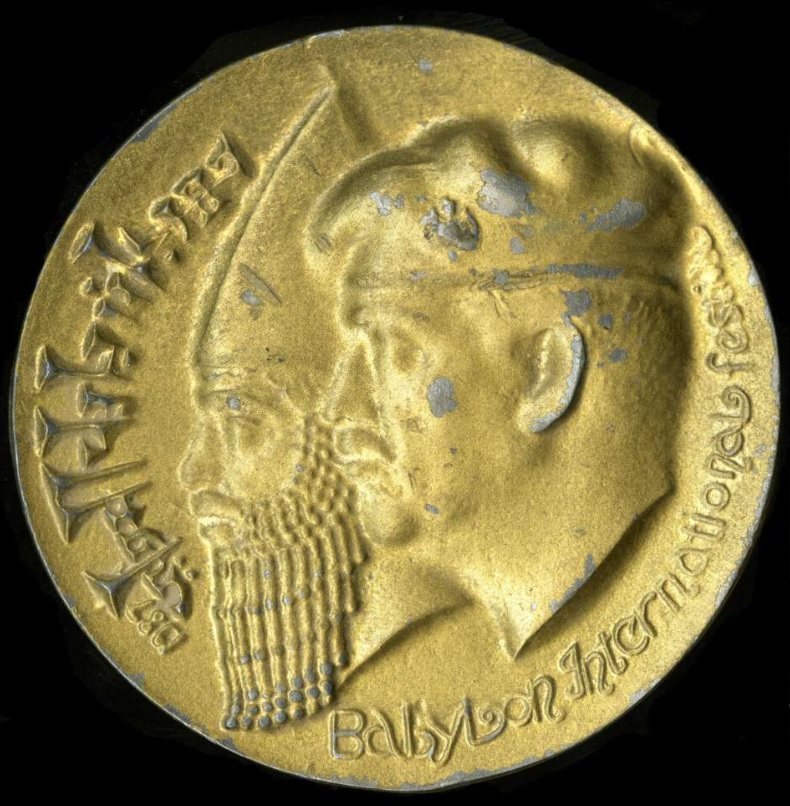
A 1987 gold-plated medal minted by Saddam Hussein, depicting his own face alongside Nebuchadnezzar’s.

The death of Khameini is significant, especially on Shabbat Zachor (when we read about Amalek), and on the cusp of Purim, which commemorates the death of another genocidal Persian figure, the Amalekite Haman. The alliteration of Haman and Khameini is unmissable. Moreover, the Zohar (II, 58b) prophecies that at the End of Days, God will bring back all the old oppressors of Israel and punish them one last time: “The Holy One, blessed be He, shall resurrect those kings that distressed Israel and Jerusalem, such as ‘Adrianus’ [Vespasian] and ‘Lupinus’ [Titus], Nebuchadnezzar and Sancheriv, and all the other kings of the world that took part in the destruction of His House…” In the past, I’ve noted how Saddam Hussein believed himself to be the reincarnation of Nebuchadnezzar. He spoke about it openly, built his palace over the archaeological remains of Nebuchadnezzar’s palace, and minted coins superimposing his face over Nebuchadnezzar’s, among other things. Saddam was president of Iraq, which is modern-day Babylon. It is quite possible that Iran’s Khameini is the modern-day version of ancient Iran’s Haman.

Another well-known prophecy about Persia in the End of Days is in the Talmud (Yoma 10a). Here, the Sages debate whether Rome will ultimately fall to Persia, or will Persia ultimately fall to Rome? Now, it is important to remember that in the time when the Talmud was written, the Roman Empire and the Persian Empire were locked in a centuries-long war. In fact, the Roman-Persian War is one of history’s longest, officially dated from 54 BCE to 628 CE, a whopping 681 years! The peshat here in the Talmud is that the Sages were debating how that Roman-Persian war they were mired in at the time would end. Some thought Rome would win and some thought Persia would win. The debate concludes with Rav Yehuda citing a teaching from Rav (in Sanhedrin 98b) that “The son of David will come only when the wicked kingdom of Rome spreads its dominance throughout the world for nine months.” This implies that Rome would ultimately win over Persia. Right now, we are certainly seeing the modern-day “Roman Empire” displaying its dominance over the whole world, Persia included.
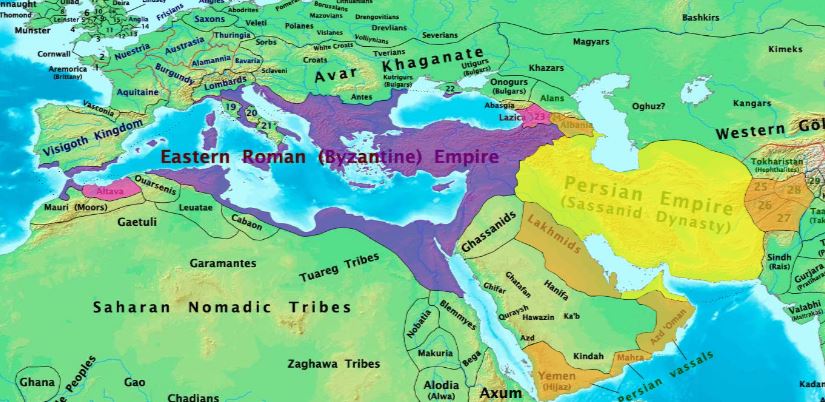
Sasanian and Eastern Roman (Byzantine) Empires in 600 CE, before the rise of Islam

Finally, no discussion of Iran in prophecy would be complete without the well-known Midrash in Yalkut Shimoni II, 499 (worth reading the whole passage!) Amidst a long discussion of the Light of Creation and the Light of Mashiach, we are told that “In the year that King Mashiach will be revealed, all the kings of the nations of the world will taunt each other. The king of Persia will taunt the king of Arabia. And the king of Arabia will go to Aram to get advice from them…” Standard versions of the text today typically say “Aram” (ארם) here, but it is far more likely that original manuscripts said “Edom” (אדם), which makes a lot more sense both then and now. It is interesting to note that Iran responded today by attacking neighbouring Arab countries as well, and one of the first victims (outside Iran) was a citizen in the United Arab Emirates. Also revealed in the news now is that Saudi crown prince Mohammed bin Salman was encouraging Trump to launch the attack on Iran despite presenting himself publicly as being opposed to it.

The prophecy continues to say that in the midst of this war “the king of Persia returns and destroys the entire world…” A desperate Persian regime will, it seems, unleash something terrible upon the world. Not to worry, though, because Hashem says “My children, do not be afraid! All that I have done, I have only done for your sake. Why are you afraid? Do not be afraid, the time of your redemption has arrived!” Shortly after, Mashiach is revealed (referred to here in the Midrash as “Ephraim”) to bring an end to the war and peace and prosperity to Israel: “At that time, the Holy One, blessed be He, will raise up Mashiach to the highest Heavens, and spread upon him some of His glory, before the nations of the world and before the wicked Persians. They tell him: ‘Ephraim, our righteous Mashiach, judge them and do as you wish with them…’”

Here, the Midrash describes that Persian forces are not alone in the area, but that “Not one or two kingdoms come upon him, but one hundred and forty kingdoms surround him.” As I first suggested a couple of years ago in this shiur on Mashiach ben Yosef, this may be referring to the United Nations peacekeeping forces which officially have troops from about 140 nations. In addition, Trump’s “International Stabilization Force” in Gaza (with its headquarters in Kiryat Gat, Israel) will soon bring in troops from all over the world, including 8000 already committed by Indonesia (the world’s largest Muslim country, no less). Just this past week, I spoke to a friend in Indonesia who told me his taxi driver’s soldier son is already on the way to Gaza!

The Midrash does not provide an exact timeline, but does mention one clue: “Our Rabbis taught: The Patriarchs are destined to stand in Nisan and say: ‘Ephraim, our righteous Mashiach, even though we are your forefathers, you are better than us because you suffered the sins of our children and harsh and evil things have befallen you which have not befallen the former ones or the latter ones…’” The Patriarchs are worried that Mashiach will not want to save his people because of all the torment they caused him, but he reassures the Patriarchs that “All that I have done I have only done for you and for your children to enjoy this goodness that the Holy One, blessed be He, has bestowed upon Israel.” The Patriarchs reply: “Ephraim, our righteous Mashiach, rest your mind for you have rested the mind of your Maker and our minds.” Hopefully, the Nisan referenced to here is the forthcoming Nisan next month.
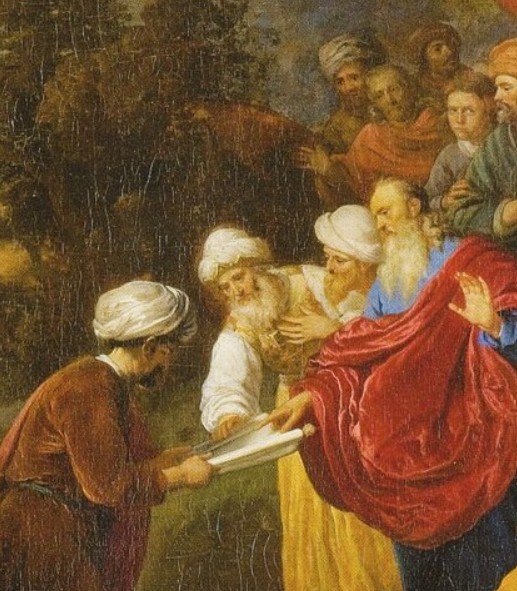
‘Zerubbabel shows Cyrus the Great a plan of the rebuilt Jerusalem’ by Jacob van Loo (1614-1670)

Finally, it is worth remembering that it was the Persian emperor Cyrus who liberated the Jews some 2500 years ago and allowed them to rebuild the Holy Temple in Jerusalem. We read in Isaiah 45:1 that Cyrus is surprisingly referred to as God’s meshicho, “anointed one”. Our Sages (Megillah 12a) discuss this puzzle and conclude that, of course, he was not the Messiah. So what might we learn from it instead? Perhaps it is a prophetic allusion for the present day: that Mashiach has a Persian connection, that we should expect Iran to once again play a big role, and that they will once again pave the way for the rebuilding of the Holy Temple in Jerusalem, speedily and in our days.

Wishing Everyone a Happy & Meaningful Purim!


Purim Learning Resources:
Secrets of Purim (Video)
Who is Ahashverosh?
Queen Esther’s Kabbalah (Video) 
The Secret, Secret Story of Stalin’s Purim Death
A Mystical Peek Into Megillat Esther
Trump, Iran & the Year of the Horse, Part 2

In Part 2, we explore where President Trump may have been alluded to in ancient prophecies, alongside Qatar, Erdogan, the Houthis, and the Epstein Files. Along the way, we review how the Biblical “Star of Jacob” prophecy has been fulfilled in recent years, what might happen with Iran in the weeks ahead, and how Daniel’s prophecy of 1290 years to the End of Days might soon be realized. Plus, who is Armilus? Where is the Staff of Moses hidden? And what is the true origin of the Dome of the Rock in Jerusalem?

Leviathan & the Seven Serpents

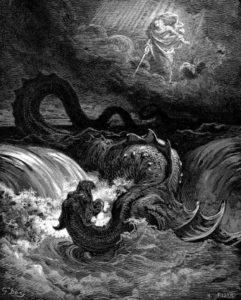
‘Destruction of Leviathan’ by Gustav Doré

In this week’s parasha, Va’era, we read about Moses’ first confrontation with Pharaoh and the famous battle of their serpentine staffs. Interestingly, in last week’s parasha when Moses’ staff first turned into a serpent (Exodus 4:3), the word used was nachash, while this time it says tanin (7:9-10)! The former term certainly means a “snake”, but the latter is more general and can be any serpent, reptile, or even crocodile. Mystical texts see this as an allusion to the greatest of the taninim, created by God on the Fifth Day of Creation, the great sea dragon called Leviathan. The Zohar (II, 27b) comments here that the Leviathan was red like a rose, with iron-like scales, wing-like fins, a powerfully-thrashing tail, and fire coming out of its mouth. It has long migrations in the deep seas lasting seventy years.

Commenting on the words hataninim hagedolim, “the great sea monsters”, in Genesis 1:21, Rashi says that God originally created a pair of Leviathans, but they were so terrible that He slew the female so that the couple wouldn’t reproduce. God then “salted” its flesh and preserved it for the righteous in the World to Come, who are said to enjoy it at the “Feast of Leviathan” in the End of Days. Rashi is quoting the Talmud here (Bava Batra 74b-75a), which adds that God will make a sukkah for the tzadikim from the skin of the Leviathan. The leftover skin will be draped over “the walls of Jerusalem” and will shine and glow to wow the entire world. Perhaps that means the Kotel will have a miraculous new look in the near future, which is quite fitting since it will no longer be a “wailing” wall.

We read here in the Talmud that God castrated the male Leviathan, too, and provides a Scriptural source for it all in Isaiah 27:1, that “He will slay the Serpent that is in the sea…” The Sages ask: why did God slay the female and not the male? One answer is that the female could have still laid eggs without the male. Indeed, we know scientifically that there is a phenomenon called parthenogenesis where female fish are able to reproduce even without fertilization by a male. The Talmud then gives another answer based on Psalms 104:26, which says “There is Leviathan, whom You have formed to sport with.” God created the Leviathan just to “sport with”, and it wouldn’t be appropriate to sport with a female Leviathan, so he left the male only. (It seems gender segregation in sports is not a new issue!)

There is a way to interpret all of this metaphorically, too, and the Talmud goes on to say that the Jordan River flows into the “mouth of Leviathan”, while the ancient Seder Rabbah d’Beresheet says the entire planet “rests” on one of the fins of Leviathan. Even the Zohar has an interesting interpretation of the taninim gedolim of Creation, saying they are actually referring to the “Seventy Princes”, the Heavenly angels overseeing the seventy nations of the world. Leviathan is chief among them. From other sources, we learn that the chief of all the Seventy Princes is the angel Metatron (ie. Enoch), so we find here a link between the great Metatron and Leviathan. (This is further appropriate because the earliest known reference to a “Feast of Leviathan” is actually the apocryphal Book of Enoch!)

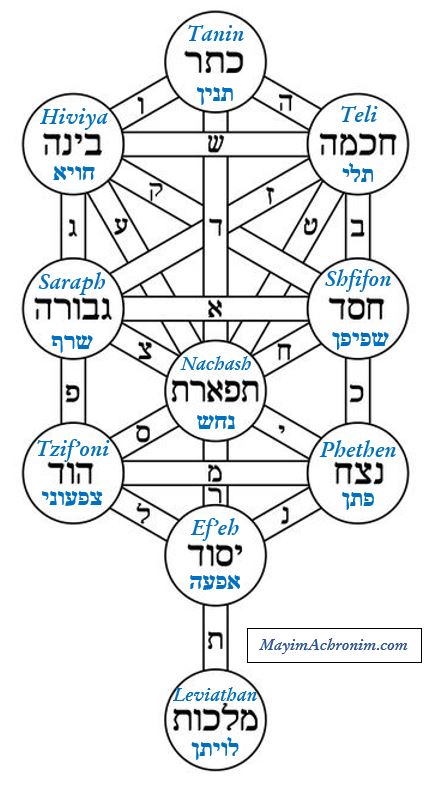
Mystical texts say the spirit of Metatron is found within Mashiach (see, for instance, Kol haTor), and Mashiach is destined to slay the remaining Leviathan at the End of Days, ushering in the final Kingdom of God on Earth. This, too, might be a metaphor for Mashiach subduing all seventy nations and unifying them under one God, as we read in Zechariah 14:9 that “Hashem shall be king over the entire Earth; on that day Hashem will be one and His name will be one.” In fact, the numerical value of “Leviathan” (לויתן) is 496, equal to Malkhut (מלכות), “Kingdom”. Leviathan thus corresponds to the last of the Sefirot. (We explored in the past how the changing astronomical constellations in the sky above us are shifting now to reveal this very process.) Intriguingly, we find six other terms for serpents throughout the Tanakh, and they neatly parallel the six other “lower” Sefirot from Chessed to Yesod.

The Seven (Eight?) Serpents

The most common term for a serpent is, of course, nachash. This snake corresponds to the central Sefirah of Tiferet. Tiferet is the spiritual root of all Israel, and of Mashiach in particular. This is another reason why the values of nachash (נחש) and “Mashiach” (משיח) are equal, both being 358. When Jacob blessed his son Dan, he saw a vision of Mashiach and said “I await Your salvation, Hashem!” (Genesis 49:18) Before that, Jacob fittingly described Mashiach (while seemingly speaking of Dan) as a nachash ‘alei derekh, a “snake upon the road”.

He then used another serpentine term, saying that Mashiach should also be a shfifon ‘alei orach, typically translated as a “viper upon the path”. The Maharal (Rabbi Yehuda Loew of Prague, c. 1512-1609) in Gur Aryeh connects this mysterious term with several roots, including the humbling shofef, as well as neshef, meaning an “exhale” or a “relaxation” or even a happy gathering of some sort. The shfifon (שפיפן) has positive energy, and corresponds to the loving Sefirah of Chessed. Jacob was possibly alluding to Mashiach’s role to bring all of Israel together and reconnect them spiritually through various “paths”.

On the opposite side of the Sefirotic tree we have the fiery and judging Gevurah. This corresponds to the Torah’s saraph (שרף), a “burning” venomous snake that God used to punish the people in the Wilderness for their rebelliousness (Numbers 21). To heal the people, Moses then made a nachash nechoshet, a copper serpentine rod. Now we can understand why it had to be specifically a nachash because, as we saw above, that one corresponds to Tiferet, which is said to be the source of healing and shares a root with refuah!  Mashiach, too, is said to carry a serpentine staff. In fact, the Midrash and Zohar state that a woman called “Heftzibah” will bring it to him, finding it somewhere in Tiberias where Eliyahu hid it. She is also known as Mevaseret Tzion, the “Herald of Zion”, as per Isaiah 40:9 (see Sefer Zerubbabel and Zohar III, 173b).

Next, we have the “twin” Sefirot of Netzach and Hod, corresponding to the legs. They are always referred to as being the source of prophecy. In Psalm 91 we read “You will tread on lion cubs and phethen…” The phethen (פתן) is none other than the python. It is worth noting that in ancient Greece, the python was associated with prophecy, and their prophetic Oracle at Delphi was called Pythia. In the famous messianic prophecy of Isaiah, we read of another serpent paralleling the python: “A babe shall play over the hole of a phethen, and an infant pass its hand over the den of a tzif’oni.” (11:8) The word used for a “den” here is me’urat, which can be read as m’orat, ie. “from the light [or fire] of the tzif’oni”. The Malbim (Rabbi Meir Leibush Wisser, 1809-1879) reads it this way, saying the “fiery” poison of the tzif’oni (צפעוני) will no longer harm a child in the Messianic Age. This gives us a clue that the tzif’oni corresponds to Hod, lying beneath the fiery Sefirah of Gevurah, and tempering its judgement. More significantly, we can learn from this Isaiah verse that in the Messianic Age, even a child will be able to connect to Netzach and Hod and attain the light of prophecy.

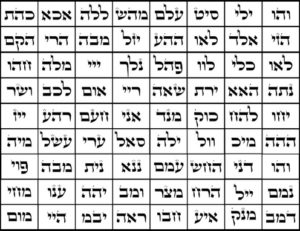
The 72 Names of God (For the origin of these Names, see here.)

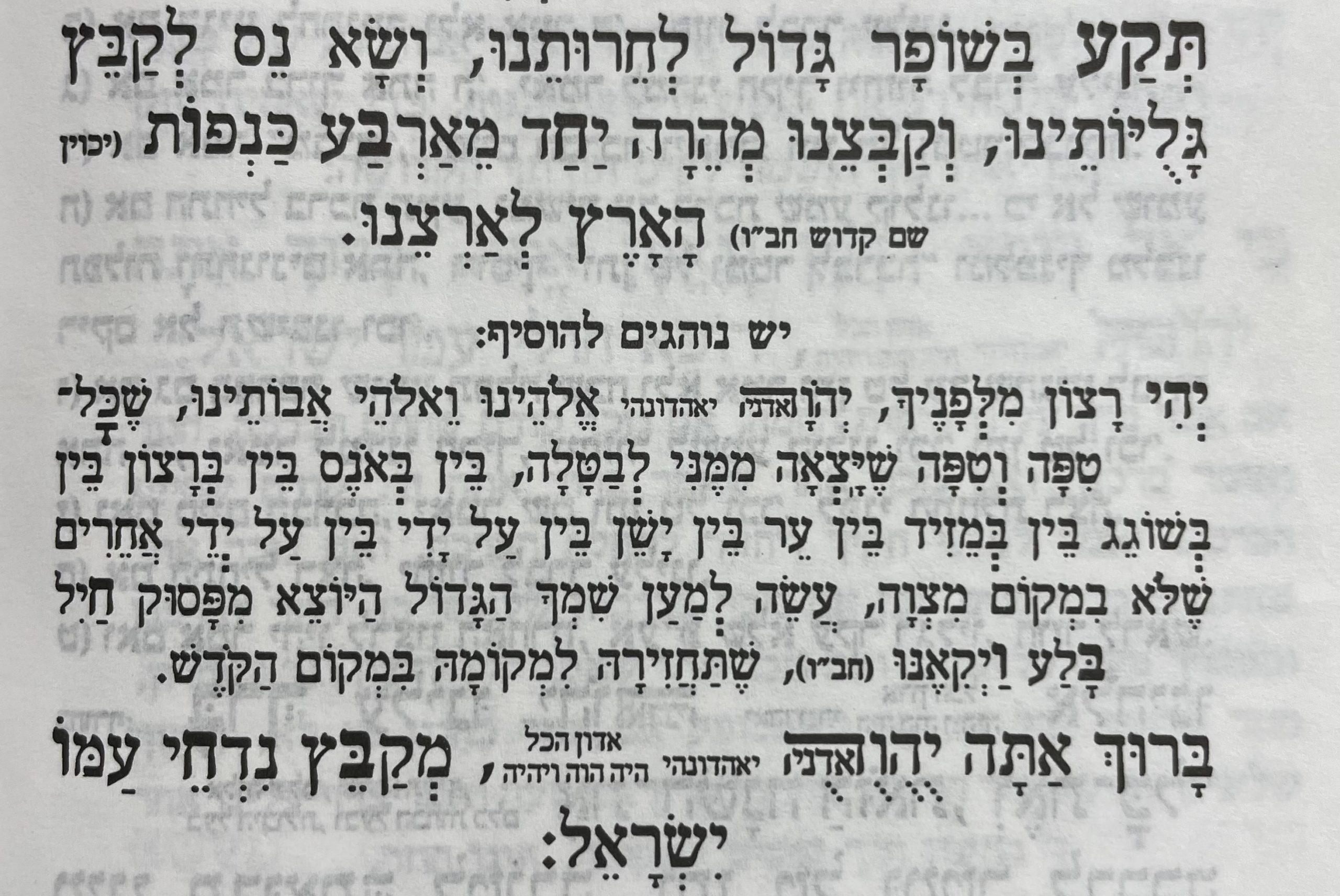
Finally, the last word for a serpent in Tanakh is ef’eh (אפעה), as we read in the Book of Job that “He sucks the head of a viper; the tongue of the ef’eh kills him.” (20:16) This one parallels the Sefirah of Yesod, the domain of sexual purity. In fact, the Kabbalists teach that of the 72 Names of God, the one that links to Yesod and through which one can atone for sexual sins is חב״ו. In the Amidah, there is a kavanah to insert during the kibbutz galuyot blessing to purify one of wasted seed and other sexual issues and it quotes a well-known phrase chayil bala’a vayakienu, mibitno yorishenu El, “The riches that he swallowed he vomits; God empties it out of his innards.” The letters of the first three words (חַיִל בָּלַע וַיְקִאֶנּוּ מִבִּטְנוֹ יֹרִשֶׁנּוּ אֵל) spell חב״ו. And where does this powerful verse come from? The preceding one in Job! (20:15) Thus, we have a clear Scriptural link between the ef’eh and Yesod.

Text of the blessing, with kavanah, both highlighting the חב״ו name.

And what of the Mochin, the upper three Sefirot? Perhaps we can link them to serpentine terms outside of Scripture. For instance, there’s the Teli (תלי) of Sefer Yetzirah (6:1-2), typically understood as the dragon constellation Draco. Recall that Sefer Yetzirah is an exposition of the Lamed-Bet Netivot Chokhmah, 32 Paths of Wisdom, so the Teli is directly linked to the Sefirah of Chokhmah. Then there’s the Talmud’s Aramaic hiviya (חויא), the root of which is said to come from Eve (חוה), and her encounter with the Snake. This would parallel the “motherly” Sefirah of Binah (also called Ima). And Keter on top, the origin of all the others, would be the generic term Tanin (תנין) with which we started, referring to any of the serpents below and often used interchangeably with them, as in this week’s parasha. Altogether, we have the following array of links between mystical Sefirot and mystical serpents: