Tag Archives: Vision

The Spiritual Significance of Fruits

This Sunday evening brings Tu b’Shevat, the “New Year for Trees” and the start of a new agricultural and fruit-tithing season. Fruits play a huge role in Judaism, starting right at the beginning of the Torah with a special double-blessing on Day Three of Creation when fruit-bearing trees emerged. Then comes the Forbidden Fruit of the Tree of Knowledge, setting in motion all of history as we know it. The importance of fruits carries over into the Talmud, where the Sages teach that a Torah scholar should not live in a place that does not have a wide variety of fruits! The passage (Sanhedrin 17b) begins like this:

וְתַנְיָא: כׇּל עִיר שֶׁאֵין בָּהּ עֲשָׂרָה דְּבָרִים הַלָּלוּ אֵין תַּלְמִיד חָכָם רַשַּׁאי לָדוּר בְּתוֹכָהּ: בֵּית דִּין מַכִּין וְעוֹנְשִׁין, וְקוּפָּה שֶׁל צְדָקָה נִגְבֵּית בִּשְׁנַיִם וּמִתְחַלֶּקֶת בִּשְׁלֹשָׁה, וּבֵית הַכְּנֶסֶת, וּבֵית הַמֶּרְחָץ, וּבֵית הַכִּסֵּא, רוֹפֵא, וְאוּמָּן, וְלַבְלָר, וְטַבָּח, וּמְלַמֵּד תִּינוֹקוֹת. מִשּׁוּם רַבִּי עֲקִיבָא אָמְרוּ: אַף מִינֵי פֵירָא, מִפְּנֵי שֶׁמִּינֵי פֵירָא מְאִירִין אֶת הָעֵינַיִם

And it is taught: A Torah scholar is not permitted to reside in any city that does not have these ten things: A court that has the authority to flog and punish transgressors; and a charity fund for which monies are collected by two people and distributed by three. And a synagogue; and a bathhouse; and a public restroom; a doctor; and a craftsman; and a scribe; and a ritual slaughterer; and a teacher of young children. They said in the name of Rabbi Akiva: The city must also have varieties of fruit, because fruits illuminate the eyes.

It’s easy to see how the ten requirements neatly parallel the Ten Sefirot: a charity fund is Chessed, while a beit din is Gevurah (or Din). A doctor (rof’e) is tied directly to Tiferet, the root of balance and healing. A beit knesset is a place to connect and communicate with the Eternal One, Netzach. The bathhouse is tied to the Sefirah of Hod (as explained in detail in the recent class on health). Today’s equivalent of the Roman bathhouses they used to have in Talmudic times is probably something like a country club or fitness room (with amenities like pool, sauna, and hot tub). A restroom corresponds to Yesod for obvious reasons. Thankfully, we live in an age where there are restrooms everywhere, including in our own homes. A craftsman who can construct things ties to the “kingdom” of Malkhut. (In fact, numerically, the value of “craftsmanship”, אמנות, is 497, one more than Malkhut, מלכות, which is 496.) Rashi says that “craftsman” here is referring to a bloodletter (also discussed in the same class on health linked to above). Kabbalistically, blood parallels the lowest level of soul, the nefesh, which parallels Malkhut.
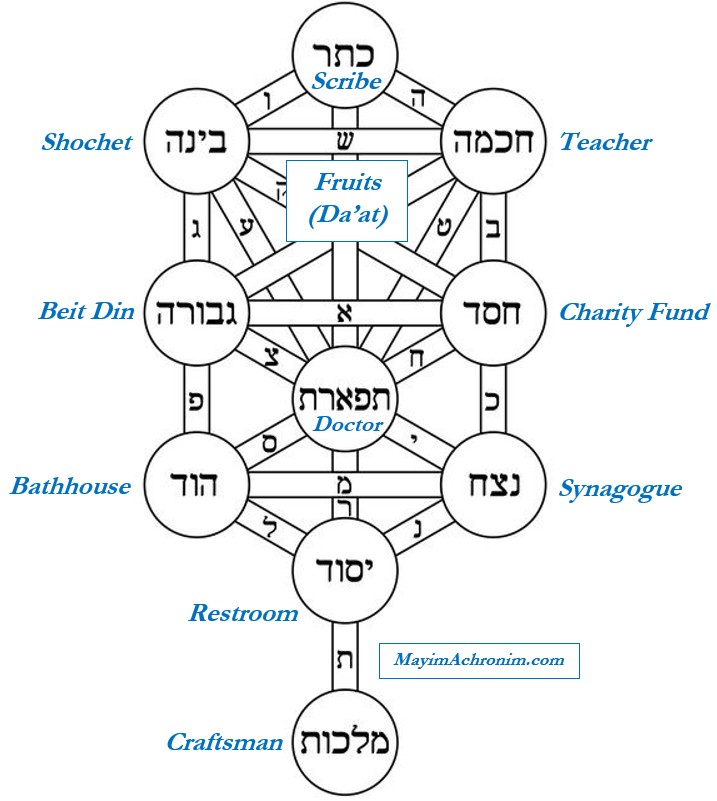
The remaining three correspond to the upper three Sefirot, the Mochin. The shochet to Binah (since he must be both God-fearing and Torah-learned, but also knowledgeable in the biology and physiology of the animals), the teacher to Chokhmah (as his job is to spread wisdom and educate others), and the scribe to Keter (for reproducing the Word and Will of God). Then Rabbi Akiva adds an eleventh requirement, which is appropriate since there is a hidden “eleventh” Sefirah, too, the opposite face of Keter, called Da’at. The requirement corresponding to Da’at is having fruits, fittingly reminding us of the Etz haDa’at, the Forbidden Fruit of the Tree of Knowledge. The big question is: why are fruits so important that they are a fundamental requirement for a Torah scholar?

The simple answer that Rabbi Akiva gives is that fruits are good for the eyes. Indeed, fruits are very nutritious and have things like vitamin A (retinol) which is helpful for vision, as well as different pigments that help with eye health. Today we know that carotenoids (which give fruits and vegetables their yellow and orange colours) protect the eye’s retina, while anthocyanins (which make fruits and flowers blue or purple) have been shown to boost rhodopsin proteins which allow one to see. Evidence suggests that both lycopene (the red pigment) and vitamin C reduce cataracts, the leading cause of blindness. So, modern science confirms Rabbi Akiva’s teaching. And it’s all the more important for Torah scholars to have good vision since they spend so many hours a day pouring over books and fine print.

Fruits are also important for Jewish practice, and are intricately tied to the Jewish calendar. We need various fruit and tree varieties for Rosh Hashanah simanim, and for the four species of Sukkot; to fulfil mitzvot like orlah and bikkurim, to recite a bor’e pri ha’etz blessing, to make charoset for Pesach, and to conduct a proper Tu b’Shvat seder. So, of course, having access to fruit is absolutely vital for a Torah scholar. That said, how can we understand Rabbi Akiva’s teaching on a deeper level?

Rabbi Akiva says that fruits are meirin et ha’eynaim, “illuminate the eyes”. This is a clear allusion to the Garden of Eden, where the Serpent told Eve that if she eats of the Fruit, “your eyes will be open and you will become like Elohim” (Genesis 3:5). The next verse says that Eve now saw that the Fruit was good to eat and “desirable for the eyes”. And the following verse says that once Adam and Eve consumed the Fruit, “the eyes of both of them were opened”. There is a constant repetition of “opening eyes” in relation to the Fruit, taking us right back to Rabbi Akiva’s teaching of fruits being good for opening one’s eyes. Because, ultimately, what is the purpose of the Torah scholar? The goal is cosmic tikkun, rectification, restoring the world to its primordial holy state, as it was in the Garden of Eden. That means reversing the “primordial sin” of the Forbidden Fruit—and the curses that came about as a result—and recreating a reality where Hashem is openly revealed.

So a Torah scholar needs ten things to facilitate this work and to accomplish that ultimate goal. What follows is “illuminating” one’s eyes as it was originally for Adam and Eve, where they could see Hashem openly revealed and communicate with Him directly. Recall that Rabbi Akiva’s primary disciple, Rabbi Meir, taught that Adam and Eve were originally clothed with “garments of light” (כׇּתְנוֹת אוֹר), and only after did that get replaced with “garments of skin” (כׇּתְנוֹת עוֹר), or “garments of leather” (3:21). Rabbi Akiva specifically uses the expression meirin et ha’eynaim, reminding us of Rabbi Meir’s teaching about being able to see the divine light openly revealed. This is the world we are working towards—and something deeper to meditate on as we consume our illuminating Tu b’Shevat fruits.

Chag Sameach!  
Tefillin: Past, Present, and Future

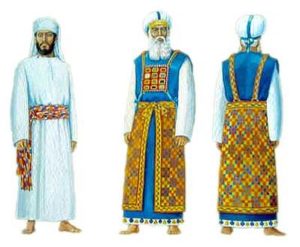
Vestments of the regular priest and the High Priest (Courtesy: Temple Institute)

This week’s parasha, Pekudei, summarizes all the components and items of the Mishkan. In the second aliyah, we read about the special ephod and choshen, the apron and breastplate of the kohen gadol. The choshen was studded with precious stones engraved with the names of the Tribes of Israel. Behind the choshen were placed the mysterious urim v’tumim. Through these, the Israelites were able to communicate with God. According to one understanding, the Israelites could ask questions, and God would respond by making the letters engraved on the stones light up.

The Zohar (II, 230a-b) on this week’s parasha connects the ephod, choshen, and urim v’tumim with tefillin. This is the secret of when God showed Moses “His back” but not “His face” (Exodus 33:23). On this, the Sages metaphorically state that God showed Moses the knot on the back of His tefillin (Berakhot 7a). Obviously, God does not literally wear tefillin, so the Zohar explains that it really serves to teach us the power of tefillin: Like the ephod, choshen, and urim v’tumim through which the Israelites could divine both past and future, tefillin can give a Jew the same power. The tefillin box that is on the front of the head is likened to the choshen on the front of the kohen, and represents looking ahead into the future. Meanwhile, the knot of the tefillin at the back (in the shape of a letter dalet) corresponds to the ephod covering the back of the kohen, representing the ability to understand the past. (The Zohar adds that the box on the front represents aspaklaria nahara, a “clear lens”, whereas the knot on the back is a murky lens.)

One explanation from our Sages about Moses being shown God’s “back” is that God showed him all of human history up to that point, so that Moses could see how God acted justly and righteously throughout. Everything that happened was brought about by God for a good reason, measure-for-measure. However, the reasons for future events, God’s “face”, were not revealed to Moses. This ties in to another teaching where Moses asked to see Rabbi Akiva and, while God granted him this request and transported Moses into Rabbi Akiva’s classroom, God did not reveal why Rabbi Akiva had to suffer a gruesome death (see ‘Time Travel in the Torah’).

A different explanation is that showing His “back” meant that God revealed to Moses everything from Creation forward (see Malbim on Exodus 33:23). What happened before Creation, God’s “face”, could not be revealed, for no human mind could possibly grasp this and live (Exodus 33:20). This implies that only after death, when the soul is no longer hindered by the body, could it grasp what happened before Creation. Our Sages taught that Moses attained 49 of the 50 Gates of Understanding, Nun Sha’arei Binah, while alive (see Rosh Hashanah 21b or Nedarim 38a). Only following death could he reach the 50th Gate. This is why Moses died on Mount Nebo (נבו), nun-bo, hinting that he finally had all nun levels of understanding “within him”, bo.

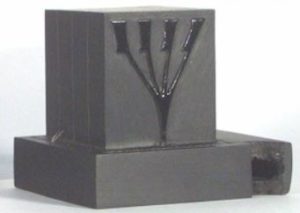
A four-pronged Shin on the head tefillin.

Putting it all together, we can see how the head tefillin gives us access to all Fifty Gates of Binah. There is a nice allusion to this in the two letters shin embossed on the box, one mysteriously having four prongs instead of three. The three prongs of a regular shin correspond to the Sefirot of Chessed, Gevurah, and Tiferet (see Sha’ar haPesukim on Shemot). The four prongs of the special shin are the remaining Netzach, Hod, Yesod, and Malkhut. This gives us all seven lower Sefirot from which the 50 Gates are derived: seven times seven (as we do during Sefirat haOmer), plus the fiftieth being Binah above. It is worth noting that elsewhere (III, 254a-b), the Zohar connects the seven prongs of the two tefillin shins—which are shaped like fire—to the seven branches of the Menorah.

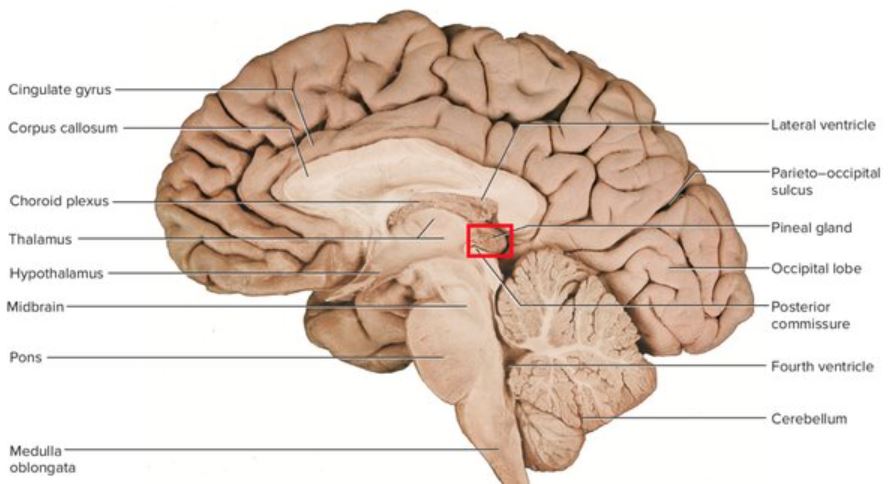
We see that the head tefillin is associated specifically with vision. Fittingly, the knot on the back aligns right with the occipital lobe of the brain, which is the visual processing centre. Meanwhile, the box of the tefillin “between the eyes” alludes to the inner “third eye” of the brain, the pineal gland, which bizarrely has photoreceptors like our eyes despite being deep inside the brain. The pineal gland regulates our sleep cycle and makes us dream, releasing a neurotransmitter called DMT which opens the mind up to all kinds of spiritual visions. (DMT is the active ingredient in Ayahuasca and used as both a therapeutic plant medicine and psychedelic drug. For more on the inner third eye in Judaism, see here.)

Based on the above, we can further understand why the Zohar says the box of the head tefillin represents clear vision while the knot at the back represents murky vision: the box (aligning with the pineal) is for tuning in to higher vision and prophecy, for spiritual vision; the knot at the back (aligning with the occipital lobe) is for regular physical vision. And this helps to explain why the box is associated with the future, while the knot is associated with the past. To get glimpses of what’s to come, we have to tap into our inner prophetic eye. But using our physical eyes we have the ability to look back in history and see God’s fingerprints all over the place. As Moses himself advised the people, if you want to find God, just “Remember the days of old, understand past generations…” (Deuteronomy 32:7) Jewish history—millennia of survival against all odds, and inexplicable success, influence, and prosperity at the same time—is perhaps the greatest proof for God’s existence. “Inquire now to the earliest days that came before you, from the day God created man on Earth, and from one end of Heaven to the other, has there ever been such a great thing? Or has anything like this ever been known?” (Deuteronomy 4:32)

So, the head tefillin takes care of past and future. And what of the present? For that we have the arm tefillin, bound specifically to the arm as a sign of action in the here and now, in this world of Asiyah. The arm tefillin is the present. In this way, our tefillin contain past, present, and future. Recall that the knot on the arm tefillin is in the shape of a letter yud, so altogether we have the shin on the head box, the dalet on the head knot, and the yud on the arm knot, spelling “Shaddai”. This is perfect because the divine name Shaddai embodies God’s presence throughout cyclical time—past, present, and future—and the value of “Shaddai” (שדי) is precisely 314, equal to the 3.14 of cyclical π (see here for more on ‘Secrets of Pi’). With this we come full circle, and get another reason for wrapping tefillin in circular fashion, around our heads, down our arms, hands, and fingers—the “Eternal Jew” binding past, present, and future into one.

Colours of the Sefirot

This week’s parasha, Tetzave, continues in describing the design of the objects used in the Mishkan, the Holy Tabernacle. The focus turns to the vestments of the kohen gadol. We see again that the most notable fibres used in sewing these clothes were tekhelet, argaman, and tola’at shani—blue, purple, and red wool. Our Sages taught (Menachot 43b) that tekhelet is sea-blue, and the sea reflects the sky, which is symbolic of God’s Throne, as per Exodus 24:10, where the nation saw that “there was under His feet the likeness of sapphire stone, and the likeness of clear skies…” (Similarly, Isaiah 66:1 has God declaring that “the skies are My throne, and the Earth is My footstool…”)

Among other things, blue is associated with water, which is in turn associated with life. In Kabbalah, blue is one of the colours of Chessed, lovingkindness. Red is its polar opposite, the colour of blood and fire, representing Gevurah, judgement and severity. Combining red and blue gives purple, the balance between them, Tiferet, seat of truth and beauty. On a mystical level, the purple argaman (ארגמן) also represents the chief angels Uriel (אוריאל), Raphael (רפאל), Gabriel (גבריאל), Michael (מיכאל), and Nuriel (נוריאל).

At first glance, the colours of the three key Sefirot of Chessed, Gevurah, and Tiferet appear to be blue, red, and purple, respectively. However, this is not always the case. In varying sources, the colours of the Sefirot are presented differently. While it is undoubtedly true that in Judaism multiple opinions can be correct simultaneously, can we nonetheless put together a definitive colour spectrum for the Sefirot? Today, we have a great deal of scientific knowledge of light and colour that can greatly assist us in this endeavour. So, which colours correspond to the Sefirot? Continue reading