
This week we read another double portion, Acharei Mot and Kedoshim. The latter, literally meaning “holies”, instructs us on the key mitzvot that make us especially holy. Of course, while all of the Torah’s mitzvot serve to make us holier, the ones in Kedoshim particularly have special merits. The list starts with revering one’s parents and observing the Sabbath (Leviticus 19:3). It peaks with the famous mitzvot of judging others favourably (v. 15), not gossiping (v. 16) nor bearing a grudge (v. 18), and loving your fellow as yourself. Other big mitzvot include not wearing shaatnez (v. 19, a mixture of wool and linen), and not getting tattooed (v. 28). Finally, there is a list of prohibited sexual relationships, before God says: Continue reading
Tag Archives: Yalkut Shimoni
Unicorns in the Torah
Yesterday was my daughter’s birthday, and her favourite thing in the world is unicorns. Perhaps this is because the unicorn makes a hidden appearance in her parasha, this week’s parasha, Vayak’hel-Pekudei. In summarizing the construction of the Mishkan, the Torah notes that it was made with the skins of the tachash (Exodus 35:7). The tachash is a mysterious animal whose true identity is entirely unknown. The Talmud (Shabbat 28b) states that it was a unique mammal species, wild and undomesticated, with a singular horn on its head. It came specifically in the time of Moses to be used for the Mishkan, and has since disappeared. The Talmud goes on to suggest that it was probably the same animal that was brought by Adam as a sacrifice in the Garden of Eden. This ties to another passage in the Talmud (Avodah Zarah 8a) that explains how Adam brought a thanksgiving offering to God, of a unique animal with a single horn, as it states in Psalms 69:32 that “it shall please God better than an ox with horn and hooves.” Elsewhere (Chullin 60a), the Talmud adds that this special animal emerged fully formed, horn-first, from the Earth. The Sages hold that having horn and hooves means it was probably kosher! Continue reading
Did Jacob Kill Esau?
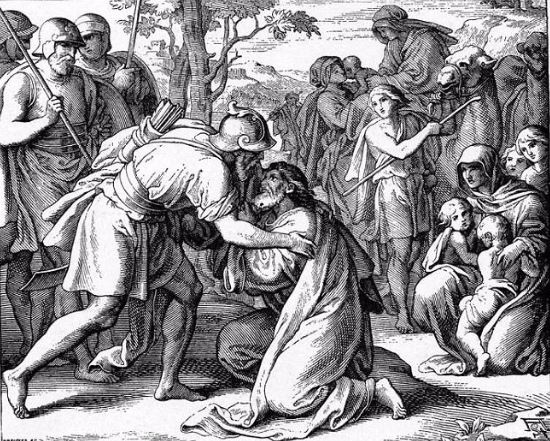
Esau meets Jacob, by Charles Foster (1897)
In this week’s parasha, Vayishlach, the Torah records the final encounter between the twins Jacob and Esau. This takes place when their father, Isaac, passes away and “is buried by his sons, Esau and Jacob.” (Genesis 35:29) Following this, the Torah presents a detailed genealogy of Esau and the various future chiefs of Edom. Nothing more is said of Esau. It is the Talmud (Sotah 13a) that describes how his life came to an end.