
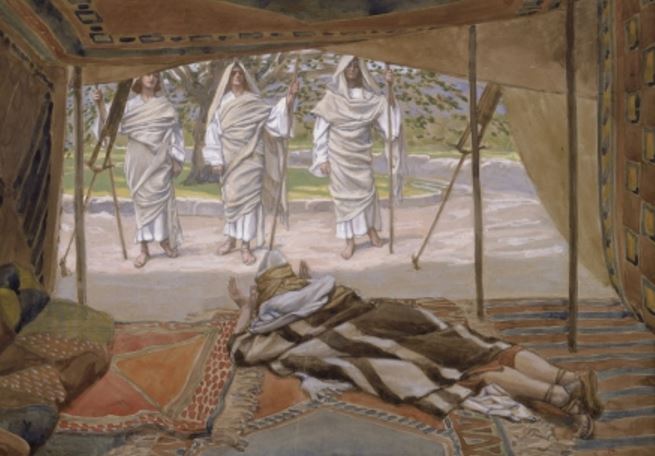
‘Abraham and the Three Angels’ by James Tissot
This week’s parasha, Vayera, begins with Abraham’s famous encounter with three angels (Genesis 18). Abraham gives them water to wash their feet and proceeds to feed them a multi-course meal. There brings up a classic question: did the angels actually eat? Are angels not entirely spiritual beings? How could they have their feet washed, and physically consume Abraham’s food? Are angels biological beings, or not? And, relatedly, do angels have any kind of free will, or are they simply “robotic” agents of God?
At first glance, the Talmud (Chagigah 16a) seems to suggest that angels are entirely “spiritual” and have no biological functions:
Six statements were said with regard to humans: In three ways, they are like ministering angels, and in three ways they are like animals. In three ways they are like ministering angels: They have intelligence like ministering angels; and they walk upright like ministering angels; and they speak in the holy tongue like ministering angels. In three ways humans are like animals: They eat and drink like animals; and they reproduce like animals; and they excrete like animals.
From this, one might conclude that angels do not eat or drink, and therefore do not excrete waste, nor do they mate. However, they are not entirely ethereal beings, since they do “walk upright” and do speak and produce physical sound, and are comparable to humans in some ways. The same passage tells us:
Six statements were said with regard to demons: In three ways they are like ministering angels, and in three ways they are like humans. In three ways they are like ministering angels: They have wings like ministering angels; and they fly from one end of the world to the other like ministering angels; and they know what will be in the future like ministering angels… And in three ways they are similar to humans: They eat and drink like humans; they reproduce like humans; and they die like humans.
Angels do have bodies of some sort, with legs that allow them to walk and wings that allow them to traverse the physical cosmos. In fact, when we go back to the Tanakh, we see that angels are essentially always described in physical terms. The first explicit mention of an angel in the Torah is following the Forbidden Fruit incident, when Hashem stationed sword-wielding Cherubs to protect the entryway to the Garden of Eden (Genesis 3:24). We find that angels are often described in military armour, like the sword-wielding “commander of God’s army” that greets Yehoshua before the battle of Jericho to promise victory (Joshua 5:13-15). One mustn’t forget that God Himself is frequently called Hashem Tzva’ot, “God of Legions”, and is even described as a “Man of War” (Exodus 15:3). Moreover, His legions of angels are depicted riding chariots.
The most explicit description of this is Ezekiel’s opening chapter. He goes on to say that the angels “beamed” him up on their chariot, and he got to fly on it! This was clearly not just a vision, and Ezekiel describes what he felt physically on his journey, and that the flight made him sick to his stomach, and it felt like “God’s hand” was pressing down on his body:
Then a spirit carried me away, and behind me I heard a great roaring sound: Blessed is the presence of God, from its place! And the sound of the wings of the creatures beating against one another, and the sound of the wheels beside them—a great roaring sound. A spirit seized me and carried me away. I went in bitterness, in the fury of my spirit, while God’s hand was strong upon me. (Ezekiel 3:12-14)
Ezekiel’s description is an obvious reference to the G-forces that he felt as the chariot accelerated, along with the motion sickness that made his spirit “bitter”. Ezekiel says he heard the loud sounds of the wings and wheels, reminiscent of roaring engines. Previously in 1:24, he had described them like the sound of raging waters. In Psalm 68, we read that 22,000 such chariots descended on Mt. Sinai during the Ten Commandments revelation (see also Bamidbar Rabbah 2:3). The angels are seemingly coming down in very physical, military-like, loud and armoured spacecraft.
Elijah was taken up to Heaven in a similar “horse-drawn” chariot (II Kings 2), as was Enoch before him (Genesis 5). Some say these must have been “spiritual” entities, and that Elijah had abandoned his physical body when he went to Heaven. (It is worth noting the corresponding opinion that angels only become physical when they enter our realm, but are otherwise entirely spiritual in Heaven. See, for instance, Zohar I, 101a, on this week’s parasha.) But that makes little sense. If Elijah lost his physical body and only his spirit went up, how is that different than any other person dying and their spirit going to Heaven? Elijah’s case was clearly different, and he is counted among a handful of “immortals” who merited to enter Heaven with their physical bodies (explored in a previous essay here). The implication is that physical bodies are able to enter Heaven, and that the chariots that took these people up must be physical as well.
In fact, the Talmud’s description of the Heavens and what goes on in the various levels is quite “materialistic”. In one level, the angel Michael is bringing sacrifices in the Heavenly Temple (Chagigah 12b). What kind of “sacrifices” could these be, if there is no physicality up there? And why is there even a need for sacrifices in Heaven? Who are these sacrifices atoning for? Why would Michael need to serve as the “high priest” at all? Isn’t such service for us humans to repair ourselves and draw closer to Hashem? What is the purpose of the angel’s service? More puzzling, we are told that angels pray to Hashem the same exact way we do down below—and even with the same siddur and nusach! (See Zohar II, 131a) Why do angels need to pray? We humans need to pray for introspection, cheshbon nefesh, connection, meditation, etc. Do angels need these things?
The truth is, when we look carefully at our ancient holy sources we find that, contrary to popular belief, angels do have free will, and do make mistakes, and do need to work on themselves, and do have rectifications to accomplish. They transgress, and they are punished, and they repent, and Jewish sources are full of such narratives. Here are a few examples:
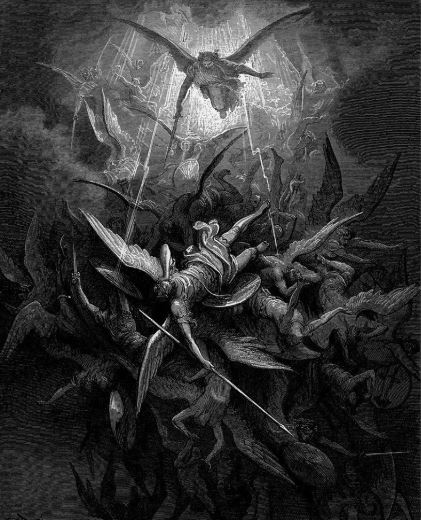
‘Michael Casts Out Rebel Angels’ by Gustav Doré
One is right at the beginning of the Torah, when the Serpent comes to tempt Eve. The ancient Sefer haBahir (#200) explains that it was actually the angel Samael, who came down from Heaven together with his supporters to deliberately try to corrupt mankind. He was jealous and proud, the first “fallen angel”. Some say he even mated with Eve, and Cain was the offspring (see, for instance, Zohar I, 37a). Later, we know there were more fallen angels, including Shemhazai and Azazel (sometimes called Aza and Aza’el), who were the Bnei haElohim, “sons of God” who saw the “daughters of man” on Earth and mated with them, producing giant offspring (Genesis 6). They were called Nephilim, literally “fallen ones”. We see angels taking matters into their own hands, arguing with God, rebelling, sinning, and even mating with humans.
Shemhazai went on to repent, but was not restored to his place in Heaven. Instead, the Midrash (Yalkut Shimoni I, 44) says he was “suspended” half-way between Heaven and Earth, and is apparently still repenting to this day (שַׁמְחֲזַאי חָזַר בִּתְשׁוּבָה וְתָלָה עַצְמוֹ בֵּין שָׁמַיִם לָאָרֶץ רֹאשׁוֹ לְמַטָּה וְרַגְלָיו לְמַעְלָה וַעֲדַיִן הוּא תָּלוּי בִּתְשׁוּבָה). Meanwhile, his former partner Azazel did not repent and continued his evil ways until ultimately being subdued and chained in the Judean wilderness. This explains why later in history the Israelites would send a “scapegoat” to Azazel, to atone for his sins, every year on Yom Kippur.
Even good angels get punished. In this week’s parasha, after visiting Abraham, two of the three angels went on to oversee the destruction of Sodom. They came to Lot to warn and save him, revealing that “we are destroying this place!” (Genesis 19:13) The Midrash (Beresheet Rabbah 50:9) comments on this verse that:
Rabbi Levi said in the name of Rav Nachman: The ministering angels, because they revealed the secret of the Holy One blessed be He, were expelled from their Heavenly stations for one hundred and thirty-eight years. Rabbi Tanchuma attributed it rather to their improper expression, as Rabbi Hama bar Chanina said: It is because they were arrogant and said “For we are destroying this place.”
The two angels spoke haughtily and took credit for the destruction of Sodom, and were thereby punished by being expelled from their Heavenly positions for 138 years. Why specifically 138? The Midrash suggests that it was 138 years later that Jacob saw the Heavenly Ladder, and those angels he saw going up to Heaven were these same angels that had been banished to stay on Earth since Sodom!
We read of other angels having free will, and even malicious intent towards God’s chosen ones. In one place, the Talmud (Shabbat 88b) records:
When Moses ascended on High [to receive the Torah], the ministering angels said before the Holy One, Blessed be He: Master of the Universe, what is one born of a woman doing here among us? The Holy One, Blessed be He, said to them: He came to receive the Torah. The angels said before Him: The Torah is a hidden treasure that was concealed by You 974 generations before the creation of the world, and You seek to give it to flesh and blood? …The Holy One, Blessed be He, said to Moses: Provide them with an answer! Moses said before Him: Master of the Universe, I am afraid lest they burn me with the breath of their mouths. God said to him: Grasp My throne of glory for strength and protection, and provide them with an answer!
The angels question God, and Moses worries that they will physically harm him. Note again how Moses, full-bodied, is able to go to Heaven. Moses proceeds to explain to the angels why they don’t need the Torah, since they were not taken out of Egypt, do not live among idolaters, don’t need to labour and then keep a day of rest, and so on. They go on to admire him and present him with gifts, and the Angel of Death even reveals a secret to Moses! (89a)
Satan was not happy about all of this, of course, and shows up to question God. He asks where the Torah went and God says He gave it to the Earth, so Satan goes on a goose chase of sorts to find it. He gives up before God hints that he should go to Moses. Satan confronts Moses and Moses outwits him. But Satan gets the last laugh, as he takes advantage of Moses being up on Sinai and goes down to incite the Israelites to make the Golden Calf! None of these narratives describe angels as passive, robotic agents that simply do as God wishes. On the contrary, they are rebellious, curious, questioning, and even malicious sometimes. There are many other cases of angels (not demons) seeking to harm good people. Another one involves Jacob, again at the Heavenly Ladder, as the Talmud (Chullin 91b) says:
It was taught that the angels were ascending and gazing at the image of Jacob above, engraved on the Throne of Glory, and descending and gazing at his image below. The angels [were jealous], and wanted to endanger his life. Immediately “behold, God stood over him” (Genesis 28:13). Rabbi Shimon ben Lakish says: Were it not written in a verse it would be impossible to utter it! [That God was standing over Jacob] like a man who waves a fan over his son to cool him down.
The jealous angels wish to harm Jacob, so Hashem steps in to shield him. The Talmud itself is deeply troubled by this anthropomorphic statement! The ancient mystical Heikhalot report something similar happened when Rabbi Akiva went up to Heaven. There were angels that wanted to attack him, so Hashem had to step in (see Merkava Shlema, Tefilat Keter Nora). Recall that Rabbi Akiva was one of four sages who went up to Heaven (Chagigah 14b). His colleague Elisha ben Avuya returned to Earth and became a heretic. Why? The Talmud says he saw Metatron sitting enthroned in Heaven. Metatron was supposed to stand up when the four sages arrived. Metatron was punished for this blunder, struck with “sixty fiery lashes”. Why would Metatron be punished if he has no free will, and it was all staged by God? We must conclude that it was not staged at all; Metatron has free choice, and pays the consequences for his actions. A similar fate befell Gabriel:
The Talmud (Yoma 77a) says Hashem wanted to punish Israel for their sinful ways at the end of the First Temple era. He sent Gabriel to strike down the wicked, and the good among them, too, since they did not rebuke the wicked. Gabriel, however, had mercy on Israel and “cooled the embers” so that Israel was not obliterated. One would think this was a good thing, and that Gabriel did well. But no, Hashem was unimpressed by his rebellious conduct. “At that moment, they cast out Gabriel from behind the Curtain, and they struck him with sixty fiery lashes.” Moreover, Gabriel was demoted from his position, and replaced with the angel Dubiel (guardian prince of Persia) for 21 days. Once again, we see angels depicted with free will, contradicting God’s commands, acting on their own, and getting punished for it. Note also how all of the punishments of the above narratives are physical—lashes, chains, imprisonment. Angels are a lot more like us than we think!
If so, how did this idea that angels have no free will, and no corporeality, develop? The truth is that it is a very late concept, not found in Tanakh, and clearly not Talmudic either. (Regarding those few statements in the Talmud of “ministering angels” not eating or mating like humans, that might refer only to a specific class of malakhei hasharet, not other higher classes of angels like Seraphim.) The notion only became popularized in the late Medieval era, at a time of strict rationalism, and pioneered by those like Rabbi Yehuda haLevi (c. 1075-1141) and the Rambam (1138-1204). In the Kuzari, Rabbi Yehuda haLevi writes that angels are entirely spiritual and eternal, with no physicality. The Rambam, meanwhile, went so far as to say that angels are not even real, but simply allegorical devices, and all references to angels in Tanakh are symbolic and metaphorical, appearing only in dreams and visions! In the Guide for the Perplexed (II, 41-44), for instance, the Rambam writes:
Know again that in the case of everyone about whom exists a Scriptural text that an angel talked to him or that speech came to him from God, this did not occur in any other way than in a dream or in a vision of prophecy.
This is, of course, totally contrary to the pshat of Tanakh, where angels are certainly real and physically interact with humans in a waking state. They are described as very corporeal and quite biological—eating, washing, mating, wrestling with humans (like Jacob); covered in armour, wielding swords, flying in chariots. Some might point to a possible exception in the story of Manoach, his wife, and the birth of Samson.
Recall that Samson’s wife was barren, and then an angel appeared to tell her she would have a child, and he would be a holy nazir from birth (Judges 13). At the end, Samson’s father Manoach wants to honour the angelic guest with a meal, and offers to barbecue a goat. We then read:
But the angel of God said to Manoah, “If you detain me, I shall not eat your food; and if you present a burnt offering, offer it to God.” For Manoah did not know that he was an angel of God. (Judges 13:16)
Depending on how you read the verse, it might imply that the angel refuses to eat because he is an angel and can’t eat. Manoach makes a blunder because he doesn’t realize his guest is an angel. However, we know this cannot be the case because in this week’s parasha, the angels have no problem eating with Abraham (or at least pretending to eat). There is no reason why Manoach’s angel had to refuse a meal. Based on what the commentaries say, it seems like the issue was that the angel did not want to be honoured, and instead told Manoach to honour Hashem alone, hence telling him to make a burnt offering to God. (Perhaps the angel learned from the arrogant speech of the two angels in Sodom!)
The angel then proceeds to ascend back to Heaven in the flames of Manoach’s altar. This is a unique ability that we find nowhere else in Tanakh, for angels always come down in chariots as discussed above. The Zohar explains that it’s because this angel was Uriel (literally “fire of God”), the one most closely associated with altar fire. However, Uriel is also identified as the very same angel as Metatron. As explored in this recent essay, he is also called Yofiel and Raziel. The gematria of both Uriel (אוריאל) and Raziel (רזיאל) is 248, equal to “Abraham” (אברהם), and it was Metatron that had first revealed himself to Abraham at the start of this week’s parasha (and ate with him). The same Metatron is said to be the one “riding the chariot” in the visions of Ezekiel and Daniel. Metatron is the “angel of fire”, and can make himself disappear in Manoach’s flame. Thus, the case of Manoach does not actually change anything about the nature of angels, nor their physical and biological aspects, nor their free will.
All of this is further confirmed earlier in Judges, following Deborah and Barak’s victorious battle. Deborah sings that “from the Heavens they came to battle, stars from their paths came to fight Sisera.” (Judges 5:20) But then she sings that “cursed is Meroz, said the angel of God, cursed are its inhabitants, for they did not come to help God; to help God among the warriors.” (Judges 5:23) The Talmud (Mo’ed Katan 16a) explains that Meroz is a distant star, and the angelic inhabitants of that world were supposed to come to help Deborah in battle, but didn’t show up. So the other angels cursed them, and Deborah records it in her song. Again, yet another case of physical, military angels—this time from a planet called Meroz—who messed up, didn’t heed God’s command, and were cursed. And it’s not just Meroz.
In mystical texts, angels are described as inhabiting different worlds within the cosmos. The Zohar (II, 126b) says one such planet has 60 million of them. The Talmud (Avodah Zarah 3b), meanwhile, says God visits 18,000 worlds every night, and some comment that these are angelic worlds. Otherwise, why would God have to visit those places if they have no inhabitants? We mustn’t forget that angels were also created by God, either on Day Two or Day Five of Creation as taught by our Sages (or on both days, depending on the type of angel). They are very much a part of this physical cosmos.
They preceded us, and are naturally closer to God. Some say God even consulted them before creating mankind, when He said “Let us make man in our image…” (Genesis 1:26) They are independent beings, with their own intelligence, their own will, their own actions, and mistakes. They can rebel, and they can repent. They pray, and they bring sacrifices. They wrestle with people, and eat with people, and join people in battle, and sometimes even mate with people. Evidently, they are not much different from us. Older, yes, perhaps wiser and more spiritual, and certainly with better technology—but not much different from us. And they will be revealed again soon to help us usher in the Final Redemption.
For lots more on this topic, see the following classes:
The Four Who Ascended to Heaven
Anunaki: Giants & Aliens in the Torah
Secrets of Sukkot
Chanukah’s Electrifying Secret
Names of God