
In this week’s parasha, Ki Tetze, we read about the famous mitzvah of sending away the mother bird:
If a bird’s nest happens upon you on the way, in any tree or on the ground, chicks or eggs, and the mother-bird is sitting over the chicks or the eggs, do not take the mother together with her young. You shall surely send away the mother bird, and take the young for yourself, so that it will be good for you and your days will be lengthened. (Deuteronomy 22:6-7)
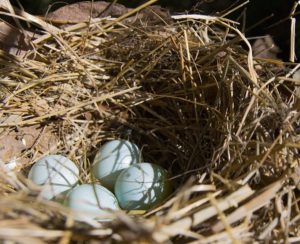 There are actually two mitzvahs here: not taking the mother together with her children (a negative mitzvah), and sending away the mother bird before taking the children (a positive mitzvah). The Torah does not explain the rationale here, but for most of history the message seemed quite obvious: don’t be cruel! It was so obvious that the Mishnah (Berakhot 5:3) states we should stop people from requesting in their prayers that since God has mercy on birds, He should also have mercy on us. The Rambam (Rabbi Moshe ben Maimon, 1138-1204) comments here that the reason one shouldn’t pray this way is because it is seemingly giving a reason for the mitzvah, yet we do not know the true reason for the mitzvah, except that it is God’s Will. Moreover, the Rambam points out that if it is a matter of mercy, then God should have commanded us not to slaughter or eat any animals at all! Continue reading
 In this week’s parasha, Beha’alotcha, we read how a year had passed since the Israelites had left Egypt, and God was now reminding the nation to commemorate Pesach. However, some people were spiritually impure at Pesach time because they had handled a corpse and were unable to take part in the Paschal offering. They approached Moses and asked “why should we be excluded so as not to bring the offering of the Lord in its appointed time, with all the children of Israel?” (Numbers 9:7) Moses was not sure how to answer them, so he took the case up to God, after which God told Moses about Pesach Sheni, the “second Passover” that could be done a month later in Iyar for those who had missed Passover in Nisan.