Category Archives: Mysteries & Origins

The Mysterious Urim and Thummim, and the Dome of the Rock

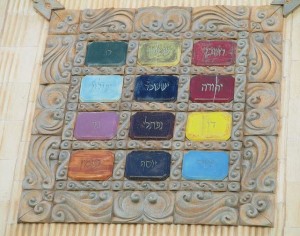
Modern Rendition of the Choshen, the High Priest’s Breastplate

This week’s Torah portion is Tetzave, which focuses on the holy vestments worn by the Kohen Gadol, the High Priest. Perhaps the most enigmatic of these vestments is the choshen hamishpat, the “breastplate of judgement”. This breastplate was embedded with twelve different precious stones, each symbolizing one of the Twelve Tribes. Housed within the breastplate were the Urim v’Tumim, mysterious objects whose nature has been speculated upon for centuries.

The Torah itself does not elaborate on what the Urim and Tumim are. The Talmud (Yoma 21b) states that they were one of the five things that were in the First Temple but missing in the Second Temple. Many believe that these were a couple of stones used to communicate with God. Unseen and unused for some two and a half millennia, it isn’t surprising that the Urim and Tumim are clouded in mystery.

Guilty or Innocent?

Some scholars see urim rooted in the root arur, “cursed”, and tumim from tam, “innocent”. Thus, these stones were used to figure out if a person was guilty or innocent, or if a certain decision was right or wrong. We read in I Samuel 14:36-44 how King Saul debated whether to pursue the Philistines in battle or not, so the High Priest addressed the question to God. God does not respond, so Saul concludes there must be a guilty person among them causing God to turn away. He then separates the people into groups to see which group contains the guilty party. It turns out that it is Saul’s son Jonathan who erred. This passage highlights the use of Urim and Tumim in divine communication, both in finding whether an action is right or wrong, and in determining guilt and innocence.

How did the stones communicate this? The word urim can mean “lights”, so it is thought that the stones glowed: one stone for yes/innocent, and the other for no/guilty. Others hold that the Urim and Tumim gave power to the Breastplate itself, causing the letters engraved upon it to glow. Each of the twelve stones on the Breastplate was engraved with the name of the corresponding tribe. However, the twelve names do not include all twenty-two letters of the Hebrew alphabet! The missing letters—Chet, Tet, Tzadi, Kuf—are in the names of the patriarchs, which were also engraved onto the plate, together with the phrase shivtei yeshurun, “Tribes of Jeshurun”. (Jeshurun was an ancient name for Israel.)

Interestingly, Rabbi Chaim Vital writes that this is how the Arizal could “read” people’s faces, by seeing a sort of Breastplate on their forehead. In Sha’ar Ruach HaKodesh, he explains that each person’s forehead has the twenty-two letters mystically engraved upon it, and the letters glow allowing the adept to penetrate into one’s soul and fortune. Each letter symbolizes different things. If no letters at all are shining, the person is nearing their death!

The Foundation Stone

Meanwhile, Targum Yonatan comments (on Exodus 28:30) that the Urim and Tumim were themselves inscribed with the alphabet, through a mystical name of God—“the name through which He created all three hundred and ten worlds”. Again, the letters would glow in sequence to provide the answer to one’s question. Targum Yonatan appears to suggest that the Urim and Tumim were special stones formed from the great Even HaShetiya, the Foundation Stone. According to tradition, this is the Stone from which Creation began, some seeing it is the very centre of the universe. Targum Yonatan says the Foundation Stone was placed by God to “seal up the mouth of the great deep at the beginning”.

This refers to the account of Creation, where it is stated at the beginning that everything was “chaos and void, with darkness upon the deep” (Genesis 1:2) before God said, “Let there be light.” Looking at these verses carefully, we see that the Torah uses the word tehom for the great deep, before the introduction of light, or. It isn’t difficult to see a connection between or v’tehom and urim v’tumim. The Urim and Tumim are meant to be conduits for communicating with the Divine, while the Foundation Stone has traditionally been seen as the very link between the Heavens and Earth.

Where is this Foundation Stone? The Talmud (Yoma 53b) tells us that the Even Shetiya is precisely the site of the Holy of Holies, the inner sanctum of the Temple, where the High Priest entered just once a year on Yom Kippur. The Stone served as the foundation for the Ark of the Covenant. The Ark, too, was a means of Divine Communication, with a Heavenly Voice emanating from between the Cherubs on the Ark’s Cover. We therefore see a link between the Ark and the Urim v’Tumim. The Talmud tells us that both the Ark and the Urim were missing in the Second Temple, together with the Shekhina and the spirit of prophecy. In short, the Second Temple era was devoid of any real divine communication.

The Dome of the Rock
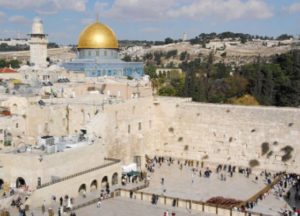
The Dome of the Rock and the Western Wall. Some believe the Temple was located right in front of the Wall, in the forested area pictured above.

So, what stood instead of the Ark in the Holy of Holies of the Second Temple? The Foundation Stone! It protruded “three fingers above the ground” and it is on this Stone that the High Priest would place the burning coals and incense on Yom Kippur (Yoma 53b). It is atop this Stone that the Muslims built the famous gold-topped Dome of the Rock (hence the name).

The Rabbis debate whether the Rock inside the Dome really is the Foundation Stone or not. The Arizal is among those who believed it is not, suggesting instead that the Temple was built right in front of where the Western Wall is today. Meanwhile, the Radbaz and Rav Ovadia of Bartenura maintained that it is indeed the Stone. They are supported by an ancient Midrash which prophesies that the Ishmaelites will do fifteen things in Israel, one of which is building a shrine atop the Holy of Holies (Pirkei d’Rabbi Eliezer, ch. 30). The midrashic passage concludes by presciently saying the Ishmaelites will instigate three great wars at the end: one in Arab lands, one in the Sea, and one in the West. It is in the midst of these wars that Mashiach will come.

A picture from beneath the Rock, the area known as the “Well of Souls”

When that time comes, the Ark of the Covenant—which many believe is currently hidden under the Foundation Stone—will be restored, together with the Priestly Vestments. In light of the fact that we are now quite clearly living out the final verses of that midrashic passage, it seems we shall soon be able to finally unravel the mystery of the Urim v’Tumim.


The above article is adapted from Garments of Light: 70 Illuminating Essays on the Weekly Torah Portion and Holidays. Click here to get the book! 
How Long Were the Israelites Actually In Egypt?

Bo chronicles the final events in the exodus from Egypt. We read about the final three plagues (locust, darkness, and the smiting of the firstborn), the first Passover night, and at last, the liberation of the Israelites. Here, we are told that the Israelites left Egypt after having dwelled there for 430 years (Exodus 12:40). However, Jewish tradition (based on counting up all the years mentioned in the Torah) holds that the Israelites were only in Egypt for 210 years! To further complicate things, God had prophesized to Abraham that his descendants would be slaves in a foreign land for 400 years (Genesis 15:13). So, which is it? Were the Israelites in Egypt for 430 years, 210 years, or 400 years? There appears to be a simple answer to this question, and is the one most commonly cited. However, upon closer examination, this explanation breaks down entirely, and the real answer becomes much harder to find.

The Simple Answer

Let’s begin with the simple answer. Rashi’s commentary on the verse in question is that the Israelites were indeed in Egypt for only 210 years, since this is the sum one comes to when counting the lifespans of Jacob, Levi, Kohath, Amram, and Moses. According to this chronology, the Israelites lived prosperously in Egypt for 116 years. By this point, Jacob and his sons (the original immigrants) had all passed away, and a new pharaoh ascended to power in Egypt. Envious of Israelite prosperity and success, and suspicious of their populous numbers, the new pharaoh began instituting various anti-Semitic laws. Tradition holds that this period of segregation and persecution lasted thirty years, after which the Israelites were formally enslaved. Thus, the Israelites were slaves for 86 years. The year of their enslavement corresponds to the year of Miriam’s birth, hence her name, which (according to one explanation) literally means “very bitter”.* Moses was born six years later, and liberated the Israelites when he was eighty.

Rashi states that since 400 or 430 years in Egypt is impossible, one must assume that by “dwelling” and “sojourning”, the Torah refers to all the dwellings and sojourning since the time of Abraham. Rashi points out that if one counts back 400 years from the Exodus, one comes to the year that Isaac was born. Another thirty years before that was when Abraham beheld the “Covenant of the Parts”, and received the prophecy that his descendants will be slaves and foreigners for 400 years. Therefore, when the Torah states that the Israelites were in Egypt for 430 years, it is going all the way back to Abraham’s Covenant, which happened exactly 430 years earlier. And when God told Abraham his descendants would be slaves for 400 years, He literally meant all of Abraham’s descendants, starting with his first son, Isaac, born thirty years later. This explanation seems to work, at least when reinterpreting the definition of what it means to be “enslaved” and what it means to be “in Egypt”.

However, even Rashi is unhappy with this answer. He says that one has no choice but to accept this explanation al karchacha, literally “against one’s will”. He finishes by saying that this was one of the things that the Sages edited when translating the Torah into Greek for King Ptolemy. (Recall that over two millennia ago, Ptolemy gathered seventy rabbis, put them in separate guarded rooms, and forced them to translate the Torah into Greek. Despite their separation, all seventy rabbis produced the exact same translation, making the exact same amendments where necessary, to make the text more palatable to the Greeks. This text became known as the Septuagint, because of the seventy rabbis. According to Yalkut Shimoni, there were seventy-two rabbis, and they made fifteen changes to the text, one of which is the duration of the Israelites’ dwelling in Egypt.)

The Problem with the Simple Answer

Aside from the fact that the Israelites were slaves for 86 years, not 400, and that the Torah states that they dwelled specifically in Egypt for 430 years, and not elsewhere, there is a much more pronounced problem with the simple answer. If we say that the 430 figure comes from the moment when Abraham first received the prophecy, that means that Abraham got it thirty years before Isaac was born, which means Abraham was seventy years old at the time (since Isaac was born when Abraham was 100). However, the Torah tells us that Abraham only came to the land of Israel for the first time when he was 75 (Genesis 12:4). Sometime after this, he descended to Egypt because of a famine, then returned to Israel. Years later, he participated in the war against the Mesopotamian kings (Genesis 14). It is only following this war that the Torah states, “After these things the word of Hashem came to Abram in a vision…” (Genesis 15:1). And it was in this vision that Abraham received the prophecy of 400 years. It is therefore impossible that he was seventy years old at that time! In fact, the very next chapter speaks of the birth of Ishmael, Abraham’s first son through Hagar, who was born when Abraham was 86. Based on this, some commentaries suggest the Covenant of the Parts happened when Abraham was 85 or 86 years old.

So, we may accept the figure of 400 years starting with Isaac, but where did 430 come from? In lieu of a historical answer, we may have to delve into more mystical literature.


The above is an excerpt from Garments of Light, Volume Two. To continue reading, get the book here

Should Jews Celebrate New Year’s?

On December 31st, much of the world’s population stays up past midnight to commemorate the start of the new calendar year. This event is considered to be the most widely-celebrated public holiday in the world. Yet every year, many Jews wonder if they should be participating in these celebrations. Some answer with a quick no, since January 1st is associated with the circumcision of Jesus (as it is the 8th day following Christmas, December 25th). Others may say yes, since, among other reasons, we all use the Gregorian calendar, and January 1st is simply a secular holiday, having lost any past religious affiliations. As is often the case, the truth lies somewhere in the middle.

Back to the Roman Calendar

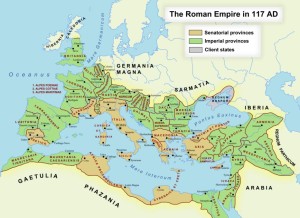
Roman Empire (Credit: Ancient History Encyclopedia)

Roman Empire (Credit: Ancient History Encyclopedia)

Today’s Gregorian calendar is based on the older Julian calendar, introduced by Julius Caesar. Historical records show that by the time of Julius Caesar, the Romans celebrated their new year on January 1st. In fact, “January” is named after the Roman god Janus, the deity of beginnings and ends, doors and gateways. Janus is always depicted as a double-headed god, with one head looking back into the past, and the other gazing into the future.

January 1st was also the start of the consular year in Rome, when the two highest-ranking elected officials, the consuls, took up their office for a single year term. From this information, we see that January 1st was already celebrated as a new year long before the time of Jesus.

Was Jesus Circumcised on the 1st of January?

Today, some Christian denominations still commemorate January 1st as the “Feast of the Circumcision”. The math is simple: if Christmas is the holiday of Jesus’ birth, then like all Jews he would have been circumcised on the eight day following his birth – January 1st. The question is: was Jesus actually born on the 25th of December?

Of course, many are aware of the fact that Jesus was certainly not born on the 25th of December. The New Testament does not mention the date of his birth at all, and suggests it was sometime in the summer, since it mentions people going to take a census (always done in the summer months), and that the shepherds were out watching their flocks (which they probably wouldn’t do in the cold winter nights of December). Early Christian leaders gave various dates to the birth of Jesus, ranging from March 28th to November 18th. Today, scholars believe it was likely the end of September.

Ironically, early Christian leaders actually mocked those who celebrated birthdays of any kind, especially that of Jesus, and considered it a pagan ritual. Alas, this is where Christmas actually comes from. Originally, December 25th was around the time of the pagan Roman holiday of Saturnalia. Later, it was also instituted as a holiday in honour of the birth of Sol Invictus, the solar deity. This comes from an ancient tradition to celebrate the “birth of the sun”, since the days start getting longer around this time of the year, hence the “solar rebirth”. To make Christianity more palatable to pagans, Christian leaders eventually switched “birth of the sun” to “birth of the Son”, ie. Jesus. And so, Jesus was not born on the 25th of December, and certainly wasn’t circumcised on the 1st of January.

(That is, of course, if Jesus had existed at all. More and more scholars are agreeing that Jesus probably never existed to begin with. Click here to read more about this.)

Celebrating the New Year on the 1st of January

Most European countries actually adopted January 1st as the start of a new year quite recently. The British Empire celebrated the New Year on March 25th until 1752! Similarly, many calendars continue to celebrate a new year sometime in the spring, including the Iranian, Assyrian, and several Indian calendars. Others have New Year’s days at other times, most famously the Chinese New Year in late January/early February. Nonetheless, most of these places, including China, also commemorate January 1st as the start of an international new year. Today, January 1st is definitely devoid of any real religious significance, and is perhaps the one truly global celebration. Having said that, it may still be tied to a historical bitterness for the Jewish people.

Sylvester’s Day

In several European countries, New Year’s Eve is called “Sylvester” or “St. Sylvester’s Day”. In Israel, too, December 31st is called “Sylvester”. This is the day of the passing of Pope Sylvester I, later canonized as a saint. Essentially nothing is known of this pope, though various legends arose over the centuries. Historical records suggest that it was during his reign that the Roman Emperor Constantine proclaimed the Edict of Milan which, among other things, stripped Jews of various rights and forbade them from living in Jerusalem.

Yet, Sylvester has nothing to do with New Year’s Eve itself; it is simply a coincidence of dates. Besides, many churches mark Sylvester’s Day on January 2nd, not December 31st. Either way, few people commemorate Sylvester’s Day at all, and most people have never even heard of it. (If Sylvester really was so bad for the Jews, maybe we should celebrate the day of his death!)

New Year’s in the Talmud

Amazingly, the Talmud (Avodah Zarah 8a) actually discusses New Year’s, calling it by its Roman name, Kalenda, or Kalends. The Mishnah here begins by listing it among the holidays of idol worshippers. However, it then goes on to explain that Kalenda originates in the Torah!

The Rabbis explain that following the consumption of the Forbidden Fruit, Adam soon noticed that the days were gradually getting shorter. (Since he was created on Rosh Hashanah – in the autumn – and consumed the Fruit that very same day.) Adam mistakenly thought that the days must be getting shorter because of his sin, and the world was descending into eternal darkness. He started to fast in repentance, and after eight days of fasting, the winter solstice came, and Adam noticed that the days were once again getting longer. In celebration, Adam established an eight-day feast (to balance out his eight-day fast). The following year, Adam commemorated both the winter solstice (around December 25th) and the day that marked the end of his eight-day feast (January 1st). The Talmudic sages conclude: “However, [Adam] established them for the sake of Heaven, but the [heathens] appropriated them for the sake of idolatry.”

So perhaps, if we have the sake of Heaven in mind, we may just be able to celebrate New Year’s in some way after all.