
In this week’s parasha, Re’eh, we are told that a time would come when God would choose to rest His Divine Presence in one particular city in the Holy Land (Deuteronomy 12:5). This city is, of course, Jerusalem. The Torah says that it is only there that sacrifices could be brought, and this is the place to which Jews should pilgrimage thrice a year on the holidays. The pilgrimage mitzvah is referred to as re’iyah (רְאִיָּיה), “appearing” or “being seen” before God in Jerusalem. This name has a deep connection, and shares a linguistic root, with the name of this week’s parasha.
The re’iyah is the subject of the first Mishnah in the tractate Chagigah. It begins by stating that all Jews are obligated to appear in Jerusalem on the festivals, with twelve exceptions. One of these exceptions is a minor. The Mishnah then asks who is considered a “minor”? Beit Shammai held that a minor is any child who is unable to make the trip riding on his father’s shoulders as he ascends up to the Temple Mount. Beit Hillel held a more lenient opinion that a minor is any child who cannot make the trip up to the Temple Mount while holding his father’s hand. Beit Hillel reason that since the pilgrimage holidays are called regalim, literally “legs”, a person must be able to use their own legs to ascend to the Temple Mount.
Today, we have yet to rebuild the Temple, but we do have the Temple Mount, and many Jews wish to ascend it. This has generated much controversy in recent decades, with many rabbis in opposition, and others strongly in favour of Jews making their presence felt on the Temple Mount. It is worth carefully exploring the issues at hand and come to a clear conclusion regarding whether or not ascending the Temple Mount is permissible and advisable.
Where Was the Temple?
In ancient times, entering the Temple itself required one to be on the highest level of spiritual purity. Among other things, anyone who had come in contact with a corpse had to first be purified using the special mixture that contains the ashes of the red heifer. However, a person did not have to be pure to enter the Temple Mount, only the Temple proper. The Rambam rules clearly in his Mishneh Torah that “a corpse may be brought into the Temple Mount, and one who has contracted ritual impurity from a corpse may definitely enter there.” (Sefer Avodah, Hilkhot Beit haBechirah 7:15)
For the past two millennia, we have not had the red heifer mixture, so everyone is considered to carry the impurity of death by default. This means that while we cannot enter the Temple, we are still allowed to enter the Temple Mount. Now, since we do not have a Temple, there shouldn’t be any issue here at all. Nonetheless, many rabbis affirm that even though there is no Temple, a person who is impure cannot walk where the Temple once stood, since the Divine Presence has not left the area. A few big questions emerge here: Where exactly was the Temple located? And is the Divine Presence still in that area?
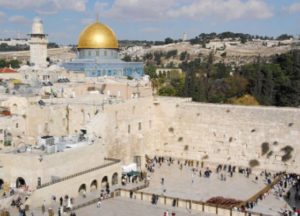
The Dome of the Rock overlooking the Western Wall plaza
The majority of opinions hold that the Temple stood directly where the Dome of the Rock stands today, though a minority holds otherwise. We know that the Temple was built over the Even haShetiya, the “Foundation Stone”, and our Sages state that in the Second Temple, the kohen gadol would rest the incense in the Holy of Holies atop this large rock, which protruded out of the ground (Yoma 53b). There is only one such large stone on the Temple Mount, and it currently lies beneath the Dome of the Rock.
The Muslims built the Dome of the Rock in the 7th century specifically over the site of what they believed to be Solomon’s Temple. In fact, an ancient Midrash prophesied that this would happen. Pirkei d’Rabbi Eliezer (dating back to the 1st century Rabbi Eliezer ben Hyrcanus, teacher of Rabbi Akiva) predicted that the Ishmaelites would one day conquer the Holy Land, and would do 15 major things there. One of these things is building a shrine atop the site of the Temple (see ch. 30). This is further supported by Nistarot d’Rabbi Shimon bar Yochai (an ancient text we explored in depth here), which clearly states that Ishmael “will build for himself there a place for prayer upon the site of the Foundation Stone, as Scripture says: ‘And set your nest on the rock…’” (Numbers 24:21) All of this makes it pretty much certain that the Beit HaMikdash really did sit where the Dome of the Rock is today, and not elsewhere on the Temple Mount.
Based on this, the argument of some poskim that we should not ascend the entire Temple Mount since we do not know where exactly the Temple stood doesn’t hold much water. Even if it did, we have to answer the other big question: does the Divine Presence remain where the Temple once stood? Such a position would strongly contradict a fundamental Midrash, and much more.
It is taught that when the Temple was destroyed, the Shekhinah moved on and took rest in the Kotel, the Western Wall. The Midrash prophesies that, therefore, the Western Wall would never be destroyed (see Eichah Rabbah 1:31, as well as Shemot Rabbah 2:2). This is another incredible prophecy that has come true: Jerusalem has been conquered and reconquered more than any other city in the world over the past two thousand years, and despite all the wars and changing regimes, the Western Wall remains. In fact, this is why Jews are so attached to the Western Wall, since this is where the Shekhinah currently lies, awaiting the return of the Temple.
As such, the Shekhinah probably does not remain where the Temple once stood. This is further supported by the fact that few would dare argue that the Shekhinah lies within the Dome of the Rock, a Muslim shrine. While there is no doubt that the ground retains its sanctity, it is safe to say there is no greater spiritual presence within the Dome of the Rock area—certainly no more than around the Western Wall, for which we have a clear source saying the Shekhinah rests there! Therefore, one can strongly argue that not only should Jews be allowed to enter the Temple Mount, we should even be allowed to enter the Dome of the Rock. It is worth mentioning here the position of the Raavad (Rabbi Avraham ben David, c. 1125-1198) who held that there is no longer any karet prohibition to go anywhere on the Temple Mount. Which brings us to the last big question:
Why have many gedolim today ruled against ascending the Temple Mount when the sources are quite clear that it should be permissible?
The Solution to Fear and Politics
In 1967, the Israeli army liberated Jerusalem during the Six-Day War. The commander of the Golani Brigade, Motta Gur, is the person who led the way. Gur believed that it was his life’s purpose and mission to liberate Jerusalem. In fact, he predicted he would do so all the way back in 1961, in a conversation with Rabbi Shlomo Goren. Gur thought that the reason God put him on this planet was to return the Temple Mount to the Jewish people. His vision was realized in 1967, and it was Gur who loudly declared “Har HaBayit beYadeinu!” The recording of his voice was broadcast to jubilant Jews around the world. And that’s not all.
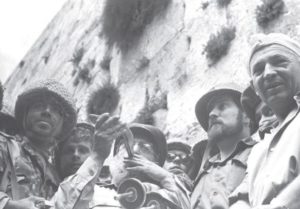
Rabbi Shlomo Goren blows the shofar by the Western Wall during the 1967 liberation of Jerusalem.
When the Temple Mount was secured, Gur immediately ordered one of his soldiers to put an Israeli flag atop the Dome of the Rock. He wanted to make clear that Jews have regained complete sovereignty over their holiest site. Unfortunately, as soon as General Moshe Dayan saw the Israeli flag atop the Dome with his binoculars, he ordered it removed immediately. “Do you want to set the Middle East on fire?!” Dayan shouted into his radio. Dayan, like most of the Israeli government at the time, feared taking control of the Temple Mount. The fear was both of the Muslim reaction, as well as of the religious Jewish reaction. Rabbi Shlomo Goren, IDF chief rabbi, was also on-hand during the capture, and immediately began working on establishing a synagogue on the Temple Mount. (In fact, we know from historical sources that there used to be synagogues on the Temple Mount at various times during the Arab and Ottoman periods.) In response to this, Dayan instituted a ban on Jews establishing synagogues, or even just praying, on the Temple Mount.
Nonetheless, with the Temple Mount in our hands, countless Jews would undoubtedly want to ascend. Not only that, but religious Jews may want to start fulfilling other major laws. For instance, the korban pesach can be fulfilled on the Temple Mount, and does not require a Temple (and is permitted to be done even with tumat met, under certain conditions). On that note, it is vital to point out that the korban pesach is one of two positive mitzvot that results in karet if not fulfilled (the other is circumcision, see Keritot 1:1). So, while many rabbis are quick to point out that ascending the Temple Mount may result in a karet due to impurity, few mention that we are already in a de-facto state of karet since we cannot bring a korban pesach!
In short, the Israeli authorities feared what would happen if Jews were in charge of the Temple Mount: Packed synagogues? Numerous public mikvehs like in ancient times? Sheep sacrifices? Rebuilding the Temple? The ultra-secular government would never allow such a thing. They also didn’t want to stand up to the Muslim threats nor deal with any possible Muslim violence, though there really was no way of knowing how the Muslim world would actually respond. So, the government quickly gave up sovereignty back to the Muslim Waqf.
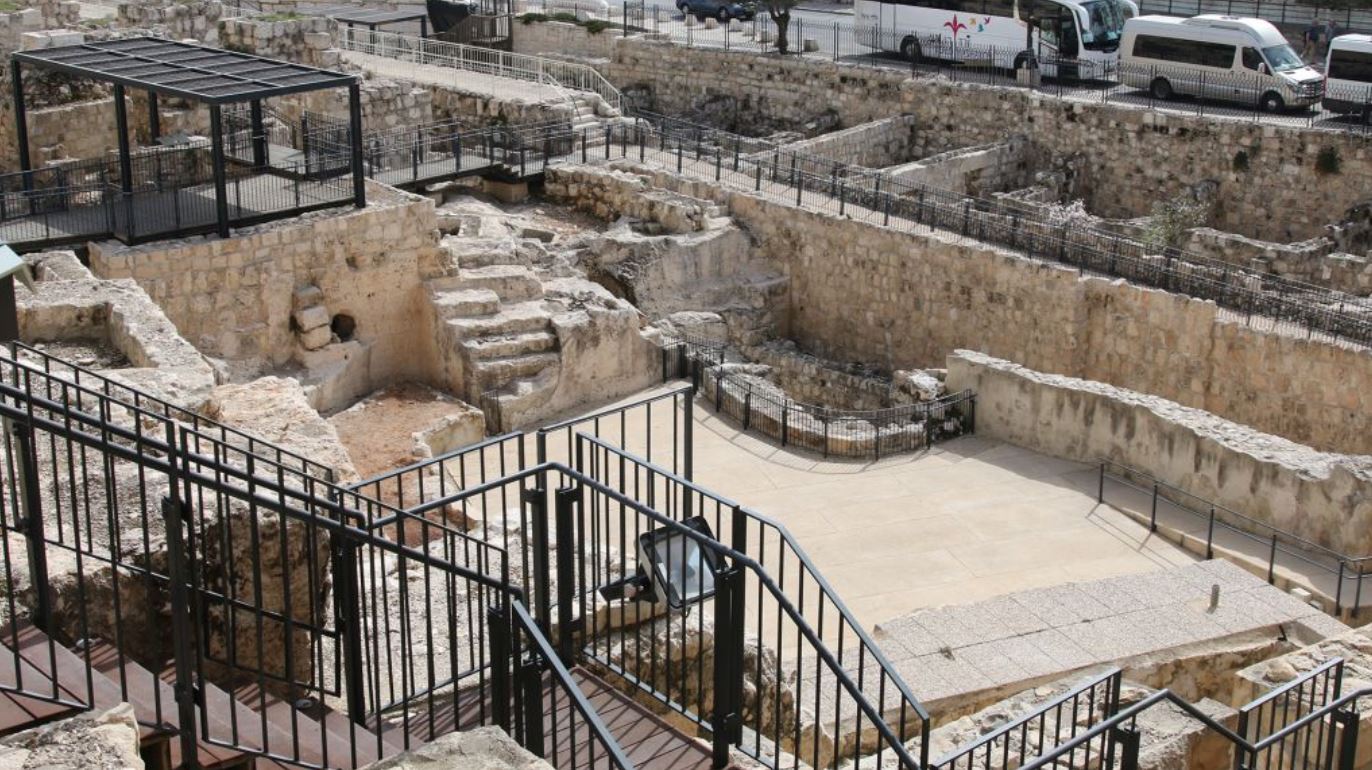
The ‘Mikveh Trail’ of the Jerusalem Archaeological Park. Over 50 different mikvehs have been uncovered around the Temple Mount, including this one most recently. (Photo Credit: Shmuel Bar-Am)
Unfortunately, many of the rabbinic authorities at the time agreed with the secular Israeli authorities, and wished to maintain the status quo. I imagine some of them thought it best to just leave it to Mashiach to deal with, whenever he would arrive. Soon, the Chief Rabbinate put up a sign warning Jews not to ascend the Temple Mount. It seems the ban had more to do with fear and politics than it did with genuine halakhah. The result was that the Muslims then (and now) took it as a sign that the Jews do not truly want this holy place, and it only bolstered the Muslim claim to the site. In reality, the Muslims have no legitimate claim to the site whatsoever, and even Muslim scholars agree that Mohammad’s “al-Quds” was nowhere near Jerusalem, and the Dome of the Rock holds no actual sanctity for Muslims. (Here’s one, for example.)
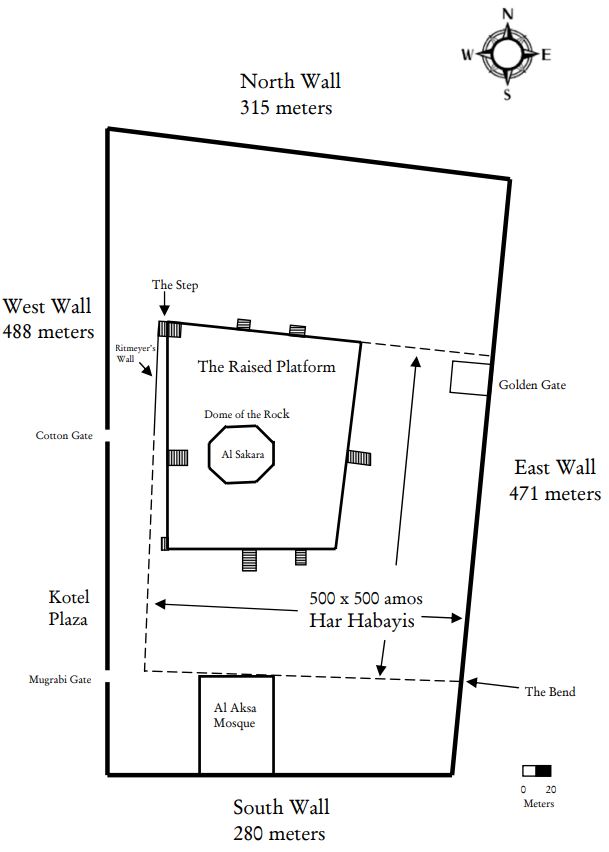
A map of the Temple Mount, and the rough position of the original Temple Mount area (“Har HaBayis”). The Temple would have stood inside of the “Raised Platform”, which pre-dates the Dome of the Rock. Credit: Gedalia Meyer and Henoch Messner. Read their excellent in-depth analysis of the Temple Mount issue here.
As such, Jews have to come together and make it clear that this is our holy site, and no one else’s. We have to take back complete sovereignty; we have to show that this site matters to us, and that we will make use of it to its full extent. Jews have to ascend the Temple Mount as much as possible, and do as many mitzvot there as we can. If you are concerned about Temple sanctity and issues of purity, then ascend and stay on the periphery—but do ascend! (The Mishnah, Middot 2:1, tells us that the original Temple Mount was 500 by 500 amot, which is less than half the size of the current Temple Mount area, so there is little chance of accidentally stepping on holy ground if you stay on the periphery, for those who are concerned.)
If we continue to avoid the Temple Mount, we will never live to see the restoration of the Temple—which we all pray for daily. The words of our prayers are empty without action. Recall that God did not split the Sea until Nachshon dove into it. The people prayed and prayed to no avail. “Then God said to Moses: ‘Why do you cry out to Me? Tell the Israelites to go forward!’” (Exodus 14:15) It is time to boldly go forward.
Our Sages had a principle, based on Psalms 119:26, et la’asot la’Hashem, heferu Toratecha! “It is a time to act for God, for they have violated your Torah!” The simple meaning of this verse is that since the Torah has been violated, it is a time to act. Our Sages interpreted this verse another way: at certain critical times, a revolutionary action is needed—one that might even violate the Torah! Rashi gives examples in his commentary on this verse. For instance, we see how Eliyahu brought a sacrifice on Mt. Carmel—which is forbidden based on the law given in this week’s parasha that sacrifices could only be brought at the Temple in Jerusalem. He did so because it was a critical time to act, and so a small violation was necessary for the greater good of Israel.
Now is another such time to act. Everyone agrees, including all gedolim, that we are in the Ikvot haMashiach. Everyone also agrees that the world is spiritually at a tremendous low point, and Israel isn’t doing so well either. We are at a moment that is very much like that of Eliyahu’s time, and like that of the Exodus. It is an unmistakable et la’asot la’Hashem, a time to act for God.
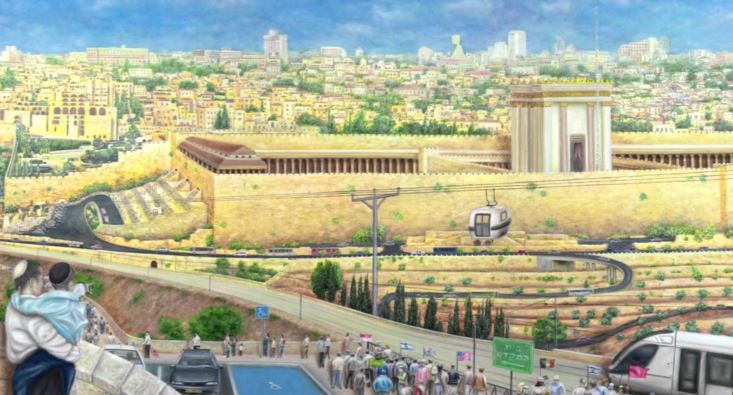
‘Going Up To The Third Temple’ by Ofer Yom Tov