The Year 5778: Apex of the Messianic Era

The stars of this week’s parasha, Vayeshev, are Joseph and Judah. We are told how the sons of Jacob were envious (and suspicious) of Joseph, and ended up throwing him in a pit while deliberating what to do with him. Shimon wished to kill him, Judah to sell him, and Reuben to save him. Meanwhile, Midianite merchants found the helpless Joseph and abducted him, later selling him to Ishmaelites who brought Joseph down to Egypt. There, Joseph enters into servitude in the home of a well-to-do Egyptian family.

The Torah diverges from this narrative to describe what happens to Judah. Judah marries and has three sons. The elder Er marries Tamar and dies because of his sinful ways, as does the second son Onan after fulfilling the law of levirate marriage and marrying his former sister-in-law. After Judah fearfully avoids another levirate marriage for Shelah, his last son, Tamar seduces Judah and becomes pregnant. She gives birth to twins, Peretz and Zerach.

Peretz would go on to be a forefather of King David, and thus a forefather of Mashiach. As is known, there are actually two messianic figures (or two aspects to Mashiach): Mashiach ben David, and Mashiach ben Yosef—one from the line of Judah and one from the line of Joseph. In fact, it is in this week’s parasha where the spiritual origins of the two messiahs begin.

Samson and the Messiahs

Mashiach ben Yosef is the first messiah. He is the warrior that battles evil in the “End of Days”. Unfortunately, he is destined to die in these battles. The Talmud (Sukkah 52a) states how the entire nation will mourn his tragic death. However, it will not be too long before Mashiach ben David arises. As the direct descendant of the royal line, he re-establishes the rightful throne and restores the holy Kingdom of Israel. The Third Temple is built thereafter, and according to some Mashiach ben David reigns for forty years, as did his progenitor King David (Sanhedrin 99a, Midrash Tehillim 15).

We have already discussed why Mashiach ben Yosef must die in the past (see ‘Secrets of the Akedah’ in Garments of Light). How he will die is not exactly clear. What will bring him to his death? It appears that Mashiach ben Yosef will be sold out by his own people. This is what happened to one of the earliest prototypes of Mashiach ben Yosef: the Biblical judge Shimshon (Samson).

As is well known, when Jacob blessed his children, he concluded the blessing to Dan with the words “I hope for Your salvation, Hashem” (Genesis 49:18) which Rashi says refers to Samson, a descendent of Dan. Samson was the potential messiah of his generation. He was a warrior fighting the oppressive Philistines. Yet, the people of Judah did not appreciate the “trouble” he was causing, and apprehended him (Judges 15:11-12):
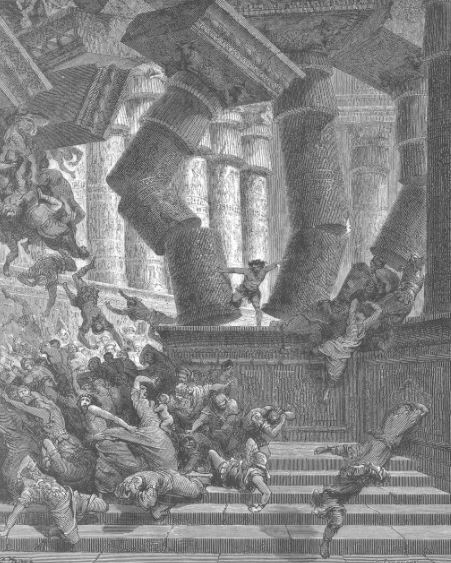
“Death of Samson”, by Gustav Doré

Then three thousand men of Judah went down to the cleft of the rock of Eitam, and said to Samson: “Do you not know that the Philistines are rulers over us? What then is this that you have done to us?” And he said to them: “As they did to me, so have I done to them.” And they said to him: “We have come to bind you, that we may deliver you into the hand of the Philistines.”

Samson turned himself in voluntarily, but with God’s help smote the Philistine oppressors and freed himself. He would be betrayed again by Delilah, but would manage to defeat the Philistines for good, though at the cost of his own life. Like Mashiach ben Yosef, Samson sacrifices himself.

The text above specifically states that three thousand men of Judah came for Samson. What is the significance of this numeric detail?

The Evil 3000

At the Exodus, the Torah states there was a “mixed multitude” (erev rav) of three thousand men among the Israelites. They, too, accepted the Torah at Mt. Sinai, only to instigate the Golden Calf incident forty days later. It is said that the same will happen at the End of Days, with an “erev rav” among the Jews who will instigate all sorts of problems for the nation from within (see, for example, Zohar I, 25 or Sha’ar HaGilgulim, ch. 39). Like Samson’s three thousand men of Judah, Mashiach ben Yosef is sold out by three thousand “Jewish” individuals.

And the fact that they are men of Judah is all the more significant. It was Judah in this week’s parasha who proposed selling Joseph. And to whom did he want to sell him?

And Judah said to his brothers: “What is the gain if we slay our brother and cover up his blood? Come, let us sell him to the Ishmaelites, but our hand shall not be upon him, for he is our brother, our flesh.” (Genesis 37:26-27)

Judah wanted to sell his brother to the Ishmaelites. In speaking of the battles of Mashiach ben Yosef and the End of Days, it is often the Ishmaelites (or the Ishmaelites banded together with Esau) that are implicated (see, for example, Pirkei d’Rabbi Eliezer, ch. 30). Today, of course, the modern “Philistines” are Ishmaelites, and among their biggest supporters are the descendants of Esau.

In The Era of Mashiach

This discussion is particularly timely in light of what’s currently happening in the Middle East. It seems the region is preparing for a massive war, one that would inevitably engulf the entire Ishmaelite sphere, if not the whole world. We’ve written before that we are undoubtedly in the “footsteps of the Messiah” and here is another intriguing point:

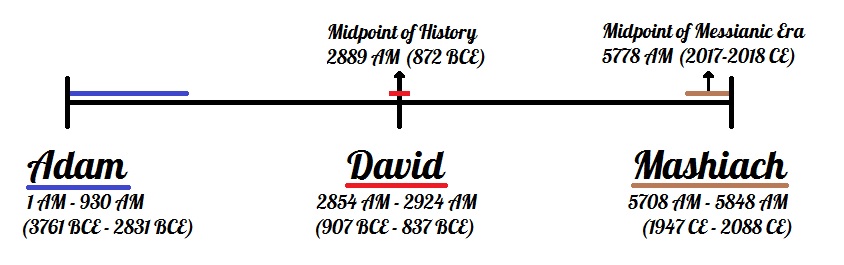
God originally intended for Adam to live 1000 years. Yet, we see in Genesis that Adam lived only 930 years. This is because, as is well known, Adam foresaw that David would be stillborn, and donated 70 years of his life to him. Indeed, David went on to live exactly 70 years. The Arizal saw in the name Adam (אדם) an acronym for three figures: Adam, David, Mashiach. These are the first, middle, and last major figures of human history. Based on this, Rabbi Yitzchak Ginsburgh teaches that David is supposed to be the literal midpoint of history. If that’s the case, then we only need to see when David lived to calculate the era of Mashiach.

The traditional lifetime for David is 2854-2924 AM (Anno Mundi, Hebrew calendar years, corresponding to about 907-837 BCE). To find the time period for the End of Days we must simply multiply David’s years by two. This gives 5708-5848, or 1947/1948-2087/2088 CE. That’s quite amazing, considering that Israel officially became a state in 5708 (the UN vote to create Israel took place in November 1947, and Israel declared independence in May 1948—both dates fall within the Jewish year 5708). And what would be the midpoint, or perhaps the apex, of the “End of Days” period? None other than 5778, the year which we are currently in.

Stay tuned.

The above essay is adapted from Garments of Light, Volume Three.
Get the book here! 
 

The Incredible History and Absurd Politics of Rachel’s Tomb

In this week’s parasha, Vayishlach, we read about Jacob’s return to the Holy Land after twenty years in Charan. After some time, Jacob and the family make a stop in Beit El, where Jacob first encountered God decades earlier. God appears to Jacob once more, and promises that “the land which I gave to Abraham and to Isaac, I will give to you and to your seed after you” (Genesis 35:12). God makes it clear that the Holy Land is designated solely for the descendants of Jacob—not the descendants of Esau, and not the descendants of Ishmael, or any other of Abraham’s concubine sons. It is the land of Israel, the new name that Jacob receives in this week’s parasha.

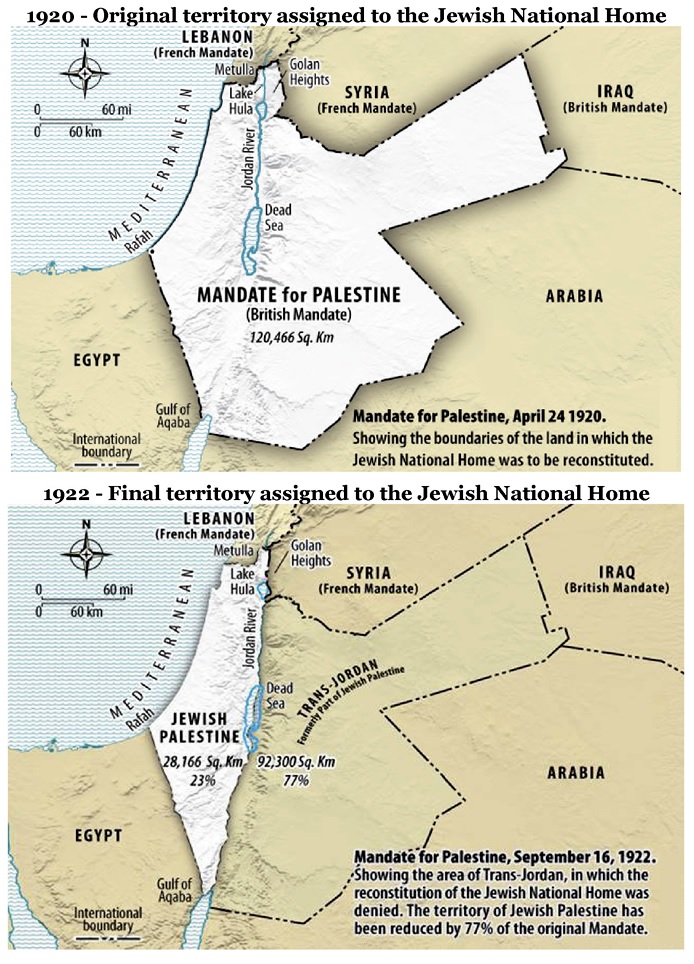
In fact, in this parasha we see mention of many Israelite sites, both ancient and modern, such as Hebron and Bethlehem. In our day, all of these are unfortunately within the political entity typically referred to as the “West Bank”. This title comes from the fact that the area is geographically on the west side of the Jordan River. Initially, the British Mandate for Palestine included both sides of the Jordan River, before the British gave the east to the Arabs to create the state of Jordan. This was the original “partition plan” for Palestine, with the eastern half meant to serve as the Arab state and the western half to become a Jewish one. Many have forgotten this important detail.

British Mandate for Palestine – Before and After (Credit: Eli E. Hertz)

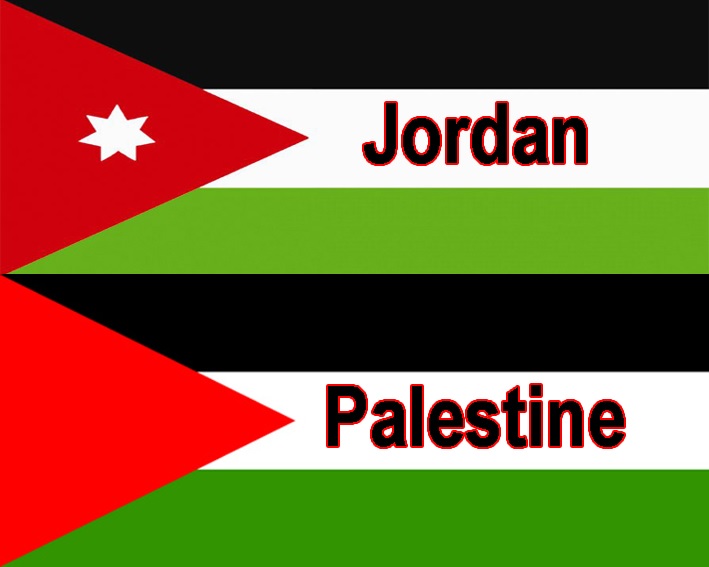
The current flags of the state of Jordan and the Palestinian movement. It is estimated that about half of Jordan’s current population of 9.5 million is Palestinian Arab.

Nonetheless, the unsuitable title of “West Bank” has stuck ever since. Some rightly avoid using the term in favour of the more appropriate “Judea and Samaria”. Truthfully, even this title is not entirely accurate, for the region is nothing less than the very heartland of Israel, the location of the vast majority of Biblical events, and the home of a plethora of Jewish holy sites. Among them is the tomb of Rachel, as we read in this week’s parasha (Genesis 35:16-20):

And they journeyed from Beit El, and there was still some distance to come to Ephrath, and Rachel gave birth, and her labor was difficult… So Rachel died, and she was buried on the road to Ephrath, which is Bethlehem. And Jacob erected a monument on her grave; that is the tombstone of Rachel until this day.

Throughout history, Rachel’s tomb was one of the most venerated sites in Judaism, and is often described as the Jewish people’s third-most holiest site (after the Temple Mount/Western Wall and Cave of the Patriarchs). As early as the 4th century CE the historian Eusebius already wrote of Rachel’s tomb being a holy site for Jews and Christians. Keep in mind that this is two centuries before anyone even whispered Islam. Not that it really matters, since Islam does not consider this a particularly special place. The Arab-Muslim historian and geographer of the 10th century, Al-Muqaddasi, doesn’t even mention Rachel’s tomb in his descriptions of Muslim-controlled Israel and its holy sites.

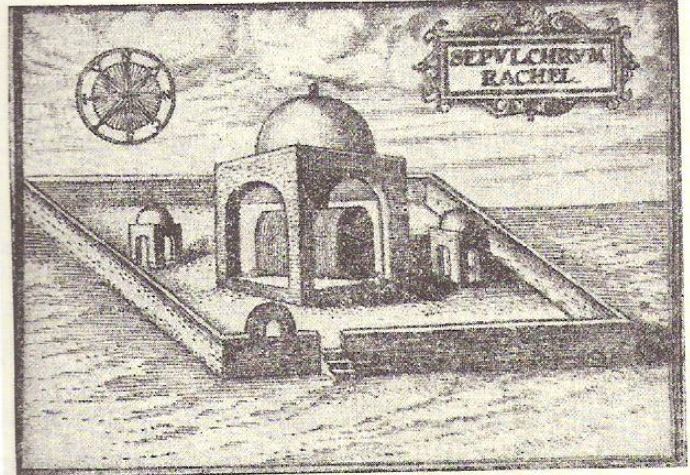
1585 Illustration of Rachel’s Tomb

Meanwhile, the Jewish traveler and historian Benjamin of Tudela (1130-1173) describes Rachel’s tomb in detail as being a domed structure resting upon four pillars, with Jewish pilgrims regularly visiting and inscribing their names on the surrounding eleven stones (representing the Tribes of Israel, less the tribe of Benjamin, as Rachel died giving birth to him). The earliest Muslim connection to the tomb is in 1421, when Zosimos mentions a small mosque at the site. (“Zosimos the Bearded” was a Russian Orthodox deacon famous for proposing the Moscow-Third Rome principle—which may be of great significance for calculating the time of Mashiach’s coming, as we’ve written in the past.)

The Ottomans originally transferred ownership of the site to the Jewish community (in 1615) but later reneged on the promise and even built walls to prevent Jews from going there, according to the British priest and anthropologist Richard Pococke (1704-1765). Pococke writes that the Ottomans used the area as a cemetery. Nonetheless, Jews could not be kept away from their millennia-old holy site, and continue to make pilgrimages. Christian writers G. Fleming and W.F. Geddes note in their 1824 report that “the inner wall of the building and the sides of the tomb are covered with Hebrew names, inscribed by Jews.”

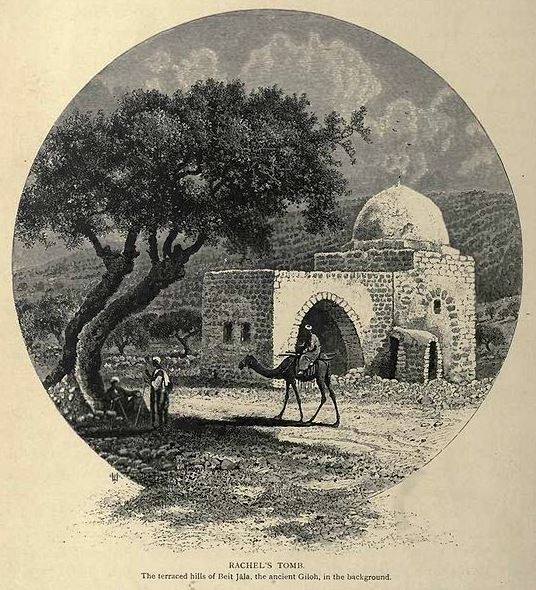
1880 Illustration of Rachel’s Tomb

Six years later, the Ottomans officially recognized Rachel’s tomb as a Jewish holy site again, and ten years later the site was purchased by famous Sephardic Jewish financier and philanthropist Moses Montefiore. Montefiore rebuilt the crumbling tomb, and even constructed a small adjacent mosque to appease the local Muslims. Around this time, British writer Elizabeth Anne Finn, who lived in Jerusalem while her husband was the consul there, wrote that Jerusalem’s Sephardic Jews never left the Old City unless to pray at Rachel’s tomb. Similarly, the Missionary Society of Saint Paul the Apostle wrote in 1868 that Rachel’s tomb

has always been held in respect by the Jews and Christians, and even now the former go there every Thursday, to pray and read the old, old history of this mother of their race. When leaving Bethlehem for the fourth and last time, after we had passed the tomb of Rachel, on our way to Jerusalem, Father Luigi and I met a hundred or more Jews on their weekly visit to the venerated spot.

Later, Jewish businessman Nathan Straus (of Macy’s fame) purchased even more land around the site that Montefiore had purchased. (Interestingly, Montefiore’s own tomb in England is a replica of Rachel’s tomb.)

Under the British Mandate, Jewish groups applied on multiple occasions for permission to repair the site, but were denied because of Muslim opposition. The Muslims themselves didn’t bother repairing it, of course. Conversely, many of them were (and still are) happy to attack the site whenever an opportunity presents itself:

Throughout the 1800s, the local e-Ta’amreh Arab clan had blackmailed the Jews to pay up 30 pounds a year or else they would destroy the tomb. In 1995, Arabs—led by a Palestinian Authority governor—attacked Rachel’s tomb and tried to burn it down. In 2000, they laid a 41-day siege on the site during the Second Intifada. In light of this, it made total sense when UNESCO declared in 2015 that Rachel’s tomb is a Muslim holy site that is “an integral part of Palestine”. The laughable resolution only confirms the senselessness and irrelevance of the United Nations.

Had they bothered to look at the historical record, they would have seen that Rachel’s tomb is, was, and always will be a Jewish holy site of immeasurable significance. Countless Jewish pilgrims have experienced miracles there, particularly for health and fertility. According to tradition, Rachel is the only matriarch to be buried outside of the Cave of the Patriarchs so that her spirit can weep and pray for her children in exile. Her prayers are successful, for we are in the midst of the exile’s final end, as prophesied by Jeremiah (31:14-16):

Thus said Hashem: “A voice is heard in Ramah, in lamentation and bitter weeping.” It is Rachel, weeping for her children. She refuses to be comforted for her children, because they are not. Thus said Hashem: “Refrain your voice from weeping, and your eyes from tears, for your work shall be rewarded,” said Hashem. “And they shall return from enemy lands. And there is hope for your future,” said Hashem. “And the children shall return to their borders…”


The above essay is adapted from Garments of Light, Volume Three.
Get the book here! 
Marriage and Prayer: Why They Are the Same, and How to Succeed in Both

This week’s parasha is Toldot, which begins:

And these are the genealogies [toldot] of Isaac, the son of Abraham; Abraham begot Isaac. And Isaac was forty years old when he took Rebecca… for a wife. And Isaac prayed to Hashem opposite his wife, because she was barren, and Hashem accepted his prayer, and Rebecca his wife conceived.

The Torah juxtaposes Isaac’s marriage to Rebecca with Isaac’s successful prayer. One of the Torah’s central principles of interpretation is that when two ideas or passages are placed side by side, there must be an intrinsic connection between them. What is the connection between marriage and prayer?

Another central principle of interpretation is that when a word or concept appears for the first time in the Torah, its context teaches the very epitome of that word or concept. The first time that the word “love” is used between a man and woman in the Torah is with regards to Isaac and Rebecca, and the two thus represent the perfect marital bond (a topic we’ve explored in the past; see: ‘Isaac and Rebecca: the Secret to Perfect Marriage’ in Garments of Light).

So, we see that Isaac and Rebecca were very successful in their love and marriage, and simultaneously very successful in their prayers. In fact, our Sages teach that when the Torah says “Isaac prayed… opposite his wife”, it means that the two prayed together in unison, and some even say they prayed while in a loving embrace, face-to-face, literally “opposite” one another. God immediately answered their prayers. What is the secret of Isaac and Rebecca’s success in love and prayer?

Understanding Prayer

It is commonly (and wrongly) believed that prayer is about asking God for things. Not surprisingly, many people give up on prayer when they feel (wrongly) that God is not answering them, and not fulfilling their heartfelt requests. In reality, prayer is something quite different.

A look through the text of Jewish prayers reveals that there is very little requesting at all. The vast majority of the text is made up of verses of praise, gratitude, and acknowledgement. We incessantly thank God for all that He does for us, and describe over and over again His greatness and kindness. It is only after a long time spent in gratitude and praise that we have the Amidah, when we silently request 19 things from God (and can add some extra personal wishes, too). Following this, we go back to praise and gratitude to conclude the prayers.

Many (rightly) ask: what is the point of this repetitive complimenting of God? Does He really need our flattery? The answer is, of course, no, an infinite God does not need any of it. So why do we do it?

One answer is that it is meant to build within us an appreciation of God; to remind us of all the good that He does for us daily, and to shift our mode of thinking into one of being positive and selfless. Through this, we build a stronger bond with God, and remain appreciative of that relationship.

The exact same is true in marriage. Many go into marriage with the mindset of what they can get out of it. They are in a state of always looking to receive from their spouse. Often, even though they do receive a great deal from their partner, they become accustomed to it, and forget all the good that comes out of being married. They stop appreciating each other so, naturally, the marriage stagnates and the couple drifts apart.

Such a mindset must be altered. The dialogue should be like that of prayer: mostly complimenting, acknowledging, and thanking, with only a little bit of request. The Torah tells us that God created marriage so that man is not alone and has a helper by his side. The Torah says helper, not caretaker. We should appreciate every little bit that our spouses do, for without them in our lives we would be totally alone and would not even have that little bit. The Talmud (Yevamot 62a) tells a famous story of Rabbi Chiya, whose wife constantly tormented him and yet, not only did he not divorce her, but he would always bring her the finest goods. His puzzled students questioned him on this, to which he responded: “It is enough that they rear our children and save us from sin.”

A Kind Word

By switching the dialogue to one of positive words and gratitude, we remain both appreciative of the relationship, and aware of how much good we do receive from our other halves. Moreover, such positive words naturally motivate the spouse to want to do more for us, while constant criticism brings about the very opposite result.

Similarly, our Sages teach that when we constantly praise God and speak positively of Him, it naturally stirs up His mercy, and this has the power to avert even the most severe decrees upon us. We specifically quote this from Jeremiah (31:17-19) in our High Holiday prayers:

I have surely heard Ephraim wailing… Ephraim is my precious child; a child of delight, for as soon as I speak of him, I surely remember him still, and My heart yearns for him. I will surely have compassion for Him—thus said Hashem.

Ephraim is one of the Biblical names for the children of Israel, especially referring to the wayward Israelite tribes of northern Israel. Despite the waywardness, Ephraim’s cries to God spark God’s compassion and love for His people.

A kind, endearing word can go very far in prayer, as in marriage. The same page of Talmud cited above continues to say that Rav Yehudah had a horrible wife, too, yet taught his son that a man “who finds a wife, finds happiness”. His son, Rabbi Isaac, questioned him about this, to which Rav Yehudah said that although Isaac’s mother “was indeed irascible, she could be easily appeased with a kindly word.”

Judging the Self

The Hebrew word for prayer l’hitpalel, literally means “to judge one’s self”. Prayer has a much deeper purpose: it is a time to meditate on one’s inner qualities, both positive and negative, and to do what’s sometimes called a cheshbon nefesh, an “accounting of the soul”. Prayer is meant to be an experience of self-discovery. A person should not just ask things of God, but question why they are asking this of God. Do you really need even more money? What would you do with it? Might it actually have negative consequences rather than positive ones? Would you spend it on another nice car, or donate it to a good cause? Why do you need good health? To have the strength for ever more sins, or so that you can fulfill more mitzvot? Do you want children for your own selfish reasons or, like Hannah, to raise tzadikim that will rectify the world and infuse it with more light and holiness?

Prayer is not simply for stating our requests, but analyzing and understanding them. Through proper prayer, we might come to the conclusion that our requests need to be modified, or sometimes annulled entirely. And when finally making a request, it is important to explain clearly why you need that particular thing, and what good will come out of it.

Central to this entire process is personal growth and self-development. In that meditative state, a person should be able to dig deep into their psyche, find their deepest flaws, and resolve to repair them. In the merit of this, God may grant the person’s request. To paraphrase our Sages (Avot 2:4), when we align our will with God’s will, then our wishes become one with His wishes, and our prayers are immediately fulfilled.

Once more, the same is true in marriage. Each partner must constantly judge their performance, and measure how good of a spouse they have been. What am I doing right and what am I doing wrong? Where can I improve? How can I make my spouse’s life easier today? Where can I be more supportive? What exactly do I need from my spouse and why? In the same way that we are meant to align our will with God’s will, we must also align our will with that of our spouse.

The Torah commands that a husband and wife must “cleave unto each other and become one flesh” (Genesis 2:24). The two halves of this one soul must reunite completely. This is what Isaac and Rebecca did, so much so that they even prayed as one. In fact, Isaac and Rebecca were the first to perfectly fulfil God’s command of becoming one, and this is hinted to in the fact that the gematria of “Isaac” (יצחק) and “Rebecca” (רבקה) is 515, equal to “one flesh” (בשר אחד). More amazing still, 515 is also the value of “prayer” (תפלה). The Torah itself makes it clear that marital union and prayer are intertwined.

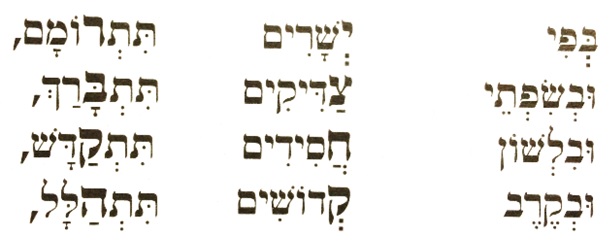
One of the most popular Jewish prayers is “Nishmat Kol Chai”, recited each Shabbat right before the Shema and Amidah. The prayer ends with an acrostic that has the names of Isaac and Rebecca. The names are highlighted to remind us of proper prayer, and that first loving couple which personified it.

Confession

The last major aspect of Jewish prayer is confession. Following the verses of praise and the requests comes vidui, confessing one’s sins and genuinely regretting them. It is important to be honest with ourselves and admit when we are wrong. Among other things, this further instills within us a sense of humility. The Talmud (Sotah 5a) states with regards to a person who has an ego that God declares: “I and he cannot both dwell in the world.” God’s presence cannot be found around a proud person.

In marriage, too, ego has no place. It is of utmost significance to be honest and admit when we make mistakes. It is sometimes said that the three hardest words to utter are “I love you” and “I am sorry”. No matter how hard it might be, these words need to be a regular part of a healthy marriage’s vocabulary.

And more than just saying sorry, confession means being totally open in the relationship. There should not be secrets or surprises. As we say in our prayers, God examines the inner recesses of our hearts, and a couple must likewise know each other’s deepest crevices, for this is what it means to be one. In place of surreptitiousness and cryptic language, there must be a clear channel of communication that is always wide open and free of obstructions.

To summarize, successful prayer requires first and foremost a great deal of positive, praising, grateful language, as does any marriage. Prayer also requires, like marriage, a tremendous amount of self-analysis, self-discovery, and growth. And finally, both prayer and marriage require unfailing honesty, open communication, and forgiveness. In prayer, we make God the centre of our universe. In marriage we make our spouse the centre of our universe. In both, the result is that we ultimately become the centre of their universe, and thus we become, truly, one.