
In this concluding installment of the series, we explore the intriguing mechanisms of reincarnation and look at specific examples from Cain and Abel, Moses and Jethro, Balaam, Terach, Job, Deborah, Tamar, and others. Also, can a male soul reincarnate in a female body, or vice versa? And how many total souls are meant to exist across all time? Plus: What is a dybbuk and does Judaism have a notion of “exorcism”? Who did Cain and Abel marry? And did God make other humans besides Adam and Eve?
Gentiles Becoming Jews
The Haftarah for this week’s parasha, Beha’alotkha, is a passage from the prophet Zechariah in which we read that in the End of Days, “many nations will attach themselves to Hashem and become [part of] My people, and I shall dwell among you…” (2:15) This is reminiscent of a more famous verse later in Zechariah: “In those days, ten people from nations of every tongue will take hold—they will take hold of every Jew by a corner of their cloak and say, ‘Let us go with you, for we have heard that God is with you.’” (8:23) What we find in these verses is that in the lead-up to the Messianic Age, many nations will start to realize the truth of Hashem and His Torah and wish to learn with the Jewish people and even become Jews themselves. Today, we are living the fulfilment of this prophecy and witnessing mass-conversions and similar “Judafying” trends all over the world.
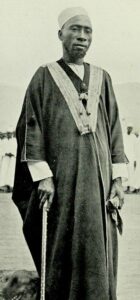
Semei Kakungulu
One of the first such notable cases was that of Semei Kakungulu of the Baganda tribe in Africa about a century ago. Kakungulu had converted to Christianity in his youth, before becoming a powerful British-backed chief and warlord. Later in life, Kakungulu took a deep dive into the Bible and started to find inconsistencies and errors in the New Testament. According to legend, he isolated himself in a room and emerged some time later having thrown out the New Testament and declaring only the “Old” to be true. He then circumcised himself and his son and started to live according to Torah law. In 1925, a group of Orthodox Jews passed by Kakungulu’s village, and ended up staying to teach the locals proper Jewish laws and practices, including shechitah and prayer services. By the end of his life, Kakungulu had inspired 8,000 Africans to join him and built a network of 36 synagogues. Despite challenges and persecutions over the subsequent decades, today there are still some 2,000 of them in Uganda (called Abayudaya), and the community is recovering and growing.
A more recent case is that of Segundo Villaneuva of Peru. Like Kakungulu, he found many inconsistencies in the New Testament, and ultimately ended up immersing in Torah. He started his own community, called Bnei Moshe, which soon grew to over 500 people. In 1989, Villaneuva and 160 others completed Orthodox conversions, and the following year made aliyah. Two more waves of conversions and aliyahs followed. Villaneuva’s story inspired many more Latin American communities to embrace Judaism, and it is estimated that there are now 60 such communities across 14 countries in the region.
Parallel to this are many Christian communities that are not abandoning their core beliefs, but still choosing to transition towards traditional Torah observance. This isn’t new, and groups like Seventh-Day Adventists (currently numbered at 21 million around the world) long ago switched to a kosher-style diet and Sabbath observance on Saturday. The Evangelical “Living Church of God”—with 400 congregations around the world and over 10,000 members—commemorate Rosh Hashanah and Yom Kippur, along with the three regalim, and have embraced other Jewish practices. Similar to them are the 8,000 or so Brazilians that are Pentecostal Christians but keep a host of Orthodox Jewish laws, down to circumcision, going to the mikveh, covering their hair, and eating kosher. While these communities still retain their wayward Christian beliefs, they are nonetheless starting to wake up to the truth and shifting in the right direction. Even the Pope said (in a 2018 interview) that more people should keep Shabbat like Jews do! I believe all of this, too, is a fulfilment of Zechariah’s vision.
Of course, mention must be made of the rapidly growing Noahide movement. The Bnei Noach are righteous people who choose to abide by the Torah’s Noahide Laws, without converting to Judaism. It is estimated that there are between 20,000 and 50,000 Noahides around the world today, and the unofficial number could be much higher. The Lubavitcher Rebbe played a key role in launching the Noahide movement, and was particularly adamant about educating non-Jews about the Noahide Laws. He hoped to make the Noahide Laws the backbone of all societies and legal systems, and famously corresponded with President Reagan on this matter.
Rethinking Conversion
Today there are converts to Judaism from all over the globe, from hundreds of different ethnicities and cultures. This includes Palestinians from Gaza, even a former Hamas terrorist, and the famous case of Abraham Sinai, a one-time Shia Hezbollah terrorist who ended up becoming a rabbi! Many African-Americans are converting to Judaism, including the well-known cases of NBA superstar Amar’e Stoudemire (now Yehoshafat) and musician Nissim Black.
This ties right back to our parasha, in which the Torah tells us that Moses married a Cushite woman. While there are certainly numerous differing interpretations of what exactly happened there, the simple pshat seems to be that Moses married a black woman and Miriam apparently had a problem with this. In turn, measure-for-measure, God punished Miriam by making her skin “snow-white” (Numbers 12:10). Perhaps God was sending Miriam a message: you’re not so white yourself! We should remember the words of the prophet Amos (9:7) in which God declares: “Are you children of Israel not like the children of Cush to Me?” (הֲלוֹא כִבְנֵי כֻשִׁיִּים אַתֶּם לִי בְּנֵי יִשְׂרָאֵל נְאֻם־יְהֹוָה) We must not forget that all human beings were made in the image of God, and every person is precious in Hashem’s eyes. Indeed, the Midrash states in several places:
I bring Heaven and Earth to witness that the Divine Spirit may rest upon a non-Jew as well as a Jew, upon a woman as well as a man, upon a maidservant as well as a manservant—all depends on the deeds of the particular individual. (Yalkut Shimoni II, 42; Eliyahu Rabbah 9)
מעיד אני עלי את השמים ואת הארץ, בין גוי בין ישראל, בין איש בין אשה, בין עבד בין שפחה,
הכל לפי מעשיו של אדם רוח הקדש שורה עליו
Just about everyone agrees that we are in the Ikvot haMashiach, on the doorstep of the Messianic Age, and our dear prophets told us long ago to expect in these days that many people will wish to join Israel. We are living this time now, and we must do everything possible to welcome more people into the Jewish fold. The Orthodox world urgently needs to rethink how conversions are carried out: to simplify and soften the process, to remove the unnecessary roadblocks and red tape, and to make it easier (and more pleasant) for people to become Jewish—in fulfilment of prophecy. Let’s not forget what our Sages said in the Talmud that “Israel was exiled among the nations only to draw converts” (Pesachim 87b). Indeed, the actual laws of conversion according to the Talmud, Mishneh Torah, and other ancient halakhic sources is very simple and straight-forward, and could even be done in a single day! If Hillel could famously convert a man “while standing on one foot” (Shabbat 31a), there’s no reason why we can’t.
Some worry about the consequences of such an approach, namely that it will result in inauthentic or “fake” Jews. The truth is, as our Sages state in multiple places, all you need to be considered a bona fide “Jew” is to reject idolatry! In Megillah 13a it says “anyone who spurns idolatry is called a Yehudi” (שֶׁכׇּל הַכּוֹפֵר בַּעֲבוֹדָה זָרָה נִקְרָא ״יְהוּדִי״) while Nedarim 25a says “so grave is idolatry that anyone who rejects it is considered to have acknowledged the entire Torah” (חֲמוּרָה עֲבוֹדָה זָרָה, שֶׁכׇּל הַכּוֹפֵר בָּהּ — כְּאִילּוּ מוֹדֶה בַּתּוֹרָה כּוּלָּהּ). Others pose a similar argument that loosening conversion standards will “dilute” Judaism and result in more secularism and less Torah observance. The reality is that some 90% of the Jewish world is already secular anyway, so what difference does it really make? On the contrary, in absolute terms you will have more potential for Torah observance and Torah learning, plus a larger number of people overall keeping mitzvot and doing good, going to shuls, giving tzedakah, supporting Israel, and so on.
In short, the positives far outweigh the potential negatives. And at the very least, it will lessen the scourge of antisemitism, and will serve to strengthen our nation through sheer numbers. At the moment, Jewish people are easy to pick on because there are very few of us. For instance, we are outnumbered about 100 to 1 by Muslims, and this is one reason why Muslims have little fear in abusing Jews around the world, and why many Jews fear their far-more-numerous Muslim neighbours. In recent months, Jews have sadly been taking down their mezuzot and hiding their Star of David necklaces. This wouldn’t be the case if we weren’t so terribly outnumbered. If every other house in the world had a mezuzah, there would be no fear in displaying one. If half the university was made up of Jewish students, there would be no fear of going to class (nor would there be such flagrant, raging anti-Israel protestors shutting down the campus).
Judaism has never really been a missionary religion, but perhaps it’s time to change that. After all, Moshe Rabbeinu told us that when the nations of the world hear Torah, they will be inspired and say “Surely, this great nation must be a wise and discerning people!” (Deuteronomy 4:6) And Isaiah predicted that in the End of Days, we will no longer be a small people serving God, but shall become a “light unto the nations, so that My salvation should reach the ends of the Earth.” (Isaiah 49:6) The verses are clear and unambiguous: it’s time to spread Torah openly and outwardly, to all the nations, to every corner of the planet. The world is thirsty for it, and needs it now more than ever.
Rav Yitzchak Ginsburgh, too, argues that now is the time for the “Fourth Revolution in Torah Learning”: The first revolution was putting the Oral Law into written form—which had previously been forbidden. Nearly two thousand years ago, the Sages decided it was time to break that taboo and record the Oral Torah. The result, of course, was entirely positive, and resulted in an explosion of Torah learning. The second revolution was allowing Torah to become “one’s trade”, and have full-time Torah scholars and rabbis. This was originally unheard of, and Torah scholars in previous generations all had jobs and businesses of their own. However, changes in society necessitated having dedicated people who are full-time facilitators of Torah and mitzvot for the community. We wouldn’t be able to have the beautiful Jewish communities we have today without full-time rabbis. The third revolution came in the late 1800s, when advanced Torah study was finally opened up for women. Now, Rav Ginsburgh says, we are on the cusp of the fourth revolution, to teach Torah to the non-Jewish world, and this is the key for bringing about the Final Redemption.
Coming back to this week’s parasha, we read that “when a stranger who resides with you offers a Passover sacrifice to God, it must be offered in accordance with the rules and rites of the Passover offering. There shall be one law for you, for the stranger, and the citizen of the land.” (Numbers 9:14) The Torah says that even foreigners and those non-Jews dwelling among us could participate in Passover. Meanwhile, Zechariah describes that following the final war of Gog u’Magog, which will see a coalition of nations from around the world seek to destroy Israel, those same nations will be required to “pilgrimage to Jerusalem from year to year to bow to the King, God of Hosts, and celebrate the holiday of Sukkot.” (14:16) The Torah is inviting the nations of the world to join the Jews. Let’s extend that invitation, welcome with open arms all those who seek Hashem, and bring the whole world one step closer to Geulah.
Netanyahu and Yirmiyahu
This week’s parasha, Bechukotai, contains an infamous list of curses that could befall the Jewish people, has v’shalom, if they stray from God’s ways. Jewish history shows that we have indeed experienced such tragic curses over the millennia every so often, and not just in the distant past but recently on October 7. As difficult and inexplicable such events may be, we have to keep in mind that while they come at the hands of various political entities and ethnoreligious groups, ultimately the source of the pain is God Himself. As the parasha tells us, the tragedies are both an unfortunate retribution for our transgressions, and a wake-up call to be better.
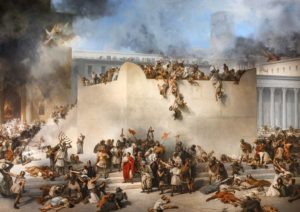
‘Destruction of the Temple in Jerusalem’ by Francesco Hayez (1867)
One of the first such unspeakable catastrophes took place roughly twenty-five centuries ago, at the hands of Nebuchadnezzar and the Babylonians. They massacred tens of thousands of Jews, enslaved and exiled many more, destroyed Jerusalem, and burned down the Holy Temple. Yet, the prophet Jeremiah quotes Hashem saying Nebuchadnezzar is His “servant” (Jeremiah 43:10), His instrument in bringing about punishment. The sad reality is that history’s wicked tormentors were tools of God. They would not arise had we not deserved it. We read in Isaiah 45:7 that “I am God, and there is no other; I form light and create darkness; I make peace and create evil, I am Hashem, doing all of these things.” If it is God’s Will to do such things, what does that make of the free will of the human tormentors?
Our Sages teach that when a person ascends to a high political position, and holds the lives of many in their hands, God limits that person’s free will. God will occasionally “harden their hearts” (as He did with Pharaoh) and steer their choices if necessary. This was described long ago by King Solomon when he said “Like channeled water is the heart of a king in God’s Hand; He directs it wherever He wishes.” (Proverbs 21:1) The Talmud cites this verse in saying that each person should pray “for a good king”, meaning we should pray that God direct political leaders to act justly and kindly with the populace (Berakhot 55a). God can cause a political leader to do more good, or to bring about punishment. And this takes us right back to October 7:
Everyone is puzzled by the fact that the Israeli government missed all the warning signs, was paralyzed by inaction on the morning of, and seemingly allowed the October 7 massacre to happen. It appears to be totally inexplicable and, not surprisingly, has given rise to multiple conspiracy theories. Did the government deliberately allow the massacre to happen? Did they want a serious external conflict to end the civil unrest that was taking place in the months prior to October 7? Did they have a hand in planning the attack? Did they purposely keep the border unguarded, or move military units away from the border, or give an abnormally large number of soldiers holiday vacations, or jam communication channels, or change permits to move the Nova festival from its original location right to the Gaza border? The theories are numerous, each more sinister than the next. Personally, I find them hard to believe, and although I am no fan of the government, it feels absurd to suggest that anyone could deliberately allow something like this to happen to their own people.
But then I was reading Jeremiah—the same Jeremiah that refers to Nebuchadnezzar as God’s servant, and the same Jeremiah from whom we read this week’s Haftarah. We find something quite amazing in the Book of Jeremiah: it is the one place in the Tanakh that describes a family called “Netanyahu”. (Another is briefly mentioned in a list in I Chronicles 25:12.) Jeremiah first speaks of a righteous court official named Yehudi ben Netanyahu (36:14). Yehudi delivers a scroll bearing Jeremiah’s gloomy prophecy to the king, and reads it before him. Judea’s King Yehoyakim refuses to heed the warning and thinks he is safe from the Babylonians. He scoffs and burns the prophetic scroll of Jeremiah. We hear no more of Yehudi ben Netanyahu after this.
We then read how Jeremiah’s prophecy was tragically fulfilled. The Babylonian armies arrived, destroying Jerusalem and the Temple and starting the grim period of the Babylonian Captivity. However, the Babylonians did not expel all the Jews from the Holy Land, and even allowed the Jews some autonomy to continue governing themselves. They appointed a Jewish leader named Gedaliah ben Ahikam as governor of Judea. Gedaliah reassured the remaining Jews that everything would be okay; to stay in the Holy Land and rebuild.
Here we are introduced to another Jewish leader, called Ishmael ben Netanyahu (40:8). A descendant of the Davidic monarchy, he had dreams of becoming king and making himself the undisputed leader of Israel. Gedaliah, of course, stood in his way. Ishmael made a secret alliance with the king of Ammon (same place as today’s Amman, capital of the Palestinian state of “Jordan”) to assassinate Gedaliah. Gedaliah was warned of Ishmael’s sinister plans, but dismissed the rumours, thinking no self-respecting Jew could ever stoop so low.
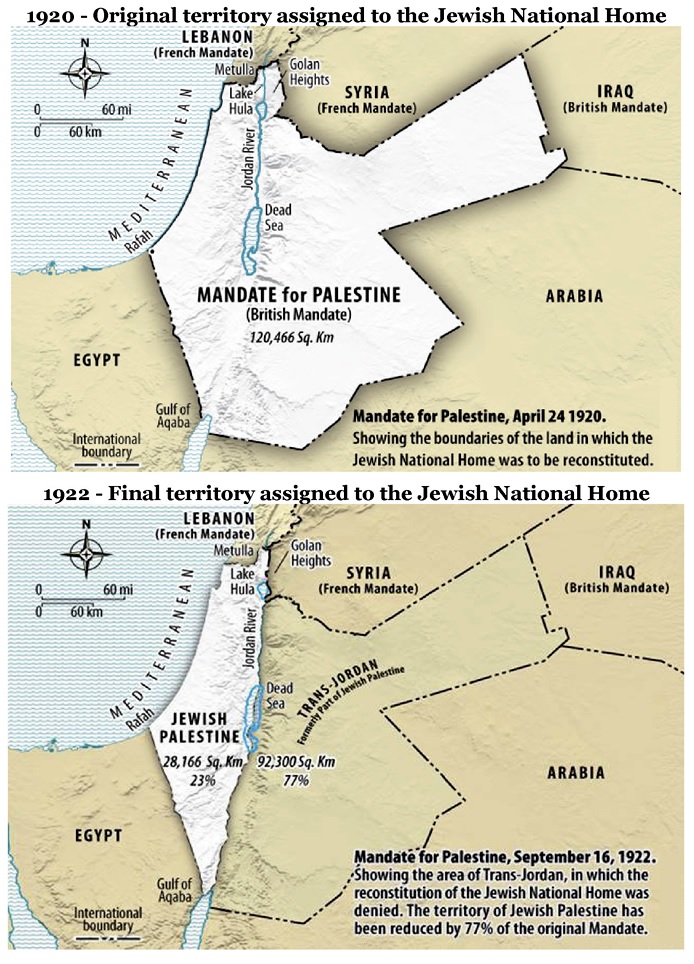
Although the entire British Mandate for Palestine was originally promised to the Jewish people, the British suddenly gave away more than two-thirds to the Arabs to form a new Palestinian state now called “Jordan”. (Credit: Eli E. Hertz)
But then, “in the seventh month” (Tishrei), Gedaliah was having a holiday feast and Ishmael joined him for the yom tov meal (41:1). Wicked Ishmael suddenly struck down Gedaliah “and all the Jews who were with him” (41:3). The next day, pilgrims “came from Shechem, Shiloh, and Samaria” to bring holiday offerings. Ishmael came out to greet them and invited them into town before turning on them and slaughtering them, too (41:7). Ishmael threw all the corpses into a cistern. He didn’t stop there:
Ishmael carried off all the rest of the people who were in Mizpah, including the daughters of the king—all the people left in Mizpah, over whom Nebuzaradan, the chief of the guards, had appointed Gedaliah son of Ahikam. Ishmael son of Netanyah carried them off, and set out to cross over to the Ammonites. (41:10)
Ishmael took hostages and fled back to Ammon. A Judean general named Yochanan ben Kareach finally figured out what’s going on and chased after Ishmael with his men, managing to free the hostages. Ishmael, however, escaped and we don’t know what happened to him afterwards.
In the aftermath of the massacre, the frightened and traumatized Judeans feared the Babylonians would come back to punish them for the death of the Babylon-appointed governor Gedaliah. Despite Jeremiah’s protests and assurances that all would be fine, the remnant of Jews decided to flee to Egypt. The result of Ishmael’s treachery was that the Holy Land lost its last Jews, along with its semi-autonomous Jewish government. The last traces of the Kingdom of Judea were officially obliterated.
For this terrible tragedy, we still observe the “Fast of Gedaliah” today every year immediately following Rosh Hashanah. Though the Tanakh doesn’t say exactly which holiday it was, according to tradition the Gedaliah massacre occurred on Rosh Hashanah. Since we don’t fast on holidays, the fast is observed on the third of Tishrei. However, a careful reading of the Tanakh suggests that the holiday may have been Sukkot, hence the pilgrims that came the following day to bring offerings. Altogether, the narrative is eerily similar to what we experienced last Sukkot in Tishrei, when Ishmaelites came into the land and slaughtered Jews peacefully celebrating a holiday, while taking other Jews hostage.
Strangely, the villain in the Jeremiah narrative (also recounted in II Kings 25) is a power-hungry Jewish leader named Ishmael ben Netanyahu. It would be another millennium before an Ishmaelite by the name of Muhammad would arise, and henceforth “Ishmael” would always be associated with the Muslims. If this episode in Tanakh is not only historical, but prophetic, I wonder what it might mean for all of us today.
I am reminded of the fact that our own Netanyahu was all too kind to the Ishmaelites, giving record-high work permits to Gazans to enter Israel (the Bennett government gave 10,000 before Netanyahu came back to power last year and doubled it to 20,000), transferring Qatari suitcases of cash to support them, and refusing pre-emptive strikes when warned by military officials. The same Netanyahu has yet to fulfil a single objective in the current war. Nearly eight months later, most of Hamas’ tunnel infrastructure is still in place, their leaders still at large, rockets still being fired on Israel, and worst of all, a multitude of hostages still in captivity. The government of Israel is paralyzed, the Knesset remains a circus of corruption (on both sides left and right, secular and “religious”), and “there is no one to rely on but our Father in Heaven.” (Sotah 49b)
Will today’s Netanyahu be more like the righteous Yehudi ben Netanyahu—who supported Jeremiah the Prophet and sought to lead people towards truth and repentance, while confronting the corrupt government of Yehoyakim—or is he more like Ishmael ben Netanyahu, a power-hungry manipulator and a collaborator with Israel’s enemies, a facilitator of Jewish massacres? Will he go down in history as a real “Yehudi”, or as an imposter “Ishmael”? I hope time will prove the former to be the case, but I fear the reality is fast-approaching the latter. If Benjamin Netanyahu does not make some dramatic changes for himself and his country, he may well end up like Ishmael ben Netanyahu long before him; shamefully fleeing his country, remembered for centuries thereafter as a villain.
Whatever happens, Jeremiah in this week’s Haftarah reminds us of a critical principle never to lose sight of: “Cursed is the man who trusts in man… Blessed is the man who trusts in God; and God shall be his security.” (17:5-7)