
Tag Archives: 24000 Students

Embracing Converts, and the Seeds of Amalek

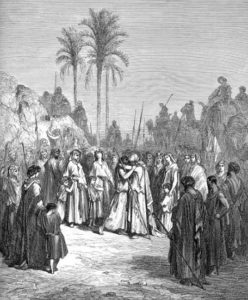
'The Meeting of Jacob and Esau' by Gustav Doré

‘The Meeting of Jacob and Esau’ by Gustav Doré

This week’s parasha is Vayishlach, which recounts Jacob’s return and settlement in the Holy Land after twenty years of living in Charan. At the end of the parasha is a long list of the genealogies of Jacob’s brother, Esau. The list seems unnecessary, and many Sages have wondered why the Torah bothers to spend so much time recounting Esau’s descendants. There have even been debates on whether the entire text of the Torah is equally holy, or if passages like the Ten Commandments are holier than passages such as this list of Esau’s genealogies. Meanwhile, the Arizal states that many of the deepest secrets of Creation are embedded particularly in this seemingly boring and superfluous passage. He draws particular significance from the list of the kings of Edom. The Arizal says these kings are codenames for the Sefirot, and a careful reading of the text reveals the cosmological rectifications (tikkunim) required to repair all of Creation and restore the world to perfection.

About half way through the list we are told that “… the sister of Lotan was Timna” (Genesis 36:22). Again, the Sages are baffled at this extra addition. We already care little enough that there was once an Edomite chief named Lotan – who cares that he had a sister named Timna? The Talmud (Sanhedrin 99b) notes how there were those who scoffed at such verses, saying: “Did Moses have nothing better to write?” And then, the same page of Talmud comes in to explain its tremendous significance:

Timna was a royal princess… Desiring to become a proselyte, she went to Abraham, Isaac and Jacob, but they did not accept her. So she went and became a concubine to Eliphaz the son of Esau, saying, “I’d rather be a servant to this people than a mistress of another nation.” From her, Amalek was descended, who afflicted Israel. Why so? Because they should not have repulsed her!

The Talmud combines the verse in question – which states that Timna was the royal sister of the chief, or prince, Lotan – with an earlier verse (36:12) that says she married Esau’s son Eliphaz and bore Amalek. She wished to convert to Judaism and approached the Patriarchs. All three rebuffed her. So, she ended up with Eliphaz – the closest she could get to being part of the nation. This union gave rise to the evil Amalek, that antagonizing force which has been oppressing Israel for millennia. The Sages state that the Patriarchs should have embraced this potential convert, instead of pushing her away. Their failure to open their arms led to centuries of Jewish suffering. The Talmud sends a pretty clear message: gentiles and converts should not be turned away, and doing so only breeds more resentment against Jews, bringing out all of the world’s “Amaleks”.

Soulmates of Jacob and Moses

The Arizal comments on the Timna passage and points out something even more amazing. He taught (Sha’ar HaMitzvot, Shoftim) that Timna was actually the soulmate of Jacob! Timna contained a great deal of holiness, and Jacob was meant to convert her and marry her, thereby elevating her spiritual sparks. That would have been a massive tikkun of its own, and would have hastened the coming of Mashiach. Instead, Jacob rejected her, and she went on to produce Amalek, bringing evermore evil into the world, and further delaying the coming of Mashiach.

The Arizal highlights that Moses made a similar mistake in not consummating his marriage to the Cushite (Ethiopian) woman. Both Tzipporah and the Cushite woman were Moses’ soulmates, and while Moses did the right thing in converting the Cushite, he never properly married her. Her sparks of holiness were not fully elevated, and the tikkun was left incomplete. This is why Aaron and Miriam were upset with their brother, as we read later in Numbers 12:1, “And Miriam and Aaron spoke against Moses because of the Cushite woman whom he had married…”

Rabbi Akiva’s 24,000 Students in Shechem

In this week’s parasha, too, we read how the people of Shechem genuinely wished to unite with Jacob’s family, agreed to circumcise themselves, and converted en masse. However, Jacob’s sons Shimon and Levi rejected them and resorted to violence in avenging what was done to their sister Dinah. Jacob was horrified at the actions of his sons, and later did not bless the two on his deathbed. It appears their sin was never forgiven, as hundreds of years later the tribes of Shimon and Levi were not given set borders within the Holy Land, but only a handful of cities interspersed among the other tribes. Kabbalistic texts reveal that Shimon and Levi killed 24,000 people in Shechem, and these 24,000 converted souls later reincarnated as the 24,000 students of Rabbi Akiva!

Did You Know These Famous People Converted to Judaism?

All of these narratives point to the same lesson: converts should be welcomed and accepted wholeheartedly. They have the potential for great holiness. The Talmud (Bava Kamma 38a) states that a gentile who occupies himself with Torah is equal to a kohen gadol, a High Priest! The Arizal describes five types of Jewish souls, and the souls of converts are among the purest. (The other types are “Old Souls”, “New Souls”, “True New Souls”, and the “Souls of Cain and Abel”. Of these, the most impure are Old Souls.) It goes without saying that there is no place for racism of any kind within Judaism – Moses himself married a black woman, and was reprimanded for not being diligent in consummating that union.

Historically, Jews were never the proselytizing kind. There are no Jewish missionaries that go out knocking on the doors of gentiles to seek converts. At the same time, Judaism was rarely a popular religion to convert in to. But this will change very soon, and we have to be ready for that day, for the prophet Zechariah (8:23) predicted:

It shall come to pass that ten men shall take hold – from all the languages of the nations – shall take hold of the corners of a Jew’s clothes, saying: “We will go with you, for we have heard that God is with you…”


The above essay is an excerpt from Garments of Light, Volume One. Get the book here!
The Hidden History of Lag B’Omer

This week’s Torah reading is Emor, which begins with a continuation of various priestly and Temple-related laws. The parasha then lists all of the Biblical holidays, starting with the weekly Sabbath, then Passover, Shavuot, Rosh HaShanah, Yom Kippur, Sukkot, and Shemini Atzeret. The holidays of Chanukah and Purim are Rabbinically-instituted, having occurred long after the events of the Torah were complete (although it is important to note that the Torah does allude to those future events, too).

It is here in this week’s parasha that we are also commanded to count the 50 days between Passover and Shavuot, the period known as Sefirat HaOmer (the meaning of which we have explored in the past; see ‘The Spiritual Significance of Sefirat HaOmer‘). There are a number of important dates that fall during the Sefirat HaOmer period. Perhaps the most well-known of these is Lag B’Omer, which literally means “the 33rd day of the Omer” (Lag, ל”ג is the Hebrew designation for the number 33). This festive holiday is marked with lighting bonfires, playing with bows and arrows, and taking a break from the usual mourning customs of the Omer period.Bonfire

The basic story of Lag B’Omer is that during the first 32 days of the Omer period nearly two thousand years ago, a plague decimated Rabbi Akiva’s 24,000 students. All of his students died, hence the mourning customs still observed today to commemorate that tragic event. The plague ended on the 33rd day of the Omer, which is why the mourning rituals are now lifted.

The big question is: why were Rabbi Akiva’s students punished with a plague? What had they done to deserve this? The Talmud (Yevamot 62b) says that apparently these 24,000 students failed to love and respect one another. However, this immediately begs a whole bunch of other questions.

First of all, it was Rabbi Akiva who taught that the greatest principle of Torah is to love your fellow (TY Nedarim 9:4). Could it really be that Rabbi Akiva’s own students failed to uphold their master’s central teaching? And if it really was the case that these students didn’t love or respect each other, then they really weren’t very righteous people, so why are we so fervently mourning their deaths? Throughout history, there have been much greater numbers of much greater people who have perished, yet we do not mourn for such a lengthy period of time for any of them!

What’s Really Going On?

The Talmud (TY Ta’anit 24b) tells us that Rabbi Akiva was a central supporter of Shimon Bar Kochva during the Bar Kochva Revolt (132-136 CE), also known as the Third Roman-Jewish War. Bar Kochva was initially very successful against the Romans, and it seemed like the Jews would be able to throw off the yoke of the Roman authorities, and rebuild the Temple (after it was destroyed by the Romans around 70 CE). Not surprisingly, Rabbi Akiva went so far as to declare Bar Kochva as the Messiah! After all, the major role of Mashiach is to secure Israel’s borders, end the exile, and rebuild the Temple – which Bar Kochva seemed to be doing. Rabbi Pinchas Stolper has written that Bar Kochva’s army may have reconquered Jerusalem on Lag B’Omer itself (hence the holiday), and began the reconstruction of the Temple on that day. In fact, the Third Temple was nearing completion when Rabbi Akiva announced the messiahship of Bar Kochva.

Unfortunately, Bar Kochva’s power got to his head, and it seems that he became a violent dictator, even killing his own uncle, Rabbi Eleazar haModa’i. Soon, his armies fell to the Romans, who brutally quashed the rebellion. The Romans went on a killing spree, massacring countless people in Judea. One of their victims was Rabbi Akiva himself, who was tortured to death with iron combs (Berachot 61b).

It isn’t hard to imagine that Rabbi Akiva’s students were killed in a similar fashion, during this tragic time period. The “plague” that took their lives was the Romans, and the war ended on Lag B’Omer. Indeed, one explanation for why we light bonfires on Lag B’Omer is to commemorate the Bar Kochva war, when the Jewish guerilla warriors would light signal fires to each other. It may also explain why there is a custom to this day to play with bows and arrows – implements of war.

So why would Jewish texts say that Rabbi Akiva’s students died in a plague? It wasn’t uncommon in those days for the secular authorities to censor various texts. Perhaps the Romans, in a propaganda effort, forbid the Jews from publicly speaking about the real reasons for the deaths of the 24,000. Others suggest that it was the Sassanians, under whose domain the Talmud was completed, that censored the text to discourage Jews from rebelling against Sassanian authority (as they had rebelled against Rome so many times and so devastatingly). The Rabbis therefore had to encode the real history of Lag B’Omer through indirect means, like bonfires and bows and arrows. Maybe this is why they said that Rabbi Akiva’s students died out of failure to respect one another. They knew that such a statement would immediately set off alarm bells, for this is probably the last thing Rabbi Akiva’s students would fail in.

Many scholars of the past, both religious and secular, have explored this possibility in depth, including Rav Sherira Gaon, Nachman Krochmal, Eliezer Levi, and Rabbi Isaac Nissenbaum, as well as Rabbi David Bar-Hayim and others in modern times.

Rashbi and Kabbalah

Ultimately, the story ends with a small number of Rabbi Akiva’s students – some say five, others a little more – surviving “the plague”, and going on to re-establish Judaism, saving it from extinction. One of those students was Rabbi Shimon bar Yochai (also known as Rashbi). The Talmud (Shabbat 33b) is explicit in telling us that he hid from the Romans in a cave for 13 years, together with his son, surviving off of a carob tree. This is yet another piece of evidence suggesting Rabbi Akiva’s students were killed by the Romans, and not in a plague.

It was Rabbi Shimon who was first to publicly reveal the mystical teachings of Kabbalah. It is said that he did this to his own students on the day of his death – which was the 18th of the month of Iyar, and the 33rd day of the Omer. The central book of Kabbalah, The Zohar, which was first published in the 13th century, originated with Rabbi Shimon bar Yochai and those teachings that he revealed. According to tradition, those Kabbalistic teachings were so holy and powerful that when Rabbi Shimon expounded on them on that day of his death, the very house in which he and his students were in appeared to be engulfed in flames. This is another reason for lighting bonfires on Lag B’Omer.

Rabbi Shimon told his students not to mourn his death, for it was a happy occasion: the deepest of spiritual and mystical secrets were now revealed, and would help to preserve the Jewish religion and nation for centuries to come.


The article above is adapted from Garments of Light – 70 Illuminating Essays on the Weekly Torah Portion and Holidays. Click here to get the book!