As we witness incredible events in the Middle East, it is worth reviewing and summarizing ancient prophecies that speak of Iran at the End of Days. First is Ezekiel’s prophecy of Gog u’Magog (Ch. 38-39), where he lists Persia (Paras) as the first ally of Gog in the final apocalyptic war against Israel. The Persian regime goes on to be described as the main adversary in many rabbinic prophecies. Nearly two millennia ago, Rabbi Shimon bar Yochai taught that “If you see a Persian horse tied up to the graves of the land of Israel, expect the footsteps of Mashiach.” (Shir haShirim Rabbah 8:9) In other words, when Persian military might is causing deaths in Israel, God forbid, the Final Redemption is near. Tragically, one woman was killed today in Tel-Aviv from an Iranian missile. Let us pray it is the last grave in Israel caused by a “Persian horse”.
In the 7th century Sefer Zerubavel (explored fully and in depth in the recent class on ‘Trump, Iran and the Year of the Horse, Part 2’), Persia again plays a big role. We are told that the king of Persia, referred to as “Seroy”, will launch attacks against Israel: “Seroy the king of Persia will attack Nehemiah ben Hushiel and Israel, and there will be great suffering in Israel.” Here, Nehemiah ben Hushiel is the title given to Mashiach ben Yosef. The suffering won’t last long, though, and Hashem “will place a spirit of confusion upon [the Persian army], and they will kill one another, each (slaying) his companion or his countryman. The wicked one [Seroy] will die.” The Persian king will die early on in the war, perhaps at the very beginning. This is important to keep in mind as we now have reports confirming the death of Supreme Leader Ali Khameini. Meanwhile, Iran’s remaining leadership is in disarray, and some of them are calling for mercy and “de-escalation”. (Incredibly, Sefer Zerubavel begins by stating that the prophecy was relayed on the 11th of Adar—precisely the date on which Khameini was eliminated!)
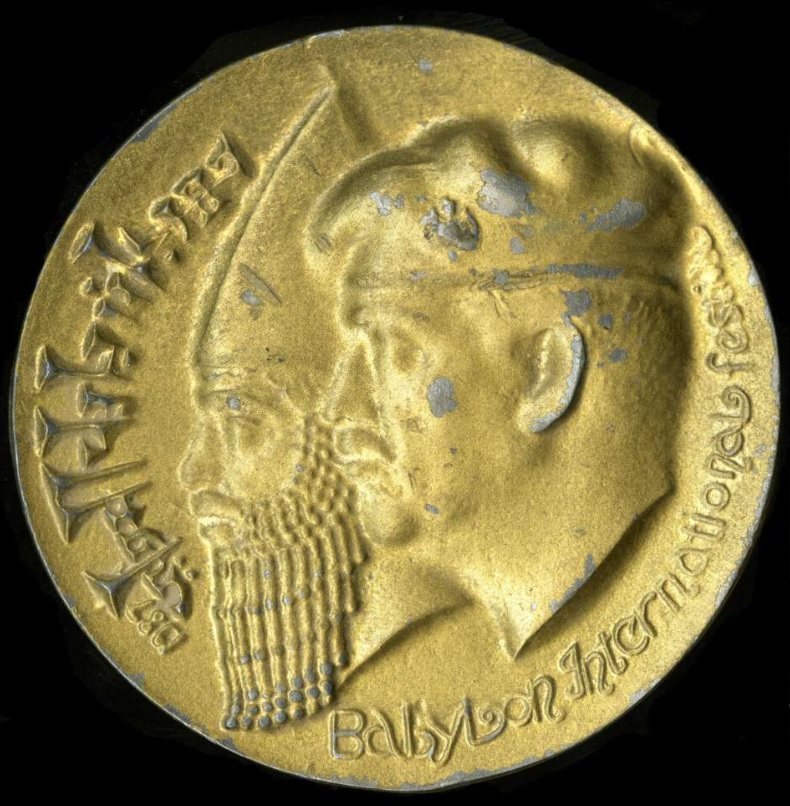
A 1987 gold-plated medal minted by Saddam Hussein, depicting his own face alongside Nebuchadnezzar’s.
The death of Khameini is significant, especially on Shabbat Zachor (when we read about Amalek), and on the cusp of Purim, which commemorates the death of another genocidal Persian figure, the Amalekite Haman. The alliteration of Haman and Khameini is unmissable. Moreover, the Zohar (II, 58b) prophecies that at the End of Days, God will bring back all the old oppressors of Israel and punish them one last time: “The Holy One, blessed be He, shall resurrect those kings that distressed Israel and Jerusalem, such as ‘Adrianus’ [Vespasian] and ‘Lupinus’ [Titus], Nebuchadnezzar and Sancheriv, and all the other kings of the world that took part in the destruction of His House…” In the past, I’ve noted how Saddam Hussein believed himself to be the reincarnation of Nebuchadnezzar. He spoke about it openly, built his palace over the archaeological remains of Nebuchadnezzar’s palace, and minted coins superimposing his face over Nebuchadnezzar’s, among other things. Saddam was president of Iraq, which is modern-day Babylon. It is quite possible that Iran’s Khameini is the modern-day version of ancient Iran’s Haman.
Another well-known prophecy about Persia in the End of Days is in the Talmud (Yoma 10a). Here, the Sages debate whether Rome will ultimately fall to Persia, or will Persia ultimately fall to Rome? Now, it is important to remember that in the time when the Talmud was written, the Roman Empire and the Persian Empire were locked in a centuries-long war. In fact, the Roman-Persian War is one of history’s longest, officially dated from 54 BCE to 628 CE, a whopping 681 years! The peshat here in the Talmud is that the Sages were debating how that Roman-Persian war they were mired in at the time would end. Some thought Rome would win and some thought Persia would win. The debate concludes with Rav Yehuda citing a teaching from Rav (in Sanhedrin 98b) that “The son of David will come only when the wicked kingdom of Rome spreads its dominance throughout the world for nine months.” This implies that Rome would ultimately win over Persia. Right now, we are certainly seeing the modern-day “Roman Empire” displaying its dominance over the whole world, Persia included.
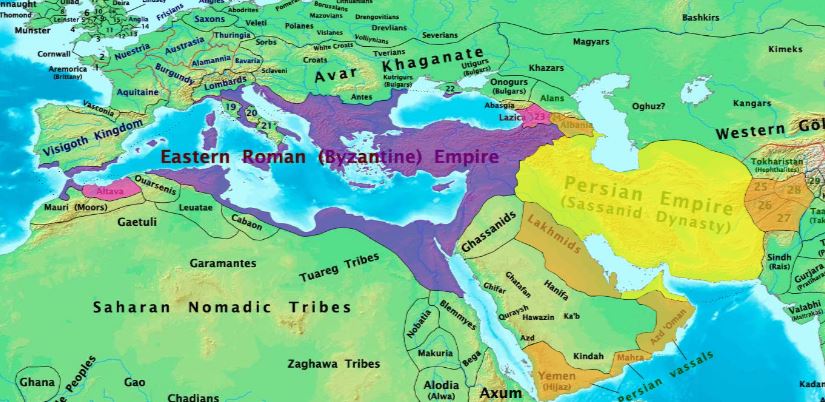
Sasanian and Eastern Roman (Byzantine) Empires in 600 CE, before the rise of Islam
Finally, no discussion of Iran in prophecy would be complete without the well-known Midrash in Yalkut Shimoni II, 499 (worth reading the whole passage!) Amidst a long discussion of the Light of Creation and the Light of Mashiach, we are told that “In the year that King Mashiach will be revealed, all the kings of the nations of the world will taunt each other. The king of Persia will taunt the king of Arabia. And the king of Arabia will go to Aram to get advice from them…” Standard versions of the text today typically say “Aram” (ארם) here, but it is far more likely that original manuscripts said “Edom” (אדם), which makes a lot more sense both then and now. It is interesting to note that Iran responded today by attacking neighbouring Arab countries as well, and one of the first victims (outside Iran) was a citizen in the United Arab Emirates. Also revealed in the news now is that Saudi crown prince Mohammed bin Salman was encouraging Trump to launch the attack on Iran despite presenting himself publicly as being opposed to it.
The prophecy continues to say that in the midst of this war “the king of Persia returns and destroys the entire world…” A desperate Persian regime will, it seems, unleash something terrible upon the world. Not to worry, though, because Hashem says “My children, do not be afraid! All that I have done, I have only done for your sake. Why are you afraid? Do not be afraid, the time of your redemption has arrived!” Shortly after, Mashiach is revealed (referred to here in the Midrash as “Ephraim”) to bring an end to the war and peace and prosperity to Israel: “At that time, the Holy One, blessed be He, will raise up Mashiach to the highest Heavens, and spread upon him some of His glory, before the nations of the world and before the wicked Persians. They tell him: ‘Ephraim, our righteous Mashiach, judge them and do as you wish with them…’”
Here, the Midrash describes that Persian forces are not alone in the area, but that “Not one or two kingdoms come upon him, but one hundred and forty kingdoms surround him.” As I first suggested a couple of years ago in this shiur on Mashiach ben Yosef, this may be referring to the United Nations peacekeeping forces which officially have troops from about 140 nations. In addition, Trump’s “International Stabilization Force” in Gaza (with its headquarters in Kiryat Gat, Israel) will soon bring in troops from all over the world, including 8000 already committed by Indonesia (the world’s largest Muslim country, no less). Just this past week, I spoke to a friend in Indonesia who told me his taxi driver’s soldier son is already on the way to Gaza!
The Midrash does not provide an exact timeline, but does mention one clue: “Our Rabbis taught: The Patriarchs are destined to stand in Nisan and say: ‘Ephraim, our righteous Mashiach, even though we are your forefathers, you are better than us because you suffered the sins of our children and harsh and evil things have befallen you which have not befallen the former ones or the latter ones…’” The Patriarchs are worried that Mashiach will not want to save his people because of all the torment they caused him, but he reassures the Patriarchs that “All that I have done I have only done for you and for your children to enjoy this goodness that the Holy One, blessed be He, has bestowed upon Israel.” The Patriarchs reply: “Ephraim, our righteous Mashiach, rest your mind for you have rested the mind of your Maker and our minds.” Hopefully, the Nisan referenced to here is the forthcoming Nisan next month.
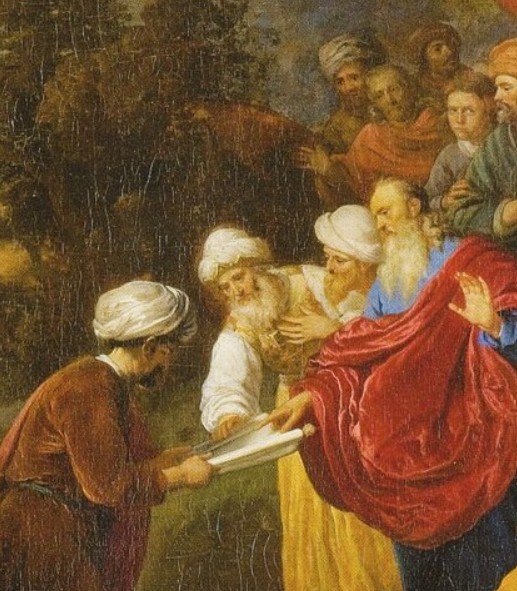
‘Zerubbabel shows Cyrus the Great a plan of the rebuilt Jerusalem’ by Jacob van Loo (1614-1670)
Finally, it is worth remembering that it was the Persian emperor Cyrus who liberated the Jews some 2500 years ago and allowed them to rebuild the Holy Temple in Jerusalem. We read in Isaiah 45:1 that Cyrus is surprisingly referred to as God’s meshicho, “anointed one”. Our Sages (Megillah 12a) discuss this puzzle and conclude that, of course, he was not the Messiah. So what might we learn from it instead? Perhaps it is a prophetic allusion for the present day: that Mashiach has a Persian connection, that we should expect Iran to once again play a big role, and that they will once again pave the way for the rebuilding of the Holy Temple in Jerusalem, speedily and in our days.
Wishing Everyone a Happy & Meaningful Purim!
Purim Learning Resources:
Secrets of Purim (Video)
Who is Ahashverosh?
Queen Esther’s Kabbalah (Video)
The Secret, Secret Story of Stalin’s Purim Death
A Mystical Peek Into Megillat Esther