
What is the true meaning of the name El Shaddai? What did the Ark of the Covenant actually look like? Who is El Elyon? Adam Kadmon? What are the 41- and 72- and 216-Letter Names of God? And what are the secrets hidden in the name Ehyeh Asher Ehyeh (“I Will be What I Will Be”)? Find out in this eye-opening concluding installment of the series. Also: What is the esoteric meaning of Jacob’s sheep? Is the Torah text we have today identical to the Dead Sea Scrolls and other ancient manuscripts? And which name of God is most-associated with the forthcoming Final Redemption?
Tag Archives: Arizal
Physical Blemishes & Spiritual Heights
In this week’s parasha, Emor, we read:
Speak to Aaron and say: No man of your offspring throughout the ages who has a defect shall be qualified to offer the food of his God. No one at all who has a defect shall be qualified: no man who is blind, or lame, or has a limb too short or too long; no man who has a broken leg or a broken arm; or who is a hunchback, or a dwarf, or who has a growth in his eye, or who has a boil-scar, or scurvy, or crushed testes. No man among the offspring of Aaron the priest who has a defect shall be qualified to offer to God by fire; having a defect, he shall not be qualified to offer the food of his God. (Leviticus 21:17-21)
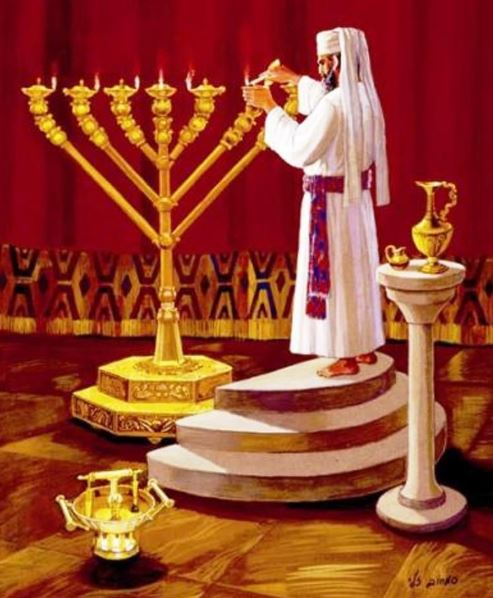
Kohen Lighting Temple Menorah (Courtesy: Temple Institute)
The Torah seems to be saying that any kohen with a physical disability or serious blemish is disqualified from serving God. Some are understandably distraught by this—after all, is it a person’s fault that they were born lame, or with dwarfism, or have a cancerous growth, or suffered a serious injury resulting in a disability? Why should this disqualify a person from serving God? Are they somehow “less” because of a disability? Why the apparent discrimination?
This position appears to be exacerbated by a Talmudic teaching that “the Shekhinah only rests upon a person who is wise, strong, wealthy, and of great statute.” (Shabbat 92a) A similar teaching elsewhere is that “the Holy One, Blessed be He, rests His Shekhinah only upon one who is strong, and wealthy, and wise, and humble.” (Nedarim 38a) So, does that mean that if one is not physically strong or healthy, they cannot merit to have the Shekhinah dwell upon them? How do we make sense of these perplexing statements? Continue reading
Erev Rav (Video)
Who is the Erev Rav, the “Mixed Multitude”, first mentioned in Exodus? How do they return and manifest in every generation? And why are they locked in a cosmic battle with Moses that spans all of human history? Find out in this class as we being to explore the mysterious and dangerous Erev Rav phenomenon, and what we can do to defeat this ideology—which the Zohar says is a necessary precursor to the Final Redemption and the forthcoming Messianic Age.
For a written summary and lots more information, see here.
For the previous class that explored the Erev Rav’s connection to the Tree of Knowledge, see ‘Queen Esther’s Kabbalah’.
For more on the “quantum brain” theory and a scientific explanation for reincarnation, see here.