Tag Archives: Edom

The Year 5778: Apex of the Messianic Era

The stars of this week’s parasha, Vayeshev, are Joseph and Judah. We are told how the sons of Jacob were envious (and suspicious) of Joseph, and ended up throwing him in a pit while deliberating what to do with him. Shimon wished to kill him, Judah to sell him, and Reuben to save him. Meanwhile, Midianite merchants found the helpless Joseph and abducted him, later selling him to Ishmaelites who brought Joseph down to Egypt. There, Joseph enters into servitude in the home of a well-to-do Egyptian family.

The Torah diverges from this narrative to describe what happens to Judah. Judah marries and has three sons. The elder Er marries Tamar and dies because of his sinful ways, as does the second son Onan after fulfilling the law of levirate marriage and marrying his former sister-in-law. After Judah fearfully avoids another levirate marriage for Shelah, his last son, Tamar seduces Judah and becomes pregnant. She gives birth to twins, Peretz and Zerach.

Peretz would go on to be a forefather of King David, and thus a forefather of Mashiach. As is known, there are actually two messianic figures (or two aspects to Mashiach): Mashiach ben David, and Mashiach ben Yosef—one from the line of Judah and one from the line of Joseph. In fact, it is in this week’s parasha where the spiritual origins of the two messiahs begin.

Samson and the Messiahs

Mashiach ben Yosef is the first messiah. He is the warrior that battles evil in the “End of Days”. Unfortunately, he is destined to die in these battles. The Talmud (Sukkah 52a) states how the entire nation will mourn his tragic death. However, it will not be too long before Mashiach ben David arises. As the direct descendant of the royal line, he re-establishes the rightful throne and restores the holy Kingdom of Israel. The Third Temple is built thereafter, and according to some Mashiach ben David reigns for forty years, as did his progenitor King David (Sanhedrin 99a, Midrash Tehillim 15).

We have already discussed why Mashiach ben Yosef must die in the past (see ‘Secrets of the Akedah’ in Garments of Light). How he will die is not exactly clear. What will bring him to his death? It appears that Mashiach ben Yosef will be sold out by his own people. This is what happened to one of the earliest prototypes of Mashiach ben Yosef: the Biblical judge Shimshon (Samson).

As is well known, when Jacob blessed his children, he concluded the blessing to Dan with the words “I hope for Your salvation, Hashem” (Genesis 49:18) which Rashi says refers to Samson, a descendent of Dan. Samson was the potential messiah of his generation. He was a warrior fighting the oppressive Philistines. Yet, the people of Judah did not appreciate the “trouble” he was causing, and apprehended him (Judges 15:11-12):
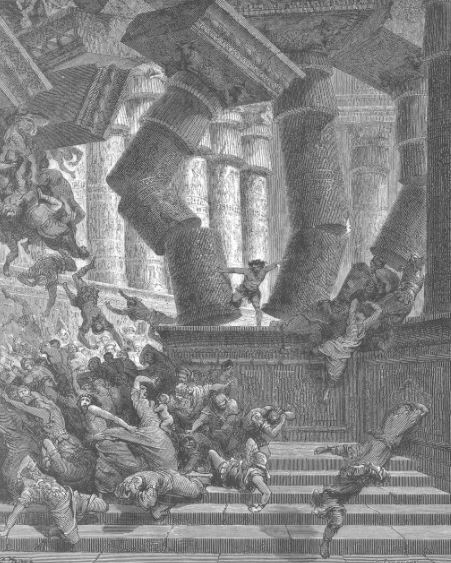
“Death of Samson”, by Gustav Doré

Then three thousand men of Judah went down to the cleft of the rock of Eitam, and said to Samson: “Do you not know that the Philistines are rulers over us? What then is this that you have done to us?” And he said to them: “As they did to me, so have I done to them.” And they said to him: “We have come to bind you, that we may deliver you into the hand of the Philistines.”

Samson turned himself in voluntarily, but with God’s help smote the Philistine oppressors and freed himself. He would be betrayed again by Delilah, but would manage to defeat the Philistines for good, though at the cost of his own life. Like Mashiach ben Yosef, Samson sacrifices himself.

The text above specifically states that three thousand men of Judah came for Samson. What is the significance of this numeric detail?

The Evil 3000

At the Exodus, the Torah states there was a “mixed multitude” (erev rav) of three thousand men among the Israelites. They, too, accepted the Torah at Mt. Sinai, only to instigate the Golden Calf incident forty days later. It is said that the same will happen at the End of Days, with an “erev rav” among the Jews who will instigate all sorts of problems for the nation from within (see, for example, Zohar I, 25 or Sha’ar HaGilgulim, ch. 39). Like Samson’s three thousand men of Judah, Mashiach ben Yosef is sold out by three thousand “Jewish” individuals.

And the fact that they are men of Judah is all the more significant. It was Judah in this week’s parasha who proposed selling Joseph. And to whom did he want to sell him?

And Judah said to his brothers: “What is the gain if we slay our brother and cover up his blood? Come, let us sell him to the Ishmaelites, but our hand shall not be upon him, for he is our brother, our flesh.” (Genesis 37:26-27)

Judah wanted to sell his brother to the Ishmaelites. In speaking of the battles of Mashiach ben Yosef and the End of Days, it is often the Ishmaelites (or the Ishmaelites banded together with Esau) that are implicated (see, for example, Pirkei d’Rabbi Eliezer, ch. 30). Today, of course, the modern “Philistines” are Ishmaelites, and among their biggest supporters are the descendants of Esau.

In The Era of Mashiach

This discussion is particularly timely in light of what’s currently happening in the Middle East. It seems the region is preparing for a massive war, one that would inevitably engulf the entire Ishmaelite sphere, if not the whole world. We’ve written before that we are undoubtedly in the “footsteps of the Messiah” and here is another intriguing point:

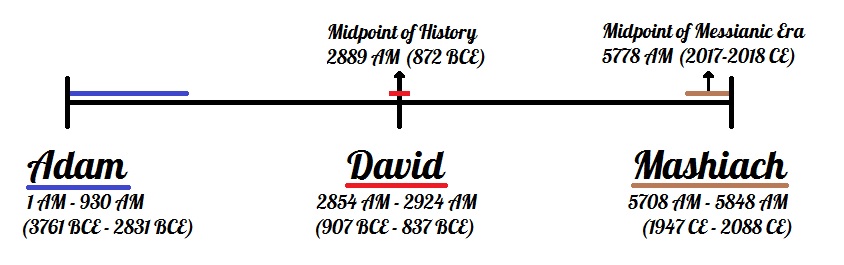
God originally intended for Adam to live 1000 years. Yet, we see in Genesis that Adam lived only 930 years. This is because, as is well known, Adam foresaw that David would be stillborn, and donated 70 years of his life to him. Indeed, David went on to live exactly 70 years. The Arizal saw in the name Adam (אדם) an acronym for three figures: Adam, David, Mashiach. These are the first, middle, and last major figures of human history. Based on this, Rabbi Yitzchak Ginsburgh teaches that David is supposed to be the literal midpoint of history. If that’s the case, then we only need to see when David lived to calculate the era of Mashiach.

The traditional lifetime for David is 2854-2924 AM (Anno Mundi, Hebrew calendar years, corresponding to about 907-837 BCE). To find the time period for the End of Days we must simply multiply David’s years by two. This gives 5708-5848, or 1947/1948-2087/2088 CE. That’s quite amazing, considering that Israel officially became a state in 5708 (the UN vote to create Israel took place in November 1947, and Israel declared independence in May 1948—both dates fall within the Jewish year 5708). And what would be the midpoint, or perhaps the apex, of the “End of Days” period? None other than 5778, the year which we are currently in.

Stay tuned.

The above essay is adapted from Garments of Light, Volume Three.
Get the book here! 

 

Embracing Converts, and the Seeds of Amalek

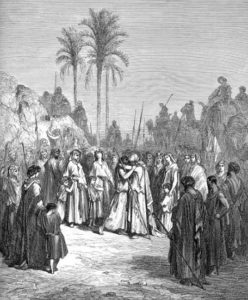
'The Meeting of Jacob and Esau' by Gustav Doré

‘The Meeting of Jacob and Esau’ by Gustav Doré

This week’s parasha is Vayishlach, which recounts Jacob’s return and settlement in the Holy Land after twenty years of living in Charan. At the end of the parasha is a long list of the genealogies of Jacob’s brother, Esau. The list seems unnecessary, and many Sages have wondered why the Torah bothers to spend so much time recounting Esau’s descendants. There have even been debates on whether the entire text of the Torah is equally holy, or if passages like the Ten Commandments are holier than passages such as this list of Esau’s genealogies. Meanwhile, the Arizal states that many of the deepest secrets of Creation are embedded particularly in this seemingly boring and superfluous passage. He draws particular significance from the list of the kings of Edom. The Arizal says these kings are codenames for the Sefirot, and a careful reading of the text reveals the cosmological rectifications (tikkunim) required to repair all of Creation and restore the world to perfection.

About half way through the list we are told that “… the sister of Lotan was Timna” (Genesis 36:22). Again, the Sages are baffled at this extra addition. We already care little enough that there was once an Edomite chief named Lotan – who cares that he had a sister named Timna? The Talmud (Sanhedrin 99b) notes how there were those who scoffed at such verses, saying: “Did Moses have nothing better to write?” And then, the same page of Talmud comes in to explain its tremendous significance:

Timna was a royal princess… Desiring to become a proselyte, she went to Abraham, Isaac and Jacob, but they did not accept her. So she went and became a concubine to Eliphaz the son of Esau, saying, “I’d rather be a servant to this people than a mistress of another nation.” From her, Amalek was descended, who afflicted Israel. Why so? Because they should not have repulsed her!

The Talmud combines the verse in question – which states that Timna was the royal sister of the chief, or prince, Lotan – with an earlier verse (36:12) that says she married Esau’s son Eliphaz and bore Amalek. She wished to convert to Judaism and approached the Patriarchs. All three rebuffed her. So, she ended up with Eliphaz – the closest she could get to being part of the nation. This union gave rise to the evil Amalek, that antagonizing force which has been oppressing Israel for millennia. The Sages state that the Patriarchs should have embraced this potential convert, instead of pushing her away. Their failure to open their arms led to centuries of Jewish suffering. The Talmud sends a pretty clear message: gentiles and converts should not be turned away, and doing so only breeds more resentment against Jews, bringing out all of the world’s “Amaleks”.

Soulmates of Jacob and Moses

The Arizal comments on the Timna passage and points out something even more amazing. He taught (Sha’ar HaMitzvot, Shoftim) that Timna was actually the soulmate of Jacob! Timna contained a great deal of holiness, and Jacob was meant to convert her and marry her, thereby elevating her spiritual sparks. That would have been a massive tikkun of its own, and would have hastened the coming of Mashiach. Instead, Jacob rejected her, and she went on to produce Amalek, bringing evermore evil into the world, and further delaying the coming of Mashiach.

The Arizal highlights that Moses made a similar mistake in not consummating his marriage to the Cushite (Ethiopian) woman. Both Tzipporah and the Cushite woman were Moses’ soulmates, and while Moses did the right thing in converting the Cushite, he never properly married her. Her sparks of holiness were not fully elevated, and the tikkun was left incomplete. This is why Aaron and Miriam were upset with their brother, as we read later in Numbers 12:1, “And Miriam and Aaron spoke against Moses because of the Cushite woman whom he had married…”

Rabbi Akiva’s 24,000 Students in Shechem

In this week’s parasha, too, we read how the people of Shechem genuinely wished to unite with Jacob’s family, agreed to circumcise themselves, and converted en masse. However, Jacob’s sons Shimon and Levi rejected them and resorted to violence in avenging what was done to their sister Dinah. Jacob was horrified at the actions of his sons, and later did not bless the two on his deathbed. It appears their sin was never forgiven, as hundreds of years later the tribes of Shimon and Levi were not given set borders within the Holy Land, but only a handful of cities interspersed among the other tribes. Kabbalistic texts reveal that Shimon and Levi killed 24,000 people in Shechem, and these 24,000 converted souls later reincarnated as the 24,000 students of Rabbi Akiva!

Did You Know These Famous People Converted to Judaism?

All of these narratives point to the same lesson: converts should be welcomed and accepted wholeheartedly. They have the potential for great holiness. The Talmud (Bava Kamma 38a) states that a gentile who occupies himself with Torah is equal to a kohen gadol, a High Priest! The Arizal describes five types of Jewish souls, and the souls of converts are among the purest. (The other types are “Old Souls”, “New Souls”, “True New Souls”, and the “Souls of Cain and Abel”. Of these, the most impure are Old Souls.) It goes without saying that there is no place for racism of any kind within Judaism – Moses himself married a black woman, and was reprimanded for not being diligent in consummating that union.

Historically, Jews were never the proselytizing kind. There are no Jewish missionaries that go out knocking on the doors of gentiles to seek converts. At the same time, Judaism was rarely a popular religion to convert in to. But this will change very soon, and we have to be ready for that day, for the prophet Zechariah (8:23) predicted:

It shall come to pass that ten men shall take hold – from all the languages of the nations – shall take hold of the corners of a Jew’s clothes, saying: “We will go with you, for we have heard that God is with you…”


The above essay is an excerpt from Garments of Light, Volume One. Get the book here!

Did Bilaam Prophesize 9/11?

Parashat Balak describes how the Moabite king Balak hired the (non-Jewish) prophet Bilaam to curse the Israelites. Balak saw what the Israelites had done to neighbouring kingdoms, and feared that he would lose his own as well. He therefore sought to reverse their fortunes through a curse. The Sages state that Bilaam could sense the precise moment when – just once a day, for precisely 1/58,888th of an hour (or about 61 milliseconds) – God was in his “strictest” mode, and Bilaam could take advantage of this moment to kindle God’s wrath against His chosen people (Berakhot 7a).

The plan ultimately failed, of course, and instead of cursing the Israelites, Bilaam’s mouth uttered blessings and praises. Perhaps most interesting, Bilaam also spoke a series of prophecies about the End of Days. They begin like this:

I see it, but not now; I behold it, but it is not soon. A star has gone forth from Jacob, and a scepter will arise from Israel which will smite the Moabite princes and uproot the sons of Seth. Edom shall be inherited, and Seir will become the inheritance of its enemies, and Israel shall do valiantly. And out of Jacob shall one have dominion, and will destroy the remnant of the city… (Numbers 24:17-19)

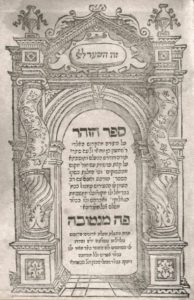
1558 Mantua Publication of the Zohar

1558 Mantua Publication of the Zohar

Bilaam describes a time in the very distant future, and the Sages agree that the “star of Jacob” refers to Mashiach. The Zohar (III, 212b) further elaborates on Bilaam’s prophecies, and describes what precisely is supposed to happen, and when that star of Jacob will be seen. Within this lengthy passage are a few verses that describe a scene quite familiar to the modern reader, and have therefore been used to suggest that the Zohar predicted the events of September 11, 2001:

… And [the star] will be seen on the sixth day, on the 25th day of the sixth month. It will be gathered on the seventh day, at the end of seventy days. On the first day it will be seen in a city of Rome. On that same day, three high structures of that city of Rome will fall and a great edifice will fall…

In traditional Jewish texts, Rome is typically referred to as Edom, and represents the entire Western (or European/Christian) world. The “city of Rome” represents whatever place is the centre of the Western world at a particular period of time. After the city of Rome itself had fallen in 476 CE, the “new Rome” was Constantinople. When this new Rome collapsed as well (and became present-day Istanbul), a “Third Rome” was said to arise. In the past, we have written about the identity of the Third Rome. Most scholars – at least in Jewish circles – agree on two possibilities: the Third Rome is either Moscow (as we have written about before), or New York.*

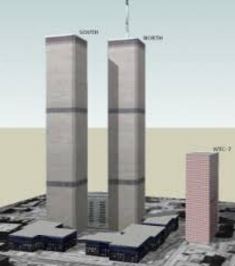
World Trade Centers: North, South, and 7

World Trade Centers North, South, and 7

If it is indeed New York, then the Zoharic passage above makes a lot of sense. A great edifice of three high structures will fall? Yes, on September 11, three of the iconic World Trade Center buildings collapsed (WTC1, WTC2, and WTC7). And the dates match quite closely, too. The Zohar says the 25th of the sixth month, ie. the 25th of the month of Elul. September 11, 2001 happened to be the 23rd of Elul!

Shortly after the 9/11 attacks, a number of articles circulated online (for example, here) suggesting that the Zohar predicted this tragedy, and added an additional detail of great interest: These articles claimed that Rabbi Eliyahu Kramer, better known as the Vilna Gaon – who lived in the 18th century – corrected the Zohar and wrote that the event will, in fact, take place on the 23rd of Elul. These articles claim that the Vilna Gaon’s correction is recorded in a mystical text called Sifra DiTzniuta.

Are these claims true, and did the Zohar really predict the September 11 attacks?

What Do The Prophecies Actually Say?

First of all, Sifra DiTzniuta was written and published long before the Vilna Gaon’s time, so suggesting that his correction of the Zohar was recorded there is already unlikely. The Vilna Gaon did write a commentary to the Sifra DiTzniuta. Having searched through both Sifra DiTzniuta and the Vilna Gaon’s commentary on it, I was unable to find any reference to the 23rd of Elul, or any correction of the Zohar’s prophecy. This doesn’t necessarily mean the claim is false, but it definitely looks like the source is incorrect.

Either way, we have to go back to the Zohar and read the entire passage, not only those few verses describing the fall of the buildings. It reads like this:

It is taught that in the future, the Holy One, blessed be He, will rebuild Jerusalem and reveal one firm star, glowing with seventy pillars of fire, and with seventy sparks flashing from it in the middle of the Firmament, and they will be reigned over by seventy other stars, and they will glow and burn for seventy days.

And [the star] will be seen on the sixth day, on the 25th day of the sixth month. It will be gathered on the seventh day, at the end of seventy days. On the first day it will be seen in a city of Rome. On that same day, three high structures of that city of Rome will fall and a great edifice will fall. The ruler of that city will die. Then the star will spread out to be seen in the rest of the world. In that time, great wars will stir all around the four corners of the world and no faith will be found among [its people].

In the middle of the world, when that star will shine in the middle of the Firmament, a great king will arise and rule the world, and his spirit will gain pride over all the kings, and he will awaken a war between both sides, and he will become strong against them.

On the day that the star will be hidden, the Holy Land will tremble forty-five miles around the place of the Holy Temple, revealing an underground cave. From this cave will come out a blazing fire to burn the world. And from this cave a great branch will grow out, and it will rule over the whole world, and to it will be given the kingdom. The Holy Beings will gather to it. Then Mashiach will be revealed to the entire world…

Clearly, there is a lot more going on! While Jerusalem has been rebuilt, we have yet to see the emergence of a star glowing with seventy pillars of fire, with seventy other stars glowing for seventy days. (These may be metaphors, of course, and may not be literally referring to celestial objects.) The Zohar says the edifice would fall at the end of seventy days (or at the beginning, depending on how one reads the passage). There was nothing particularly salient about the period of seventy days before or after 9/11. Moreover, “the ruler of that city” did not die on that day. The events of 9/11 did instigate “great wars” and it is true that we live in an increasingly faithless world. Ultimately, a “great king” to rule the entire world has not arisen (as far as we can tell), nor did the Holy Land tremble to reveal a cave from which Mashiach sprang forth.

Therefore, to suggest that this Zohar is speaking of the 9/11 attacks is perhaps a bit premature. While there are several parallels, the entire sequence of events has not occurred in the years since September 11, 2001. It appears that we have yet to witness the true fulfilment of Bilaam’s and the Zohar’s prophecies.

*While New York is the largest city in the United States, and by far its most important and famous, another candidate for the “Third Rome” is Washington, D.C. Washington has the plus of being a capitol city, the seat of “the ruler” as the Zohar says. It, too, was attacked on 9/11, and its major edifice – the Pentagon (the world’s largest office building) – damaged. Interestingly, long before Washington became America’s capital city, it was settled by a man who named it Rome!


The article above is adapted from Garments of Light – 70 Illuminating Essays on the Weekly Torah Portion and Holidays. Click here to get the book!