Tag Archives: Gematria

The Mystical Significance of Bones

In this week’s parashah, Beshalach, the Israelites finally leave Egypt. We read how Moses made sure to take with him ‘atzamot Yosef, the “bones of Joseph” (Exodus 13:19). It is interesting that a bone is called an ‘etzem (עצם), which literally means an “essence”. As an adjective, ‘atzum (עצום) means “strong”, as well as “shut” or “closed up”. This is fitting since bones are the strongest components of the body, and “closed up” within muscles and other tissues. (For those who like numbers, the gematria of עצום is 206, which is the total number of bones in the human body!) There is something especially significant about bones. God made Eve from Adam’s bone, and Adam later declared that Eve is “bone of my bone” (‘etzem mi’atzamai), implying that her essence is like his essence, and now he would finally be happy and no longer feel alone. What is so special about bones that they hold the very essence of a person?

One of the amazing wonders of biology is that each and every cell of our bodies contains our entire genome (except, of course, the reproductive cells). So, the DNA inside the nucleus of eye cells contains the genes that also program toenails, and the toes have the DNA of the retinal proteins in our eyes! It remains one of the great mysteries of biology how cells are able to control exactly which genes are turned “on” or “off” in every cell, and how they make sure that eyes don’t have nails, and nails don’t grow eyes. In our adult bodies, most cells have already been differentiated into something specific (like eyes or toes), but there is one place where cells remain undifferentiated, and could become anything. These are called stem cells, and they exist mainly within our bones. Here in the bone marrow, we do indeed find our ‘etzem, the core essence of who we are, still undifferentiated and full of potential to become anything.

This explains why God made Eve from Adam’s bone specifically, as if He took some of Adam’s undifferentiated stem cells to create Eve! This is precisely how a modern-day scientist experimenting with genetic engineering or organ printing would do it. Better yet, when scientists and surgeons need to extract bone marrow for stem cell transplants today, the rib bone is actually a great place to get them, since they are near the surface and easily accessible, with little meat around them. (I know that some people will quote a different opinion from our Sages, as in Berakhot 61a, that Eve was “split” from a two-faced Adam, or that she was made from his “tail”, but the rib opinion makes a great deal of sense from a scientific perspective.) In any case, when we remember that our bones contain our undifferentiated cells and our untampered DNA, we appreciate the beauty of divine Hebrew in calling a bone an “essence”.
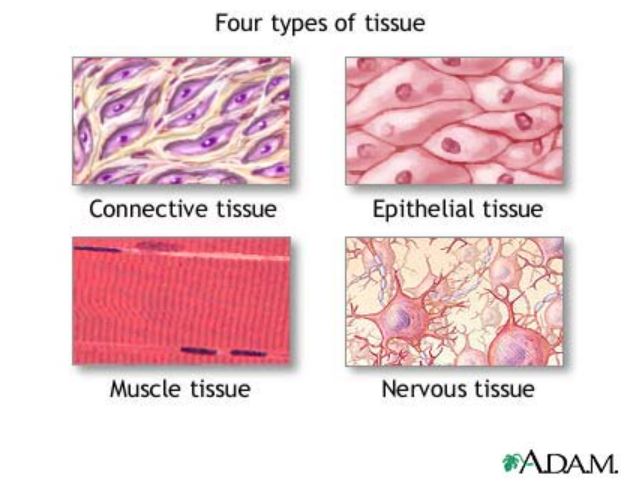
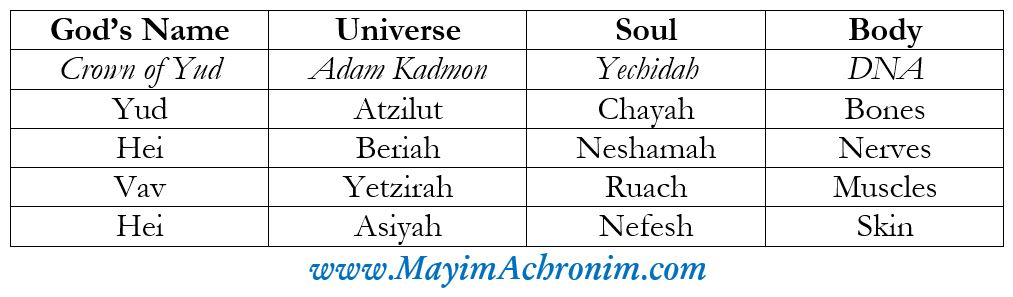
Scientifically speaking, the human body has four main types of tissues: bones are a type of connective tissue, and then there is muscle tissue, nervous tissue, and epithelial tissue. The Torah, too, speaks of four types of tissues: bones, plus bassar (meat), gidim (nerves), and ‘or (skin), neatly paralleling the four biological categories. We know that all fours in the Torah—such as the four mystical universes, the four Pardes aspects of Torah study, and the four letters of God’s Ineffable Name—match up and correspond to each other. We can link these up yet again with the four tissue types, to see once more the divine anatomy with which we were created:

Skin represents the surface level of Torah study, pshat (פשט), corresponding to the lowest realm, the physical and superficial Asiyah (as well as the lowest level of soul, the nefesh). Interestingly, the word in Hebrew to undress, ie. to remove one’s surface garments and reveal the skin, is lehitpashet (להתפשט)!

Beneath the skin is muscle, the bulkiest and heaviest part of the body, representing the sub-surface level of Torah study, remez, and the angelic realm of Yetzirah, as well as the next level of soul, ruach. The ruach is typically associated with the heart, also a muscle. With this we can understand why bassar (בשר), “flesh” or “meat”, shares a root with revealing news, levasser (לבשר)—for what is levasser but to reveal something currently hidden and as yet unknown? Levasser is to give more information beyond the obvious surface pshat that is already known! Moreover, we can now better understand why the Torah specifically uses the term yetzirah to describe the creation of Adam’s body (Genesis 2:7), and the command later for him to specifically become one bassar with his wife (2:24).

Going onwards, the muscles are innervated and controlled by nerves, paralleling drash, the metaphorical and allegorical level of Torah study, and the higher realm of Beriah, along with the neshamah level of soul. The neshamah is seated in the brain, the largest bundle of nerves in our body.

Finally, the inner-most part of the body is the bone, representing sod, the deepest part of Torah and its very essence. This is the level of soul called chayah, fitting because our Sages taught that Eve (made from Adam’s bone) was originally called Chayah, and only after the consumption of the Fruit did she become Chavah (see Kli Yakar on Genesis 3:20). The bone-sod level corresponds to the highest realm of God’s pure emanation, Atzilut. (The pure white colour of bone symbolically adds to this, along with the alliteration between Atzilut and ‘atzamot!) Atzilut is the place of pure, unadulterated light. Light is אור, with a value of 206, again like the total number of bones in the human body. We see a beautiful phonetic relationship between the surface level of skin, ‘or, spelled עור, and the deepest-most level of bone, corresponding to secret light, or, אור. (A word for an even more profound secret is raz, רז, with a value of 207, going one step further.) Without bones, the body would fall apart into a shapeless mass, just as would Torah without sod. (The Chida, Rabbi Chaim Yosef David Azulai [1724-1806] pointed out that if you take the sod out of Pardes [פרדס], you are left with pered [פרד], a mule!)

And what of the hidden-most “fifth” part—the “crown” atop the Yud of God’s Name and the yechidah soul, paralleling the most mysterious and mystical Adam Kadmon? Perhaps it’s the DNA itself, the very code that gives rise to all four tissue types of our bodies.

To summarize:
A final thought: Damage to the skin often heals back to the way it was before. Muscle and nerve damage is much harder to reverse, and sometimes irreparable. Bones, however, tend to heal back even stronger than they were. There is a wonderful lesson here for each of us, both individually and collectively as a nation: If something hurts us deeply and damages our very essence, we should bounce right back and recover, growing even stronger than we were before, so that our inner essence shines brighter than ever.

Shavua Tov and Happy Tu b’Shevat!


For more on ‘The Divine Anatomy of the Human Body’, see here.
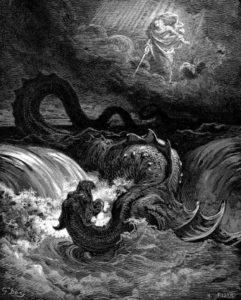
Leviathan & the Seven Serpents

‘Destruction of Leviathan’ by Gustav Doré

In this week’s parasha, Va’era, we read about Moses’ first confrontation with Pharaoh and the famous battle of their serpentine staffs. Interestingly, in last week’s parasha when Moses’ staff first turned into a serpent (Exodus 4:3), the word used was nachash, while this time it says tanin (7:9-10)! The former term certainly means a “snake”, but the latter is more general and can be any serpent, reptile, or even crocodile. Mystical texts see this as an allusion to the greatest of the taninim, created by God on the Fifth Day of Creation, the great sea dragon called Leviathan. The Zohar (II, 27b) comments here that the Leviathan was red like a rose, with iron-like scales, wing-like fins, a powerfully-thrashing tail, and fire coming out of its mouth. It has long migrations in the deep seas lasting seventy years.

Commenting on the words hataninim hagedolim, “the great sea monsters”, in Genesis 1:21, Rashi says that God originally created a pair of Leviathans, but they were so terrible that He slew the female so that the couple wouldn’t reproduce. God then “salted” its flesh and preserved it for the righteous in the World to Come, who are said to enjoy it at the “Feast of Leviathan” in the End of Days. Rashi is quoting the Talmud here (Bava Batra 74b-75a), which adds that God will make a sukkah for the tzadikim from the skin of the Leviathan. The leftover skin will be draped over “the walls of Jerusalem” and will shine and glow to wow the entire world. Perhaps that means the Kotel will have a miraculous new look in the near future, which is quite fitting since it will no longer be a “wailing” wall.

We read here in the Talmud that God castrated the male Leviathan, too, and provides a Scriptural source for it all in Isaiah 27:1, that “He will slay the Serpent that is in the sea…” The Sages ask: why did God slay the female and not the male? One answer is that the female could have still laid eggs without the male. Indeed, we know scientifically that there is a phenomenon called parthenogenesis where female fish are able to reproduce even without fertilization by a male. The Talmud then gives another answer based on Psalms 104:26, which says “There is Leviathan, whom You have formed to sport with.” God created the Leviathan just to “sport with”, and it wouldn’t be appropriate to sport with a female Leviathan, so he left the male only. (It seems gender segregation in sports is not a new issue!)

There is a way to interpret all of this metaphorically, too, and the Talmud goes on to say that the Jordan River flows into the “mouth of Leviathan”, while the ancient Seder Rabbah d’Beresheet says the entire planet “rests” on one of the fins of Leviathan. Even the Zohar has an interesting interpretation of the taninim gedolim of Creation, saying they are actually referring to the “Seventy Princes”, the Heavenly angels overseeing the seventy nations of the world. Leviathan is chief among them. From other sources, we learn that the chief of all the Seventy Princes is the angel Metatron (ie. Enoch), so we find here a link between the great Metatron and Leviathan. (This is further appropriate because the earliest known reference to a “Feast of Leviathan” is actually the apocryphal Book of Enoch!)

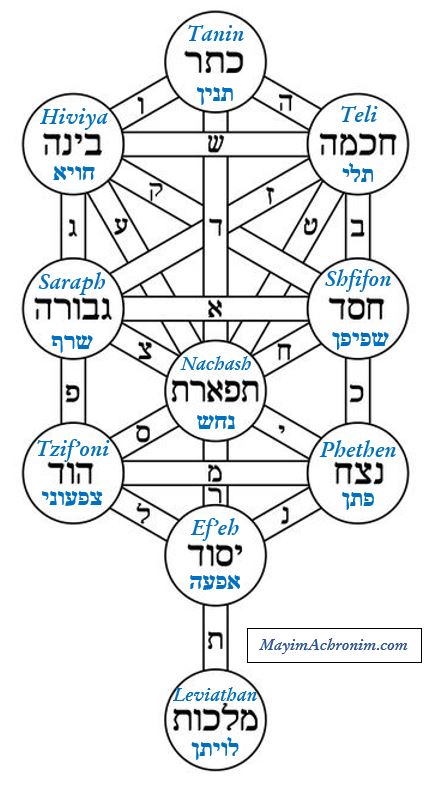
Mystical texts say the spirit of Metatron is found within Mashiach (see, for instance, Kol haTor), and Mashiach is destined to slay the remaining Leviathan at the End of Days, ushering in the final Kingdom of God on Earth. This, too, might be a metaphor for Mashiach subduing all seventy nations and unifying them under one God, as we read in Zechariah 14:9 that “Hashem shall be king over the entire Earth; on that day Hashem will be one and His name will be one.” In fact, the numerical value of “Leviathan” (לויתן) is 496, equal to Malkhut (מלכות), “Kingdom”. Leviathan thus corresponds to the last of the Sefirot. (We explored in the past how the changing astronomical constellations in the sky above us are shifting now to reveal this very process.) Intriguingly, we find six other terms for serpents throughout the Tanakh, and they neatly parallel the six other “lower” Sefirot from Chessed to Yesod.

The Seven (Eight?) Serpents

The most common term for a serpent is, of course, nachash. This snake corresponds to the central Sefirah of Tiferet. Tiferet is the spiritual root of all Israel, and of Mashiach in particular. This is another reason why the values of nachash (נחש) and “Mashiach” (משיח) are equal, both being 358. When Jacob blessed his son Dan, he saw a vision of Mashiach and said “I await Your salvation, Hashem!” (Genesis 49:18) Before that, Jacob fittingly described Mashiach (while seemingly speaking of Dan) as a nachash ‘alei derekh, a “snake upon the road”.

He then used another serpentine term, saying that Mashiach should also be a shfifon ‘alei orach, typically translated as a “viper upon the path”. The Maharal (Rabbi Yehuda Loew of Prague, c. 1512-1609) in Gur Aryeh connects this mysterious term with several roots, including the humbling shofef, as well as neshef, meaning an “exhale” or a “relaxation” or even a happy gathering of some sort. The shfifon (שפיפן) has positive energy, and corresponds to the loving Sefirah of Chessed. Jacob was possibly alluding to Mashiach’s role to bring all of Israel together and reconnect them spiritually through various “paths”.

On the opposite side of the Sefirotic tree we have the fiery and judging Gevurah. This corresponds to the Torah’s saraph (שרף), a “burning” venomous snake that God used to punish the people in the Wilderness for their rebelliousness (Numbers 21). To heal the people, Moses then made a nachash nechoshet, a copper serpentine rod. Now we can understand why it had to be specifically a nachash because, as we saw above, that one corresponds to Tiferet, which is said to be the source of healing and shares a root with refuah!  Mashiach, too, is said to carry a serpentine staff. In fact, the Midrash and Zohar state that a woman called “Heftzibah” will bring it to him, finding it somewhere in Tiberias where Eliyahu hid it. She is also known as Mevaseret Tzion, the “Herald of Zion”, as per Isaiah 40:9 (see Sefer Zerubbabel and Zohar III, 173b).

Next, we have the “twin” Sefirot of Netzach and Hod, corresponding to the legs. They are always referred to as being the source of prophecy. In Psalm 91 we read “You will tread on lion cubs and phethen…” The phethen (פתן) is none other than the python. It is worth noting that in ancient Greece, the python was associated with prophecy, and their prophetic Oracle at Delphi was called Pythia. In the famous messianic prophecy of Isaiah, we read of another serpent paralleling the python: “A babe shall play over the hole of a phethen, and an infant pass its hand over the den of a tzif’oni.” (11:8) The word used for a “den” here is me’urat, which can be read as m’orat, ie. “from the light [or fire] of the tzif’oni”. The Malbim (Rabbi Meir Leibush Wisser, 1809-1879) reads it this way, saying the “fiery” poison of the tzif’oni (צפעוני) will no longer harm a child in the Messianic Age. This gives us a clue that the tzif’oni corresponds to Hod, lying beneath the fiery Sefirah of Gevurah, and tempering its judgement. More significantly, we can learn from this Isaiah verse that in the Messianic Age, even a child will be able to connect to Netzach and Hod and attain the light of prophecy.

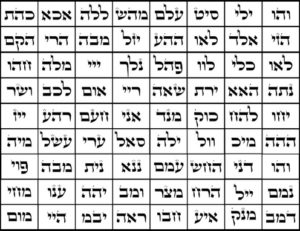
The 72 Names of God (For the origin of these Names, see here.)

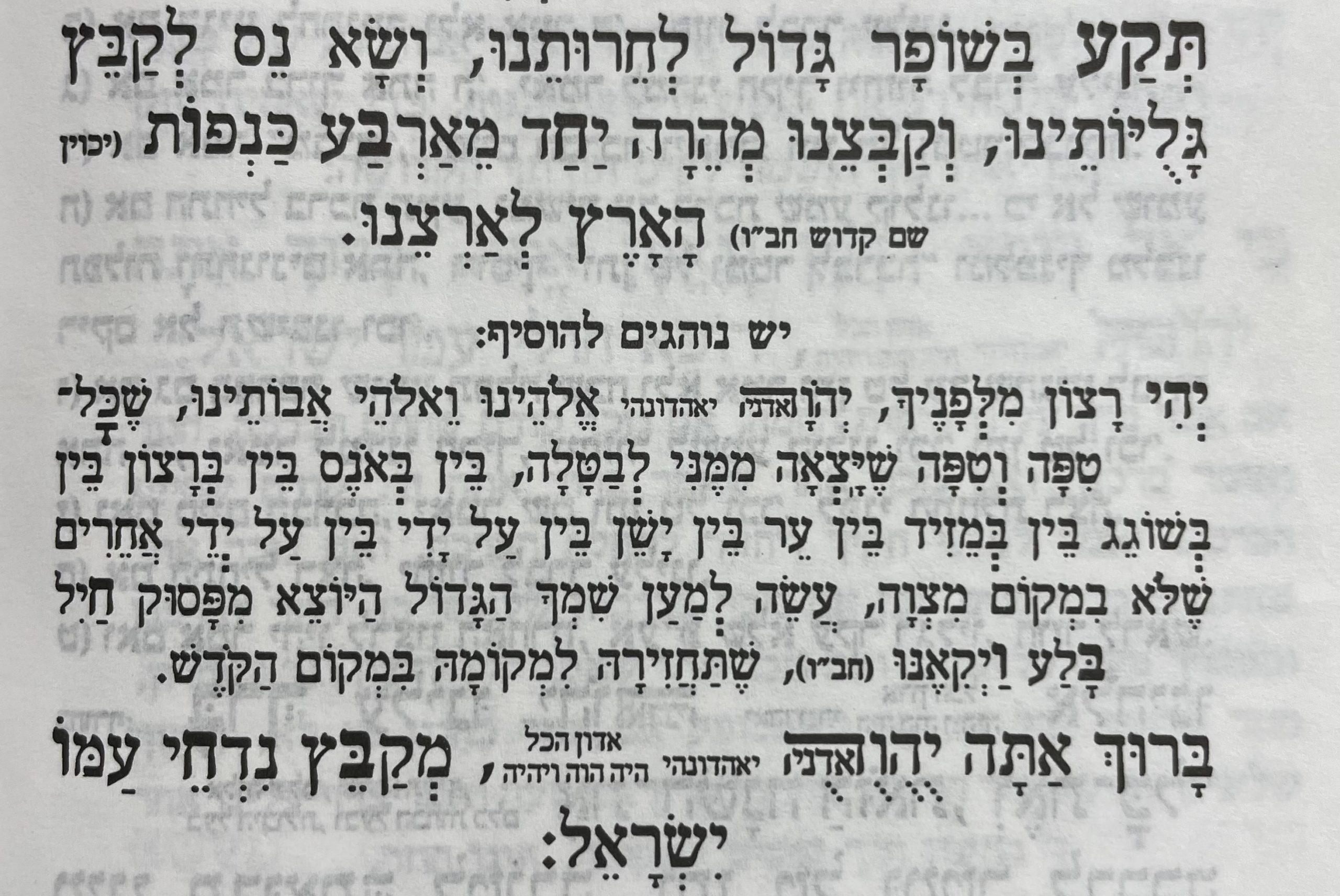
Finally, the last word for a serpent in Tanakh is ef’eh (אפעה), as we read in the Book of Job that “He sucks the head of a viper; the tongue of the ef’eh kills him.” (20:16) This one parallels the Sefirah of Yesod, the domain of sexual purity. In fact, the Kabbalists teach that of the 72 Names of God, the one that links to Yesod and through which one can atone for sexual sins is חב״ו. In the Amidah, there is a kavanah to insert during the kibbutz galuyot blessing to purify one of wasted seed and other sexual issues and it quotes a well-known phrase chayil bala’a vayakienu, mibitno yorishenu El, “The riches that he swallowed he vomits; God empties it out of his innards.” The letters of the first three words (חַיִל בָּלַע וַיְקִאֶנּוּ מִבִּטְנוֹ יֹרִשֶׁנּוּ אֵל) spell חב״ו. And where does this powerful verse come from? The preceding one in Job! (20:15) Thus, we have a clear Scriptural link between the ef’eh and Yesod.

Text of the blessing, with kavanah, both highlighting the חב״ו name.

And what of the Mochin, the upper three Sefirot? Perhaps we can link them to serpentine terms outside of Scripture. For instance, there’s the Teli (תלי) of Sefer Yetzirah (6:1-2), typically understood as the dragon constellation Draco. Recall that Sefer Yetzirah is an exposition of the Lamed-Bet Netivot Chokhmah, 32 Paths of Wisdom, so the Teli is directly linked to the Sefirah of Chokhmah. Then there’s the Talmud’s Aramaic hiviya (חויא), the root of which is said to come from Eve (חוה), and her encounter with the Snake. This would parallel the “motherly” Sefirah of Binah (also called Ima). And Keter on top, the origin of all the others, would be the generic term Tanin (תנין) with which we started, referring to any of the serpents below and often used interchangeably with them, as in this week’s parasha. Altogether, we have the following array of links between mystical Sefirot and mystical serpents:

Understanding Chabad and 770

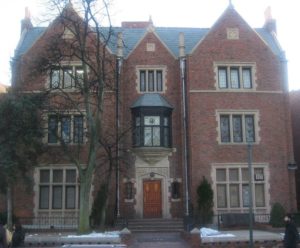
770 Eastern Parkway, global headquarters of Chabad

At the start of this week’s parasha, Vayetze, Jacob sees a vision of a Heavenly Ladder and receives a blessing from God. He is told: “you shall break out [u’faratzta] westward and eastward and northward and southward; and through you shall be blessed all the families of the Earth and through your seed.” (Genesis 28:14) The term u’faratzta, translated as “break out” or “gain strength” or “spread out”, is something of a slogan and rallying cry among Chabad Hasidim, who’ve made it their mission to bring Judaism to every corner of the globe, “westward, eastward, northward, southward”. It has further significance for Chabad because the verb faratzta (פרצת) has a numerical value of 770, as if alluding to Chabad headquarters at 770 Eastern Parkway in Brooklyn. It was the seventh and last Lubavitcher Rebbe, Rabbi Menachem Mendel Schneerson (1902-1994), who transformed Chabad from a small Hasidic group into an international phenomenon. What was his vision? Why did he want to put a “Chabad House” within reach of every Jew around the globe? And what does it really have to do with bringing Mashiach and the Final Redemption?

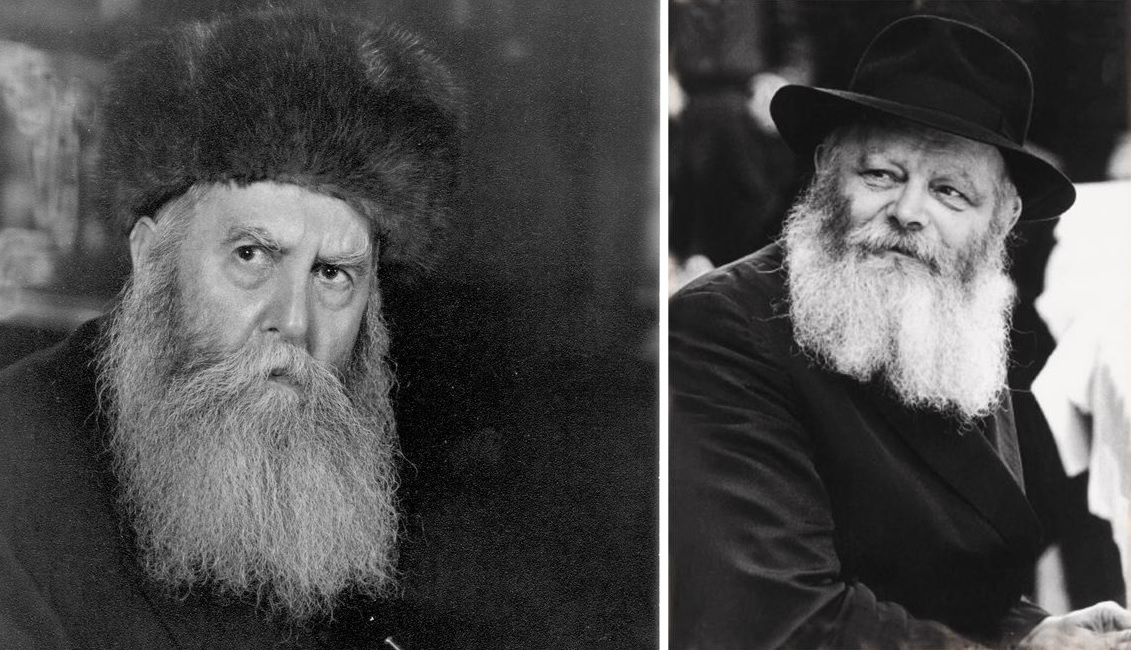
The sixth and seventh Lubavitcher Rebbes.

In 1940, the previous Lubavitcher Rebbe, Rabbi Yosef Yitzchak Schneersohn (1880-1950) arrived in New York City, having fled Warsaw following the Nazi invasion. As the Rebbe was in a wheelchair, he needed an accessible home. A former medical office at 770 Eastern Parkway was the perfect choice, and was purchased for him to live in and to serve as the Chabad main office. His son-in-law (who would become the next Rebbe in 1951) arrived the following year, was put in charge of Chabad’s educational arm, Merkos L’Inyonei Chinuch, and got some office space on the first floor, too. He would take over the movement in those critical years following the Holocaust and the founding of the State of Israel. While his predecessors were officially “anti-Zionist”, the new Lubavitcher Rebbe took a different approach, engaging closely with the State and advising its leaders regularly. While he never visited Israel, he actually never left New York at all from the time he became Rebbe. The groundbreaking events that took place in the years before he took on Chabad leadership had an indelible impact on his vision and philosophy. He was convinced that the time for Redemption had arrived, and he made it clear in his very first discourse, Basi l’Gani.

The Rebbe explained that the seventh generation of Chabad had begun, as he was the seventh rebbe since the Alter Rebbe, Rabbi Schneur Zalman of Liadi (1745-1812), the founder of Chabad. This was comparable to Moses, the seventh generation from Abraham. It was that seventh generation of Moses, the “First Redeemer”, that merited the divine revelation at Mount Sinai. So, too, the Rebbe said, this seventh generation of Chabad would live to see the final divine revelation with Mashiach, the “Final Redeemer”. In his first discourse, the Rebbe made clear that “The spiritual task of the seventh generation is to draw down the Shekhinah truly below…” The Divine Presence must be made manifest in this material world. How is this to be done? The Rebbe said we must remember that “the quality of the seventh of a series is merely that he is seventh to the first” so we must look to the initial mission of the first generation, and finish the job now in the seventh. We must be like the first generation, “like Abraham: arriving in places where nothing was known of Godliness, nothing was known of Judaism, nothing was even known of the alef beit, and while there setting oneself completely aside [to call in God’s Name, as Abraham did].” Torah, mitzvot, and knowledge of God has to be spread as far and wide as possible, u’faratzta!

The Rebbe saw the events of the previous years as being a fulfilment of ancient prophecies about the End of Days, and thus the time was ripe for Redemption. He concluded his discourse like this: “Since we have already experienced all these things, everything now depends only on us—the seventh generation.” Henceforth, his entire mission was centered around bringing that Redemption. A decade later, however, no Redemption had arrived. The Rebbe understood that we must not be doing enough, and need to double down our efforts. In a discourse on Lag b’Omer 1962, the Rebbe explained that we all must be like Rabbi Shimon bar Yochai (“Rashbi”, whose mystical teachings we celebrate on Lag b’Omer):

[Rabbi Shimon] did not wait until he saw a problem, and then set out to correct it. Instead, he sought out problems to correct, asking others: “Is there anything that I could rectify?” And when he was told that there was a place which priests avoided because of a question of ritual impurity, he set out to correct the difficulty. Although the question involved impurity contracted from a human corpse—the most serious form of ritual impurity—Rabbi Shimon was able to make the place suitable even for priests. (Likkutei Sichos, Vol. VIII, pg. 131)

The Rebbe explained that Rashbi was not afraid to go to places of great impurity in order to affect spiritual rectifications. Moreover, the Rebbe continued:

Our Sages also quote Rabbi Shimon as saying: “I can acquit every Jew from the attribute of judgement.” Although there are people who have committed undesirable acts, Rabbi Shimon was able to find grounds for their defense… Rabbi Shimon was willing and able to descend to such a low level because he was among “the superior men who are few in number.”

In other words, Rashbi was one of the first “kiruv rabbis” who went out of his way to reach out to wayward and unobservant Jews. He would see every Jew in a positive light, and find a redeeming quality within them. He would find sinners and help them get back on the right path. He could descend even to the lowest places on Earth without fear of being sullied by the impure surroundings. This has become a fundamental of Chabad philosophy, with Chabad emissaries showing unparalleled ahavat Israel and being widely beloved for their non-judgemental attitude and open arms, along with a willingness to connect with all kinds of Jews on every street corner. Finally, the Rebbe concluded:

… the stories about Rabbi Shimon’s conduct serve as a directive for every Jew in later generations. This has been particularly true ever since the teachings of Pnimiyus haTorah [inner mystical dimensions of Torah], the wisdom of Rabbi Shimon, were revealed. Following Rabbi Shimon’s example, it is necessary for us to “spread the wellsprings outward” to join the two ends of the spiritual spectrum… and spread the “water” to the most extreme peripheries. This will prepare the world for the coming of Mashiach, who will likewise join two extremes… the Redemption will come when the outlook of Rabbi Shimon—who stood above the destruction of the Beit HaMikdash—is spread throughout the world. Rabbi Shimon’s teachings must be spread everywhere, even in places which need correction, even in places which are ritually impure…

The Rebbe here was alluding to a well-known story about the Baal Shem Tov, Rabbi Israel ben Eliezer (1698-1760, founder of Hasidism), who described in a letter how he ascended to Heaven and met Mashiach. When the Baal Shem Tov asked Mashiach when he would come, Mashiach replied that he would come when the Baal Shem Tov’s “wellsprings”, his mystical teachings, would spread worldwide. In this discourse, the Rebbe took things a step further in saying that the wellsprings must spread not only to established Jewish communities around the world or to other receptive audiences, but everywhere, “to the most extreme peripheries”, to the most impure of places.

While the Rebbe had sent emissaries (“shluchim”) to various communities from the very start of his tenure, now he was going to send them even to places of impurity, immorality, and secularism. In 1965, he sent Rabbi Shlomo Cunin to Los Angeles to work specifically with university students, plunging him into the heart of the liberal world at the height of the hippie movement. Four years later, Rabbi Cunin established the first official “Chabad House” at UCLA. In 1972, on his 70th birthday, the Rebbe famously requested a gift from his Hasidim: to open up another 71 Chabad Houses before his 71st birthday! That same year, Rabbi Cunin expanded to UC Berkeley and UC San Diego. The model was quickly replicated around the world, and the rest is history. Today, there are over 5000 Chabad Houses and Chabad institutions in over 100 countries.

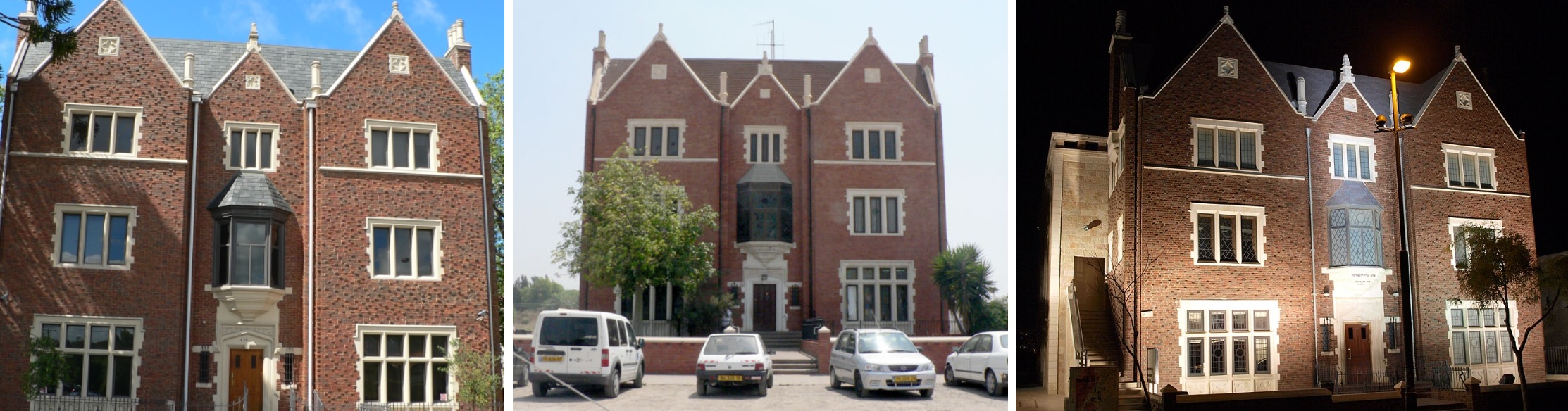
While each Chabad institution is really stand-alone and is expected to raise its own funds and manage its own activities, the overall movement is still centrally-run and guided from 770 Eastern Parkway. The headquarters has become something of a shrine and temple of its own. Replicas of the building have been built in other parts of the world, including Jerusalem and Australia. Of course, many within Chabad believe the Rebbe to have been Mashiach (a question we addressed before here), and find proof within the fact that 770 is the value of “Mashiach’s House” (בית משיח), and more support in that the house is in Brooklyn’s Crown Heights neighbourhood. Some within Chabad believe that when Mashiach comes, 770 will be miraculously transported to Jerusalem. A minority fringe has even associated it with the Third Temple itself!

Replicas of 770 in Melbourne, Australia; and in Kfar Chabad and Jerusalem, Israel

Now, there is no doubt that the Lubavitcher Rebbe was a complete tzadik and did more for kiruv in absolute terms than anyone else in history. Nor is there any doubt that no one has done more to bring the Redemption than he did. It is pretty safe to say that while he was alive, he was probably the “presumptive messiah” of the generation, and it is clear from his own teachings that he hoped himself to be as well. Alas, it wasn’t meant to be. The Rebbe delivered a difficult speech in April 1991 where he seemingly “gave up”, and left his Hasidim totally confounded. Elderly and frail, just months before suffering a debilitating stroke that left him unable to speak and partially paralyzed, the tearful Rebbe said:

How is it that the Redemption has not yet been attained? That despite all that has transpired and all that has been done, Mashiach has still not come? What more can I do? I have done all I can to bring the world to truly demand and clamour for the Redemption…The only thing that remains for me to do is to give over the matter to you. Do all that is in your power to achieve this thing—a most sublime and transcendent light that needs to be brought down into our world… I have done all I can. I give it over to you. Do all that you can to bring the righteous redeemer, immediately! I have done my part. From this point on, all is in your hands…

Sadly, the Rebbe passed away three years later. Nonetheless, within Chabad there are still those who believe the Rebbe is somehow Mashiach, despite the fact that he has been gone for nearly three decades. Some go even further and hold him to have some kind of divine status. No one is quite sure how prevalent these beliefs are within Chabad, and whether they are subsiding or actually growing stronger. Some say it is only a vocal tiny minority that continues to believe, while others argue there is definitely a silent majority. This puts Chabad in a precarious position:

On the one hand, Chabad is the most successful Jewish organization of all time, with massive resources and many adherents, with branches all over the world touching just about every Jewish community. (A 2005 survey found that over a million Jews attend a Chabad service at least once a year.) Chabad is an absolute success, and has the potential to become the dominant form of Judaism worldwide.

On the other hand, if the messianic fervour does not dissipate, or if it gets stronger, Chabad risks following in the footsteps of other Jewish messianic sects that ended up splitting into their own religions over time, forever waiting for the “second coming” of their messiah. Much depends on Chabad leadership, and what will happen as the older generation passes on and is replaced by younger idealists. It remains to be seen which of the two possibilities materialize in the coming decades: will Chabad save Judaism, or will it fracture it? As someone who had his bar mitzvah at a Chabad synagogue, was married by a Chabad rabbi (alongside a Bukharian one), prayed with a Chabad minyan for many years, and still occasionally participates in Chabad services, I very much hope that it will be the former.