
In parashat Korach, we read how “the earth opened her mouth and swallowed them up, and their households, and all the men that were with Korach” (Numbers 16:32). Evidently, Korach and his entire family perished. Yet, later on the Torah tells us: “And the earth opened its mouth and swallowed them up with Korach… but the sons of Korach did not die.” (Numbers 26:10-11) Apparently, his sons actually survived! We know this must be the case because there are a number of Psalms (such as numbers 42 to 49) which begin with a byline saying they were written by the “sons of Korach”. How is this possible?
Tag Archives: God’s Names
The Spiritual Purpose of Jewish Exile and Wandering
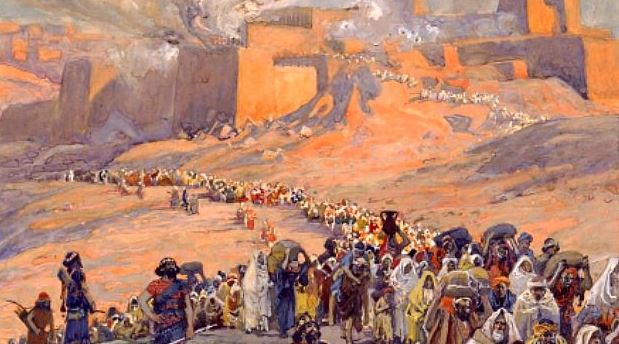
‘The Flight of the Prisoners’ by James Tissot, depicting the Jewish people’s exile after the destruction of the First Temple.
This week’s Torah portion, Nitzavim, has a most unique line when reading it in a proper Torah scroll. We read of a future time where “… Hashem removed them from upon their soil, with anger, with wrath, and with great fury, and He cast them out [וישלכם] to another land, as this very day.” (Deuteronomy 29:27) The Torah prophecies that a time will come when Israel will be exiled out of their land. The word וישלכם, “cast them out” is written with an enlarged letter lamed (ל). As is known, there are instances in the Torah where certain letters are written larger or smaller than normal. What is the significance of this enlarged lamed?
The Divine Anatomy of the Human Body
This week we conclude the fourth book of the Torah (Bamidbar) with the double parasha of Matot and Massei. The latter lists the 42 stops that the Israelites made during the course of their forty year sojourn in the Wilderness. While we know that this forty year period was a “punishment” because the Israelites failed to enter and settle the Holy Land as commanded, there are deeper reasons as well. One of these is that the Israelites spent those four decades learning the Torah for the first time. In some ways, it was like their gestation period.
The Sages compared the 40 years in the Wilderness to the 40 weeks of pregnancy, and pointed out that the gematria of Bamidbar (במדבר) is 248, equal to rechem (רחם), “womb”. This number is not random, for the Sages enumerated precisely 248 parts of the body, which first develop in the womb. The number agrees with modern science, the human body having 206 bones and about 42 major organs (though the latter number is subject to some controversy, depending on how one defines “organ”). The 42 stops that the Israelites made in the Wilderness neatly parallel the 42 organs. The number 206, meanwhile, is the gematria of davar (דבר), literally “word” or “thing”, and is the root of Bamidbar, “In the Wilderness”. The Wilderness was where Israel first heard the Word of God, and where Israel was officially born as a people.
So, there was something of a “divine anatomy” to the time and place of the Israelite wandering. In a similar—and far more amazing—way, there is a “divine anatomy” to the human body.