Tag Archives: Isaiah

Mashiach and the Mysterious 13th Zodiac Sign

When Jacob blesses his children before his passing, he begins by telling his sons that he wishes to reveal to them what will happen b’acharit hayamim, “in the End of Days”. Yet, the text we read does not appear to say anything about the End of Days! The Talmud (Pesachim 56a) states that the Shekhinah withdrew from Jacob at that moment so he was unable to reveal those secrets. If that’s the case, how was he able to properly bless his children?

The Talmud states that when the Shekhinah left him, Jacob worried one of his children was unworthy to hear those secrets. His sons then recited the Shema in unison and said, “just as there is only One in your heart, so is there in our heart only One.” Jacob was comforted to know they are all indeed righteous, and it seems the Shekhinah returned to him at this point, allowing him to bless his children in holiness. Nonetheless, Jacob reasoned that to reveal the secret of the End in explicit fashion would be unwise, so he encoded these mysteries within the blessings he recited. In fact, Jacob not only encrypted what will happen in the End, but summarized the breadth of Jewish history (see ‘How Jacob Prophesied All of Jewish History’ in Volume One of Garments of Light).

One place where Jacob appears to make an explicit reference to the End is in blessing Dan, when he says, “I hope for Your salvation, Hashem” (Genesis 49:18). Jacob says Dan will be the one to judge his people—alluding to the great Judgement Day—and wage the final battles like a “snake upon the road… who bites the horse’s heel so that its rider falls backwards”. Jacob is speaking of Mashiach. Although Mashiach is a descendent of David and from the tribe of Judah, the Midrash states that this is only through his father, while through his mother’s lineage Mashiach hails from the tribe of Dan.

Why does Jacob compare Mashiach to a snake?

Snakes of Divination

In cultures around the world, there is a peculiar connection between snakes and prophecy. In ancient Greece, for example, the Oracle went into a prophetic trance when supposedly breathing in the fumes (or spirit) of the dead python upon which the Temple in Delphi was built. According to myth, this great python (a word which has a Hebrew equivalent in the Tanakh, פתן) was slain by Apollo. The Temple was built upon its carcass. For this reason, the Greek prophetess was known as Pythia.

Similarly, the Romans had their sacred hill on the Vatican (later adopted as the centre of Christianity). The second-century Latin author Aulus Gellius explained that the root of the word Vatican is vates, Latin for “prophet”. Others explain that vatican refers more specifically to a “divining serpent”. Meanwhile, on the other side of the world the Aztecs had Quetzalcoatl and the Mayans had Kukulkan, the “feathered serpent” god of wisdom and learning. And such mystical dragons appear just about everywhere else, from Scandinavia to China.

Incredibly, the Torah makes the same connection, where Joseph is described as a diviner who uses a special goblet to nachesh inachesh (Genesis 44:5). This term for divination is identical to nachash, “snake”. In Modern Hebrew, too, the term for guessing or predicting is lenachesh. Why is the snake associated with otherworldly wisdom and prophecy?

Primordial Serpent

Back in the Garden of Eden, it was the Nachash, “Serpent”, who encouraged Eve to consume of the Forbidden Fruit. This was the fruit of the Tree of Knowledge. The Serpent is the one who unlocked the minds of Adam and Eve to higher wisdom so that they could “be like God”. Jewish tradition maintains that Adam and Eve were eventually supposed to eat of the Tree of Knowledge (for otherwise why would God put it there to begin with?) but they simply rushed to do so when they were not yet ready. They transgressed God’s command, and knew not what to do with all of this tremendous information, resulting in the shameful descent of man into sin. The one who instigated it all was the Nachash.

It appears that ever since then, the snake has been a symbol of forbidden wisdom. Such divination and mysticism can be quite dangerous, and most are unable to either grasp or properly use this knowledge. The Talmud cautions as much in its famous story of the four sages who entered “Pardes” (Chagigah 14b). Pardes is an acronym for the depths of Jewish wisdom, from the simple (pshat) and sub-textual (remez) to the metaphorical (drash) and esoteric (sod). The result of entering the mystical dimensions was that Ben Azzai died, Ben Zoma detached from this world, and Elisha ben Avuya became a heretic. Only Rabbi Akiva was able to “enter in peace and depart in peace.” It is important to remember that Rabbi Akiva was the teacher of Rabbi Shimon bar Yochai, the originator of the Zohar. (Still, the Zohar, like most mystical texts, does not speak explicitly of esoteric matters, but cloaks them in layers of garments and complex language which only the most astute can unravel.)

Long before, Joseph was a master of this wisdom, surprising even the Pharaoh and his best mystics, who proclaimed: “Can there be such a man in whom the spirit of God rests?” (Genesis 41:38). Joseph, of course, is a prototype of Mashiach. The sages state that Mashiach is a great prophet and sage in his own right, but can he really surpass the unparalleled prophecy of Moses or the wisdom of Solomon? The Alter Rebbe (Rabbi Schneur Zalman of Liadi, 1745-1812) solved the issue thus:

After the resurrection all will rise… the Patriarchs and Matriarchs, Moses and Aaron, all the righteous ones and the prophets, tens of thousands beyond number. Is it possible that Mashiach will teach them the same Torah that is revealed to us today? …Will all who knew the whole Torah be required to learn new laws from Mashiach? We must therefore say that Mashiach will instruct them in the “good of discernment and knowledge of the secrets of the esoteric teachings of Torah” that the “eyes will not have seen”—Moses and the Patriarchs not having been privileged to that knowledge, for only to Mashiach will it be revealed as it is written of him [Isaiah 52:13] “and he shall be very high.” (Likkutei Torah, Tzav)

Mashiach is the greatest of mystics, the holder of “forbidden” knowledge which will soon no longer be forbidden. The time will come when, as God originally intended, man will eat from the Tree of Knowledge and be “like God”. That first requires a return of mankind to the Garden of Eden, which is the very task of Mashiach. Beautifully, the gematria of Mashiach (משיח)—the one who brings us back into Eden—is 358, the same as Nachash (נחש)—the one who forced us out to begin with. And so, as Jacob foresaw, the snake symbolizes Mashiach himself.

While Mashiach is likened to a serpent, he must also defeat the Primordial Serpent which embodies all evil. Indeed, the Sages speak of two serpents (based on Isaiah 27:1): the “straight” serpent (nachash bariach) and the “twisted” serpent (nachash ‘akalaton). Mashiach is the straight serpent that devours the twisted one. This was all alluded to in Moses’ staff-turned-serpent consuming the Pharaoh’s staff-turned-serpent. In fact, another serpent staff, the nachash nechoshet, is later used by Moses to heal the nation. This healing staff found its way into Greek myth as well, where it was wielded by the healer god Asclepius, and eventually into the modern internationally-recognized medical symbol.

And that brings us back to the End of Days.

The 13th Zodiac

In recent years, there have been whispers of a necessity to change the current 12-sign horoscope to include a 13th zodiac sign. This was featured in the media on a number of occasions, with flashy headlines suggesting that some people’s astrological sign may now have changed. It is based on the fact that there is a “precession of the equinoxes”: Earth’s axis changes very slowly over time, meaning that the constellations which are visible in the night sky change, too.

The astrological signs are based on the 12 major constellations (out of 88 constellations total) that align with the sun and “rule” for about a month’s time every year (each making up 30º of the total 360º). The argument is that due to the precession of the equinoxes, a 13th sign has crept in which we can no longer ignore. The majority of astrologers have rejected this argument, mainly because astrology isn’t really based on the stars but fixed to the vernal equinox. While some in the East (namely Hindus) use “sidereal astrology”, which is based on shifting star positions, the system used in the West (“tropical astrology”) has 12 signs roughly corresponding to the 12 months.

The same is true in traditional Jewish thought, where each sign corresponds to a month on the Hebrew calendar, as well as to one of the twelve tribes of Israel. Having said that, including a 13th month for the Jewish system is not a problem at all. In fact, it is actually a solution, since the Jewish calendar has a 13th month in a leap year. The extra month has an astrological sign, too! Similarly, although we always speak of twelve tribes of Israel, there are really thirteen since, as we read in this week’s parasha, Jacob made Joseph count as two separate tribes: Ephraim and Menashe.

Whatever the case, whether the horoscope requires modification or not is irrelevant to Judaism, which denies any astrological effect on Israel (see ‘Should Jews Believe in Astrology’ in Volume One of Garments of Light). Besides, unlike astrologers, astronomers both ancient and modern have always been aware of this thirteenth constellation. To the ancient Babylonians it was the snake-like Nirah, while to the ancient Greeks it was known as Ophiuchus, the “serpent-bearer”. This constellation is in the shape of a man firmly grasping a twisted snake (the interlinked constellation Serpens). This is, of course, the very symbol of Mashiach, that serpentine saviour who defeats the primordial snake and all of its evil. After being an astrological footnote for a very long time, Ophiuchus has entered the spotlight, as if the cosmos itself is reminding us of Mashiach’s impending arrival.
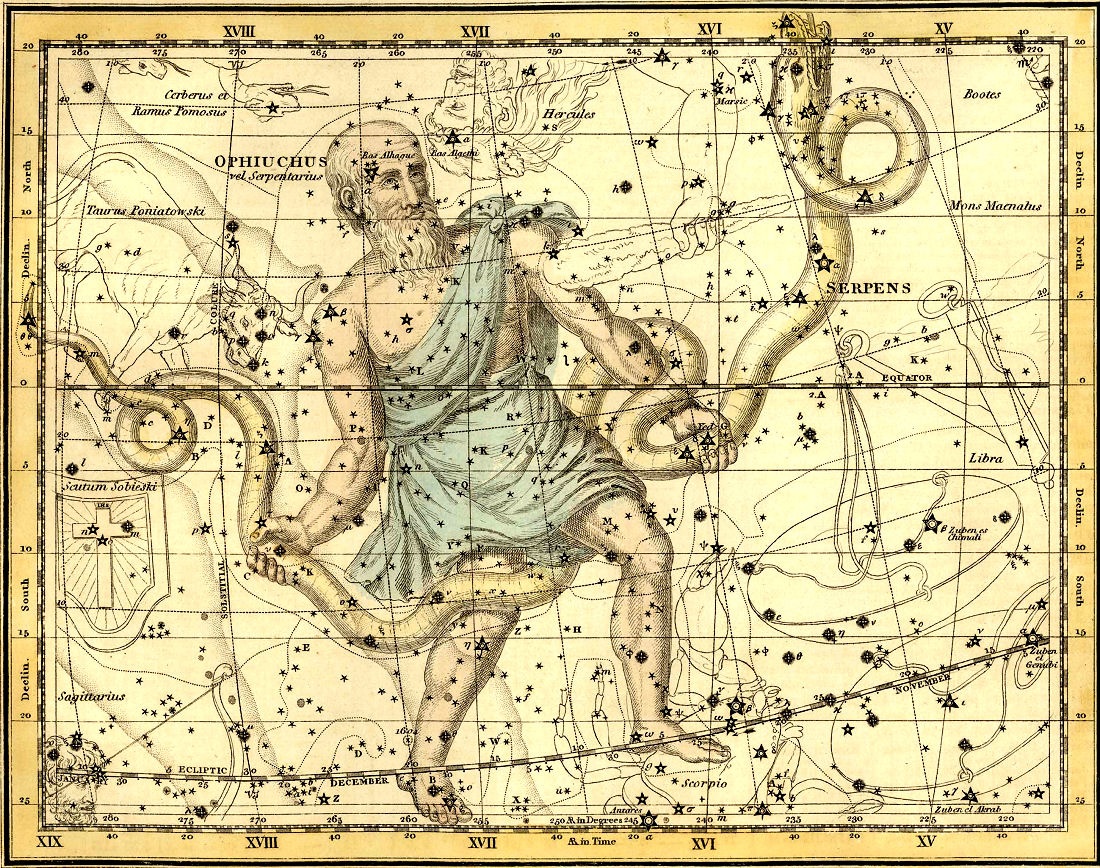
The constellation Ophiuchus (or Serpentarius) grasping the constellation Serpens, from Alexander Jamieson’s Celestial Atlas of 1822. It is interesting to note that Mashiach must be a direct descendant of King David, whose own father Yishai (Jesse) was also called Nachash! (See Talmud, Shabbat 55b.)


The above is an excerpt from Garments of Light, Volume Two. Get the book here

1909: End of the “Jewish Curse” and Fulfilment of Prophecy

Towards the end of this week’s parasha, Ki Tavo, we read a long list of horrifying curses with which God threatens the Jewish people if they stray from the path of righteousness. What’s more shocking than reading this terrible list is realizing that the Jewish people have experienced just about every one of these curses in our long history: oppression, destruction, injustice, fear, poverty, starvation, exile, genocide, desperation, forced conversion, captivity, expulsion, and utter annihilation. The Torah says that these travails will be so extensive that the Jewish people “will become an astonishment, an example, a byword among all the peoples to whom Hashem will lead you.” (Deut. 28:37) Israel will become the very epitome of curses and suffering. Indeed, history has confirmed this unfortunate prophecy.

Thankfully, the prophecies don’t end there. The haftarah for this parasha is a passage from the prophet Isaiah. Isaiah prophesies the very opposite, and says that a time will come when all of these curses will be reversed into blessings. Whereas Moses says God “will scatter you among all the nations, from one end of the earth to the other,” (28:64), Isaiah says that “all have gathered, they have come to you; your sons shall come from afar, and your daughters shall be raised…” (60:4). While Moses warns that “your skies above you will be copper, and the earth below you iron” (28:23), Isaiah says that “Instead of the copper I will bring gold, and instead of the iron I will bring silver.” (60:17) God confirms that He has put us through many trials in the past, and while this was long in duration, it was nonetheless only temporary, for “in My wrath I struck you, and in My grace I have had mercy on you.” (60:10)

Amazingly, we are living the fulfilment of Isaiah’s prophecies. The Jewish people have returned en masse to the Promised Land, have made the barren deserts bloom once more, and have miraculously defended their borders time and again. In the span of just several decades, the State of Israel has transformed into an agricultural, technological, and military powerhouse – despite very few natural resources, a small landmass, and a tiny population. As Isaiah predicted “…the abundance of the west shall be turned over to you, the wealth of the nations will come to you.” (60:5) Now, all that remains to be seen is the last part of Isaiah’s promises:

Violence shall no longer be heard in your land, neither robbery nor destruction within your borders, and you shall call your walls “salvation”, and your gates “praise”… And your people, all of them righteous, shall inherit the land forever, a scion of My planting, the work of My hands in which I will glory. The smallest shall become a thousand and the least a mighty nation; I am Hashem, in its time I will hasten it. (60:18, 21-22)

Israel will finally have true peace, with the world no longer questioning the indigenous Jewish people’s legitimacy to inhabit their Holy Land. The very last verse of this prophecy then says that when that time finally comes, God will “hasten” its arrival. This is quite the perplexing statement, and one that has kept rabbis and scholars thinking for millennia. The problem is as follows: If something is being hastened, then it is obviously coming before its time, and if it is coming on time, then it hasn’t been hastened!

Another way of looking at it is that one makes haste when they are already late. Few would disagree that this final redemption is long overdue. Since it is so late in coming, God will make haste to bring it about. An even simpler explanation is that when the time comes, God will hasten the series of events to bring about that happy ending. Recent history has shown that this is exactly what has happened.

In the late 1800s, the thought of an independent Jewish state in the Holy Land was still a very distant dream. The “first aliyah” began in 1882, and though as many as 35,000 Jews migrated to Israel by 1903, some scholars estimate that up to 90% of them left Israel soon after because of unfavourable conditions.

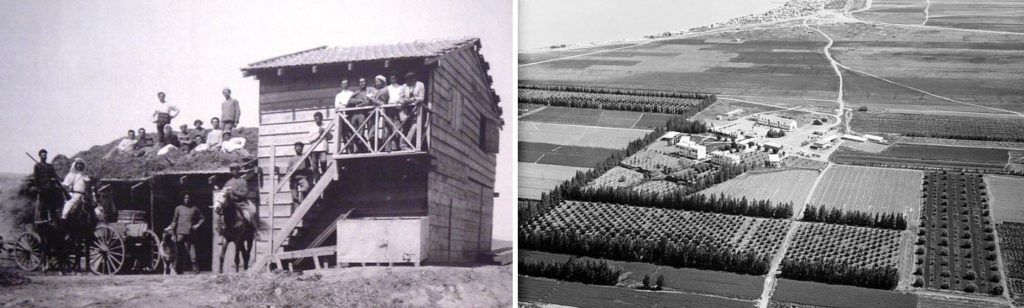
Then came 1909. In that year, a group of ten men and two women established a unique collective near the Galilee which would become the first kibbutz. The model of the kibbutz proved successful, and expanded from twelve people in 1909 to four thousand people living in thirty kibbutzim across the country by 1929. The kibbutz became one of the most significant factors in the rebirth of Israel, playing a key role in defending the land, driving agricultural innovation, and inspiring the “Israeli dream”.

Degania Alef, the first kibbutz, in 1910 (Left), and in 1931 (Right)

Degania Alef, the first kibbutz, in 1910 (Left), and in 1931 (Right)

Around the same time in 1909, a group of 66 families parceled out a plot of land outside of Jaffa (which was previously purchased by a wealthy Dutch Jew named Jacobus Kann). By 1922, this little settlement had become the bustling city of Tel-Aviv, with a population hitting 34,000 just a few years later. It would only take two more decades for the declaration of independence to be proclaimed from that city, and two more to liberate all of Jerusalem.

66 Families Parcel Out Tel-Aviv in 1909 (Left), the city in 1922 (Middle), and Tel-Aviv today (Right)

66 Families Parcel Out Tel-Aviv in 1909 (Left); the city in 1922 (Centre); and Tel-Aviv today (Right)

Events have certainly progressed very quickly, and a glance at today’s geopolitical situation shows that they continue to rapidly accelerate. The spark for it all appears to have been lit in 1909 by those two seminal events – the first kibbutz and the first city – which propelled the rebirth of Israel and the fulfilment of Biblical prophecy. What’s most interesting is that this special number – 1909 – is precisely the gematria (numerical value) of that final cryptic verse of Isaiah: “The smallest shall become a thousand and the least a mighty nation; I am Hashem, in its time I will hasten it.”


The above is adapted from Garments of Light: 70 Illuminating Essays on the Weekly Torah Portion and Holidays. Click here to get the book! 

Yom Ha’Atzmaut: Uniting the Secular and the Religious

The 5th of Iyar is Yom Ha’Atzmaut, Israel’s Independence Day. It was on this day in 1948 that David Ben-Gurion proclaimed the establishment of the State of Israel. Immediately, the armies of three neighbouring Arab states—Egypt, Jordan, and Syria—declared war and invaded. Iraq and Saudi Arabia sent in additional forces. Lebanon assisted them, too. Yemen, Pakistan, and Sudan sent even more fighters. On top of that, there were fighters of the Holy War Army, essentially a local Arab militia composed of over 1,300 troops, as well as the Arab Liberation Army, with over 6,000 troops from various Arab states. Despite being completely surrounded, outnumbered, and outgunned, the nascent State of Israel miraculously destroyed its enemies in just under ten months.

The miracles did not stop there. In 1967, Egypt, Syria, Jordan, and Iraq amassed 550,000 troops to “drive Israel into the sea.” With less than half of those numbers, Israel launched a pre-emptive strike that decimated the Arab forces in six days. Jerusalem was reclaimed, allowing Jews to visit their most holy sites for the first time in centuries. The miracles continued through the Yom Kippur War of 1973, and even through the 1991 Gulf War (which Israel did not directly take part in), and continue to this day. Ben-Gurion’s famous words are fitting: “In Israel, in order to be a realist, you must believe in miracles.”

Despite the fact that Jews once more have an independent state that is strong and prosperous (for the first time since the Maccabees defeated the Greeks and established the Hasmonean kingdom over 2000 years ago) there have been some, particularly in the Ultra-Orthodox Jewish world, that have opposed the State. This opposition comes in various degrees, from those that simply don’t support the secular government; to those that refuse to participate in state programs, military or national service, and the like; to those that completely side with anti-Israel groups bent on annihilating the State. Although, of course, the State of Israel is far from perfect, and its secularization often takes reprehensible forms, opposing the State makes little sense, particularly in light of what Jewish holy texts tell us.

Meanwhile, the ultra-secular elements in Israel, who strive to expunge Judaism, make even less sense, considering that the only claim Jews have to the land is tied to the Torah—the fact that God gave us this land, and we are its indigenous people, inhabiting it since Biblical times. Without the Tanakh, what claim does a secular person have to live in Israel? Moreover, many secular Israelis are blinding themselves to the miracle that is Israel, failing to see God’s hand in every step of its history.

By properly exploring Israel’s miraculous existence, perhaps the gap between the secular and the religious may be bridged. The former can come to see the validity and truth of God and His Torah, while the latter can come to see the State of Israel as a fulfilment of Biblical prophecy.

Prophecy Fulfilled

A look through history makes it clear: if it were not for God’s incredible miracles, the State of Israel would have never gotten off its feet, nor would it have survived to this day. God promises us in the Torah that “five of you shall chase a hundred, and a hundred of you shall chase ten thousand; and your enemies shall fall before you by the sword.” (Leviticus 26:8) This is precisely what has happened in every single war that Israel has participated in. In 1948, Israel tragically suffered 6,000 casualties, while the Arabs suffered over 20,000. In 1967, Israel suffered as many as 983, but the Arabs over 24,000. In 1973, Israel was surprise-attacked on Yom Kippur, completely unprepared for battle, faced with an invasion that had over one million troops from literally all over the world, including nearly 4,000 from Cuba! In comparison, Israel had 400,000 at best, reservists included. The highest estimates place 2,800 Israeli casualties, compared to 20,000 for the attackers.

In one well-known incident from this war, 150 Syrian tanks went up against just 7 remaining Israeli tanks left with no ammo in the “Valley of Tears” of the Golan Heights. Just as Israeli commander Avigdor Ben-Gal prepared to send a message saying his forces could no longer hold on, the Syrians suddenly retreated in a panic. All in all, Israel lost around 60 tanks in the Valley of Tears; the Syrians lost over 500. To this day, military analysts are puzzled by the Syrian withdrawal. Many theories have been proposed, including that the Syrians thought it must be an ambush, or even that higher up in the government Israel had threatened Syria with a nuclear strike. One Syrian soldier would later reveal what may have been the real reason: they thought they had been swarmed by an army of angels!

It isn’t just in military victories that God has clearly blessed the State. In under 70 years, Israel has flourished and is among the most developed and prosperous countries in the world. Isaiah prophesized:

The wilderness and the parched land shall be glad; and the desert shall rejoice, and blossom as the rose. It shall blossom abundantly, and rejoice… they shall see the glory of Hashem, the excellency of our God. (Isaiah 35:1-2)

Indeed, Israel and its once-parched lands have blossomed abundantly. Israel is now self-sufficient in its food production (meaning no one will starve if Israel stops all imports of food) and exports over $1.3 billion in food every year.

Israel famously exports a great deal of innovation and technology, too, and is a global leader in science. Its high-tech sector, nicknamed “Silicon Wadi”, is second only to Silicon Valley. Despite its short existence, Israel ranks 12th in per capita Nobel Prizes—higher than Canada and the US, Germany, France, and the entire European Union for that matter. There are nearly 400 million Muslim Arabs across 22 countries, and altogether they account for just 7 Nobel Prizes (of which two were “peace” prizes for terrorist-sponsors Anwar Sadat and Yasser Arafat!) while some 6 million Jews in Israel alone have won 12 Nobel Prizes. There is no doubt that Israel, with God’s blessing, has lived up to the Biblical ideal of being a “light unto the nations.” (Isaiah 42:6)

History makes it clear that the establishment and survival of the State of Israel is nothing short of a divine miracle, and would not happen were it not for God’s support and supervision. Before Moses passed away, he sang his final song to the people, and told them: “Remember the days of old, understand the years of past generations.” (Deuteronomy 32:7) Consider the historical facts: does history not make it so plainly obvious? “How could one chase away a thousand… if not for Hashem who delivers them up?” (Deuteronomy 32:30) Is it logical that 7 tanks can scare off 150? That a million invaders can be subdued by mere thousands? That a nation so soon back from the brink can rebuild such a prosperous state in a barren desert so quickly? And that it was all prophesied long ago, as Ezekiel foresaw that “in the End of Years” the Jews people shall return to their land, coming back from “the sword, gathered from among many peoples, [returning] upon the mountains of Israel, which have been a continual waste…” (Ezekiel 38:8) Is it not obvious that God is pulling the strings?

Uniting in Righteousness

Finally, the Torah also tells us a well-known principle: the land of Israel is holy, and “vomits out” anyone who does not deserve to live there. In light of this, the great Moroccan sage Rabbi Avraham Azulai (c. 1570-1643) wrote in his Chessed L’Avraham (Ma’ayan 3, Nahar 12):

And you should know, every person who lives in the Land of Israel is considered a tzadik, including those who do not appear to be tzadikim. For if he was not righteous, the land would expel him, as it says “a land that vomits out its inhabitants.” (Leviticus 18:25) Since the land did not vomit him out, he is certainly righteous, even though he appears to be wicked.

Thus, as a general rule, all Israelis—secular and religious—are deemed righteous in their own way, and for any one side to label the other as “wicked” is incorrect. We mustn’t forget that the Holy Temple was destroyed because of sinat hinam, baseless hatred and incessant infighting. Instead of opposing one another, we should all strive to support one another, to understand each other, and make Israel—the one homeland that we all have—the best that it can be. Then we will be able to realize the prophecy of Isaiah:

I will set your stones in fair colours, and lay your foundations with sapphires. And I will make your pinnacles of rubies, and your gates of carbuncles, and all your border of precious stones. And all your children shall be disciples of God, and great shall be the peace of your children… (Isaiah 54:11-13)


The above is an excerpt from Garments of Light, Volume Two. Get the book here