This week’s parasha (in the diaspora) is Shlach, recounting the Sin of the Spies. When God subsequently punished the Israelites for their lack of faith, He said of that generation: “in this wilderness they will end, and there they will die.” (Numbers 14:35). The Zohar (III, 161b) explains that they died there in the wilderness, but not in the afterlife, meaning they did still merit to enter the supernal Garden of Eden. The Zohar further points out that the Torah specifically states their “corpses shall fall in this wilderness” (Numbers 14:32). The use of the word “corpses” serves to teach us that only their physical bodies—not their souls—would fall. God would destroy the evil inclination that ensnared their bodies into sin. The souls, however, would ultimately ascend to Heaven.
Following this, the Zohar takes us on a long journey exploring the Heavenly Academies. One such yeshiva is presided over by Betzalel, the craftsman who put together the Mishkan. There is an academy of the Sages of the Mishnah, and another academy for the “masters of Scripture” (מָארֵי מִקְרָא), a place devoted to the study of Tanakh. Higher than these is the academy for the study of Aggadah (ie. Midrash), and the Zohar makes sure to point out that these luminous Aggadists are the ones who truly understand the Torah properly. (Intriguingly, the Zohar does not seem to describe an academy for the study of Talmud!)
Higher still is the yeshiva of Aaron, called the Yeshiva of Love (מְתִיבְתָּא דִּרְחִימוּתָא). Aaron leads his students through the Heavens, and they fly around “like eagles”. Aaron visits an even more exclusive academy, the yeshiva of Moses, called the Yeshiva of Light (מְתִיבְתָּא דִּנְהוֹרָא). Aaron’s students have to wait outside since only Aaron is allowed to enter, as well as any individuals Moses calls by name. Just like he did on Earth, up in his academy Moses is still wearing his special veil, his face being too luminous to behold. Even higher than this academy is the Yeshiva of the Firmament (מְתִיבְתָּא דִּרְקִיעָא), presumably presided over by the angelic Metatron.
Several pages later, the Zohar (III, 167b) tells us about the academies (“palaces”) of women. First is the school of Batya, the daughter of Pharaoh who adopted Moses. There are thousands of righteous women there learning with her. They learn “what they did not merit to learn in this world” since, until recent history, women were not expected to learn Torah. Meanwhile, there are many more thousands of female souls learning with Serach, the daughter of Asher (for more on her, see ‘The Incredible Story of Serach bat Asher’ in Garments of Light, Volume One). Here they focus on learning the secrets of the Torah’s mitzvahs, and the deeper reasons for the commandments.
The third female academy is full of myriads of women, and they don’t seem to do much learning here but rather spend their time in meditation, song, and praising God, alongside many angels. The leader here is Yocheved, mother of Moses. Opposite her academy is a similar palace belonging to Deborah the Judge and Prophetess. She, too, leads the women in song and prayer. In addition to these, there are four palaces that are concealed, belonging to each of the four Matriarchs. These are called the “palaces of the trusting daughters” (הֵיכָלִין דְּבָנוֹת בּוֹטְחוֹת), but they are too lofty to be described.
The Zohar does divulge a deep secret here. While during the day the male and female souls are segregated in their various academies and palaces, the soulmates do reunite at night:
Every night they get together, since the time of coupling is at midnight, both in this world and that world. The coupling of that world is accomplished by the adherence of one soul to the other, light with light. The coupling in this world is body to body. Everything is as it should be: a kind with its kind, a match with its match, body to body; and in the other world, it is light with light… The union in that world produces more fruit than the coupling in this world. When they pair up in the pairing in that world, with their unified desire, and when the souls cling one to another, they produce fruit. And lights emerge and lamps are produced. These are the souls of those that convert…
The souls of Jewish converts are produced from the spiritual unions of the righteous souls above!
Going back to our parasha, the Zohar tells us that despite what we might read in the Torah, the generation of the Exodus and the Wilderness was indeed a very righteous one. The Zohar (III, 168b) says there will never be another generation as worthy as they until the coming of Mashiach. And at that time, the Wilderness generation will merit to be the first to rise in the Resurrection of the Dead. May we merit to see it soon.
This week’s double parasha, Behar-Bechukotai, begins: “And God spoke to Moses on Mt. Sinai: Speak to the Children of Israel and say to them: When you enter the land that I give you, the land shall observe a sabbath to God…” (Leviticus 25:1-2) As is well-known, the Holy Land must be worked for six years, and then left fallow in the seventh “Sabbatical” year, the Shemittah. After seven such cycles, the fiftieth year is the great Jubilee. After explaining the basic peshat meaning of these verses in his commentary, Rabbeinu Bechaye (Rabbi Bechaye ben Asher, 1255-1340) gives an explanation al derekh Kabbalah:
“the land shall observe a sabbath to God…” refers to the [seventh] millennium of “desolation”, which is entirely a sabbath of eternal rest. This is a reference to the World to Come, following the Resurrection… “You shall sanctify the fiftieth year and you shall proclaim freedom throughout the land for all its inhabitants. It shall be a Jubilee…” refers to each of the seven “days” of 7000 years, making a total of 49,000 years, after which the cosmos will return to a state of tohu v’vohu… (Rabbeinu Bechaye on Leviticus 25:2-10)
Rabbeinu Bechaye is speaking of the ancient mystical doctrine of the Cosmic Shemittot. Just as there is a 49-year cycle in the Holy Land, the entire cosmos goes through a 49,000-year cosmic cycle. Each of the 7000-year periods correspond to one “day” of Creation. Each period consists of 6000 years of civilization, followed by a resting seventh millennium which is Olam HaBa, the World to Come, corresponding to the delightful and spiritual Shabbat, before restarting a new era of civilization. After 49,000 years, there is a cosmic Jubilee, and the cycle restarts again.
Raphael Shuchat points out that the first mention of this notion goes all the way back to the Second Temple era, to the apocryphal Second Book of Enoch. Recall that Hanokh (“Enoch”) never died, and was transformed into an angel when God “took him” (Genesis 5:23-24). The Book of Enoch is attributed to him, but was not accepted into the official Tanakh canon by our Sages. Nonetheless, the Zohar quotes from the book dozens of times. It was most likely kept outside of the Tanakh, as one of the sifrei hitzonim, because it was too mystical and esoteric.
In the Book of Enoch, we read that God showed Hanokh the entire span of 7000 years, each day corresponding to a millennium. Then “the eighth day will be the first of a [newly] created week, and it thus revolves in a cycle of seven thousand…” (II Enoch 33) The Zohar similarly says there is a civilization span of 7000 years (III, 9b). The Talmud mentions this briefly in several places, too, including Rosh Hashanah 31a and Sanhedrin 97a. In both cases, there is another opinion presented that the Sabbatical millennium is not one thousand years, but two thousand years. This is probably referring to the final Sabbatical and the Jubilee together, since the 49th millennium is a Sabbatical, and then the 50th is the Jubilee, meaning there would be two thousand years of rest at the very end of the cycle. Rabbeinu Bechaye explains this in his commentary, describing the cycle as being a total of 50,000 years, not 49,000 years. These 50,000 years are the secret of Nun Sha’arei Binah, the “Fifty Gates of Understanding”. And, when the Sages state that God revealed to Moses all Fifty Gates except the last (Rosh Hashanah 21b), it means God showed Moses nearly the entire span—some 49,000 years of hidden history—except for the final fiftieth Jubilee millennium! The Ramban (Rabbi Moshe ben Nachman, “Nahmanides”, 1194-1270) suggests the same in his commentary on these verses.
One of the earliest sources to discuss the Cosmic Jubilee is the ancient Sefer haTemunah, one of the oldest Kabbalistic texts. The main focus of this book is to explain the mystery of the divine Hebrew alphabet, and the secrets of the shapes of the letters. It is an important work not only for Jewish mysticism, but even halakhah, since it is used as a source for proper Torah scribing. Sefer haTemunah speaks of the cosmic cycle, too, and connects it to the Fifty Gates. Intriguingly, it posits that we are currently in the second Shemittah, meaning there was already a previous era of civilization before ours.
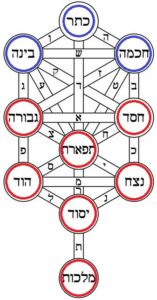
The Sefirot of Mochin above (in blue) and the Sefirot of the Middot below (in red) on the mystical “Tree of Life”.
Now, each of the seven cycles of seven thousand correspond to the seven lower Sefirot, the Middot or qualities. Thus, the first era of civilization was one of Chessed, “kindness” and positivity, while the second era, the one in which we are currently, is Gevurah, “severity” and judgement. This explains why the world we know is so difficult and full of evil and suffering. Similarly, the Kabbalists explain that the Torah manifests itself differently in each Shemittah. Since we are in the Shemittah of Gevurah and Din, the Torah in this iteration manifests itself as being full of laws, restrictions, punishments, and the like. In our reality, halakhah takes primacy. It seems that in the previous era, of Chessed, it was the aggadah that was primary, and not the halakhah, and the Torah was expressed in a much softer manner. According to some later sources, in each Shemittah it is the same Torah with the exact same set of letters, but they are rearranged!
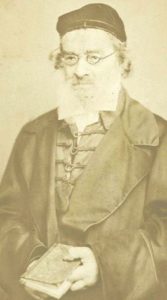
A different opinion is that we are currently not in the second Shemittah, but in the fourth. This is discussed by Tiferet Yisrael (Rabbi Yisrael Lifschitz, 1782-1860) in his Derush Or HaChaim, at the end of his Mishnah commentary on Nezikin. He uses the doctrine of Cosmic Shemittot to explain why scientists find ancient fossils and archaeological remains, reasoning that these must be the remnants of past Shemittah civilizations! He interprets the earlier sources a little differently, and says this is the second Shemittah that has civilized human life, but the fourth Shemittah altogether. He says that this is secretly encoded in the first letter of the Torah: the beit of Beresheet is written large to indicate that we are in the second Shemittah that has civilization, and the beit is written with four tagin, “crowns”, to secretly encode that we are in the fourth Shemittah overall. Tiferet Yisrael adds that this is the secret of our Sages’ statement that there were 974 generations before Adam (Chagigah 13b-14a, Shabbat 88b). These are the generations of past Shemittot.
Yet another opinion is that we are already in the seventh Shemittah. This was the preferred choice of Rabbi Aryeh Kaplan, who went into the subject in depth in Immortality, Resurrection, and the Age of the Universe. Rabbi Kaplan favoured this one because it allowed for a calculation that fit most closely with scientific estimates of the age of the universe. He cited sources that say there were already 42,000 years before Adam was created, putting us in the seventh era of Malkhut. This also makes sense because Malkhut is typically described as being “empty” and “lowly”, with no light of its own, which might reflect the reality in which we exist.
Whatever the case, we have an abundance of Torah evidence going all the way back to the Second Temple era that the notion of Cosmic Shemittot is not only legitimate, but accepted by major authorities. However, the Arizal (Rabbi Itzchak Luria, 1534-1572) seemed to be opposed to this notion, and held that the earlier generations simply misunderstood the spiritual dimensions. There are some today who still cite the Arizal in opposing the notion of Cosmic Shemittot. But, if we are going to be honest and rational, can we really say that all of the greats of the past were wrong? The Ibn Ezra, the Ramban, and Rabbeinu Bechaye could not understand spiritual realities? That Sefer Hanokh (cited countless times in the Zohar) and Sefer HaTemunah (which is also an halakhic text) were mistaken? That even the Sages of the Talmud, and the references in the Midrash (such as Kohelet Rabbah 3:11) and Zohar (including III, 61a-b which explicitly states that the souls of this world existed in previous worlds) can’t be taken at face value? In the big picture of Kabbalah, it’s the Arizal (and the Ramak) against everyone else, including major Rishonim and fundamental ancient texts. Rabbi Kaplan writes:
Since this is not a matter of law, there is no binding opinion. Although the Ari may have been the greatest of Kabbalists, his opinion on this matter is by no means absolutely binding. Since there were many important Kabbalists who upheld the concept of Sabbatical cycles, it is a valid, acceptable opinion. (pg. 6-7)
And the reality is, recent scientific and archaeological findings strongly support the notion of Cosmic Shemittot, too.
The Physical Evidence
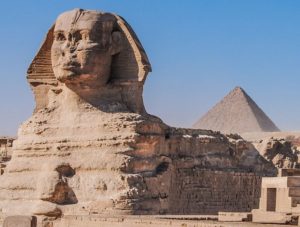
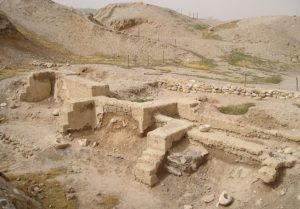
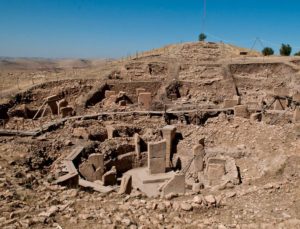
Archaeologists have found many structures around the world that date far older than previously thought. The most famous example might be the Great Pyramids of Giza and the nearby Sphinx. Though typically dated to about 4000 years old, evidence suggests that they are much older. The Sphinx, in particular, has many layers of water erosion at its base, suggesting that it has lived through years of rainy weather. In recent millennia, Egypt does not have rain, of course. However, meteorological analysis and satellite scans suggest that Egypt was once part of a massive rainforest that spanned what is now the Sahara Desert. Based on new data, some have suggested the Sphinx is something like 12,000 years old, having been built at a time when Egypt’s weather was rainy and wet. Another well-known example is that of Göbekli Tepe, an ancient city unearthed in Turkey that has been dated back some 11,500 years, and sports the world’s oldest known temple. Similarly, the Tel es-Sultan site in Israel, near today’s Jericho, has been dated back to around the same time. And there are many others.
The Sphinx
Tel es-Sultan near Jericho, Israel
The town of Göbekli Tepe in modern-day Turkey dates back some 11,500 years.
Because of these reasons, some have proposed that we should change our year-counting system to start from the earliest signs of complex civilization, and instead of saying we are in 2023 CE, simply add ten thousand on top and say we are in 12023 HE (Human Era or Holocene Era). This happens to fit quite perfectly with Cosmic Shemittot. If we go with the earliest and most authoritative text—Sefer haTemunah—and say we are in the second Shemittah, then we need to add 7000 to our current Jewish year of 5783, making it the cosmic year 12,783 of the cycle! The archaeological evidence strongly supports Sefer haTemunah, as does the general idea that our civilization is full of war, misery, and suffering corresponding to the second middah of Gevurah, and the notion that the current Torah reality is one of strict halakhah and din.
All of this fits well with the increasingly popular “Younger Dryas” hypothesis positing that great civilizations first emerged at the end of the last ice age, about 12,000 years ago, when we suddenly see rising temperatures and rising sea levels all around the planet. There is even a far-out hypothesis arguing that the moon only entered Earth’s orbit about 12,000 years ago (!) and this may be what caused the drastic changes of the Younger Dryas in the first place.
Truly, there is no reason to stop at 12,000, since we can say that the current 50,000 year cycle is not the first, and there were previous Jubilees as well. (In fact, one might argue that we are in the second Shemittah of the second Jubilee, making our reality a Gevurah sh’b’Gevurah era.) This might explain even older pieces of archaeological and scientific evidence. It is worth mentioning that Earth’s rotation and tilt has its own cycle of about 41,000 years, with a wobble that makes the tilt shift between maximums of 22.1 and a 24.5-degree tilts, with massive repercussions for weather and climate. (Recall that it is Earth’s tilt that gives rise to the seasons.) According to scientists, the last maximum tilt position is estimated to have occurred about 10,700 years ago.
To conclude, the mystical notion of Cosmic Shemittot is not only valid and kosher, but attested to by a large number of ancient sources, including the Talmud and Zohar, and many great Kabbalists and Rishonim. It is absolutely fundamental for making sense of Creation and cosmogony, along with a plethora of scientific, archaeological, and historical findings. While it remains to be seen exactly which Shemittah we are currently in, much evidence supports the earliest position that we are in the second, though it may very well be that this is not the first cycle altogether. Either way, as we approach the end of our sixth millennium, we get closer and closer each day to the seventh Sabbatical millennium of universal rest, holiness, and elevation.
What really happened with the four ancient Jewish Sages who ascended to ‘Pardes’, the Heavenly realms? Find out in this class where we also explore the difference between “physical” and “spiritual” worlds, the “upper waters” and “lowers waters” of Creation, and the proper approach to the study of mysticism and Kabbalah.
For the related class on ‘chashmal’ and electricity that was mentioned, see here.

 Following this, the Zohar takes us on a long journey exploring the Heavenly Academies. One such yeshiva is presided over by Betzalel, the craftsman who put together the Mishkan. There is an academy of the Sages of the Mishnah, and another academy for the “masters of Scripture” (מָארֵי מִקְרָא), a place devoted to the study of Tanakh. Higher than these is the academy for the study of Aggadah (ie. Midrash), and the Zohar makes sure to point out that these luminous Aggadists are the ones who truly understand the Torah properly. (Intriguingly, the Zohar does not seem to describe an academy for the study of Talmud!)