
This week’s parasha concludes the Ten Plagues of Egypt by describing the final three plagues, as alluded to in the name of the parasha, Bo (בא), which has a numerical value of three. One would think that the parashas would be divided in such a way that all the plagues appear in one portion. Yet, we see the first seven in one, and the final three in another. The mystical reason for this is to mirror the Sefirot, which are divided into the seven lower middot, and the three higher mochin, “mental” or “intellectual” faculties.
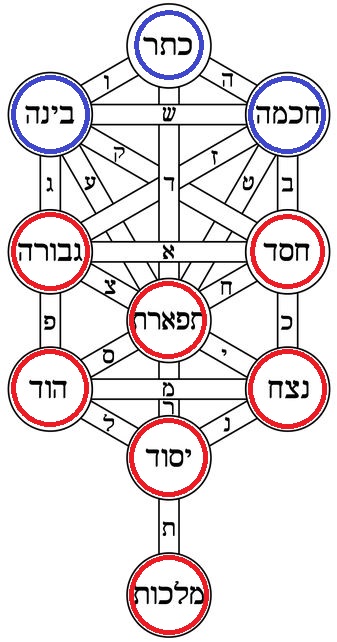
The Sefirot of mochin above (in blue) and the Sefirot of the middot below (in red) on the mystical “Tree of Life”.
The mochin are the three Sefirot of Keter (or Ratzon, God’s “Will”); Chokhmah, “Wisdom”; and Binah, “Understanding”. They are on a higher level than the lower seven Sefirot. In fact, in this physical world we find most things mirror the seven, including the seven discernible colours of the rainbow, the seven notes of the musical scale, the seven visible “luminaries” in the sky, and the seven days of the week. The mochin, meanwhile, represent the upper worlds, and correspond to more ethereal things like the three primordial elements of Creation (air, water, and fire, as per Sefer Yetzirah) and the three realms of space, time, and soul (in mystical texts referred to by the acronym ‘ashan, עשן, standing for olam, shanah, nefesh). (For a detailed explanation of this, see here.)
Recall that the Sefirot represent the ten major aspects of God, and are primarily meant to help us relate to, and understand, the Infinite One. As such, the mochin represent the highest aspects of God. That there are specifically three of them is significant. The number three is central to Judaism, and God has a particular affinity for this number, as the Talmud (Shabbat 88a) tells us:
Blessed is the All-Merciful One, Who gave the three-fold Torah [ie. the Tanakh, composed of Torah, Nevi’im, and Ketuvim] to the three-fold nation [Kohen, Levi, Israel] by means of a third-born [Moses] on the third day, in the third month [Sivan].
While this teaching is well-known, what isn’t so well known is in whose name it is brought down. The Talmud introduces it as a teaching “of that Galilean”. Who is this anonymous Galilean? Why does the Talmud use a seemingly-derogatory term for him, avoiding his name? Continue reading