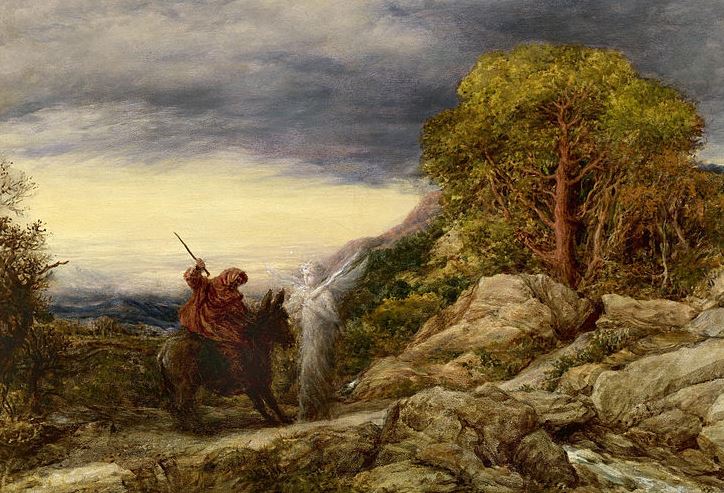
‘The Prophet Balaam and the Angel’ by John Linnell (1859)
This week’s parasha, Balak, features the infamous gentile sorcerer and prophet Bilaam. We see him riding a donkey, being confronted by an angel, and attempting to curse Israel. The Torah later states that Bilaam was slain by the sword when Israel warred with Midian (Numbers 31:8), and according to tradition he was killed by Pinchas. In the Book of Joshua (13:22) we are told again that Bilaam was slain, and here he is called hakosem, “the magician” or “the diviner”. The Sages ask (Sanhedrin 106a-b) why Scripture uses this language; after all, was Bilaam not a true prophet? The answer is peculiar and seemingly makes no sense: “This is in accordance with what people say, that she came from princes and rulers, but was licentious with carpenters.” What does this have to do with anything? More perplexingly, the Talmud goes on to make two more bizarre points about Bilaam.
First, our Sages stated that Bilaam was killed by Pinchas Lista (Sanhedrin 106b). The word lista means something like a “criminal” or “gangster”. There is certainly no way that our Sages could refer to the great and holy Pinchas as lista! Second, the same passage in the Talmud says that Bilaam was killed when he was 33 years old. This is absolutely impossible. We know that Bilaam was an advisor to Pharaoh back in Egypt when Pharaoh had decreed to drown the male children, and we know that Bilaam’s sons instigated the Golden Calf incident some 39 years prior to the events of this week’s parasha. Bilaam must have been a very old man at this point. How could our Sages say he was only 33? How do we make sense of this puzzling Talmudic passage?
Long ago, scholars had pointed out that the description of Bilaam above does not at all match the Torah personality of this week’s parasha, but it does seem to closely resemble another ancient figure. That last number 33 may have given it away, since it is often associated with a person who was killed at that age: Jesus. Could it be that the Sages were actually speaking about Jesus in code, to avoid alerting the Christian censors? Indeed, Jesus was executed at the command of the cruel Roman governor Pontius Pilate—whom the entire Jewish people at the time despised as we know from historical sources—and this is probably why the Talmud says Bilaam was killed by “Pinchas Lista”, ie. Pontius the criminal! And now we can understand the cryptic statement about the woman who “was licentious with carpenters”, since Jesus and his father were carpenters. It seems abundantly clear that the Sages were not actually speaking of Bilaam, but secretly alluding to Jesus.
The big question is: why would the Sages use Bilaam as a stand-in for Jesus? And what is all of this even supposed to teach us? Continue reading →