Tag Archives: Sefirot

Leviathan & the Seven Serpents

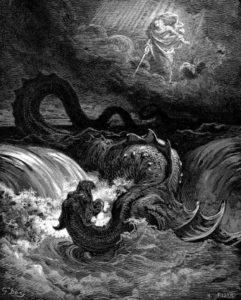
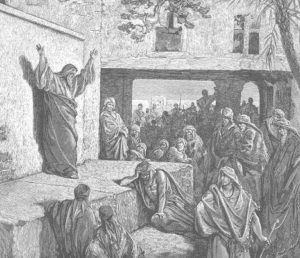
‘Destruction of Leviathan’ by Gustav Doré

In this week’s parasha, Va’era, we read about Moses’ first confrontation with Pharaoh and the famous battle of their serpentine staffs. Interestingly, in last week’s parasha when Moses’ staff first turned into a serpent (Exodus 4:3), the word used was nachash, while this time it says tanin (7:9-10)! The former term certainly means a “snake”, but the latter is more general and can be any serpent, reptile, or even crocodile. Mystical texts see this as an allusion to the greatest of the taninim, created by God on the Fifth Day of Creation, the great sea dragon called Leviathan. The Zohar (II, 27b) comments here that the Leviathan was red like a rose, with iron-like scales, wing-like fins, a powerfully-thrashing tail, and fire coming out of its mouth. It has long migrations in the deep seas lasting seventy years.

Commenting on the words hataninim hagedolim, “the great sea monsters”, in Genesis 1:21, Rashi says that God originally created a pair of Leviathans, but they were so terrible that He slew the female so that the couple wouldn’t reproduce. God then “salted” its flesh and preserved it for the righteous in the World to Come, who are said to enjoy it at the “Feast of Leviathan” in the End of Days. Rashi is quoting the Talmud here (Bava Batra 74b-75a), which adds that God will make a sukkah for the tzadikim from the skin of the Leviathan. The leftover skin will be draped over “the walls of Jerusalem” and will shine and glow to wow the entire world. Perhaps that means the Kotel will have a miraculous new look in the near future, which is quite fitting since it will no longer be a “wailing” wall.

We read here in the Talmud that God castrated the male Leviathan, too, and provides a Scriptural source for it all in Isaiah 27:1, that “He will slay the Serpent that is in the sea…” The Sages ask: why did God slay the female and not the male? One answer is that the female could have still laid eggs without the male. Indeed, we know scientifically that there is a phenomenon called parthenogenesis where female fish are able to reproduce even without fertilization by a male. The Talmud then gives another answer based on Psalms 104:26, which says “There is Leviathan, whom You have formed to sport with.” God created the Leviathan just to “sport with”, and it wouldn’t be appropriate to sport with a female Leviathan, so he left the male only. (It seems gender segregation in sports is not a new issue!)

There is a way to interpret all of this metaphorically, too, and the Talmud goes on to say that the Jordan River flows into the “mouth of Leviathan”, while the ancient Seder Rabbah d’Beresheet says the entire planet “rests” on one of the fins of Leviathan. Even the Zohar has an interesting interpretation of the taninim gedolim of Creation, saying they are actually referring to the “Seventy Princes”, the Heavenly angels overseeing the seventy nations of the world. Leviathan is chief among them. From other sources, we learn that the chief of all the Seventy Princes is the angel Metatron (ie. Enoch), so we find here a link between the great Metatron and Leviathan. (This is further appropriate because the earliest known reference to a “Feast of Leviathan” is actually the apocryphal Book of Enoch!)

Mystical texts say the spirit of Metatron is found within Mashiach (see, for instance, Kol haTor), and Mashiach is destined to slay the remaining Leviathan at the End of Days, ushering in the final Kingdom of God on Earth. This, too, might be a metaphor for Mashiach subduing all seventy nations and unifying them under one God, as we read in Zechariah 14:9 that “Hashem shall be king over the entire Earth; on that day Hashem will be one and His name will be one.” In fact, the numerical value of “Leviathan” (לויתן) is 496, equal to Malkhut (מלכות), “Kingdom”. Leviathan thus corresponds to the last of the Sefirot. (We explored in the past how the changing astronomical constellations in the sky above us are shifting now to reveal this very process.) Intriguingly, we find six other terms for serpents throughout the Tanakh, and they neatly parallel the six other “lower” Sefirot from Chessed to Yesod.

The Seven (Eight?) Serpents

The most common term for a serpent is, of course, nachash. This snake corresponds to the central Sefirah of Tiferet. Tiferet is the spiritual root of all Israel, and of Mashiach in particular. This is another reason why the values of nachash (נחש) and “Mashiach” (משיח) are equal, both being 358. When Jacob blessed his son Dan, he saw a vision of Mashiach and said “I await Your salvation, Hashem!” (Genesis 49:18) Before that, Jacob fittingly described Mashiach (while seemingly speaking of Dan) as a nachash ‘alei derekh, a “snake upon the road”.

He then used another serpentine term, saying that Mashiach should also be a shfifon ‘alei orach, typically translated as a “viper upon the path”. The Maharal (Rabbi Yehuda Loew of Prague, c. 1512-1609) in Gur Aryeh connects this mysterious term with several roots, including the humbling shofef, as well as neshef, meaning an “exhale” or a “relaxation” or even a happy gathering of some sort. The shfifon (שפיפן) has positive energy, and corresponds to the loving Sefirah of Chessed. Jacob was possibly alluding to Mashiach’s role to bring all of Israel together and reconnect them spiritually through various “paths”.

On the opposite side of the Sefirotic tree we have the fiery and judging Gevurah. This corresponds to the Torah’s saraph (שרף), a “burning” venomous snake that God used to punish the people in the Wilderness for their rebelliousness (Numbers 21). To heal the people, Moses then made a nachash nechoshet, a copper serpentine rod. Now we can understand why it had to be specifically a nachash because, as we saw above, that one corresponds to Tiferet, which is said to be the source of healing and shares a root with refuah!  Mashiach, too, is said to carry a serpentine staff. In fact, the Midrash and Zohar state that a woman called “Heftzibah” will bring it to him, finding it somewhere in Tiberias where Eliyahu hid it. She is also known as Mevaseret Tzion, the “Herald of Zion”, as per Isaiah 40:9 (see Sefer Zerubbabel and Zohar III, 173b).

Next, we have the “twin” Sefirot of Netzach and Hod, corresponding to the legs. They are always referred to as being the source of prophecy. In Psalm 91 we read “You will tread on lion cubs and phethen…” The phethen (פתן) is none other than the python. It is worth noting that in ancient Greece, the python was associated with prophecy, and their prophetic Oracle at Delphi was called Pythia. In the famous messianic prophecy of Isaiah, we read of another serpent paralleling the python: “A babe shall play over the hole of a phethen, and an infant pass its hand over the den of a tzif’oni.” (11:8) The word used for a “den” here is me’urat, which can be read as m’orat, ie. “from the light [or fire] of the tzif’oni”. The Malbim (Rabbi Meir Leibush Wisser, 1809-1879) reads it this way, saying the “fiery” poison of the tzif’oni (צפעוני) will no longer harm a child in the Messianic Age. This gives us a clue that the tzif’oni corresponds to Hod, lying beneath the fiery Sefirah of Gevurah, and tempering its judgement. More significantly, we can learn from this Isaiah verse that in the Messianic Age, even a child will be able to connect to Netzach and Hod and attain the light of prophecy.
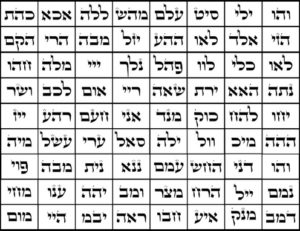
The 72 Names of God (For the origin of these Names, see here.)

Finally, the last word for a serpent in Tanakh is ef’eh (אפעה), as we read in the Book of Job that “He sucks the head of a viper; the tongue of the ef’eh kills him.” (20:16) This one parallels the Sefirah of Yesod, the domain of sexual purity. In fact, the Kabbalists teach that of the 72 Names of God, the one that links to Yesod and through which one can atone for sexual sins is חב״ו. In the Amidah, there is a kavanah to insert during the kibbutz galuyot blessing to purify one of wasted seed and other sexual issues and it quotes a well-known phrase chayil bala’a vayakienu, mibitno yorishenu El, “The riches that he swallowed he vomits; God empties it out of his innards.” The letters of the first three words (חַיִל בָּלַע וַיְקִאֶנּוּ מִבִּטְנוֹ יֹרִשֶׁנּוּ אֵל) spell חב״ו. And where does this powerful verse come from? The preceding one in Job! (20:15) Thus, we have a clear Scriptural link between the ef’eh and Yesod.
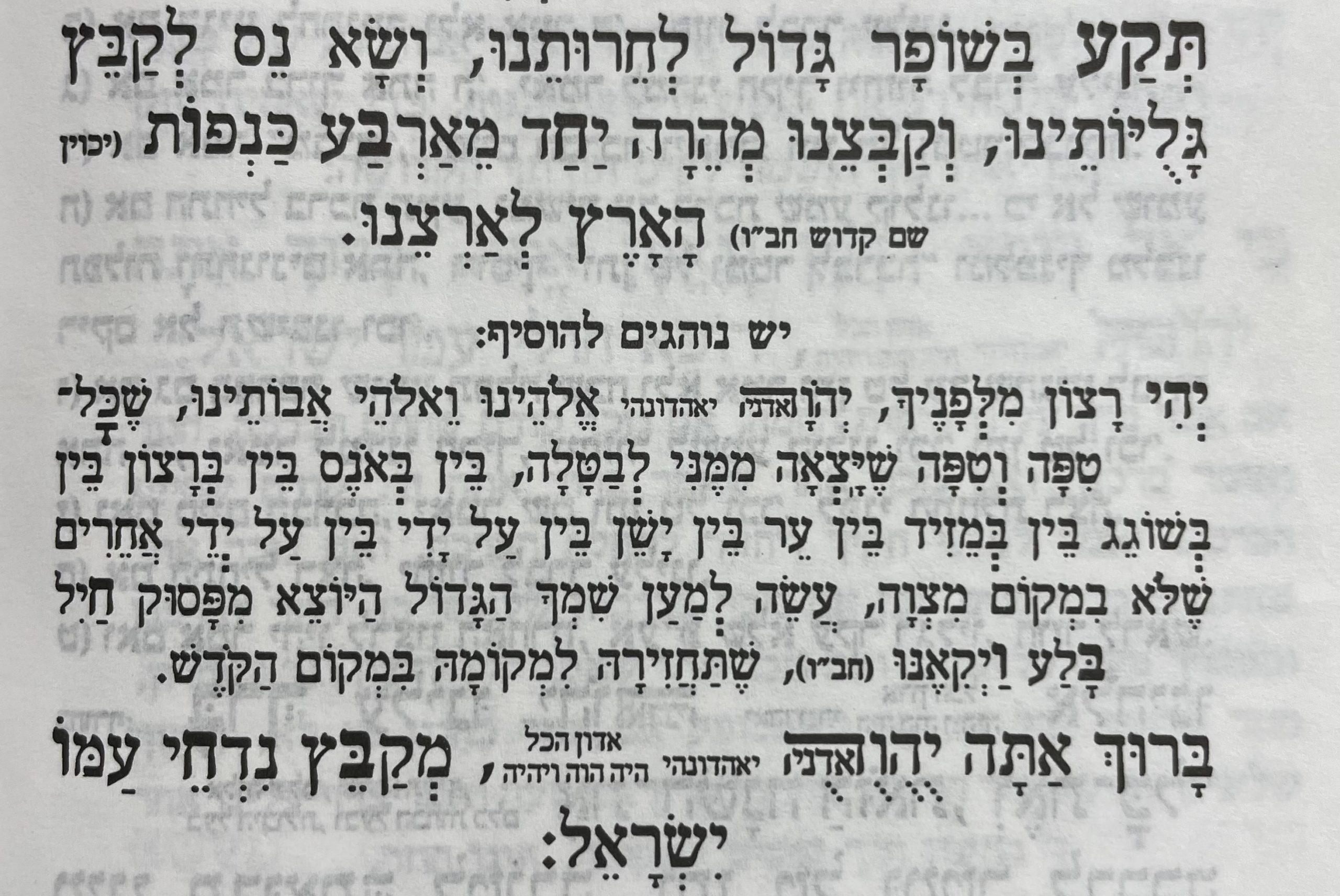
Text of the blessing, with kavanah, both highlighting the חב״ו name.

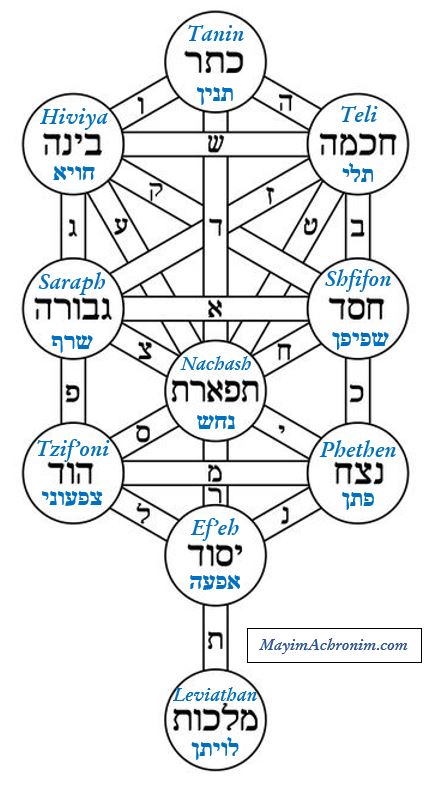
And what of the Mochin, the upper three Sefirot? Perhaps we can link them to serpentine terms outside of Scripture. For instance, there’s the Teli (תלי) of Sefer Yetzirah (6:1-2), typically understood as the dragon constellation Draco. Recall that Sefer Yetzirah is an exposition of the Lamed-Bet Netivot Chokhmah, 32 Paths of Wisdom, so the Teli is directly linked to the Sefirah of Chokhmah. Then there’s the Talmud’s Aramaic hiviya (חויא), the root of which is said to come from Eve (חוה), and her encounter with the Snake. This would parallel the “motherly” Sefirah of Binah (also called Ima). And Keter on top, the origin of all the others, would be the generic term Tanin (תנין) with which we started, referring to any of the serpents below and often used interchangeably with them, as in this week’s parasha. Altogether, we have the following array of links between mystical Sefirot and mystical serpents:
Judaism vs. Hinduism

Are Hindus spiritual descendants of the Biblical Abraham? Find out in this class where we explore the many things that Judaism and Hinduism have in common, how our histories have been intertwined for millennia, and why India and Israel are natural allies on the global stage. Also discussed: Are there Lost Tribes of Israel in India? How does Judaism view reincarnation? What are the mystical 72 Names of God? And who was the Talmud’s mysterious Rabbi Yehuda the Hindu?

For more, see ‘Holy Cow: Parallels Between Judaism and Hinduism’.

For more on the Third Eye in Judaism, please see here.

For the incredible life of Mirra Alfassa, see here, and for an amazing Jewish story with Swami Vijayananda, here.

Ushpizin & Anti-Ushpizin

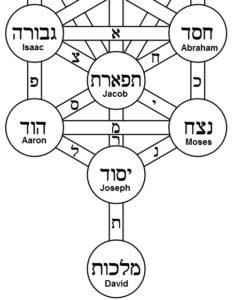
Over the course of Sukkot, we are graced with the spiritual presence of the “Seven Shepherds of Israel”: Abraham, Isaac, Jacob, Moses, Aaron, Joseph, and David. These Heavenly guests are commonly known as the ushpizin. Interestingly, the root ushpiz or oshpiz, “guest”, actually comes from the Latin hospis, as in the English “hospitality”! What is the origin of the notion of Seven Shepherds? Where did the practice of inviting the ushpizin come from? And who are the mysterious “anti-ushpizin” that oppose the Seven Shepherds?

Origins of Ushpizin

‘Micah Extorting the Israelites to Repentance’, by Gustave Doré

The idea of Seven Shepherds of Israel comes from the Tanakh, from the prophet Micah. The fifth chapter of his book begins by telling us that an ancient soul of Judah, mikedem mimei olam, will emerge out of Bethlehem of Efrat to be moshel b’Israel, a ruler of Israel. The next verse tells us it will come at a time of great desperation for Israel, following a series of “birth pangs”. This leader will be righteous, and serve in the name of God. We might think this is referring to Mashiach, but the chapter continues to warn that Assyria will invade and drive Israel into exile. It’s quite clear that Micah is speaking about the near future, and the Judean leader he envisions is the righteous Hezekiah, who drove away the Assyrian invasion and miraculously saved Jerusalem. Indeed, the Talmud (Sanhedrin 98b) records an opinion that all of the Messianic prophecies of the Tanakh were referring to Hezekiah!

Nonetheless, this chapter of Micah is seen as a “double-level” (or “dual-fulfilment”) prophecy, one that spoke of the near future in Micah’s own days, and also cryptically referred to a future time at the End of Days. This is how Rabbi Shimon bar Yochai read it, for instance, and saw “Assyria” here as secretly referring to Persia at the End of Days, who will invade Israel in the final apocalyptic war (Eichah Rabbah 1:41). Whatever the case, Micah 5:4 says that God will raise up “seven shepherds and eight princes of men” against the invaders. Again, the Midrash (Bamidbar Rabbah 14:1) wonders if this means there will be seven or eight messianic figures in the End of Days, and concludes that there will actually be four:

There is a great debate with regards to how many messiahs there will be. Some say there will be seven, as it is said “then shall we raise against him seven shepherds…” (Micah 5:4) And some say there will be eight, as it is said, “and eight princes of men.” And it is neither of these, but actually four, as it is said, “And the Lord showed me four craftsmen…” (Zechariah 2:3)

And David came to explain who these four craftsmen are [Psalms 60:9 and 108:9, where God declares: “Gilead is mine, Menashe is mine; Ephraim also is the defence of my head; Judah is my sceptre”]: “Gilead is mine” refers to Elijah, who is from the land of Gilead; “Menashe is mine” refers to the messiah who comes from the tribe of Menashe… “Ephraim is the defence of my head” refers to the Warrior Messiah who comes from Ephraim… “Judah is my sceptre” refers to the Great Redeemer, who is a descendant of David.

That said, the seven shepherds must refer to other figures. The Talmud (Sukkah 52b) explains: “Who are these seven shepherds? David is in the middle; Adam, Seth, and Methuselah are to his right; Abraham, Jacob, and Moses are to his left. And who are the eight princes among men? They are Yishai, Saul, Samuel, Amos, Zephaniah, Zedekiah, Mashiach, and Elijah.” The Sages seem to suggest that alongside Mashiach and Eliyahu, the souls of thirteen other great figures of the past come back to help them. Glaringly missing from the list of seven shepherds is Isaac. Why is he the only one of the Forefathers not included? Any why include Seth? Are there not greater figures of that era, like Noah and Enoch?

Some would explain Isaac’s omission from the shepherds by pointing out that, well, Isaac wasn’t really a shepherd! The Torah describes him digging wells and irrigating farms, his blessed crop producing me’ah she’arim, hundred-fold yields. A deeper explanation is given by the Arizal, who says that Itzhak (יצחק) is an anagram of ketz chai (קץ חי), “lives at the End”, as he will come back at the End of Days in the form of Mashiach ben Yosef, the “Warrior Messiah” mentioned above. The name Itzhak itself is in the future tense, meaning “he will laugh”—in the future when he is victorious in battle. The Arizal even proves it mathematically, as the value of Itzhak (יצחק) is 208, equal to Ben Yosef (בן יוסף)! (See Sha’ar haPesukim on Lech Lecha, for instance, and also the Ba’al haTurim on Deuteronomy 7:21.)

Noah was not a shepherd either, but a farmer. Enoch was a scribe and scholar, and transformed into an angel. That leaves Adam, Seth, and the longest-living Methuselah to represent the pre-Flood generations. Aaron was not a shepherd in Egypt, and served as high priest after the Exodus. Joseph was a shepherd-in-training in his teens, but did not return to that profession in Egypt. Instead, he oversaw all of Egypt’s farming operations and granaries. That leaves us with David, Abraham, Jacob, and Moses.

The lower 7 Sefirot correspond to the 7 Shepherds of Israel

The Zohar (III, 103b) comes in and tells us that holy figures of the past visit us on Sukkot, and this is the source for ushpizin. However, the Zohar only states “Abraham and five other tzadikim”, followed by another opinion that it’s “Abraham and five other tzadikim, plus David”. The Zohar doesn’t say who those five others are directly, but does quote Isaac and Jacob speaking. The whole passage itself comes from the mouth of Ra’aya Mehemna, the “Faithful Shepherd”, who is Moses. Right before this, Aaron is mentioned, for it was in his merit that the Clouds of Glory—which the sukkah is likened to—appeared in the Wilderness. The only one missing is Joseph. However, the Zohar always parallels such things to the Sefirot, and the six righteous figures are meant to correspond to the six Sefirot of Zeir Anpin, from Chessed to Yesod. The figure that always stands in for Yesod is Yosef haTzadik. David, meanwhile, is always paralleled to the seventh Sefirah of Malkhut. In this way, we find our Seven Shepherds, as we know them, in the Zohar.

The Anti-Ushpizin

Elsewhere, the Zohar (Sitrei Otiyot on Beresheet) says that the world endures in the merit of these Seven Shepherds of Israel. Opposing them are seven shepherds that stem from the “Left Side” or “Other Side”, the Sitra Achra. They seek to shepherd Israel away from God and towards idolatry. This is the meaning behind Jeremiah 15:9 which reads “She who bore seven is forlorn, utterly disconsolate; her sun has set while it is still day, she is shamed and humiliated. The remnant of them I will deliver to the sword, to the power of their enemies—declares God.” The Zohar lists the “anti-ushpizin”: Jeroboam, Ba’asha, Ahab, Yehu, Pekah, Menachem ben Gaddi, and Hoshea ben Elah. Who are these people?

Recall that Yerovam ben Nevat, “Jeroboam”, was the first king of the northern Kingdom of Israel after the split following King Solomon’s reign. Afraid to lose his throne and grip on power, he set up roadblocks so that his Israelites wouldn’t go to Jerusalem for the pilgrimage festivals. Instead, he built two idolatrous temples with golden calves. For this, the Sages say he has no share in the World to Come (Sanhedrin 10:2).

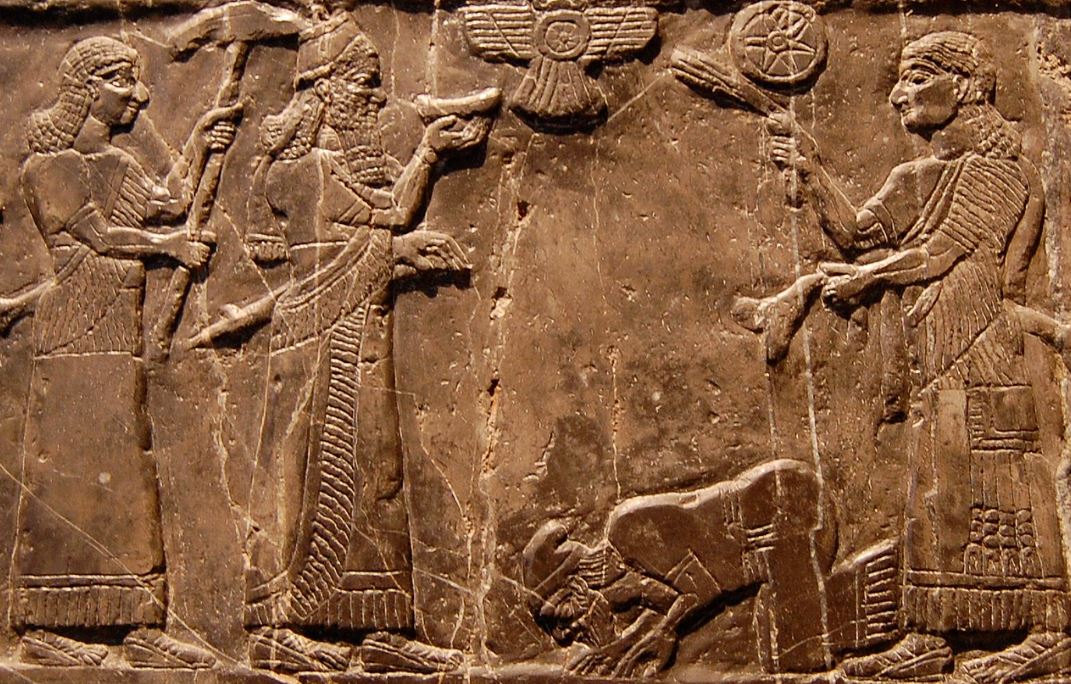
Ba’asha ben Achiya was the third king of Israel. He spent his reign at war with the Kingdom of Judah, and even allied with Aram at one point. He continued the wicked ways of Jeroboam, so God declared he would obliterate Ba’asha just as he did Jeroboam (I Kings 16:3). King Ahab is well-known, being the husband of the wicked idolatrous Queen Jezebel, and the tormenter of Eliyahu. His dynasty was destroyed by Yehu ben Nimshi, originally a military general. Yehu was used as an instrument by God to carry out Ahab’s punishment. However, Yehu went a step too far and bloodily massacred countless people in the Valley of Jezreel. Although God initially rewarded him with a multi-generational dynasty, He did declare that He would eliminate Yehu’s dynasty for the cruelty at Jezreel (Hosea 1:4). Amazingly, we have archaeological evidence clearly confirming Yehu and his story, from the Assyrian Black Obelisk.

King Yehu of Israel giving tribute to King Shalmaneser III of Assyria, on the Black Obelisk of Shalmaneser III from Nimrud (circa 827 BC), currently in the British Museum.

Menachem ben Gaddi was another such general-turned-king. We know little about him. So was Pekah ben Remalyahu. He allied with King Rezin of Aram to attack Jerusalem. The Judeans were terrified, and it was in the context of this that Isaiah relayed his famous prophecy about the miraculous birth of a saviour child (Isaiah 7). Although it is abundantly clear that the passage is speaking about Hezekiah—who did go on to save Judea and Jerusalem as a young, righteous ruler—Christians infamously interpreted the prophecy to refer to the birth of Jesus (reading the word almah, a “young lady”, as “virgin”). Their argument that this, too, is a “double-level” or “dual-fulfilment” prophecy speaking about both contemporary times and future times cannot be the case. A double-level prophecy must not give a specific time, in order to allow interpretation for the present and the future. This prophecy clearly states the events are supposed to happen “in 65 years” (Isaiah 7:9). A specific time is given, leaving no ambiguity. The Tanakh continues to relay how the prophecy was fulfilled.

Pekah was assassinated by Hoshea ben Elah. The Assyrian King Tiglath-Pileser III then appointed Hoshea as the new (and final) king of Israel. An Assyrian inscription confirms this, too, stating that the Israelites rebelled and “overthrew their king Pekah and I placed Hoshea as king over them. I received from them 10 talents of gold, 1,000 talents of silver as their [tri]bute and brought them to Assyria.” Hoshea didn’t last long. One of Tiglath-Pileser’s successors soon destroyed the northern Kingdom of Israel and exiled the tribes.

The souls of these seven idolatrous kings stand in opposition to the souls of the holy Seven Shepherds. We find that the Seven Shepherds of Israel were all about unity, bringing people together to serve God and inspire righteousness. The anti-shepherds, meanwhile, were power-hungry and vindictive, instigators of division and civil war, propagators of idolatry, and collaborators with Israel’s enemies. On Sukkot, we welcome in the spirit of the righteous ones as we bring people together in our huts. And we hope to expel the spirit of idolatry and divisiveness, of the wickedness stemming from “the Left Side”. This is all the more important to keep in mind and meditate on as we see what is happening all around us today in the Holy Land and the world at large.

Chag sameach!


More Sukkot learning resources:

Medicinal Properties of Arba Minim
Russia, Iran, and Gog u’Magog
What is Happiness?