Tag Archives: Vayishlach

The Incredible History and Absurd Politics of Rachel’s Tomb

In this week’s parasha, Vayishlach, we read about Jacob’s return to the Holy Land after twenty years in Charan. After some time, Jacob and the family make a stop in Beit El, where Jacob first encountered God decades earlier. God appears to Jacob once more, and promises that “the land which I gave to Abraham and to Isaac, I will give to you and to your seed after you” (Genesis 35:12). God makes it clear that the Holy Land is designated solely for the descendants of Jacob—not the descendants of Esau, and not the descendants of Ishmael, or any other of Abraham’s concubine sons. It is the land of Israel, the new name that Jacob receives in this week’s parasha.

In fact, in this parasha we see mention of many Israelite sites, both ancient and modern, such as Hebron and Bethlehem. In our day, all of these are unfortunately within the political entity typically referred to as the “West Bank”. This title comes from the fact that the area is geographically on the west side of the Jordan River. Initially, the British Mandate for Palestine included both sides of the Jordan River, before the British gave the east to the Arabs to create the state of Jordan. This was the original “partition plan” for Palestine, with the eastern half meant to serve as the Arab state and the western half to become a Jewish one. Many have forgotten this important detail.
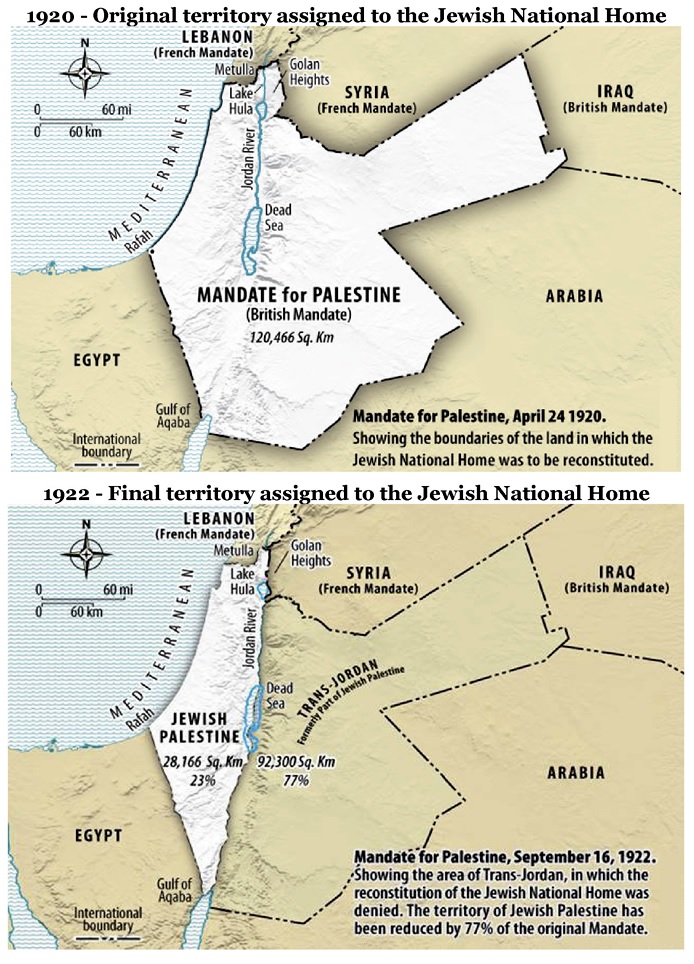
British Mandate for Palestine – Before and After (Credit: Eli E. Hertz)
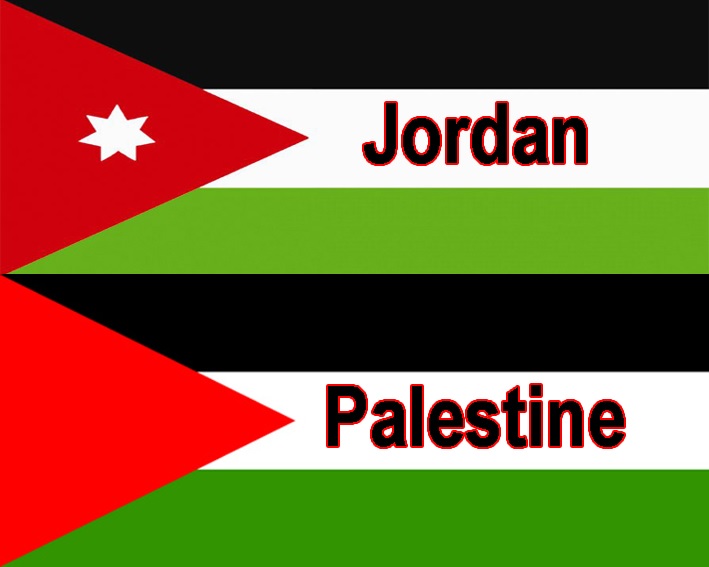
The current flags of the state of Jordan and the Palestinian movement. It is estimated that about half of Jordan’s current population of 9.5 million is Palestinian Arab.

Nonetheless, the unsuitable title of “West Bank” has stuck ever since. Some rightly avoid using the term in favour of the more appropriate “Judea and Samaria”. Truthfully, even this title is not entirely accurate, for the region is nothing less than the very heartland of Israel, the location of the vast majority of Biblical events, and the home of a plethora of Jewish holy sites. Among them is the tomb of Rachel, as we read in this week’s parasha (Genesis 35:16-20):

And they journeyed from Beit El, and there was still some distance to come to Ephrath, and Rachel gave birth, and her labor was difficult… So Rachel died, and she was buried on the road to Ephrath, which is Bethlehem. And Jacob erected a monument on her grave; that is the tombstone of Rachel until this day.

Throughout history, Rachel’s tomb was one of the most venerated sites in Judaism, and is often described as the Jewish people’s third-most holiest site (after the Temple Mount/Western Wall and Cave of the Patriarchs). As early as the 4th century CE the historian Eusebius already wrote of Rachel’s tomb being a holy site for Jews and Christians. Keep in mind that this is two centuries before anyone even whispered Islam. Not that it really matters, since Islam does not consider this a particularly special place. The Arab-Muslim historian and geographer of the 10th century, Al-Muqaddasi, doesn’t even mention Rachel’s tomb in his descriptions of Muslim-controlled Israel and its holy sites.
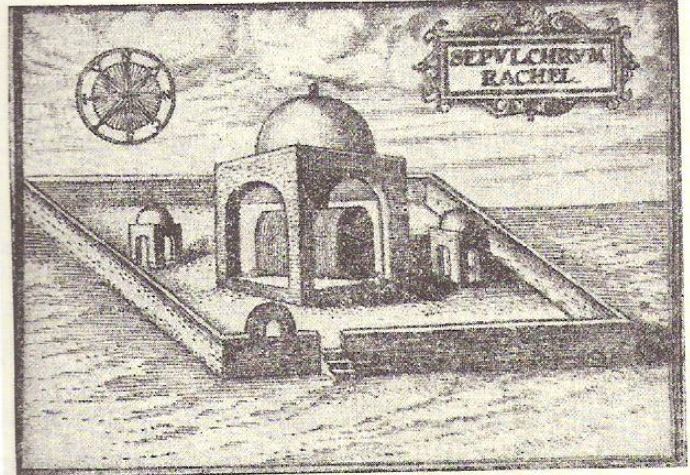
1585 Illustration of Rachel’s Tomb

Meanwhile, the Jewish traveler and historian Benjamin of Tudela (1130-1173) describes Rachel’s tomb in detail as being a domed structure resting upon four pillars, with Jewish pilgrims regularly visiting and inscribing their names on the surrounding eleven stones (representing the Tribes of Israel, less the tribe of Benjamin, as Rachel died giving birth to him). The earliest Muslim connection to the tomb is in 1421, when Zosimos mentions a small mosque at the site. (“Zosimos the Bearded” was a Russian Orthodox deacon famous for proposing the Moscow-Third Rome principle—which may be of great significance for calculating the time of Mashiach’s coming, as we’ve written in the past.)

The Ottomans originally transferred ownership of the site to the Jewish community (in 1615) but later reneged on the promise and even built walls to prevent Jews from going there, according to the British priest and anthropologist Richard Pococke (1704-1765). Pococke writes that the Ottomans used the area as a cemetery. Nonetheless, Jews could not be kept away from their millennia-old holy site, and continue to make pilgrimages. Christian writers G. Fleming and W.F. Geddes note in their 1824 report that “the inner wall of the building and the sides of the tomb are covered with Hebrew names, inscribed by Jews.”
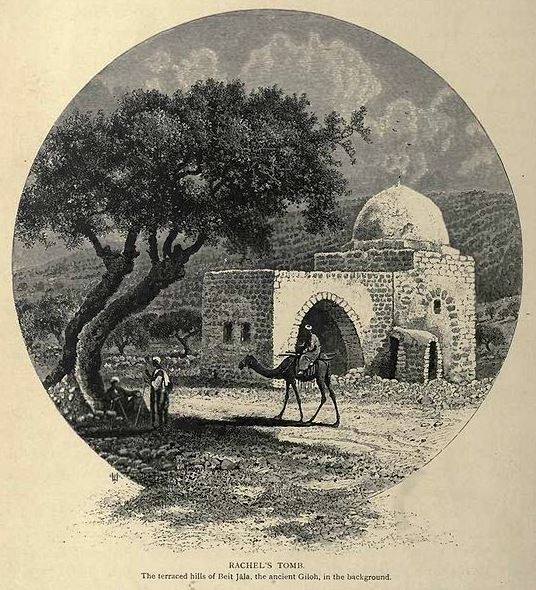
1880 Illustration of Rachel’s Tomb

Six years later, the Ottomans officially recognized Rachel’s tomb as a Jewish holy site again, and ten years later the site was purchased by famous Sephardic Jewish financier and philanthropist Moses Montefiore. Montefiore rebuilt the crumbling tomb, and even constructed a small adjacent mosque to appease the local Muslims. Around this time, British writer Elizabeth Anne Finn, who lived in Jerusalem while her husband was the consul there, wrote that Jerusalem’s Sephardic Jews never left the Old City unless to pray at Rachel’s tomb. Similarly, the Missionary Society of Saint Paul the Apostle wrote in 1868 that Rachel’s tomb

has always been held in respect by the Jews and Christians, and even now the former go there every Thursday, to pray and read the old, old history of this mother of their race. When leaving Bethlehem for the fourth and last time, after we had passed the tomb of Rachel, on our way to Jerusalem, Father Luigi and I met a hundred or more Jews on their weekly visit to the venerated spot.

Later, Jewish businessman Nathan Straus (of Macy’s fame) purchased even more land around the site that Montefiore had purchased. (Interestingly, Montefiore’s own tomb in England is a replica of Rachel’s tomb.)

Under the British Mandate, Jewish groups applied on multiple occasions for permission to repair the site, but were denied because of Muslim opposition. The Muslims themselves didn’t bother repairing it, of course. Conversely, many of them were (and still are) happy to attack the site whenever an opportunity presents itself:

Throughout the 1800s, the local e-Ta’amreh Arab clan had blackmailed the Jews to pay up 30 pounds a year or else they would destroy the tomb. In 1995, Arabs—led by a Palestinian Authority governor—attacked Rachel’s tomb and tried to burn it down. In 2000, they laid a 41-day siege on the site during the Second Intifada. In light of this, it made total sense when UNESCO declared in 2015 that Rachel’s tomb is a Muslim holy site that is “an integral part of Palestine”. The laughable resolution only confirms the senselessness and irrelevance of the United Nations.

Had they bothered to look at the historical record, they would have seen that Rachel’s tomb is, was, and always will be a Jewish holy site of immeasurable significance. Countless Jewish pilgrims have experienced miracles there, particularly for health and fertility. According to tradition, Rachel is the only matriarch to be buried outside of the Cave of the Patriarchs so that her spirit can weep and pray for her children in exile. Her prayers are successful, for we are in the midst of the exile’s final end, as prophesied by Jeremiah (31:14-16):

Thus said Hashem: “A voice is heard in Ramah, in lamentation and bitter weeping.” It is Rachel, weeping for her children. She refuses to be comforted for her children, because they are not. Thus said Hashem: “Refrain your voice from weeping, and your eyes from tears, for your work shall be rewarded,” said Hashem. “And they shall return from enemy lands. And there is hope for your future,” said Hashem. “And the children shall return to their borders…”


The above essay is adapted from Garments of Light, Volume Three.
Get the book here! 
Embracing Converts, and the Seeds of Amalek

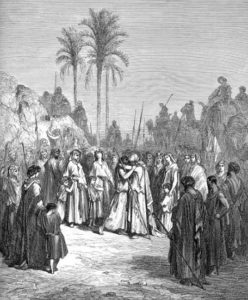
'The Meeting of Jacob and Esau' by Gustav Doré

‘The Meeting of Jacob and Esau’ by Gustav Doré

This week’s parasha is Vayishlach, which recounts Jacob’s return and settlement in the Holy Land after twenty years of living in Charan. At the end of the parasha is a long list of the genealogies of Jacob’s brother, Esau. The list seems unnecessary, and many Sages have wondered why the Torah bothers to spend so much time recounting Esau’s descendants. There have even been debates on whether the entire text of the Torah is equally holy, or if passages like the Ten Commandments are holier than passages such as this list of Esau’s genealogies. Meanwhile, the Arizal states that many of the deepest secrets of Creation are embedded particularly in this seemingly boring and superfluous passage. He draws particular significance from the list of the kings of Edom. The Arizal says these kings are codenames for the Sefirot, and a careful reading of the text reveals the cosmological rectifications (tikkunim) required to repair all of Creation and restore the world to perfection.

About half way through the list we are told that “… the sister of Lotan was Timna” (Genesis 36:22). Again, the Sages are baffled at this extra addition. We already care little enough that there was once an Edomite chief named Lotan – who cares that he had a sister named Timna? The Talmud (Sanhedrin 99b) notes how there were those who scoffed at such verses, saying: “Did Moses have nothing better to write?” And then, the same page of Talmud comes in to explain its tremendous significance:

Timna was a royal princess… Desiring to become a proselyte, she went to Abraham, Isaac and Jacob, but they did not accept her. So she went and became a concubine to Eliphaz the son of Esau, saying, “I’d rather be a servant to this people than a mistress of another nation.” From her, Amalek was descended, who afflicted Israel. Why so? Because they should not have repulsed her!

The Talmud combines the verse in question – which states that Timna was the royal sister of the chief, or prince, Lotan – with an earlier verse (36:12) that says she married Esau’s son Eliphaz and bore Amalek. She wished to convert to Judaism and approached the Patriarchs. All three rebuffed her. So, she ended up with Eliphaz – the closest she could get to being part of the nation. This union gave rise to the evil Amalek, that antagonizing force which has been oppressing Israel for millennia. The Sages state that the Patriarchs should have embraced this potential convert, instead of pushing her away. Their failure to open their arms led to centuries of Jewish suffering. The Talmud sends a pretty clear message: gentiles and converts should not be turned away, and doing so only breeds more resentment against Jews, bringing out all of the world’s “Amaleks”.

Soulmates of Jacob and Moses

The Arizal comments on the Timna passage and points out something even more amazing. He taught (Sha’ar HaMitzvot, Shoftim) that Timna was actually the soulmate of Jacob! Timna contained a great deal of holiness, and Jacob was meant to convert her and marry her, thereby elevating her spiritual sparks. That would have been a massive tikkun of its own, and would have hastened the coming of Mashiach. Instead, Jacob rejected her, and she went on to produce Amalek, bringing evermore evil into the world, and further delaying the coming of Mashiach.

The Arizal highlights that Moses made a similar mistake in not consummating his marriage to the Cushite (Ethiopian) woman. Both Tzipporah and the Cushite woman were Moses’ soulmates, and while Moses did the right thing in converting the Cushite, he never properly married her. Her sparks of holiness were not fully elevated, and the tikkun was left incomplete. This is why Aaron and Miriam were upset with their brother, as we read later in Numbers 12:1, “And Miriam and Aaron spoke against Moses because of the Cushite woman whom he had married…”

Rabbi Akiva’s 24,000 Students in Shechem

In this week’s parasha, too, we read how the people of Shechem genuinely wished to unite with Jacob’s family, agreed to circumcise themselves, and converted en masse. However, Jacob’s sons Shimon and Levi rejected them and resorted to violence in avenging what was done to their sister Dinah. Jacob was horrified at the actions of his sons, and later did not bless the two on his deathbed. It appears their sin was never forgiven, as hundreds of years later the tribes of Shimon and Levi were not given set borders within the Holy Land, but only a handful of cities interspersed among the other tribes. Kabbalistic texts reveal that Shimon and Levi killed 24,000 people in Shechem, and these 24,000 converted souls later reincarnated as the 24,000 students of Rabbi Akiva!

Did You Know These Famous People Converted to Judaism?

All of these narratives point to the same lesson: converts should be welcomed and accepted wholeheartedly. They have the potential for great holiness. The Talmud (Bava Kamma 38a) states that a gentile who occupies himself with Torah is equal to a kohen gadol, a High Priest! The Arizal describes five types of Jewish souls, and the souls of converts are among the purest. (The other types are “Old Souls”, “New Souls”, “True New Souls”, and the “Souls of Cain and Abel”. Of these, the most impure are Old Souls.) It goes without saying that there is no place for racism of any kind within Judaism – Moses himself married a black woman, and was reprimanded for not being diligent in consummating that union.

Historically, Jews were never the proselytizing kind. There are no Jewish missionaries that go out knocking on the doors of gentiles to seek converts. At the same time, Judaism was rarely a popular religion to convert in to. But this will change very soon, and we have to be ready for that day, for the prophet Zechariah (8:23) predicted:

It shall come to pass that ten men shall take hold – from all the languages of the nations – shall take hold of the corners of a Jew’s clothes, saying: “We will go with you, for we have heard that God is with you…”


The above essay is an excerpt from Garments of Light, Volume One. Get the book here!

What It Really Means to Be “Israel”

This week’s parasha, Vayishlach, begins with Jacob’s return to the Holy Land following a twenty-year stay in Charan. The most famous passage of this parasha is Jacob’s battle with a certain angel. After its defeat, the angel gives Jacob a blessing and renames him Israel. What is the meaning of “Israel”? What was the purpose of this battle to begin with? And what does it all have to do with Jacob’s difficult twenty years in servitude to his deceiving father-in-law Laban?

Jacob vs. Esau

The Torah describes in quite some detail the conception, birth, and early lives of the twins Jacob and Esau. We see that Jacob was an “innocent man, sitting in tents” while Esau was a “hunter, a man of the field.” As twins, and the only children of Isaac and Rebecca, they were meant to work together in carrying on the divine mission started by their grandfather Abraham. The mission was to rectify the world, and fill it with true Godliness and righteousness. Such work mainly consists of educating others, doing good, and spreading the light. However, when that doesn’t work, it is also necessary to fight evil head-on. This was exemplified well by Abraham, who was both a wonderful preacher and, occasionally, a fearless warrior (as in the “War of the Kings” in Genesis 14).

Jacob and Esau were meant to take this to the next level. Thus, Jacob was blessed with extra intellect, wit, and spirituality, while Esau was blessed with extra strength, physical abilities, and ambition. In an ideal world, Jacob would have acted as the peaceful teacher, while Esau would defeat any remaining evil in battle. As partners, they would have been unstoppable in bringing light, morality, and a new God-consciousness to the world.

Unfortunately, the two couldn’t channel their blessings in the right direction. Esau’s physicality got the better of him, and he descended into a never-ending spiral of materialism. At the same time, Jacob used his cunning to take Esau’s birthright instead of using his intellect to put his brother back on the right path. Nonetheless, Jacob remained dedicated to fulfilling his divine mission, while Esau “despised his birthright” (Genesis 25:34).

By taking Esau’s birthright and blessing, what Jacob had done was to take Esau’s mission upon himself. He, too, would have to become a fighter. However, Jacob was born soft and meek—not fit for battle—while Esau was the one born muscular and hairy, as if already a grown man (hence his name Esav, literally “complete”). Could Jacob really become that holy warrior that Esau was meant to be? Jacob had to be put to the test.

Becoming Israel

Right after receiving Esau’s blessings, Jacob was told that his brother was out to get him. The soft Jacob immediately fled the Holy Land, as far away from his brother as he could. This was true to his character as a docile man, “sitting in tents”. But this was clearly not what a holy warrior would do.

Jacob ended up in the home of his uncle and future father-in-law, Laban. He instantly fell in love with Laban’s younger daughter Rachel, and agreed to work for Laban for seven years to be able to marry her. After seven years, Jacob was tricked into marrying the elder Leah instead of his beloved Rachel. It is hard to miss the irony of it all: Jacob, the one who tricked his father into getting his older brother’s blessing, is now tricked by his father-in-law into marrying his beloved’s older sister!

Laban forces Jacob to work for another seven years. This is, of course, completely unjust. A man such as Esau would have surely taken on Laban in combat, but the spineless Jacob simply agrees, and slaves away for seven more years. Following this, Laban finds more ways to trick Jacob out of an honest wage. Thankfully, Jacob is starting to learn, and begins to counter Laban’s wits with his own, soon building even greater wealth than his father-in-law.

At this point, Jacob hears that Laban is not very pleased with Jacob, and Jacob fears for himself and his family once again. As he did twenty years earlier, he decides to flee. While Laban was away shearing his sheep, Jacob takes the opportunity to run, taking the whole family with him. It appears that Jacob fails the test yet again, and is unable to confront his evil enemies.

Ten days later, Laban and his men find Jacob, and everything begins to change. Laban waltzes in to Jacob’s camp and begins threatening his son-in-law as he’d always done in the past. But this time Jacob has had enough, and realizes he can’t run away anymore. “And Jacob was angered, and battled with Laban” (Genesis 31:36). Jacob succeeds, and Laban seeks a peace treaty (v. 44). The two make a pact and part ways, never to see each other again. Jacob is becoming a fighter.

Jacob vs. Israel

This sets up parashat Vayishlach, where Jacob has to face off with Esau twenty years after running away from him. The night before, Jacob goes off on his own and is confronted by a mysterious figure (see ‘With Whom Did Jacob Wrestle? in Volume One of Garments of Light). The two battle it out all night long, and Jacob finally prevails. He is certainly no longer that weak, passive man he was two decades earlier. He has earned his badge of being a holy warrior. And with this, he is given a new name: Israel, one who “battles with God”; not against God, but alongside God, to defeat evil and make the world a better place. Jacob finally proves that he can indeed be Esau, and is worthy of having taking Esau’s birthright and blessing.

The Sages tell us that this is the real reason why Jacob had to marry both Rachel and Leah. Originally, since Rebecca had two sons and Laban had two daughters, the plan was for the younger Jacob to marry the younger Rachel, while the older Esau would marry the older Leah (Bava Batra 123a). Truly, these two couples were soulmates. However, Esau lost his spiritual essence to Jacob, and with it, his spiritual counterpart, Leah. The problem is that the Torah forbids a man from marrying two sisters! The Arizal (Sha’ar HaPesukim on Vayetze) tells us that, in fact, Rachel and Leah did not marry one man, for Jacob and Israel were really two souls in one body, and while Jacob married Rachel, it was Israel that married Leah. After all, Israel was the new Esau, the part of Jacob that wasn’t just “sitting in tents” but was capable of being a “man of the field”, too.

We later see that Israel was Jacob’s true self, his more-elevated inner being, and what he was really meant to be all along. God confirms this with a prophetic blessing (Genesis 35:10): “‘You shall no longer be called Jacob, but Israel shall be your name.’ And He named him Israel.”

This brings a tremendous lesson for all of us: we are not meant to be the weak Jacob, passively sitting in tents and being pushed around. Rather, we are meant to be Israel, who can balance study and prayer with strength and might; who can balance the physical with the spiritual, science with religion, and who knows both when to seek peace and when to pursue war. It is most fitting that the founders of the modern Jewish State decided to call it “Israel”. (In fact, they had originally planned to call it “Judah”, then “Zion”, and even “Tzabar”, before voting 7 to 3 in favour of “Israel”). If Israel is to fulfill its divine task, it should live up to its name: battling alongside God, as holy, righteous warriors, to repair the world—physically and spiritually—restoring it to its original, perfected state.


The above is an excerpt from Garments of Light, Volume Two. Get the book here