
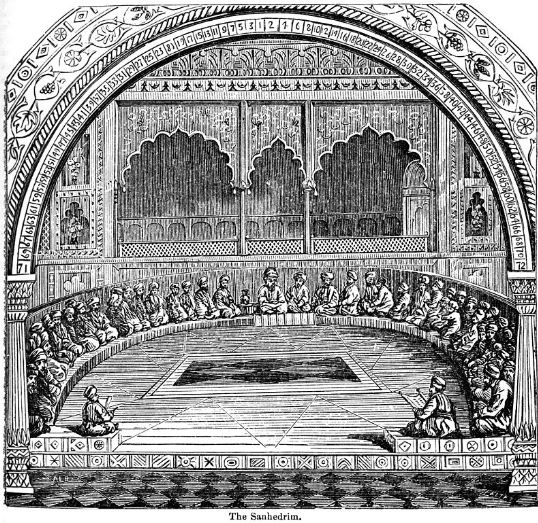
 In this fifth week between Pesach and Shavuot, it is customary to read the fifth chapter of Pirkei Avot. We read that “Every dispute that is for the sake of Heaven, will in the end endure; But one that is not for the sake of Heaven, will not endure.” (5:17) And then we are given an example of a dispute that was “for the sake of Heaven”, that of Hillel and Shammai. Recall that Hillel and Shammai were the leaders of the two main schools of Jewish learning roughly 2000 years ago in Judea. Hillel was president of the Sanhedrin, while Shammai was the deputy. Hillel passed away around the year 10 CE, and Shammai some time after that.
The Talmud (Eruvin 13b) states that the schools of Hillel and Shammai debated for 3 years about whose interpretation of Jewish law is correct, until a Bat Kol, a Divine Voice, resonated from Heaven to declare that the halakhah should follow Beit Hillel. The Bat Kol acknowledged that both interpretations are “words of the living God” or, more accurately, “the living Word of God”, but the scholars of Hillel’s school won. The Talmud explains why: “Because they were agreeable and forbearing, and would teach both their own statements and the statements of Beit Shammai.” And so, halakhah has generally followed Hillel ever since. That said, some things did come from Beit Shammai, most notably the 18 Decrees that include pat israel, gevinat akum, and by extension, chalav israel. Today, it is often repeated that in the forthcoming Messianic Age, the halakhah will switch to follow Beit Shammai entirely. Where did this idea come from, and does it have any validity?
Looking through the early sources, one will not find such a statement anywhere; not in the Mishnah, Talmud, Midrash, or Zohar, or any Rishonim for that matter. People sometimes point to the Arizal, but I have not seen anywhere in our available writings of the Arizal’s teachings where this is explicitly stated. Some say it comes from a student of the Arizal, Rabbi Shmuel de Uçeda (1545-1604), one of the Tzfat Kabbalists, yet he does not state this either. In his Midrash Shmuel commentary on the above verse in Avot, he only states that the meaning of the dispute “enduring” is that Jews will always study the approaches of Hillel and Shammai forever. He does not say halakhah will switch to follow Beit Shammai, just that we will continue to learn Shammai’s interpretations and arguments, as we always have.
It seems the first notable source to suggest that the halakhah will switch to Shammai, based on the teachings of the Arizal, is Moroccan kabbalist Rabbi Shalom Buzaglo (c. 1700-1780). In his Mikdash Melekh on Zohar I, 17b (where the Zohar links the Hillel-Shammai dispute to the separation of the waters on Day Two of Creation, as analyzed previously here), he writes:
פי’ כל מחלוקת שהוא לש”ש סופה להתקיים כי יצתה ב”ק ואמרה אנו ואלו דברי א”ח כי גם דברי שמאי יש להם שרש למעלה. ועם שאין הלכה כמותם בעוה”ז סופה להתקיים לעתיד. וכמ”ש האר”י ז”ל על משנה זו שלעתיד בזמן המשי’ תהיה הלכה כבית שמאי …
The meaning of “Every dispute that is for the sake of Heaven, will in the end endure” is that the Bat Kol came out and said “These and these are the living Word of God” because Shammai’s teachings also have a supernal source. And even though the halakhah is not according to them in this world, it “will in the end endure” in the future. This is as the Arizal taught on this Mishnah, that in the future, in the time of Mashiach, the halakhah will follow Beit Shammai…
Rabbi Buzaglo attributes the idea to the Arizal, although we have no such source available to us today. The notion was then further popularized by the Alter Rebbe (Rabbi Schneur Zalman of Liadi, 1745-1812, first rebbe of Chabad). In Likkutei Torah (Korach, Part 1) he says the halakhah will switch to Beit Shammai when Mashiach comes, and also brings it down in the name of the Arizal. However, he does not cite the Arizal directly. Instead, he cites Rabbi Buzaglo! He refers to the same passage in Mikdash Melekh quoted above (and Midrash Shmuel quoted above as well). So the Alter Rebbe clearly got it from Rabbi Buzaglo, but where Rabbi Buzaglo got it from is not clear. There is one obscure possibility:
We do have one slightly earlier source to mention this idea, from a little-known figure sometimes referred to as Shimshon haHasid (Rabbi Shimshon ben Moshe Bloch, d. 1737). In his Tosafot Chadashim commentary on the Mishnah, he writes that “The level of Beit Shammai is greater than that of Beit Hillel, and therefore in the time of Redemption, may it come speedily in our days, the halakhah will follow Beit Shammai.” It is not clear where he got this from, or if it was his own chiddush. The latter is quite possible, since he does not provide any sources. Could it be that Rabbi Buzaglo got it from Shimshon haHasid? That seems unlikely considering their distance geographically and their proximity in time. Another option is that they both got it from the same lost source, perhaps in the name of the Arizal. However, we have a weightier source from the same time period that tells us the exact opposite:
The Ramchal (Rabbi Moshe Chaim Luzzatto, 1707-1746) writes in the 20th chapter of Mesilat Yesharim, on the trait of “piety”, that being more stringent halakhically does not necessarily mean being more pious, as some falsely believe. He brings the example of Rabbi Tarfon who, as the Talmud (Berakhot 10b) describes, once decided to go according to Beit Shammai when reciting the Shema, and was immediately accosted by thugs. The Sages said he deserved to be killed for violating Beit Hillel and going with Beit Shammai! The Ramchal concludes that the Heavenly ruling to always go with Beit Hillel “will remain forever and ever [לָעַד וּלְעוֹלְמֵי עוֹלָמִים], in full strength and never be weakened”. He reaffirms that “to adopt the view of Beit Hillel, even when it was lenient, is a greater act of piety, than to adopt the view of Beit Shammai, even though it was more stringent.” Beit Shammai’s more stringent position should not be confused with more piety, and it is not something we need to aspire to at all, not even in Messianic times.
To conclude, there is not much substance to the notion that halakhah will switch to Beit Shammai in the future. It is a massive claim, and emerges out of the blue only in the 18th century, with little basis and no authentic source. It doesn’t make much sense either: How can we switch to Beit Shammai in direct contradiction to the Bat Kol? It especially doesn’t make sense when we consider that Hillel came out on top for being patient, kind, open to all others, and for bringing so many people under the wings of the Shekhinah, in contrast to Shammai. Recall the story in the Talmud (Shabbat 30b-31b) of the three converts who were all driven away by Shammai but graciously taken in by Hillel. When they later all met each other, they declared: “Shammai’s impatience sought to drive us from the world; Hillel’s patience brought us beneath the wings of the Shekhinah.”
Finally, recall the tragic case of when Beit Shammai forcibly passed their 18 Decrees. The Sages describe that event in terribly negative language, some going so far as to say the Shammaians “killed” the Hillelians, and all agreeing that day was “as tragic as the Golden Calf” (Yerushalmi, Shabbat 9a). In fact, the Shulchan Arukh (Orach Chaim 580:2) says that the 9th of Adar used to be a fast day to commemorate this horrible tragedy, that resulted in a permanent split between the two schools. It is hard to believe that Beit Shammai would be “rewarded” with halakhah going their way after Mashiach comes. If anything, one could make the opposite case: those Beit Shammai interpretations that we have adopted over the centuries—including those 18 Decrees imposed by intimidation and coercion—will be removed for a purer Beit Hillel halakhah, as the Bat Kol announced and Hashem intended.
The Talmud (Berakhot 36b) states that in a place where Beit Hillel and Beit Shammai disagree, Beit Shammai’s opinion is completely negated, “it is not a Mishnah”. And Rashi there comments succinctly and clearly: “There is no doubt about this, it is a certainty!” The Hillel-Shammai machloket was for the sake of Heaven, yes, and will endure. This simply means, as our Sages always understood it, that we will continue learning the interpretations of Beit Shammai—to help us better understand the counter-interpretations of Beit Hillel, and to clarify our own halakhic practice. But it does not mean we will change halakhah to follow Beit Shammai in the future.