
Category Archives: Holidays

The Eighth Day of Pesach: Isaac, the Afikoman, and Mashiach ben Yosef

Of the three patriarchs, the holiday of Passover is most intimately tied to Isaac. According to tradition, Isaac was born on Passover. Commenting on Genesis 18:10, Rashi explains that the angels’ visit to Abraham and Sarah occurred on Passover, and the angels promised a son to be born – Isaac – exactly one year from that time. This important detail helps to solve a key chronological problem. Earlier, God had told Abraham that his offspring would be subjugated for 400 years. However, when one makes an accounting of the timeline, they will find that the Jews were only in Egypt for a total of 210 years! How could this be?

Commenting on that verse (Genesis 15:13), Rashi calculates how the Exodus occurred exactly 400 years from the birth of Isaac. Thus, God’s word was perfectly fulfilled, since Isaac was the very first of Abraham and Sarah’s offspring. Although Isaac was not subjugated in the sense that the Jews in Egypt were, nonetheless he was certainly troubled by the Canaanites and Philistines, as the Torah records, and was considered a “foreigner” in the Holy Land throughout his life, since God had not yet officially granted the land to the Jews, nor did Isaac settle it permanently.

Digging further, if Isaac was born on the first day of Passover, then his brit milah (circumcision) would have been on the eighth day of Passover. Though the eighth day is not celebrated in Israel, it is celebrated in the diaspora. According to Chassidic custom, as initiated by the Baal Shem Tov (the founder of Chassidism) the eighth day of Passover is associated with Mashiach. In fact, it is customary to hold a Seudat Mashiach, a “Mashiach Feast” on the final afternoon of the holiday, complete with matzahs and four cups of wine. Just as Passover celebrates the First Redemption (led by Moses), the last day of Passover is meant to represent the Final Redemption (led by Mashiach). And it is only commemorated in the diaspora since, after all, it is diaspora Jewry that needs the Final Redemption and the Ingathering of the Exiles more than anyone.

Finally, during the Pesach seder we have three matzahs to go along with the Pesach platter. It is taught that these three matzahs represent the three patriarchs: Abraham, Isaac, and Jacob. One of the fifteen steps in the seder is yachatz, where the middle of the three matzahs is broken in half. The larger half is covered and hidden as the afikoman, while the smaller half remains at the seder table. Thus, the matzah which we break is specifically the one associated with Isaac.

So then, what is the deeper connection between Mashiach and the Redemption, Passover and the Afikoman, and the forefather Isaac?

Who is Mashiach?

The Jewish mystics teach that there are actually two messiahs: Mashiach ben Yosef, and Mashiach ben David. This is derived from a number of texts and principles. One of these is the fact that the Tanakh has a clear pattern when it comes to major national events: first comes a descendant of the matriarch Rachel to usher it in, and then comes a descendant of the matriarch Leah to complete the mission. For example, Yosef (a son of Rachel) came to Egypt first to set the stage, and then came Yehuda (a son of Leah) to prepare the land for the actual arrival of the rest of the family (see Genesis 46:28). First, Joshua (of the tribe of Ephraim, and a descendant of Rachel) brought the Jews into the land of Israel following the Exodus, then Othniel (from the tribe of Yehuda) finished the job of conquering and settling the land. The first king of Israel was Saul (from the tribe of Benjamin, and a descendant of Rachel) and only then came King David (again of Yehuda). Thus, in every major event, we see clearly that first comes a descendant of Rachel to prepare the way and fight the battles, and only afterwards comes a descendant of Leah to finish the job.

In the same way, the Sages teach that first comes Mashiach ben Yosef (a descendant of Rachel), whose mission is to fight all the battles on behalf of Israel, and only after this comes Mashiach ben David (a descendant of Leah), who completes the messianic role. And who is Mashiach ben Yosef? Amazingly, the Sages say that this is none other than Isaac, reincarnated!

Of all the patriarchs and major Torah figures, Isaac is spoken of the least in Scripture. Hardly anything is said of him. It is explained that this is because Isaac has not completed his mission, and his story is not over. He has yet to fight many battles. The Sages permute his name – Itzchak (יצחק) – into the words Ketz Chai (קץ חי), literally that he “will live [again] at the End”. This is one reason why Itzchak (which means “will laugh”) is in the future tense. Isaac is Mashiach ben Yosef, who will come at the End to fight the final battles. Beautifully, the gematria of Itzchak (יצחק) is 208, equivalent to Ben Yosef (בן יוסף), also 208.

This brings us back to Passover and the afikoman. The middle matzah is broken in half. One half – the one associated with the patriarch Isaac – remains on the seder plate, together with the other matzahs that symbolize the other patriarchs. The other half – the larger one – is hidden away, only to be revealed at the very end. This is symbolic of Isaac’s final role as that of Mashiach, whose arrival is also concealed until the very ‘End of Days’. And on the eighth and final day of the Passover holiday – the day on which Isaac was circumcised and entered into the Covenant – we hold a ‘Mashiach Feast’ to celebrate the coming Final Redemption, may it arrive speedily and in our days.

Chag sameach!
Eliyahu’s Immortality, Passover, and Shabbat HaGadol

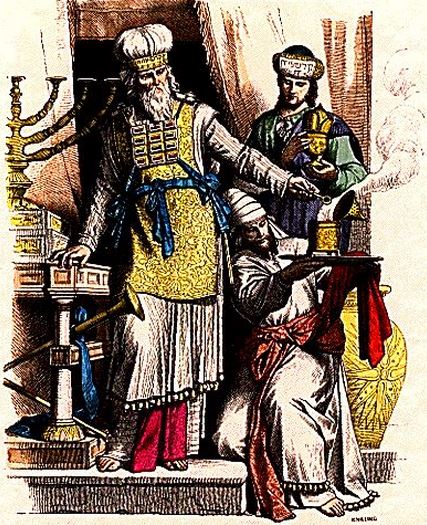
This week’s Torah reading is Tzav, detailing many of the priestly laws that applied to the Kohanim. It begins with God telling Moses to instruct Aaron (the first Kohen) and his children in the proper sacrificial rites, starting with the olah, a type of offering that is wholly consumed by the flames (as opposed to being roasted and eaten). Rashi comments that the term “tzav” – command – has the connotation of commanding not just Aaron, but all of his future descendants, and all generations of kohanim.

Kohen Gadol (High Priest) and Levites. (Braun & Schneider)

Kohen Gadol (High Priest) and Levites. (Braun & Schneider)

One of those descendants is Pinchas, the grandson of Aaron (through his son Elazar). For his heroic efforts, as described in Numbers 25, God blessed him with an eternal priesthood. Pinchas is mentioned as the Kohen Gadol (High Priest) in the book of Joshua (who was the first of the Biblical Judges). According to the Sages, he remained in this role until the times of Yiftach, one of the last Judges. This would mean he served as the High Priest for several hundred years! The Sages suggest that when God promised him an “eternal priesthood”, He literally meant it.

Due to the scandal that concluded the story of Yiftach (Judges 11-12), the commentaries state that Pinchas resigned as the High Priest. He then disappears from the narrative, only to reappear again a couple of centuries down the road. This time, he comes back as Eliyahu HaNavi, Elijah the prophet, as the Sages state: Pinchas ze Eliyahu, “Pinchas is Eliyahu”. The Arizal (Sha’ar HaGilgulim, 33, 2b) explains that Eliyahu was the reincarnation of Pinchas, while many others say it was literally one and the same person, since God’s blessing connoted everlasting life.

Eliyahu himself never passed away, further proving the point that Pinchas was meant to live forever. The Tanakh describes how Eliyahu was taken up to Heaven alive in a whirlwind of flames (II Kings 2:11). It is said that Eliyahu transformed into an angel, and thus lives on. This is why he appears (spiritually speaking) at certain times in the Jewish calendar and life cycle, including during a brit, and for the fifth cup during the Passover seder. Ultimately, it is prophesized that he will return in physical form once more at the End of Days to herald the coming of Mashiach, as it says: “Behold, I will send you Eliyahu the prophet before the coming of the Day of Hashem, the great and awesome” (Malachi 3:23).

The commentary of Abudraham (or Abu Dirham, Rabbi David ben Yosef of 14th century Spain) explains that this is why the Sabbath before Passover is called Shabbat HaGadol, “the Great Sabbath”. The verse in Malachi ends by saying “the great and awesome”, hagadol v’hanora. After all, this passage from Malachi is the Haftarah portion that we read at the synagogue on Shabbat HaGadol!

The basic purpose of Shabbat HaGadol is to get us into the “Pesach spirit” and prepare us for Passover. On this Sabbath, It is customary to review the Haggadah and the pertinent laws of the holiday. Similarly, the Haftarah portion is also designed to get us into the Passover mindset. The Haftarah ends by juxtaposing the first redemption under Moses with the coming redemption ushered in by Eliyahu:

“Remember the Law of Moses, My servant, whom I commanded at Horev [Mt. Sinai] for all Israel, statutes and ordinances. Behold, I will send you Eliyahu the prophet before the coming of the Day of Hashem…” (Malachi 3:23-24)

The Sages tell us that after the final redemption we will no longer need to recall the first redemption, which will pale in comparison. This is based on the verse in Jeremiah 23:7 which prophesizes that in the End of Days, people will no longer describe God as the One who took the children of Israel out of Egypt, but as the One who saved Israel from oppression all over the world, and restored them to their Promised Land.

This is one reason why during the Pesach seder, while commemorating the first redemption, we end by pouring a fifth cup for Eliyahu, who will come to usher in the final redemption. Is it then that Jews will no longer be misunderstood and oppressed, our exile will end, and we will all return to live in the Holy Land in peace, as we say at the conclusion of the seder: “Next year in Jerusalem”.

An Honest Look at the Film ‘Exodus: Gods and Kings’

This week we start a new book of the Torah, Shemot, known in English as ‘Exodus’. This volume is primarily concerned with the period of Israelite slavery in Egypt, and the subsequent salvation following the ten plagues and the Splitting of the Sea, climaxing with the revelation at Mt. Sinai, and the start of the transmission of the bulk of the Torah’s laws.

Coincidentally, not long ago was released Ridley Scott’s new film, Exodus: Gods and Kings, and I finally had a chance to see it this week. Though it appeared to show a little bit of promise at the start, the movie soon unravelled into a bizarre re-invention of the Biblical story. Of course, there is nothing wrong with some artistic liberties when adapting an ancient text for a modern film, nor is it too much of a problem to fill in some of the gaps in the Torah’s narrative. However, Exodus: Gods and Kings presented a completely twisted version that did not even slightly stick to the basic story of the Torah. It would take an entire tome to cover all the mistakes in the film, but perhaps we can offer just a few of the most blatant ones.

From the very beginning, we see that Moses seems to be completely unaware that he is not Egyptian. That’s quite odd: Semites and Egyptians had a totally different appearance. Take a look at this depiction of Semitic tribes, as discovered in the 12th dynasty tomb of Egyptian Khnumhotep II, official of the pharaoh Senusret II:

IbschaEgyptSemites

The Semites have a different skin tone, different hair styles, clothes, and so on. The filmmakers clearly knew this, as they show Moses bearded and sporting a nice hairdo, while all the other Egyptian royals are clean-shaven and bald. His eyes look different, and he wears clothes of a completely different style than all the others. How come? Didn’t he ever question why he doesn’t look anything like his “royal brethren”?

More importantly, the Torah clearly says that Moses was initially raised by his true birth mother, Yocheved (Exodus 2:7-9). Only after he was fully weaned did Yocheved present Moses to his new step-mother, the Pharaoh’s daughter (v. 10). It is totally inconceivable that Moses did not know he was a Hebrew! The Torah states that when Moses grew up, he “went out to his brothers and looked at their burdens” (2:11). He knew full-well that he was going out to his people.

At this point, when he saw an Egyptian taskmaster violently beating a Jew, he stepped in to save the victim, killing the Egyptian in the process. In the movie, this heroic act is replaced with an enraged Moses killing an Egyptian guard who was doing nothing terrible at all. The kind, compassionate Moses, described by the Torah as the humblest man that ever lived, is turned into a violent brute who kills indiscriminately. No wonder that Christian Bale, the actor who plays Moses, said of his character that he was “likely schizophrenic and was one of the most barbaric individuals that I ever read about in my life.” Makes sense if all he ever read about Moses was in the script for the film.

If Christian Bale did indeed read about Moses, perhaps he missed the whole part where Moses selflessly led his people for forty years in the wilderness. Where he literally sat from morning to evening to counsel the people and help them (Exodus 18:13). Or when he refused to abandon his people, even when God offered to make an entirely new nation out of Moses (Exodus 32:10). The many occasions where he convinced God to avert His just decrees and forgive the nation for their sins. The time where his sister Miriam transgressed severely against Moses, yet he did not hold even the tiniest of grudges or ill-will, and immediately prayed to God to heal Miriam and have mercy on her (Numbers 12:13). Or the simple fact that Moses led the revolution that brought monotheism (together with a higher sense of morality, starting with a set of Ten Commandments) to over two-thirds of the world’s population.

Worse than its depiction of Moses, though, was the film’s depiction of God: an irrational, pointlessly vengeful, literally childish figure. The film made it seem like the Ten Plagues were nothing more than God’s desire to kill as many people as possible. The reality, of course, was that the Ten Plagues were meant to be a measure-for-measure retribution for what the Egyptians had done; nothing more than cosmic karma. For example, just as the whole story begins with Pharaoh ordering the male-born to be drowned in the Nile, it ends with Pharaoh’s own male soldiers drowning in the Red Sea, measure for measure. Nor was God happy about any of this. The Talmud (Sanhedrin 39b) beautifully says that at the Splitting of the Sea, when the Egyptians drowned, the angels began to sing a joyous song, mimicking the Jews that were singing as well – but God immediately stopped them. He rebuked the angels, saying sadly: “My creations are drowning, and you are singing?”

When one studies the texts and commentaries, it becomes clear that each of the Plagues was specifically tailored towards the sins of the Egyptians, and was designed to bring the rightful justice that was due. Nowhere is this fact even hinted to in the movie. Most telling was after the plague of the firstborn, when Pharaoh confronts Moses demanding an answer as to why they suffered such a tragedy. The latter gives no logical reply, saying only that no Hebrews died. Perhaps the scriptwriter should have had something along the lines of: “Hey Pharaoh, did you forget all the countless babies that you slaughtered? Or the many warnings you were given that this was coming, and to stop your evil ways?” The scene almost makes Pharaoh seem like the victim, and Moses the villain. It appears that the main aim of the movie was to cast Moses (and God) in a bad light. It really seems like the filmmakers went out of their way to do this.

Moses is shown carelessly abandoning his family when he goes back to Egypt to save his people. His wife and son are angry, emotionally-scarred, losing their faith – and Moses does nothing about it. What was the point of making this shift from the Torah’s original version, which clearly states “Moses took his wife and sons, mounted them upon the donkey, and returned to the land of Egypt…” (Exodus 4:20)? He never abandoned his family, but took everyone with him!

It therefore appears quite evident that the purpose of Exodus: Gods and Kings was to turn one of the most beautiful and enduring stories into an ugly, twisted, and corrupt tale. The sheer number of mistakes is both inexcusable and inexplicable. One who wishes to experience a far truer (and more entertaining) version need only to open and read this week’s Torah portion.