
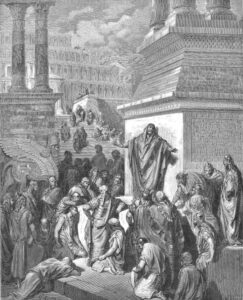
‘Jonah Preaching to the Ninevites’ by Gustav Doré
One of the great highlights of Yom Kippur is the unique afternoon Haftarah reading of the Book of Jonah. Recall that Yonah is tasked by God to go to the Assyrian metropolis of Nineveh and preach to them to repent, lest they be destroyed. Yonah fails to carry out his mission at first and instead goes out to sea. When a storm rages, he knows it is his fault and tells the sailors to throw him overboard. The storm is calmed, while Yonah is swallowed up by a “big fish”.
After three days of reflection in the belly of the beast, Yonah is vomited ashore and goes off to fulfil God’s mission. Nineveh hears his call and repents wholeheartedly, averting their fate. Yonah is upset by this, explaining that he knew the Ninevites would repent, and that’s why he didn’t want to deliver the message (4:1-2). Presumably, it would make the stiff-necked Jews look bad, since the Jews rarely listened to their own prophets! God concludes the book with a message that He cares deeply about all of His creations, including the 120,000+ people in Nineveh, and even the animals there (4:11). What does any of this have to do with Yom Kippur?
The simplest answer is that we read Yonah because it mentions many themes of the High Holiday season. First of all, Yonah gives the Ninevites forty days to repent or else the city would be overturned (3:4), just as we have Forty Days of Repentance between Rosh Chodesh Elul and Yom Kippur. (Based on this, one could reason that Yonah likely arrived in Nineveh on Rosh Chodesh Elul and the city was spared on Yom Kippur.) The Ninevites then proclaimed a fast (3:5), just as we fast on Yom Kippur. After this, Yonah leaves town and makes a sukkah for himself in the wilderness (4:5), just as we head right into Sukkot after Yom Kippur. This seems like enough to justify the selection of Yonah for the holiday reading. But I always felt like there must be more.
A few big questions jumped out at me when reading the story: Why is it that when Yonah is out at sea and the storm begins, he decides to go take a nap while the sailors are panicking (1:5)? How could he even think of sleeping? And when the sailors then question him about the storm, he tells them to throw him overboard to quell it (1:12). Why didn’t Yonah just jump overboard himself? Why make the sailors throw him out? Finally, we might expect that these rough sailors wouldn’t care much about a passing Hebrew among them, and would gladly throw him out to spare their lives. Instead, we read that the sailors refused to do so, and instead “the men rowed hard to regain the shore, but they could not, for the sea was growing more and more stormy about them.” (1:13)
The sailors eventually decide they have no choice but to throw Yonah overboard, but before doing so they pray to God wholeheartedly: “Oh, please, Hashem, do not let us perish on account of this man’s life. Do not hold us guilty of killing an innocent person!” (1:14) Why are these gentile sailors so deeply concerned about a random Hebrew that hitched a ride with them? Why are they suddenly so faithful and fearful of the God of Israel? And their faith in Hashem didn’t stop with the subduing of the storm. The chapter ends saying “The men feared God greatly; they offered a sacrifice to God and they made vows.” (1:16) What are these “vows”? The Zohar (II, 230b) says they all converted to Judaism and became tzadikim and talmidei chakhamim!
What’s going on?
Joseph Returns
I believe we can solve this mystery by recalling an ancient tradition that the Sale of Joseph took place on the tenth of Tishrei—what would later become Yom Kippur. This tradition goes all the way back to Second Temple times, and is even recorded in the Book of Jubilees (34:10-18). Jubilees go so far as to say that Jacob actually commemorated Joseph’s yahrzeit every year on the tenth of Tishrei. Centuries later, when God forgave Israel for the sin of the Golden Calf at Sinai—thus officially giving rise to Yom Kippur—He also officially forgave the Sons of Israel for the Sale of Joseph. What the ten sons had done was throw their brother Joseph “overboard” into an empty pit that didn’t even have a drop of water (Genesis 37:24). They abandoned the innocent soul, and he was later picked up and enslaved by Midianites who sold him to Ishmaelites down to Egypt. (See ‘Was Joseph Really Sold By His Brothers?’ in Volume One of Garments of Light.) When was the sin of the brothers rectified? It is quite possible that it was rectified on that ship with Yonah:
The Arizal tells us that Yonah had a spark of the soul of Yosef (and of the future Mashiach ben Yosef, too, see Sha’ar haGilgulim, Ch. 32). And so, a great storm surges and Yonah—the Joseph that he is—goes to sleep to dream divine dreams. When he is awakened, he knows the (ten?) sailors are reincarnations of his old brothers. So, he tells them that if they want to be spared, they must throw him overboard (just like old times). But the sailors know deep in their souls that they have a tikkun to make, and they staunchly refuse. When their fiercest efforts to battle the storm fail, they resort to sincere teshuva and prayer. Previously, they threw their brother into a pit “with no water”, and now they throw him right into the raging waters. The sea is immediately calmed. Then, of all things, Yonah is miraculously saved by a big fish.
Recall that the fish is symbolic of Joseph, whom our Sages (in Bava Metzia 84a) compared to a fish that is impervious to the evil eye. (Some even see the two “lucky” fish of Pisces as Joseph’s sons Ephraim and Menashe!) And Joseph’s greatest descendant (who also carried a spark of his soul) was Yehoshua bin Nun, literally “son of a fish” (nun means “fish” in Aramaic). In fact, the nun root is thought to be the etymology for Nineveh.
Another interesting parallel: the language used to describe the calming of the sea when Yonah was thrown overboard is strangely va’ya’amod hayam, literally “the sea stood”. This is a clear allusion to the standing walls of the Splitting of the Sea which, according to the Midrash, split and stood in the merit of Joseph! (Beresheet Rabbah 87:8). This only further points to Yonah being Yosef reincarnated.
Ultimately, the repentant sailors go on to convert to Judaism and become great tzadikim in their own right. Their rectification is complete; the brothers are perfectly redeemed. And this is the whole point of Yom Kippur after all: the redemption of the children of Israel. May we merit to see the Final Redemption this year.
Gmar Chatima Tova and Chag Sameach!
Yom Kippur & Sukkot Learning Resources:
The Kabbalah of Yom Kippur (Video)
How the Priestly Garments Atoned for the People
Ushpizin & Anti-Ushpizin
Medicinal Properties of Arba Minim
Russia, Iran, and Gog u’Magog (Video)
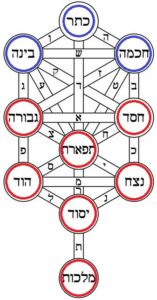
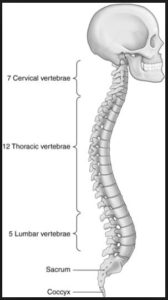 Putting it all together, we can propose that the flowing liquid log measurement is to teach us to measure and refine ourselves spiritually during this period of time. The value of log (לג) is 33 to remind us of the 33 vertebrae that line the spinal cord at birth—representing our ascent from the animalistic base where waste is excreted, to the lofty brain capable of divine intellect. These 33 bones fuse into 26 vertebrae by adulthood, 26 being the numerical value of God’s Ineffable Name, reminding us of our goal in striving ever-higher towards Hashem. And 33 reminds us of King David’s words: gal einai (גל עיני), “Open my eyes so that I can see the wonders of your Torah!” (Psalms 119:18) Now is a time to be particularly focused on Torah and mitzvot, prayer and meditation, mystical pursuits and spiritual growth.