Category Archives: Kabbalah & Mysticism

The Heavenly Academies

This week’s parasha (in the diaspora) is Shlach, recounting the Sin of the Spies. When God subsequently punished the Israelites for their lack of faith, He said of that generation: “in this wilderness they will end, and there they will die.” (Numbers 14:35). The Zohar (III, 161b) explains that they died there in the wilderness, but not in the afterlife, meaning they did still merit to enter the supernal Garden of Eden. The Zohar further points out that the Torah specifically states their “corpses shall fall in this wilderness” (Numbers 14:32). The use of the word “corpses” serves to teach us that only their physical bodies—not their souls—would fall. God would destroy the evil inclination that ensnared their bodies into sin. The souls, however, would ultimately ascend to Heaven.

Following this, the Zohar takes us on a long journey exploring the Heavenly Academies. One such yeshiva is presided over by Betzalel, the craftsman who put together the Mishkan. There is an academy of the Sages of the Mishnah, and another academy for the “masters of Scripture” (מָארֵי מִקְרָא), a place devoted to the study of Tanakh. Higher than these is the academy for the study of Aggadah (ie. Midrash), and the Zohar makes sure to point out that these luminous Aggadists are the ones who truly understand the Torah properly. (Intriguingly, the Zohar does not seem to describe an academy for the study of Talmud!)

Higher still is the yeshiva of Aaron, called the Yeshiva of Love (מְתִיבְתָּא דִּרְחִימוּתָא). Aaron leads his students through the Heavens, and they fly around “like eagles”. Aaron visits an even more exclusive academy, the yeshiva of Moses, called the Yeshiva of Light (מְתִיבְתָּא דִּנְהוֹרָא). Aaron’s students have to wait outside since only Aaron is allowed to enter, as well as any individuals Moses calls by name. Just like he did on Earth, up in his academy Moses is still wearing his special veil, his face being too luminous to behold. Even higher than this academy is the Yeshiva of the Firmament (מְתִיבְתָּא דִּרְקִיעָא), presumably presided over by the angelic Metatron.

Several pages later, the Zohar (III, 167b) tells us about the academies (“palaces”) of women. First is the school of Batya, the daughter of Pharaoh who adopted Moses. There are thousands of righteous women there learning with her. They learn “what they did not merit to learn in this world” since, until recent history, women were not expected to learn Torah. Meanwhile, there are many more thousands of female souls learning with Serach, the daughter of Asher (for more on her, see ‘The Incredible Story of Serach bat Asher’ in Garments of Light, Volume One). Here they focus on learning the secrets of the Torah’s mitzvahs, and the deeper reasons for the commandments.

The third female academy is full of myriads of women, and they don’t seem to do much learning here but rather spend their time in meditation, song, and praising God, alongside many angels. The leader here is Yocheved, mother of Moses. Opposite her academy is a similar palace belonging to Deborah the Judge and Prophetess. She, too, leads the women in song and prayer. In addition to these, there are four palaces that are concealed, belonging to each of the four Matriarchs. These are called the “palaces of the trusting daughters” (הֵיכָלִין דְּבָנוֹת בּוֹטְחוֹת), but they are too lofty to be described.

The Zohar does divulge a deep secret here. While during the day the male and female souls are segregated in their various academies and palaces, the soulmates do reunite at night:

Every night they get together, since the time of coupling is at midnight, both in this world and that world. The coupling of that world is accomplished by the adherence of one soul to the other, light with light. The coupling in this world is body to body. Everything is as it should be: a kind with its kind, a match with its match, body to body; and in the other world, it is light with light… The union in that world produces more fruit than the coupling in this world. When they pair up in the pairing in that world, with their unified desire, and when the souls cling one to another, they produce fruit. And lights emerge and lamps are produced. These are the souls of those that convert…

The souls of Jewish converts are produced from the spiritual unions of the righteous souls above!

Going back to our parasha, the Zohar tells us that despite what we might read in the Torah, the generation of the Exodus and the Wilderness was indeed a very righteous one. The Zohar (III, 168b) says there will never be another generation as worthy as they until the coming of Mashiach. And at that time, the Wilderness generation will merit to be the first to rise in the Resurrection of the Dead. May we merit to see it soon.


The above essay is an excerpt from Garments of Light, Volume Three.
Get the book here! 
Secrets of the Priestly Blessing

This week’s parasha (in the diaspora) is Nasso, the longest in the Torah. In it, we read how God commanded Moses to instruct Aaron and his priestly descendants to bless the people with the following formula:

יְבָרֶכְךָ יְהוָה, וְיִשְׁמְרֶךָ. יָאֵר יְהוָה פָּנָיו אֵלֶיךָ, וִיחֻנֶּךָּ. יִשָּׂא יְהוָה פָּנָיו אֵלֶיךָ, וְיָשֵׂם לְךָ שָׁלוֹם

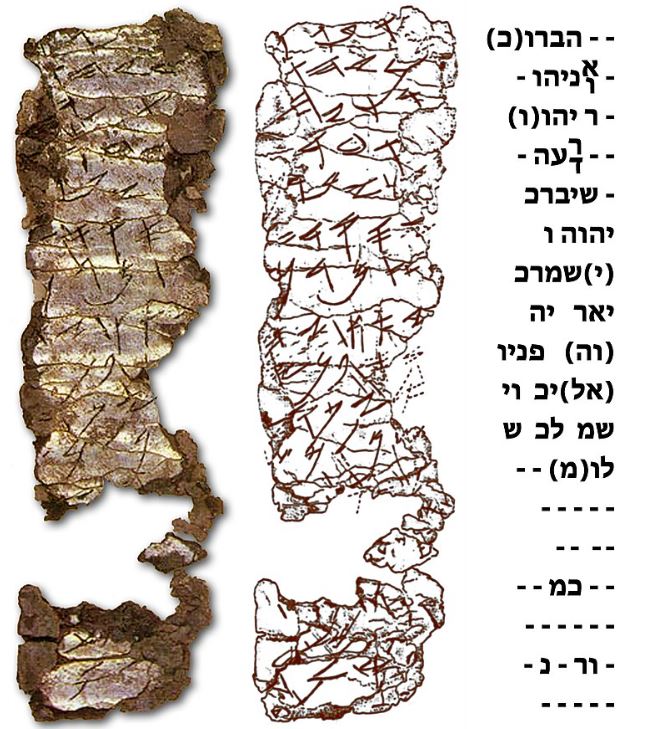
Loosely translated: “God bless you and protect you; God shine His Face upon you, and be gracious to you; God lift His Face upon you, and place peace upon you.” (Numbers 6:25-27) This unique, enigmatic phrase carries tremendous meaning, and an interesting history, too. In fact, the oldest Hebrew inscription of a Torah verse ever found is this blessing!

In 1979, archaeologists in Ketef Hinnom near the Old City of Jerusalem discovered two small silver scrolls. After painstakingly unravelling the fragile scrolls (a feat that took three years), they discovered that they were inscribed with Birkat Kohanim, the priestly blessing, along with a few introductory lines. The scrolls have been dated back to the 7th century BCE, and are considered among the greatest finds in the history of Biblical archaeology.

What secrets are buried within the words of Birkat Kohanim?

Silver scroll with priestly blessing, discovered near Jerusalem in 1979

Restoring Divine Light

In introducing the Priestly Blessing, the Torah commands koh tevarkhu, (כֹּ֥ה תְבָרְכ֖וּ), “thus shall you bless…” The Zohar (III, 146a) reminds us that koh is an allusion to the divine light of Creation. The value of koh (כה) is 25, hinting to the 25th word of the Torah, “light”. When Adam and Eve consumed the Fruit, that original divine light of Creation was concealed. This is the secret behind God calling to Adam: ayekah (איכה), usually translated simply as “where are you?” but really meaning ayeh koh, “where is the divine light?” Indeed, the very purpose of the kohen is to help restore some of that hidden divine light. This is why he is called a kohen!

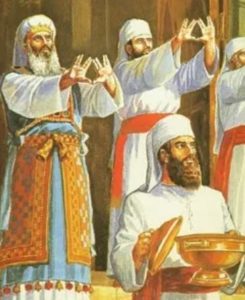
It is also why it is customary not to look directly at the kohanim when they relay the blessing. The hidden light may be far too intense, and might cause the observer’s eyes to dim (Chagigah 16a). The ancient mystical text Sefer haBahir (#124) adds that the kohanim put together their ten fingers in that unique arrangement in order to channel the energy of all Ten Sefirot. Elsewhere, we learn that the hands of the kohanim come together to roughly form an inner samekh, the only circular letter in the Hebrew alphabet, representing infinite cycles and endless blessings. Sefer haTemunah teaches that the proper shape of a samekh is a combination of a kaf and a vav. (The sum of the values of kaf and vav is 26, equal to the Tetragrammaton, God’s Ineffable Name.) Kaf literally means the “palm” of the hand, and the linear vav represents a shining ray of light.  These are the hidden rays of light, the light of koh, emerging through the hands of the kohanim as they bless.

In his commentary on the Torah, the Ba’al haTurim (Rabbi Yakov ben Asher, 1269-1340) states that koh reminds us also of the Akedah, when Abraham told his attendants that he and Isaac would go ‘ad koh, “until there”. The deeper meaning is that Abraham saw the divine light emanating from the top of Mt. Moriah, the future site of the Holy of Holies. This is how he knew exactly where to bind Isaac. Previously, God had already blessed Abraham with the words כה יהיה זרעך, that his offspring would be luminous (and numerous) like the stars (Genesis 15:5). The Ba’al haTurim adds that the Shema has 25 letters for the same reasons and, amazingly, the term “blessing” is mentioned 25 times in the Torah, as is the word “peace”!

The first line of Birkat Kohanim has three words and fifteen letters, the Ba’al haTurim points out, alluding to the three Patriarchs—Abraham, Isaac, and Jacob—whose lives overlapped for 15 years. Recall that Abraham had Isaac when he was 100 years old, and Isaac had Jacob at 60 years old, ie. when Abraham was 160. Since we know Abraham passed away at the age of 175, there were 15 years when all three Avot lived together.

More specifically, the first line of the blessing is for Abraham, the second is for Isaac, and the third is for Jacob. This is why the second line speaks of illumination since, as is well-known, Isaac saw the intensely bright divine light unfiltered at the Akedah, and this is the reason he later became (physically) blind. The Sforno (Rabbi Ovadia ben Yakov Sforno, 1475-1550) adds that within the second line of the blessing is a request for God to give light to our eyes so that we could see God within all things, in all the wonders of the world, and in all the wealth (material and otherwise) that God has blessed us with.

The Ba’al haTurim continues that the third line of Birkat Kohanim is for Jacob, which is why it begins with the word yisa (יִשָּׂ֨א), reminding us of Genesis 29:1 when Jacob fled (וישא יעקב רגליו). It has seven words to indicate the subsequent births of the Twelve Tribes, who were (except for Benjamin) born to Jacob over a span of 7 years. The last line again has 25 letters to remind us of koh, and further alludes to the Sinai Revelation—another burst of divine light—when God said (Exodus 19:3) “thus [koh] you shall speak to the House of Jacob” (כה תאמר לבית יעקב). The Ba’al haTurim concludes that the final word of the blessing, shalom, has the same numerical value as Esau (376) to teach us that one should spread peace among all people, gentiles included, and even Esau!

Ibn Ezra (Rabbi Abraham ben Meir ibn Ezra, 1089-1167) says that “peace” means complete peace, with not even a little stone or a wild animal to bother a person. Meanwhile, the Ramban (Rabbi Moshe ben Nachman, 1194-1270) says that “peace” here refers to shalom malkhut beit David, peace upon the kingdom of David and his dynasty. We may infer from this that it refers as well to geopolitical peace in Israel, and a request to hasten the coming of Mashiach. This is related to the Sforno’s interpretation, as he says the verse refers specifically to the World to Come in which, as described in the Talmud (Berakhot 17a), the righteous will bask peacefully in God’s glory.

May we merit to see it soon!


The above essay is an excerpt from Garments of Light, Volume Three.
Get the book here! 
The Zohar Prophecy of the Six-Day War

Tonight, we usher in Yom Yerushalayim, Jerusalem Day, commemorating the liberation of Jerusalem on the 28th of Iyar, 5727 (June 7, 1967) during the Six-Day War. As explored in depth before, Yom Yerushalayim happens to be on the day of Sefirat haOmer that corresponds to Chessed sh’b’Malkhut, literally “Kindness in Kingdom”. It is the first day, and first step, of the Malkhut week. In the same way, the liberation of Jerusalem on that day in 1967 was the first step towards re-establishing the ultimate Malkhut, God’s Kingdom, here on Earth, and restoring Malkhut David, the Kingdom of David in Israel. After all, it is King David who first established Jerusalem as Israel’s eternal capital. The aspect of Chessed on this day was that Yom Yerushalayim—and the entire miraculous Six-Day War in general—was a clear display of God’s Kindness. More amazing still, the Zohar seems to have exactly predicted this day many centuries earlier.

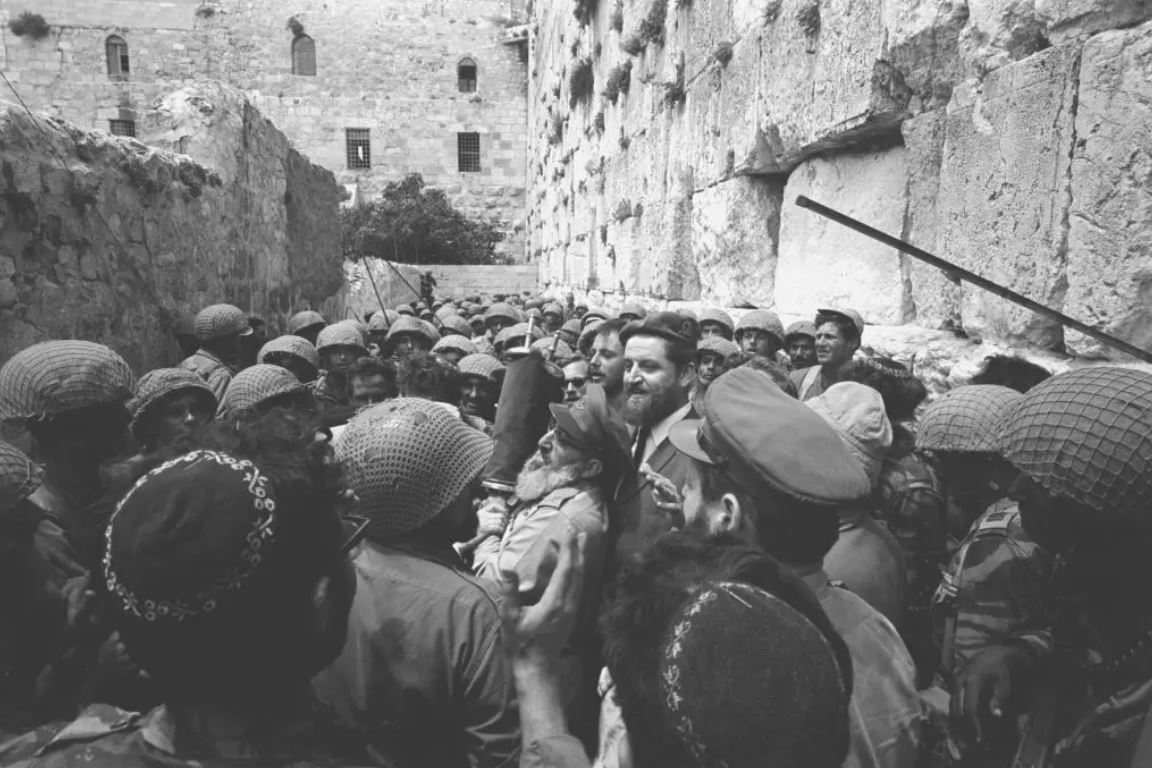
IDF Paratroopers that liberated Jerusalem, with Rabbi Shlomo Goren holding a Torah scroll, at the Western Wall on June 7, 1967.

In Zohar Chadash on parashat Balak, the Zohar comments on the End of Days prophecy of Bilaam. Recall that the gentile prophet Bilaam was hired by King Balak of Moab to curse Israel, but instead ended up blessing Israel. Within his blessing, he gave a prophecy of Acharit haYamim, the “End of Days” (Numbers 24:14, one of four places in the Torah where Acharit haYamim is mentioned). One of the things that Bilaam predicted was that in the far future (“I see it, but not now…”) the princes of Moab would be subdued. The Zohar Chadash expounds upon this verse and says:

In the End of Days, (according to the metaphorical “days”) when the sun will rise in the “Sixth Day”, when the cycle of years will work out in such a way that the Sabbatical and Jubilee will come together, which will happen 274 years [before the end] of the “Sixth Day”, a sound will go forth to arouse the great heights of the heavens…

The Zohar goes on to describe in detail the events that will happen in those final years, the “birth pangs of the Messiah”, culminating in the coming of Mashiach and his subsequent kingship. The Zohar employs the famous notion that each day of Creation corresponds to a millennium of civilization. Civilization as we know it is meant to last for 6000 years. The Messianic Age must come before the end of the sixth millennium, ie. the cosmic “Sixth Day”, to usher in the final Cosmic Shabbat millennium. The Zohar says that 274 years before the end of the Sixth Day there will be a Sabbatical Shemittah year, followed by a Jubilee (the 50th year of the Sabbatical cycle). So, if we count 274 years from the end of 6000, we get to the Jewish year 5726, or 1966. That year was indeed observed as a Sabbatical year in Israel. The following year, 5727 (corresponding to the end of 1966 and most of 1967), would have been a Jubilee. We also know that the Messianic Age is meant to begin after the conclusion of a Sabbatical year (as stated in multiple places in Midrash and Talmud, such as Sanhedrin 97a). Thus, it seems the Zohar posited long ago that the “Footsteps of the Messiah” period would begin in 1967.

This fits perfectly with what actually happened in 1967, when Israel miraculously routed all of its enemies in a mere six days (which, I think, is further symbolic of this Zohar prophecy that repeatedly speaks of the “Sixth Day” over and over again). More significantly, after two millennia, the Jewish people were once more in control of their holiest city and eternal capital, as well as the surrounding Biblical heartland of Judea and Samaria. Recall that Israel recaptured Jerusalem and the “West Bank” from the Jordanians. Jordan lies on the ancient territory of Moab, and the Zohar specifically gives this prophecy in its discourse on the verse that says the princes of Moab would be subdued!

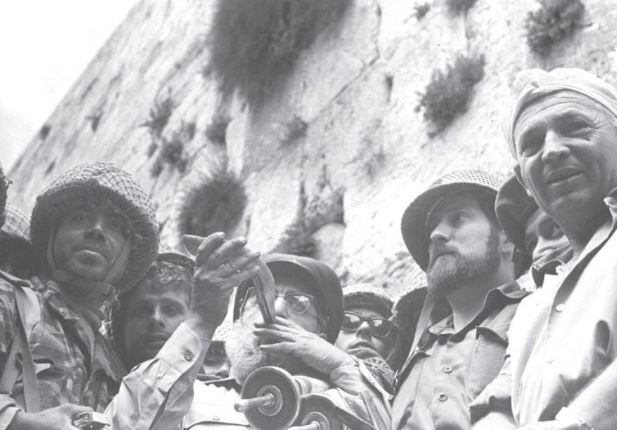
Rabbi Shlomo Goren blows the shofar by the Western Wall during the 1967 liberation of Jerusalem.

Finally, we can deduce from the Zohar that 1967 was a Jubilee year. The Torah states that in a Jubilee year, a shofar should be blown and “freedom should be proclaimed in all the land…” (Leviticus 25:10) This makes Rabbi Shlomo Goren’s blowing of the shofar at the Western Wall during the liberation of Jerusalem even more significant. It may very well be that the recapture and reunification of Jerusalem in 1967 formally began the pre-Messianic Age, and we are undoubtedly nearing the fulfilment of the rest of the incredible prophecies, too.

Happy Jerusalem Day!


*Postscript: Since first publishing this article, there have been some requests at clarification of the Zohar chronology. The exact language of the Zohar is רע”ד מן יומא שתיתאה, meaning “274 years from the sixth day”. Some interpret it to mean 274 years into the sixth day, meaning the year 5274. However, that year was not a shemittah year, so it cannot be the meaning of the Zohar. We have to say the Zohar means 274 years from the end of the sixth day, meaning 5726, and that year was indeed a shemittah. (Besides, the passage begins by saying this will happen at the End of Days, so we would expect a year closer to the final 6000.) Some have pointed out that certain commentaries say there is an alternate version of this Zohar that says 384 years, not 274, but using 384 is even more problematic since we do not get a shemittah year either counting from the start or from the end of the sixth day! I believe the only possible accurate reading is indeed “274 years from the end of the sixth day”.