
Palm-Reading in Judaism

At the start of this week’s parasha, Yitro, Moses’ eponymous father-in-law (aka. Jethro) joins the Israelite camp in the Sinai. The Zohar (II, 69b) explains, as per tradition, that Jethro wished to convert to Judaism, along with his entire family. The Zohar then uses this as a segue into a much broader discussion:

Rabbi Itzchak and Rabbi Yose were sitting one day in Tiberias and delving into Torah study. Rabbi Shimon passed by and asked: “What are you studying?” They replied: “We are on that verse from which our master taught us…” [Rabbi Shimon] asked: “And which is it?” They said: “That which is written: ‘This is the book of the generations of man [ze sefer toldot adam], when God created man, He made him in the likeness of God…’” (Genesis 5:1)

This verse in the Torah is used to introduce the genealogy of Adam and Eve. The Zohar explains that God showed Adam all future generations of humans that would descend from him, including all the future great leaders and sages (Jethro being one of them). Now, Adam was only given a vision of these people, meaning he only saw their outward appearance. Yet, from their outward appearance alone he could deduce a great deal about their souls. This is the deeper meaning behind sefer toldot adam, ie. wisdom that can reveal a person’s inner qualities, referring “to the secrets of the physical features of human beings… their hair, forehead, eyes, face, lips, lines on the hands, and ears. Through these seven traits a person can be known.” (Zohar II, 70b) The Zohar here is clearly referring to the ancient practices of physiognomy and chiromancy: understanding a person—and perhaps even telling their future—through their facial features and palm-lines. Continue reading
Origins and Secrets of the Tu B’Shevat Seder

This Wednesday evening we mark Tu b’Shevat, the “New Year for Trees”. While originally an obscure and mostly-unobserved holiday, Tu b’Shevat took on greater significance among the Kabbalists of the 16th and 17th centuries. As is well-known, an entire Tu b’Shevat “seder” emerged, complete with four cups of wine and a Haggadah of sorts. What is not so well-known is where this Tu b’Shevat seder actually came from, and the mystical foundations upon which it stands. Continue reading

The Great Disputation: Mochin vs. Trinity

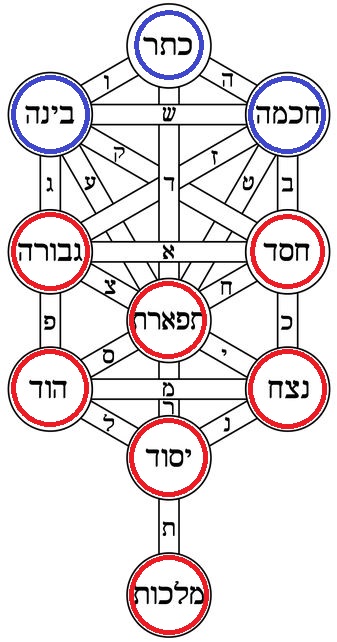
This week’s parasha concludes the Ten Plagues of Egypt by describing the final three plagues, as alluded to in the name of the parasha, Bo (בא), which has a numerical value of three. One would think that the parashas would be divided in such a way that all the plagues appear in one portion. Yet, we see the first seven in one, and the final three in another. The mystical reason for this is to mirror the Sefirot, which are divided into the seven lower middot, and the three higher mochin, “mental” or “intellectual” faculties.

The Sefirot of mochin above (in blue) and the Sefirot of the middot below (in red) on the mystical “Tree of Life”.

The mochin are the three Sefirot of Keter (or Ratzon, God’s “Will”); Chokhmah, “Wisdom”; and Binah, “Understanding”. They are on a higher level than the lower seven Sefirot. In fact, in this physical world we find most things mirror the seven, including the seven discernible colours of the rainbow, the seven notes of the musical scale, the seven visible “luminaries” in the sky, and the seven days of the week. The mochin, meanwhile, represent the upper worlds, and correspond to more ethereal things like the three primordial elements of Creation (air, water, and fire, as per Sefer Yetzirah) and the three realms of space, time, and soul (in mystical texts referred to by the acronym ‘ashan, עשן, standing for olam, shanah, nefesh). (For a detailed explanation of this, see here.)

Recall that the Sefirot represent the ten major aspects of God, and are primarily meant to help us relate to, and understand, the Infinite One. As such, the mochin represent the highest aspects of God. That there are specifically three of them is significant. The number three is central to Judaism, and God has a particular affinity for this number, as the Talmud (Shabbat 88a) tells us:

Blessed is the All-Merciful One, Who gave the three-fold Torah [ie. the Tanakh, composed of Torah, Nevi’im, and Ketuvim] to the three-fold nation [Kohen, Levi, Israel] by means of a third-born [Moses] on the third day, in the third month [Sivan].

While this teaching is well-known, what isn’t so well known is in whose name it is brought down. The Talmud introduces it as a teaching “of that Galilean”. Who is this anonymous Galilean? Why does the Talmud use a seemingly-derogatory term for him, avoiding his name? Continue reading