Tag Archives: Adam and Eve

The Real Meaning of Tikkun Olam

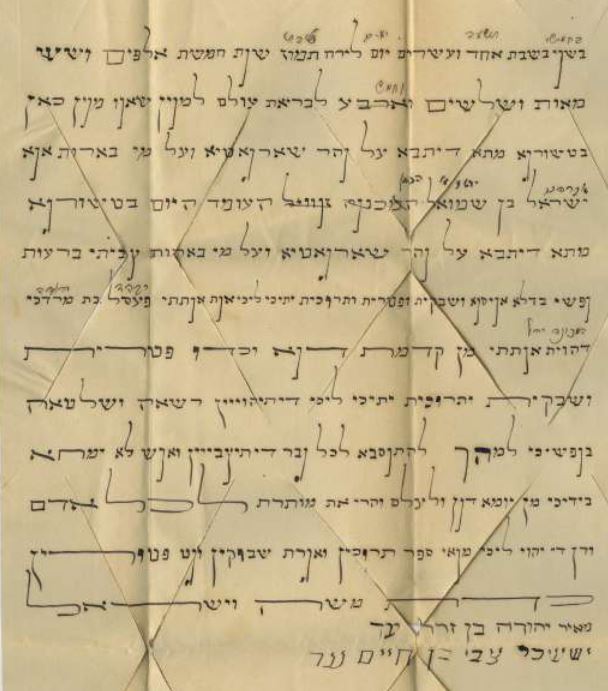
A get from the 19th-century (Credit: Israel Museum)

This week’s Torah portion, Ki Tetze, sets the record for most mitzvot in one parasha with a whopping 74 of them. One of these mitzvot is that of divorce: “When a man takes a woman and becomes her husband, and finds her displeasing because he finds something obnoxious about her, he shall write her a bill of divorce, hand it to her, and send her away from his house.” (Deuteronomy 24:1) The bill of divorce, called here a sefer kritut, would come to be more simply known as a get. In fact, there is an entire Talmudic tractate, Gittin, that explores all aspects of divorce and bills of divorce.

One of the questions discussed in this tractate is what does the Torah mean when it says the husband discovers something “obnoxious” about his wife? It is actually one of the more famous arguments between the ancient Jewish schools of Hillel and Shammai two thousand years ago. The more stringent Shammai believed that divorce was only permitted if the woman committed adultery or did something promiscuous (Gittin 9:10). Hillel believed divorce was allowed under any circumstances, for whatever reason the relationship was not working out. (Rabbi Akiva went even further and said a man could divorce even if he simply found another woman who is more attractive!)

More intriguingly, it is here in the tractate about divorce where we first come across the now-ubiquitous term tikkun olam, literally “repairing the world”. Today, many believe tikkun olam is a Hebrew term for social justice, but this is not accurate. What does “tikkun olam” actually mean? And why does it come from a tractate about, of all things, divorce?

Maintaining Order

In the fourth chapter of Gittin, the Mishnah and Talmud give many examples of things the Sages instituted mipnei tikkun ha’olam, “for the betterment of the world”. One of the first such things is that originally divorce documents needed to include essentially any name that the husband and wife went by. Rabban Gamliel, one of the last presidents of Israel before the Temple was destroyed in the 1st century CE, instituted that a get should list all names by which the husband and wife are commonly known. This was done mipnei tikkun ha’olam, and would ensure that the divorce is properly recognized in all places and by all people, even where the husband and wife might be known by other names.

Another example of tikkun olam is the prozbul, instituted by Rabban Gamliel’s grandfather, Hillel himself (Gittin 4:3). Recall that the Torah commands that all loans be paid back during Shemittah, the Sabbatical year, or otherwise be forgiven. A problem arose in that people were hesitant to lend money as the seventh year approached, since it was more likely that the borrowers would be unable to pay back the debt, putting the lender at an unfair loss. The reduction in available credit harmed the Judean economy. So, Hillel creatively came up with a prozbul that would sidestep the issue and allow the repayment of loans passed the Sabbatical year. The Talmud (Gittin 36b-37a) explains that “prozbul” came from a Greek term, meaning this decree was pro for both the bulei and the butei, the rich and the poor, benefitting all members of society.

We can now begin to understand the original meaning of the term “tikkun olam”. It was about adjusting Jewish law where necessary, within the framework of halakhah, for the betterment of society and to maintain peace and order. With time, tikkun olam took on a more mystical, cosmic meaning, too.

Rectifying the World

Ancient Jewish mystical texts described our world as one that is broken and in need of repair. God initially created a perfect world, but that world collapsed right at the beginning, in a process called shevirat hakelim, the “Shattering of the Vessels”. Adam and Eve had a chance to repair it, but only made the situation worse when they consumed the Forbidden Fruit. Since then, our mystical purpose is to reverse the damage and restore the wholesome primordial world, putting the pieces of those spiritual vessels back in place.

This process of repair and rectification, tikkun, is accomplished through the observance and fulfilment of mitzvot. This is the deeper purpose behind the Torah’s many laws—God gave them to us as tools to rectify the cosmos. Of all the mitzvot, the recitation of prayers and blessings in particular serve to elevate the world around us. All the small sparks of holiness, the nitzotzot, that came from the shattered vessels are trapped within the impure “husks”, kelipot, of the material world. The divine words of the prayers and blessings (in the original lashon hakodesh, the holy Hebrew tongue of Creation) are like spiritual formulas for freeing the sparks and restoring them to the Heavens. For instance, when one recites the boreh pri ha’etz blessing before consuming an apple, they unlock whatever sparks of holiness might be present inside. In this way, little by little, the entire cosmos is rectified.

The greatest proponent and expounder of this process was undoubtedly the Arizal (Rabbi Itzhak Luria, 1534-1572). It was he who put together the earlier Kabbalistic works into one complete mystical system, revealed only in the last two years of his short life in Tzfat, the “capital” of Jewish mysticism. The Arizal explained that this is the real reason why Jews were exiled to the farthest corners of the planet. On the surface level, it was a punishment and an exile, but God does not truly punish or exile. God is all-good, after all. The deeper reason for Jewish exile was so that Jews could reach every part of the planet and elevate all those lost sparks of holiness. Only when that process is complete will the Final Redemption be ushered in and the Messianic Age will officially begin.

Long before the Arizal, the Zohar already outlined the four aspects of tikkun. Recall that the Zohar is the central “textbook” of Kabbalah, first revealed to the public in the 13th century but originally dating back to the teachings of Rabbi Shimon bar Yochai and his 2nd-century CE mystical circle. The Zohar (II, 215b) states that the first level of tikkun is rectification of the self. This is the process of personal development and self-refinement, the life-long journey of becoming a better, more Godly person. Each of us has many internal rectifications to achieve (both spiritual and physical).

Next is the tikkun of this lower physical world, primarily referring to that process of freeing the sparks trapped in the kelipot of the material around us. This is followed by the tikkun of the higher spiritual realms. For instance, reciting Kaddish for the departed serves to elevate their souls in the afterlife. Many of the mitzvot and rituals we perform similarly serve to affect great changes in the upper worlds. Finally, there is the tikkun of “God’s Name” which means a number of things, including bringing more Godliness down to Earth. Drawing more souls to recognize God, spreading Torah wisdom, and inspiring observance of mitzvot is a part of this process, too. The ultimate goal is, as the prophet Zechariah said, to bring about the day “When God will reign over the whole world; on that day God will be one and His name one.” (Zechariah 14:9)

These are the four aspects of genuine tikkun ha’olam: improving one’s self, fixing the spiritual fabric of the cosmos above and below, and infusing more Godliness into the world. So, how did some come to believe that tikkun olam is simply synonymous with “social justice”?

Tikkun as Social Justice

Real tikkun olam is clearly rooted in observance of Torah law and halakhah. With the rise of Reform Judaism in the 1800s, and their subsequent move away from halakhah, ancient ideas had to be rebranded. Tikkun olam was one of those ideas. Since Reform made halakhah essentially optional (at best), there was no way to root tikkun olam in the Law. Thus, rectifying the world was no longer a spiritual process requiring punctilious observance of mitzvot, prayers, and blessings, but rather a generic physical task of “making the world a better place”.

Now, there is certainly an element of “social justice” and making the world a better place within the larger umbrella of tikkun olam. It is true that God gave the Jewish people a mandate to improve the world, make it a more ethical and moral place, root out idolatry, spread monotheism, make life better for all, and be a “light unto the nations” (Isaiah 42:6). This is what the Jewish people were “chosen” for. Indeed, Jews have lived up to the challenge, and have been hugely instrumental (in disproportionate fashion) in advancing science and technology, medicine, civil law, democratic government, economics, arts, and yes, social justice, too. Some of the original “social justice warriors” of the past were Jews, including giants like Samuel Gompers and Louis Brandeis.

That said, tikkun olam must be rooted in the Torah. Commenting on the famous adage of Shimon haTzadik (in Pirkei Avot 1:2) that the world is established on “Torah, service, and acts of kindness”, the great codifier Rambam (Rabbi Moshe ben Maimon, 1138-1204) writes that true tikkun olam requires all three: Torah study, service of God, and kindness to others. Therefore, if some idea or movement is obviously contradictory to what the Torah stands for, it cannot in any way be “tikkun olam”. Today, some misuse the “tikkun olam” label and think it includes embracing all kinds of philosophies that are completely at odds with God and His Torah, which openly and proudly transgress Torah law.

For instance, while we should certainly care about the living conditions of all human beings around the world, there is no tikkun in marching alongside people who support terrorists that murder innocent Israelis. While we should certainly reach out to all Jews—regardless of their background, identification, or orientation—to inspire them to come closer to God and be more Torah observant, there is no tikkun in waving a rainbow flag nor in supporting “drag” shows. Nor is there any tikkun olam in going against the Torah’s gender roles, or in dismantling the traditional family unit, or in denying basic biological facts. Tikkun olam should not be confused with “spreading love” to anyone and everyone, or to embrace all peoples and philosophies and lifestyles. Tikkun olam cannot come before Torah law—it is supposed to enhance Torah law, not transgress it. Which brings us right back to our first question:

Why is tikkun olam introduced, of all places, in a tractate devoted to exploring divorce? I believe the subtle message is that we shouldn’t ever lose sight of what tikkun olam is truly about and that, sometimes, tikkun olam is not about embrace, but about divorce. There are things that must be opposed, and there are things that must be fought, and there is a line that cannot be crossed. We should never forget the true meaning of tikkun olam, that it is a spiritual process first and foremost, about bringing more Godliness and morality into the world (not Godlessness and immorality), about understanding the deeper cosmic purpose of Jewish laws and rituals, and about actually fulfilling those laws in order to bring about the Final Redemption, when true social justice (and not a distorted social justice) will reign.

May we merit to see that day very soon.
Curses on the Primordial Serpent

What were the ten curses that God decreed upon the Nachash, the Primordial Serpent in the Garden of Eden? How do they relate to the curses on Adam and Eve, and what does it all have to do with the Sabbath and the coming Messianic Age?

This video is an excerpt from a full-length class on Feminism and Judaism, available here.

For more on the connection between the Serpent and Mashiach, see here.

The Seven Earths

This week’s parasha, Vayikra, begins outlining all the sacrificial services in the Tabernacle (and future Temple). One category of offerings is called shelamim, “peace offerings”, introduced at the start of chapter 3. Our Sages taught (as cited by commentators like Rashi and Bartenura) that these offerings are called “peace offerings” because they serve to infuse the entire world with peace. The Zohar (III, 9b) picks up on this and opens a discourse on the nature of the “entire world”, and what it is really composed of. The Zohar states that when God created the world, He created “seven heavens above, seven earths [or lands] below, seven seas, seven [great] rivers, seven days, seven weeks, seven years [in a cycle] seven times, and seven thousand years [of civilization] that the world will endure…”

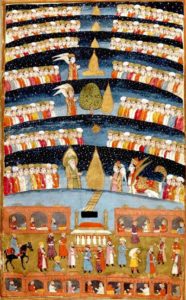
An 1808 Persian illustration of the Seven Heavens

The Zohar here draws from a more ancient Midrash that “all sevens are beloved” (Vayikra Rabbah 29:11). That Midrash expounds on another place in Vayikra that outlines the High Holidays, which are specifically in the seventh month of the year. Why the seventh? The Midrash states that there are seven heavens, and the highest heaven, called Aravot (from Psalms 68:5), is the most beloved. Of the seven earths or lands, the highest is called Tevel (as in Psalms 9:9), which we humans inhabit, and it is most beloved. The seventh generation from Adam was most beloved, for this was the generation of Enoch, who “walked” with God and never died, transforming into an angel. Similarly, the seventh generation of God’s chosen people was most beloved, for Moses was the seventh generation starting from Abraham. The Midrash continues with other sevens, including that the seventh day (Shabbat) is most beloved, as is the seventh Sabbatical year (Shemitah), and the seventh month, Tishrei, which is why the High Holidays are in that month.

Now, the Midrash above seems to suggest that just as the seven heavens are overlayed one on top of another, so too are the seven “earths” overlayed one of top of another. The surface world is our Tevel, and beneath us are six more layers of worlds, respectively called Eretz, Adamah, Arka, Gai, Tziyah, and Neshiya (אֶרֶץ, אֲדָמָה, אַרְקָא, גַּיְא, צִיָה, נְשִׁיָּה). The Zohar first quotes this teaching, tracing it back to Adam himself, and says that the lower worlds are arranged concentrically like an onion. In each subterranean world are distinct creatures that are different than those in our world. However, the Zohar then brings an alternate teaching from the great Rav Hamnuna Saba. This one is absolutely breathtaking because of its precise scientific knowledge, way ahead of its time:

… the entire world spins around like a ball, with some [people] on top and some [people] below. The living beings [across the seven lands] all differ in their appearance because of the different environments in each land, yet are all like other human beings.

When one land has light, another land has darkness, so that when it is daytime for one group [of people], it is nighttime for the other. In one land, it is always daytime, except for a short hour of night. And this is the [true meaning] of what is written in the ancient Book of Adam.

The Zohar here addresses all of our concerns and makes sense of the seven lands. The truth is that the seven lands are all on the surface, just different continents around our globe. The beings in these worlds are not distinct, bizarre creatures, but just like all shar bnei nasha, other normal human beings, but with different skin colours and appearances since they adapt to their environment!

Not only does the Zohar reveal that there are seven continents (something that humans would not uncover for hundreds of more years!) but it also tells us the world is spherical, and that it is rotating “like a ball” (not confirmed by scientists until the 1800s!) The Zohar knows about time zones, too, and says that it is daytime in some continents while it is simultaneously night in other continents. More incredible still, it knows that in the continent of Antarctica (first sighted only in 1820!) it is sometimes entirely day with practically no night, and vice versa. (This is true in the Arctic as well, but the Arctic is not a continent.)

Rav Hamnuna Saba concludes that this is the true meaning of the ancient secret of the seven lands. One should not think that the worlds are subterranean and arranged like an onion, for this is an incorrect interpretation. To help confirm this, the Zohar goes on to relay a story about Rav Nehorai Saba, who rejected the Midrash about the seven lands and did not believe it could be true. It happened that he was once at sea and a terrible storm began to rage. The ship capsized and Rav Nehorai was cast into the depths of the ocean. He washed up on a foreign land, with strange-looking people speaking a language he did not understand. Eventually, a miracle happened and he was teleported back to his home. He would often be found crying in the study halls, and when people asked why, he answered: “Because I sinned against belief in the words of the Sages…” Rav Nehorai would henceforth teach: “Happy are the righteous who labour in the Torah and know the mysteries of the supernal secrets; woe to those who disagree with them and are not believers!”

Rav Nehorai was not alone in his initial doubt. Even the Ramak (Rabbi Moshe Cordovero, 1522-1570) living in the 16th century still had a hard time believing in the seven lands, and admitted that it seemed impossible and baffling! He concluded that, like Rav Nehorai, one should accept it on faith alone (see Pardes Rimonim, Gate 6, Chapter 3). Today, we don’t have to be baffled, and we have all the empirical evidence we need to know that Rav Hamnuna Saba was correct all along. Science has finally caught up and confirmed what was once a most profound mystical secret.

Cain’s Children

Elsewhere (I, 9b), the Zohar states that when God banished Cain following his murder of Abel, he was exiled to the land of Arka, one of the “seven lands”. While some erroneously thought this to mean that Cain was somehow sent deep into the nether regions of the planet, the truth is that, as we’ve seen, he was simply banished to another continent. We learn that Cain mated with the people there, and this is where his children came from. This confirms the statement of Rav Hamnuna Saba that the inhabitants of the other lands are human beings, too, and not strange otherworldly creatures. Cain just went to another continent, probably Africa or Asia. (The Torah says in Genesis 4:16 that Cain went to the region of Nod, east of Eden.)

The Zohar above solves another great mystery: if Adam and Eve were the only people, and they only had Cain and Abel, the latter of which died, who could Cain have mated with? The Zohar reveals that there were other, “uncivilized” people, too. Adam and Eve were unique in that they were given a divine intellect, but they were not alone. This also explains why the Torah seemingly mentions the creation of man twice, in both chapters 1 and 2 of Genesis. The inescapable conclusion is that chapter 1 of Genesis describes the creation of mankind, all human beings, while chapter 2, in the Garden of Eden, describes the birth of the first fully civilized man, infused with a unique divine spirit, and given the tools to transform the world. Cain would have been the first to set forth and “civilize” the rest of the world. This may be why the Torah specifically tells us that Cain went and built a city (Genesis 4:17).

In any case, Cain’s descendants all perished in the Great Flood, leaving only the line of Seth, from whom Noah and his children descended. Intriguingly, Rav Yonatan Eybeschutz (1690-1764), in his Tiferet Yonatan commentary on the Torah, held that the Great Flood did not affect the Americas! Only the Old World of Asia, Africa, and Europe were punished. His reasoning is pretty solid: Had the Flood destroyed everyone around the globe, how could Noah’s children have populated the New World? They didn’t have the advanced ships needed to traverse the oceans! We must conclude that America was spared, and the people there, who were not affected by the sins of the Old World anyway, were completely unharmed. (We probably have to include Australia here, too.)

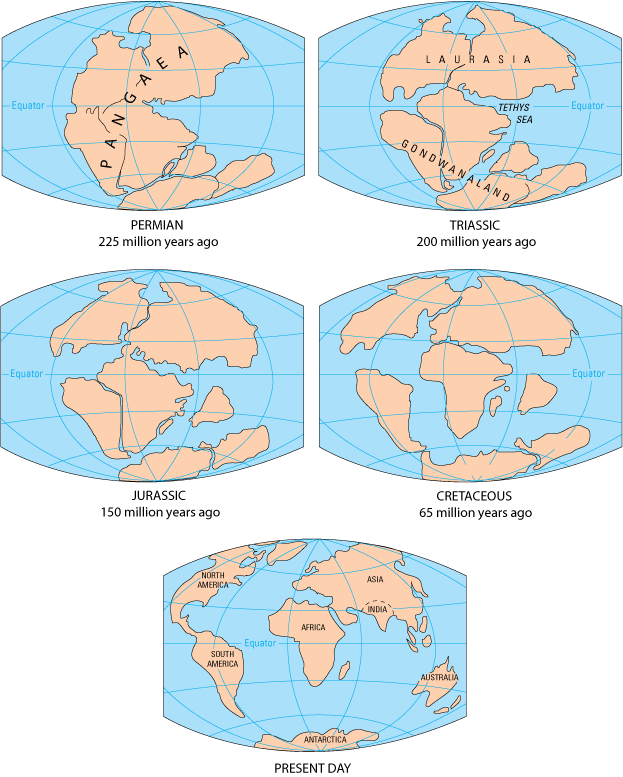
On this note, it is important to mention that some in the religious world think that the continents only split as a result of the Great Flood. Both Torah and science agree that the continents were once joined together (a landmass scientists refer to as Pangea). However, scientists estimate that the continents split long ago, and it could not have happened within the timeframe of human history. Rav Eybeschutz’s statement also confirms that the continents were already split at the time of the Flood. As the Midrash cited above states, God created the world initially with seven lands, so the seven distinct continents surely already existed at the time of Adam’s creation.

How scientists map the development of the continents, which drift about 2.5 centimetres per year. For how to deal with the age of the universe and reconciling it with Torah chronology, see here.

Continental Sefirot

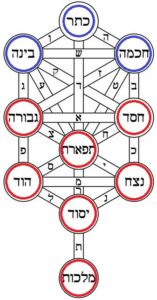
The three upper Sefirot of mochin (in blue) and the seven lower Sefirot of the middot (in red).

When the Zohar speaks of all the sevens embedded in Creation, it implies that these correspond to the seven lower Sefirot. So, how do we connect the continents to the Sefirot? The Old World three of Asia, Africa, and Europe are surely tied to the three main axes of Chessed, Gevurah, and Tiferet. We generally say that Noah’s sons divided up the three Old continents amongst themselves, with Shem getting Asia, Ham getting Africa, and Yefet getting Europe. The Zohar (I, 73a) tells us that the three sons embody Chessed, Gevurah, and Tiferet, so we can easily conclude that Asia is Chessed, Africa is Gevurah, and Europe is Tiferet.

Asia is by far the largest continent, and Chessed is also called Gedulah, “largeness”. Asian cultures are known for their warm hospitality and their altruistic, tight-knit communities, a sure sign of Chessed. There is no doubt that hot Africa, with its difficult history, is the severity of fiery Gevurah, also called Din, harsh “judgement”. Tiferet is “beauty”, sharing a close root with Yefet, which means pretty much the same thing.

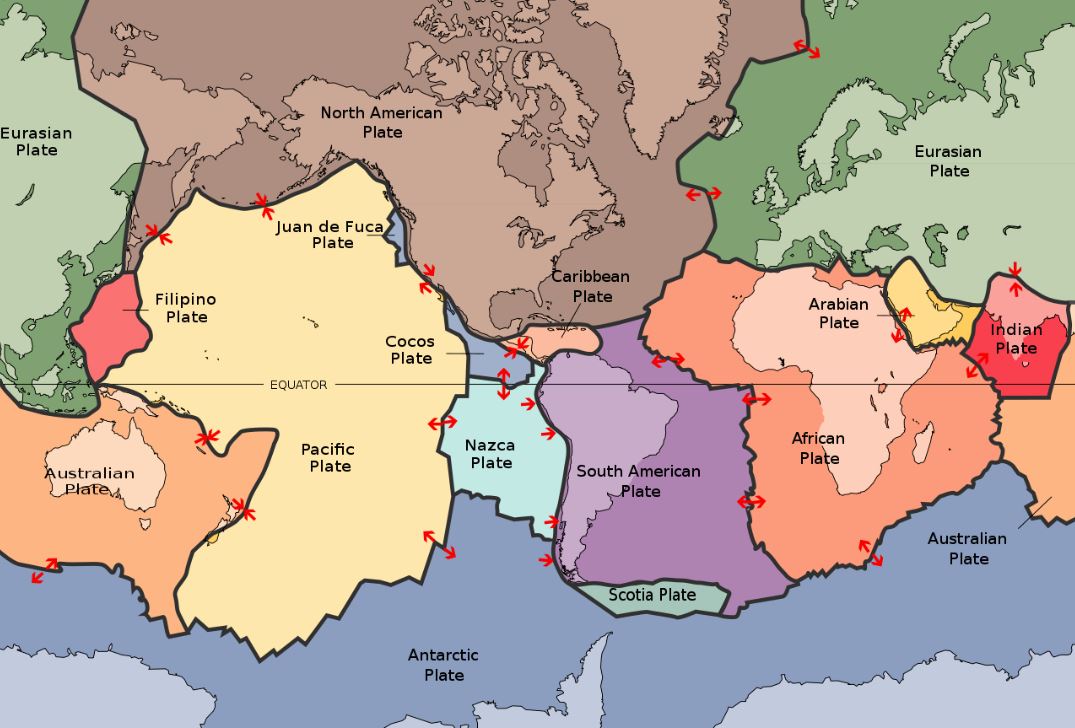
It is worth briefly exploring the unique case of the land of Israel. Geographically, we consider Israel to be a part of Asia, and those Asian qualities mentioned above are certainly prominent in the Holy Land. Yet, mystical texts typically associate Israel with Tiferet, which is closer to Europe. Indeed, Israel’s history is most closely intertwined with that of Europe, and not only in the present day when Israel is politically closer to Europe than Asia, but even in ancient times during its close encounters with Greece and Rome. Geologically, meanwhile, the land of Israel is actually part of the African continental plate! (This makes a lot of sense, too, since Canaan was a son of Ham, who got Africa.) We have to conclude that Israel, being a special land, is really outside of the seven divisions, and has elements of all the continents and all the Sefirot. (It’s important to note here that the continental plates don’t match up exactly with our divisions of the continents, since Europe and Asia are part of one Eurasian plate, while India and Arabia have their own tectonic plates.)

The “twin” continents of North and South America are undoubtedly the “twin” Sefirot of Netzach and Hod. This explains well the qualities of both: North America is the place that contains history’s most dominant and powerful empire—a fitting aspect of “victorious” Netzach. South America, meanwhile, is best known for its vibrant cultures and colours, and its showmanship in music, dance, and sports—a clear aspect of the “splendorous” Hod.

Australia is best paired with Yesod. An interesting parallel here can be made when we remember that the personification of Yesod was Joseph. He was a prisoner sent “down under” unjustly, but nonetheless emerged from this ordeal into greatness. Australia, too, is infamous for its origins as a penal colony, where the British originally sent their prisoners. (Australia celebrates its national holiday, Australia Day, on January 26th, the anniversary of the day that the penal colony was established in 1788!)

Finally, there is no doubt about the nature of cold and empty Antarctica at the very bottom of the globe. This is the “empty” Malkhut at the bottom of the Sefirot, with little energy of its own to emit and serving only as the receptable for the Sefirot above. We might learn from this that, while Antarctica has seemingly played no role in human history thus far, it has a significant role to play in the future era of Malkhut, when God’s Kingship will be revealed once again—an era which we all hope and pray will be upon us imminently.