Tag Archives: Earth

Elements of the Sefirot

As we continue counting the Omer in these weeks between Pesach and Shavuot, it is worth exploring another facet of the mystical Sefirot: their elements. It is well-known that the Sefirah of Chessed, “kindness”, is associated with water. Chessed represents positivity, generosity, and largesse (it is also called Gedulah). Chessed is flowing and life-giving, like water. On the other side, the Sefirah of Gevurah, “strength”, is always associated with fire. Gevurah represents restraint and severity. It is also commonly called Din, “judgement” and punishment. The burning flames are an appropriate metaphor and symbol.

Balancing the first two Sefirot is the third, Tiferet, literally “beauty”, harmony, or symmetry. Tiferet is the golden middle path. It is all about balance, and that’s where real truth is found, so it is also called Emet. Tiferet corresponds to the next major element, air. The ancient mystical text Sefer Yetzirah (3:3) states that “air balances fire and water” (והאויר מכריע בין האש ובין המים). It is hinting to a great secret of chemistry that no one could have known back then. Water is H2O, composed of the two gases hydrogen and oxygen. Most of the molecular weight of water (about 89%) is oxygen, which makes up about 20% of our air. Fire, meanwhile, requires oxygen to burn, and typically produces H2O as a product in the smoke and steam that emerge into the air. So, air does play a key role in both water and fire, balancing the two opposing forces.

Beneath Tiferet on the tree of Sefirot is Yesod, “foundation”, also referred to as Tzadik to represent true “righteousness”, and being the realm of intimacy and sexual purity. Yesod is “grounded-ness”, too, and fittingly parallels the element of earth. Sometimes, one will find that the Sefirah beneath Yesod, the “feminine” Malkhut, is called “earth” as well. Malkhut is literally “kingdom”, and is sometimes referred to as Shiflut, “lowliness” or humility, which is intrinsically tied to kingship or leadership. The difference elementally is that Yesod is afar, the actual dust of the earth, while Malkhut is aretz, the Earth itself, and its landmasses. The landmasses contain all the elements, including bodies of water and the atmosphere above, as well as the molten lava beneath the crust. It is like Malkhut, which sits at the bottom of the Sefirot and is seen as the receptacle that collects from all of the above.

In Western philosophy, there is a fifth element, the most subtle and sublime, called ether or quintessence. One could parallel Malkhut (commonly associated with the Shekhinah, the “divine presence”) with the ether as well. On the other side of the world, Eastern philosophy has the elements wood and metal instead of earth and ether. Scientifically, the Earth is full of metal. Aluminum is the most abundant metal in the crust, followed by iron, calcium, and sodium. And beneath the crust is mostly iron and nickel. One can integrate the Eastern system by paralleling earth-like wood with Yesod, and metal with Malkhut.

Indeed, we find that the tzadik (Yesod) is often described as a tree that has deep roots and foundations, as in Psalm 92:13-14 or Avot 3:17. And a kingdom (Malkhut) requires abundant metal both to build itself up and assert its rule. In fact, we find detailed lists of all the metals that the kings of Israel amassed, and even the metals that David specifically left for Solomon (I Chronicles 29:1-2), and in order to build the Temple, including “5,000 talents of gold, 10,000 darics, 10,000 talents of silver, 18,000 talents of copper, 100,000 talents of iron.” (I Chronicles 29:7, for the significance of this, see the class on ‘Torah Chemistry’.) Keep in mind, too, that Malkhut represents the “vessel” or “receptacle”, which we typically make from metals.

Electromagnetism

So where does that put the remaining two “twin” Sefirot of Netzach and Hod? One is unlikely to find ancient texts that parallel these mysterious Sefirot to any elements. However, a careful reading of the available texts can point to the hidden answer. (I have discussed it briefly in the past, in ‘Secrets of the Menorah Psalm’ in Garments of Light, Volume One, and more fully last year in the class on ‘Kabbalah of the Omer’.) There are two more “twin” forces in nature that can be grouped together with the primordial elements: electricity and light. Both are part of the electromagnetic spectrum, and their energies travel nearly 300,000 kilometres per second. Netzach and Hod are considered the roots of prophecy, so it is fitting to parallel them to electricity and light, through which we see and receive visions. Our eyes pick up light photons and convert them to electrical signals sent to the brain for processing.

More specifically, Netzach means “eternity” or “victory”, and represents perseverance, diligence, and faith. It lies under Chessed (which is water), and is an extension of it. Interestingly, today the vast majority of our electricity is generated using water at some point in the process, either in hydro plants and hydroelectric dams where flowing water directly spins a turbine; or in coal, oil, gas, and nuclear power plants that boil water into steam to spin a turbine. Fuel cells, meanwhile, combine hydrogen and oxygen to generate electricity, and water comes out as the byproduct. There is an intrinsic link between water and electricity, just as there is between Chessed and Netzach. Furthermore, Netzach represents the ascent towards the Eternal One, and electrical chashmal energy is precisely what God’s “Chariots” are described as using to ascend to the Heavens and traverse the cosmos (as explored in the past here).

On the other side, Hod means “glory” and “gratitude”, and is also referred to as majesty, grace, and acknowledgement. A person with good Hod energy is said to exude a light and a glow. The splendour of Hod is also associated with the Torah’s deeper mysteries, secrets of light. There is a beautiful gematria here where the word for “secret” (רז) has a value of 207, equal to the word for “light” (אור)! And this is why the holiday that celebrates Jewish mysticism and the hidden light of the Torah, Lag b’Omer, is specifically on the 33rd day of the Omer, the Sefirah of which is Hod sh’b’Hod—splendour of splendour, light within light. We kindle bonfires to bring out more light into the world. Hod lies under Gevurah and is an extension of it (like Netzach and Chessed), so fittingly the light of Hod emerges out of the fires of Gevurah.

We can think of these elements as we focus on personal development during the Sefirat haOmer period. A Chessed person is kind and flowing. A Gevurah person is tough and stoic. A Tiferet person is spirited, creative, and social. A Netzach person is “electric”, diligent, and ambitious. A Hod person is “magnetic”, graceful and charming, with a warm glow. A Yesod person is righteous and grounded. A Malkhut person is humble, ethereal, and regal. With these elements and qualities in mind, we can hopefully make our Sefirat haOmer more meaningful. To summarize:

Happy Yom ha’Atzmaut!


Learning Resources for Yom ha’Atzmaut:
The Kabbalah of Yom ha’Atzmaut
Hidden History of Zionism (Video)
Spiritual Tools for Israel’s Military Might
The Four Holy Cities (Video)
Zionism Before Zionism
The Seven Earths

This week’s parasha, Vayikra, begins outlining all the sacrificial services in the Tabernacle (and future Temple). One category of offerings is called shelamim, “peace offerings”, introduced at the start of chapter 3. Our Sages taught (as cited by commentators like Rashi and Bartenura) that these offerings are called “peace offerings” because they serve to infuse the entire world with peace. The Zohar (III, 9b) picks up on this and opens a discourse on the nature of the “entire world”, and what it is really composed of. The Zohar states that when God created the world, He created “seven heavens above, seven earths [or lands] below, seven seas, seven [great] rivers, seven days, seven weeks, seven years [in a cycle] seven times, and seven thousand years [of civilization] that the world will endure…”

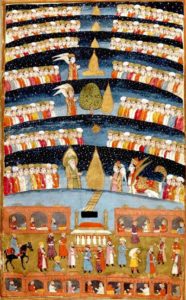
An 1808 Persian illustration of the Seven Heavens

The Zohar here draws from a more ancient Midrash that “all sevens are beloved” (Vayikra Rabbah 29:11). That Midrash expounds on another place in Vayikra that outlines the High Holidays, which are specifically in the seventh month of the year. Why the seventh? The Midrash states that there are seven heavens, and the highest heaven, called Aravot (from Psalms 68:5), is the most beloved. Of the seven earths or lands, the highest is called Tevel (as in Psalms 9:9), which we humans inhabit, and it is most beloved. The seventh generation from Adam was most beloved, for this was the generation of Enoch, who “walked” with God and never died, transforming into an angel. Similarly, the seventh generation of God’s chosen people was most beloved, for Moses was the seventh generation starting from Abraham. The Midrash continues with other sevens, including that the seventh day (Shabbat) is most beloved, as is the seventh Sabbatical year (Shemitah), and the seventh month, Tishrei, which is why the High Holidays are in that month.

Now, the Midrash above seems to suggest that just as the seven heavens are overlayed one on top of another, so too are the seven “earths” overlayed one of top of another. The surface world is our Tevel, and beneath us are six more layers of worlds, respectively called Eretz, Adamah, Arka, Gai, Tziyah, and Neshiya (אֶרֶץ, אֲדָמָה, אַרְקָא, גַּיְא, צִיָה, נְשִׁיָּה). The Zohar first quotes this teaching, tracing it back to Adam himself, and says that the lower worlds are arranged concentrically like an onion. In each subterranean world are distinct creatures that are different than those in our world. However, the Zohar then brings an alternate teaching from the great Rav Hamnuna Saba. This one is absolutely breathtaking because of its precise scientific knowledge, way ahead of its time:

… the entire world spins around like a ball, with some [people] on top and some [people] below. The living beings [across the seven lands] all differ in their appearance because of the different environments in each land, yet are all like other human beings.

When one land has light, another land has darkness, so that when it is daytime for one group [of people], it is nighttime for the other. In one land, it is always daytime, except for a short hour of night. And this is the [true meaning] of what is written in the ancient Book of Adam.

The Zohar here addresses all of our concerns and makes sense of the seven lands. The truth is that the seven lands are all on the surface, just different continents around our globe. The beings in these worlds are not distinct, bizarre creatures, but just like all shar bnei nasha, other normal human beings, but with different skin colours and appearances since they adapt to their environment!

Not only does the Zohar reveal that there are seven continents (something that humans would not uncover for hundreds of more years!) but it also tells us the world is spherical, and that it is rotating “like a ball” (not confirmed by scientists until the 1800s!) The Zohar knows about time zones, too, and says that it is daytime in some continents while it is simultaneously night in other continents. More incredible still, it knows that in the continent of Antarctica (first sighted only in 1820!) it is sometimes entirely day with practically no night, and vice versa. (This is true in the Arctic as well, but the Arctic is not a continent.)

Rav Hamnuna Saba concludes that this is the true meaning of the ancient secret of the seven lands. One should not think that the worlds are subterranean and arranged like an onion, for this is an incorrect interpretation. To help confirm this, the Zohar goes on to relay a story about Rav Nehorai Saba, who rejected the Midrash about the seven lands and did not believe it could be true. It happened that he was once at sea and a terrible storm began to rage. The ship capsized and Rav Nehorai was cast into the depths of the ocean. He washed up on a foreign land, with strange-looking people speaking a language he did not understand. Eventually, a miracle happened and he was teleported back to his home. He would often be found crying in the study halls, and when people asked why, he answered: “Because I sinned against belief in the words of the Sages…” Rav Nehorai would henceforth teach: “Happy are the righteous who labour in the Torah and know the mysteries of the supernal secrets; woe to those who disagree with them and are not believers!”

Rav Nehorai was not alone in his initial doubt. Even the Ramak (Rabbi Moshe Cordovero, 1522-1570) living in the 16th century still had a hard time believing in the seven lands, and admitted that it seemed impossible and baffling! He concluded that, like Rav Nehorai, one should accept it on faith alone (see Pardes Rimonim, Gate 6, Chapter 3). Today, we don’t have to be baffled, and we have all the empirical evidence we need to know that Rav Hamnuna Saba was correct all along. Science has finally caught up and confirmed what was once a most profound mystical secret.

Cain’s Children

Elsewhere (I, 9b), the Zohar states that when God banished Cain following his murder of Abel, he was exiled to the land of Arka, one of the “seven lands”. While some erroneously thought this to mean that Cain was somehow sent deep into the nether regions of the planet, the truth is that, as we’ve seen, he was simply banished to another continent. We learn that Cain mated with the people there, and this is where his children came from. This confirms the statement of Rav Hamnuna Saba that the inhabitants of the other lands are human beings, too, and not strange otherworldly creatures. Cain just went to another continent, probably Africa or Asia. (The Torah says in Genesis 4:16 that Cain went to the region of Nod, east of Eden.)

The Zohar above solves another great mystery: if Adam and Eve were the only people, and they only had Cain and Abel, the latter of which died, who could Cain have mated with? The Zohar reveals that there were other, “uncivilized” people, too. Adam and Eve were unique in that they were given a divine intellect, but they were not alone. This also explains why the Torah seemingly mentions the creation of man twice, in both chapters 1 and 2 of Genesis. The inescapable conclusion is that chapter 1 of Genesis describes the creation of mankind, all human beings, while chapter 2, in the Garden of Eden, describes the birth of the first fully civilized man, infused with a unique divine spirit, and given the tools to transform the world. Cain would have been the first to set forth and “civilize” the rest of the world. This may be why the Torah specifically tells us that Cain went and built a city (Genesis 4:17).

In any case, Cain’s descendants all perished in the Great Flood, leaving only the line of Seth, from whom Noah and his children descended. Intriguingly, Rav Yonatan Eybeschutz (1690-1764), in his Tiferet Yonatan commentary on the Torah, held that the Great Flood did not affect the Americas! Only the Old World of Asia, Africa, and Europe were punished. His reasoning is pretty solid: Had the Flood destroyed everyone around the globe, how could Noah’s children have populated the New World? They didn’t have the advanced ships needed to traverse the oceans! We must conclude that America was spared, and the people there, who were not affected by the sins of the Old World anyway, were completely unharmed. (We probably have to include Australia here, too.)

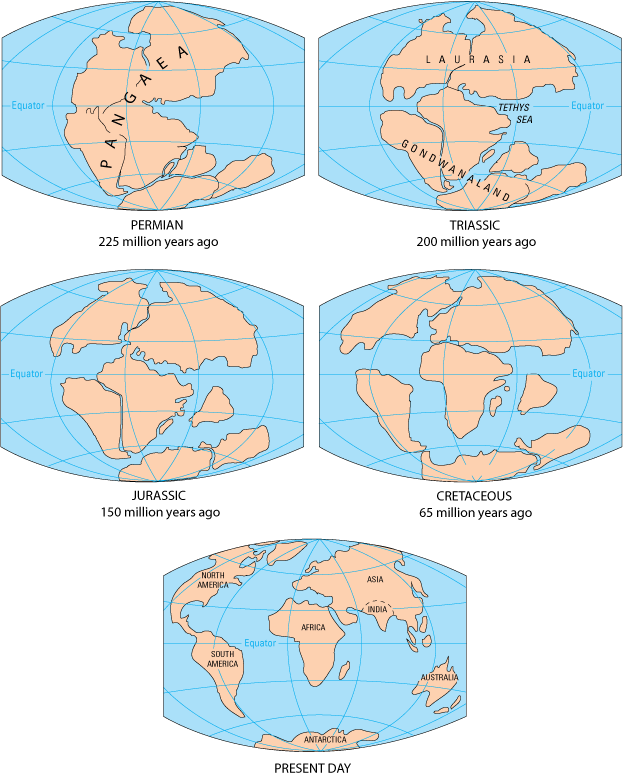
On this note, it is important to mention that some in the religious world think that the continents only split as a result of the Great Flood. Both Torah and science agree that the continents were once joined together (a landmass scientists refer to as Pangea). However, scientists estimate that the continents split long ago, and it could not have happened within the timeframe of human history. Rav Eybeschutz’s statement also confirms that the continents were already split at the time of the Flood. As the Midrash cited above states, God created the world initially with seven lands, so the seven distinct continents surely already existed at the time of Adam’s creation.

How scientists map the development of the continents, which drift about 2.5 centimetres per year. For how to deal with the age of the universe and reconciling it with Torah chronology, see here.

Continental Sefirot

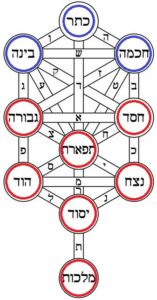
The three upper Sefirot of mochin (in blue) and the seven lower Sefirot of the middot (in red).

When the Zohar speaks of all the sevens embedded in Creation, it implies that these correspond to the seven lower Sefirot. So, how do we connect the continents to the Sefirot? The Old World three of Asia, Africa, and Europe are surely tied to the three main axes of Chessed, Gevurah, and Tiferet. We generally say that Noah’s sons divided up the three Old continents amongst themselves, with Shem getting Asia, Ham getting Africa, and Yefet getting Europe. The Zohar (I, 73a) tells us that the three sons embody Chessed, Gevurah, and Tiferet, so we can easily conclude that Asia is Chessed, Africa is Gevurah, and Europe is Tiferet.

Asia is by far the largest continent, and Chessed is also called Gedulah, “largeness”. Asian cultures are known for their warm hospitality and their altruistic, tight-knit communities, a sure sign of Chessed. There is no doubt that hot Africa, with its difficult history, is the severity of fiery Gevurah, also called Din, harsh “judgement”. Tiferet is “beauty”, sharing a close root with Yefet, which means pretty much the same thing.

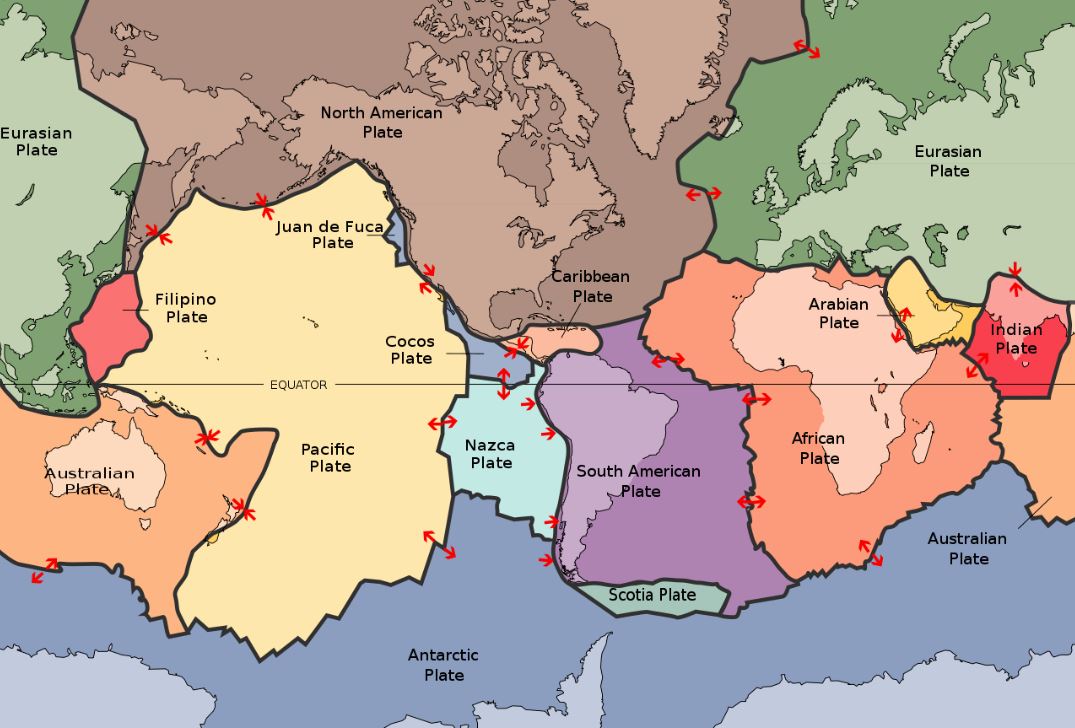
It is worth briefly exploring the unique case of the land of Israel. Geographically, we consider Israel to be a part of Asia, and those Asian qualities mentioned above are certainly prominent in the Holy Land. Yet, mystical texts typically associate Israel with Tiferet, which is closer to Europe. Indeed, Israel’s history is most closely intertwined with that of Europe, and not only in the present day when Israel is politically closer to Europe than Asia, but even in ancient times during its close encounters with Greece and Rome. Geologically, meanwhile, the land of Israel is actually part of the African continental plate! (This makes a lot of sense, too, since Canaan was a son of Ham, who got Africa.) We have to conclude that Israel, being a special land, is really outside of the seven divisions, and has elements of all the continents and all the Sefirot. (It’s important to note here that the continental plates don’t match up exactly with our divisions of the continents, since Europe and Asia are part of one Eurasian plate, while India and Arabia have their own tectonic plates.)

The “twin” continents of North and South America are undoubtedly the “twin” Sefirot of Netzach and Hod. This explains well the qualities of both: North America is the place that contains history’s most dominant and powerful empire—a fitting aspect of “victorious” Netzach. South America, meanwhile, is best known for its vibrant cultures and colours, and its showmanship in music, dance, and sports—a clear aspect of the “splendorous” Hod.

Australia is best paired with Yesod. An interesting parallel here can be made when we remember that the personification of Yesod was Joseph. He was a prisoner sent “down under” unjustly, but nonetheless emerged from this ordeal into greatness. Australia, too, is infamous for its origins as a penal colony, where the British originally sent their prisoners. (Australia celebrates its national holiday, Australia Day, on January 26th, the anniversary of the day that the penal colony was established in 1788!)

Finally, there is no doubt about the nature of cold and empty Antarctica at the very bottom of the globe. This is the “empty” Malkhut at the bottom of the Sefirot, with little energy of its own to emit and serving only as the receptable for the Sefirot above. We might learn from this that, while Antarctica has seemingly played no role in human history thus far, it has a significant role to play in the future era of Malkhut, when God’s Kingship will be revealed once again—an era which we all hope and pray will be upon us imminently.

Abraham’s Stardust Children

In this week’s parasha, Lech Lecha, God forges a covenant with Abraham and promises Abraham that his offspring will be as numerous as the dust of the earth (Genesis 13:17) and the stars of heaven (15:5). The Midrash (Lekach Tov) comments on this by stating that “So, too, are [Abraham’s] children: When they rise, they rise as high as the heavens; when they fall, they fall as low as the dust.” Israel is compared to both stars and dust simultaneously. Peering a little further, there is actually a much more profound, scientific connection hiding in this statement.
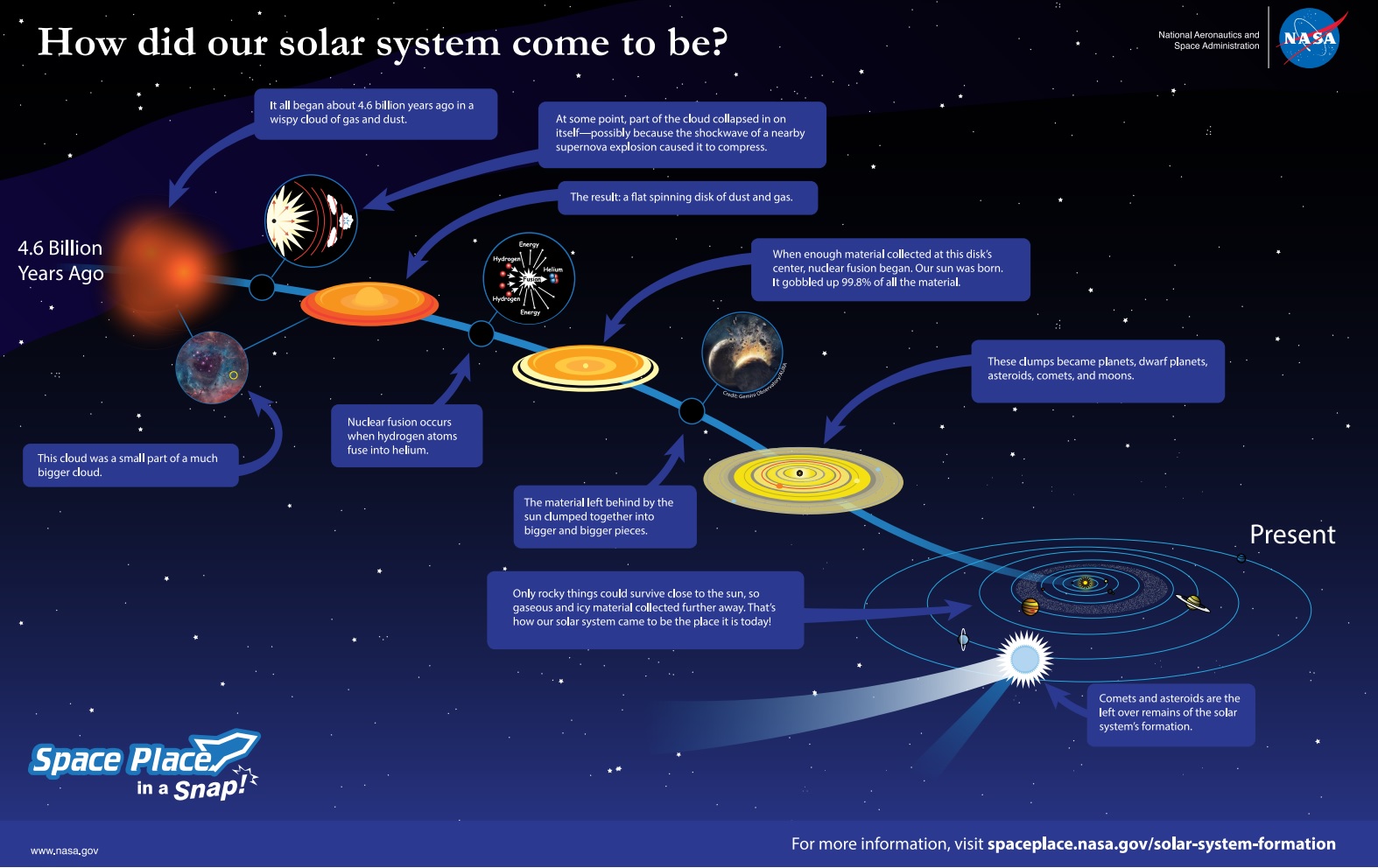
According to modern scientific understanding, the dust of the earth and the stars of the cosmos are intricately linked. Where did the dust of the earth come from? For that matter, where did all elements of Earth, and its entire mass of material, come from? The scientific answer may at first sound blasphemous, but actually fits neatly with the Torah and the ancient teachings of our Sages. Scientists believe that Earth (and the entire Solar System) formed about 4.5 billion years ago (on the issue of the age of the universe, see here), probably from the remnants of a previous star that exploded in a massive supernova. The supernova resulted in a nebula of dust and gas, that then reformed into new worlds.

Going back to the very beginning, the first element to form in the universe was simple hydrogen, with just one proton and one electron. It remains the most abundant element in the cosmos. In our sun, hydrogen atoms fuse together under immense pressure to form helium, the second element (with two protons and two neutrons). Eventually, as hydrogen will start to run out, even helium atoms will start participating in fusion. This will give birth to the first and lightest metal, lithium (three protons), and then beryllium (four protons), and so on. This process generally keeps going until iron (26 protons), the most stable atom and most abundant metal in the universe. When a star explodes, or when neutron stars merge, even heavier elements may be generated, including gold and silver.

As such, it is believed that planet Earth condensed from the minerals spewed out of an exploding star long ago. The lithium and iron we mine from the ground were once part of a star! In fact, the very atoms that make up our bodies were once part of the stars, too! The Torah tells us that the body of Adam was made from the dust of the earth (Genesis 2:7), yet the dust of the earth itself was forged in the stars. With that in mind, we can have quite a literal understanding of God’s statement to Abraham that his children are both dust of the earth and stars of heaven. It also allows us to appreciate the ancient mystical teaching that man is an olam katan, a “mini-universe” or microcosm of the universe (see, for instance, Zohar III, 33b, Ra’aya Mehemna) while the universe is, in turn, an adam kadmon, a “primordial man”.

The big question is: what do we make of these scientific statements? Might they be true? Could Earth have formed from the destruction of previous worlds? Amazingly, our Sages taught exactly that!

Disorder to Order

The Torah states that before God created our world, space was tohu v’vohu and a tehom, a chaotic and unformed abyss. What does this really mean? King Solomon stated in Ecclesiastes 3:11 that God “made everything precisely at its time; even the world…” [gam et ha’olam] In the Midrash, Rabbi Tanchuma explains that this means even the Earth had a specific time when it could be created (Kohelet Rabbah 3:11). Rabbi Abahu then teaches: “We learn from this that the Holy One, blessed be He, would create worlds and destroy them, create worlds and destroy them…” until He finally made a world that “pleased” Him. Rabbi Elazar concludes by suggesting this is alluded to by the great tehom before Earth’s formation, and says this is why God ultimately stated that everything He made was “very good”. God was finally satisfied!

Thus, long ago our Sages already taught what modern science has recently come to realize: our Earth itself was made from the remnants of previous worlds that God had destroyed! It is amazing to think that the wedding ring on your finger—meant to symbolize an eternal bond—is made from gold atoms made by God billions of years ago in a massive cosmic blast, or that the iron coursing through your veins was forged by God in the furnace of an old star. It gives such things immensely more meaning.

On that note, it is important to remember that God programmed the universe with certain unyielding natural laws (as stated, for instance, in Jeremiah 33:25). And God generally follows His own rules, working through derekh hateva, “natural ways”, as our Sages taught. It therefore isn’t surprising that He also generated all the many worlds of the universe through natural means.

A “star factory” nebula in the constellation Aquila

Intriguingly, the last Mishnah in the tractate Uktzin famously states that God made 310 worlds for each tzadik, to be enjoyed in the World to Come. This is based on Proverbs 8:21 where God promises He will reward those who love Him with yesh (יש), “substance”, the value of which is 310. It is also God’s “gift” to the righteous, since the value of “gift”, shai (שי) is 310. Going back to the Midrash above, our Sages imply that God made a multitude of worlds that pleased Him, not just the one which we inhabit now. This is probably referring to all the wonderful worlds He made—through derekh hateva, the laws of nature—for the righteous, 310 each, to inhabit in the future. And for those who like gematria, it is fitting that the value of derekh hateva (דרך הטבע) itself is 310!

A final thought: what can we learn from the notion that Abraham’s offspring are both dust of the earth and stars of heaven? Or, in other words, as the old saying goes, that “we are stardust”? We can learn from this that even if we see ourselves as minute and insignificant, a fleck of dust in the vastness of space, God nonetheless always sees us as His precious, glowing stars.

Shabbat Shalom!