Tag Archives: Archaeology

Did the Jews Build the Pyramids?

The second book of the Torah, Shemot, begins by recounting the Israelite bondage in Egypt, and the Exodus that followed. One often overlooked question is: when did all of this actually happen? The Torah itself never gives any years or specific dates for its events. The accepted Jewish tradition is that the Exodus took place in the Hebrew year 2448, which corresponds to roughly 1312 BCE. What might archaeology and the historical record reveal?

City of Ramses

The Torah tells us that one of the major cities that the Israelites built was Ramses (Exodus 1:11). The historical record shows that this city was, not surprisingly, built by the pharaoh Ramses II (the Great). However, his reign spanned 1279-1213 BCE, too late for the Jewish dating of the Exodus. Perhaps it was Ramses’ grandfather, Ramses I – the founder of Egypt’s famous 19th dynasty – that began building a new capital city to be named after him. Ramses I reigned 1292-1290 BCE; still too late to coincide with Jewish tradition.

The Torah never identifies the names of any pharaohs it mentions. It describes at least three different ones: the pharaoh that dealt with Abraham, and the one that appointed Joseph many decades later, as well as the “new pharaoh” that forgot about Joseph’s contributions (Exodus 1:8). The pharaoh at the time of the Exodus was likely a different pharaoh altogether, too. The description we have of Ramses II actually parallels the Torah’s Exodus pharaoh quite well.
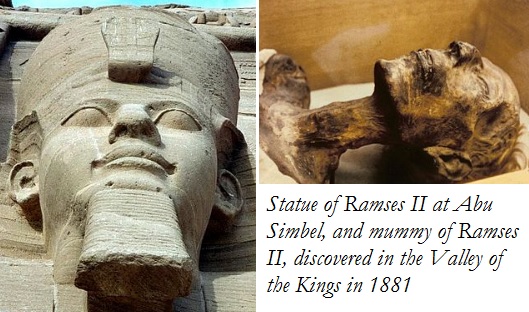
Ramses II was Egypt’s longest-reigning monarch (66 years!) and had over 100 children. He vastly expanded Egypt’s wealth, and stretched its territory and influence as far as the lands of Canaan and Syria. We see that he was a prolific builder, commissioning – among many other projects – a massive temple complex known as the Ramesseum, which still stood over 1000 years later when it marvelled the Greek historian Diodorus. His city of Ramses (or Pi-Ramses) was located in northeastern Egypt, in the land of Goshen, precisely where the Torah says the Israelites dwelled.

The Hyksos
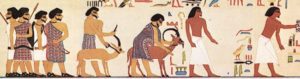
Images of Semites in Egypt, discovered in a Twelvth Dynasty tomb, dated to c. 1900 BCE

The historical record shows that a few centuries before Ramses, a mysterious Semitic tribe migrated to Egypt en masse and ended up taking over the kingdom. They were called heqa khaseshet, “foreign rulers”, which gave rise to the term “Hyksos”. Eventually, the Egyptians fought back and regained control from the foreigners. Most were expelled, many were killed, and it is likely that some were enslaved.

The ancient Jewish historian Josephus wrote that “Hyksos” comes from hekw shasu, “shepherd kings”. Of course, the Torah describes in detail how the Hebrews came down to Egypt and made sure everyone knew they were shepherds, a trade frowned upon in Egypt. Josephus cites historical sources suggesting that 480,000 Hyksos were ultimately expelled, and he concludes that these were the ancient Israelites!
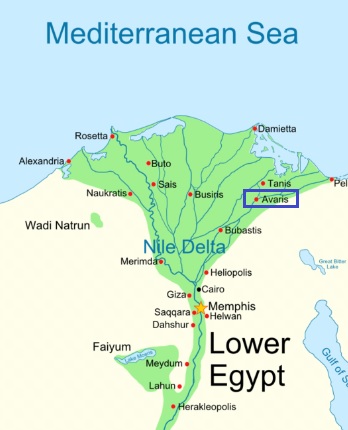
The city of Ramses was discovered 30 kilometres south of Tanis, which is right by Avaris!

It is interesting to point out that the Hyksos’s capital city was also in the northeastern region of Goshen. The city was named Avaris, or Hawara. These sound quite similar to the way the Egyptians refer to the Hebrews in the Torah: ivri.

Historians date the Hyksos period from 1638 to 1530 BCE, totalling just about 110 years. Amazingly, the Zohar (I, 212a-b) states that the Israelites ruled over Egypt for 110 years, then spent the remaining 290 years of their time in Egypt as slaves. This would mean that the Exodus happened 290 years after the end of the Hyksos period. Doing the math, 290 years after 1530 BCE takes us to 1240 BCE – right in the heart of the reign of Ramses II!

Solar Eclipse
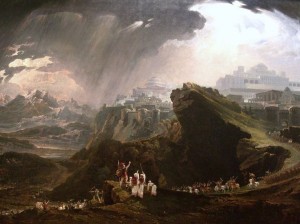
‘Joshua Commanding the Sun to Stand Still upon Gibeon’ by John Martin

All of the above suggests that the Exodus happened closer to the middle of the 13th century BCE. Recently, Israeli scientists discovered what may have been Joshua’s famous “stopping of the Sun” at the Battle of Gibeon (as described in the Book of Joshua, chapter 10). Interpreting this event as a solar eclipse, scientists at Ben Gurion University used NASA data to find any solar eclipses that may have been seen in the area between 1500 and 1000 BCE. They found exactly one, which took place on October 30, 1207 BCE.

This is incredible because the Battle of Gibeon would have happened roughly 40 years after the Exodus (since the Israelites spent 40 years in the Wilderness before Joshua led them to the Promised Land). If the Exodus took place around 1240 BCE, as we suggested above, then the dating of Joshua’s battle and the solar eclipse is right on target!

Reconciliation

The major issue now is that 1240 BCE seems to contradict the traditional Jewish dating of 1312 BCE. The truth is that Ancient Egyptian chronology is notoriously inaccurate. Scholars admit that discrepancies do exist, and are off by anywhere from 30 to 300 years. The discrepancy in our case is only about 70 years, well within the margins of errors.

Compared to the many foggy lists that scholars use to put together Egyptian chronology, the Torah’s chronology is fairly consistent and straight-forward. The years are added up based on peoples’ lifespans and the ages at which they had children, which are explicitly recorded. Historians might therefore want to take another look at Jewish chronology (as brought down in Seder Olam) if they wish to resolve some of their own conflicts.

And did the Jews build the pyramids? They may have built some pyramids (although by that time, pyramids had gone out of style). However, the famous Great Pyramid of Giza was completed by the middle of the third millennium BCE, long before any Israelites were on the scene.


The above article is adapted from Garments of Light: 70 Illuminating Essays on the Weekly Torah Portion and Holidays. Click here to get the book! 

The Amazing Story of Og, the Giant King of Bashan

Devarim, or Deuteronomy in English, is the fifth and final book of the Torah. Deuteronomy comes from the Greek deuteronomion, meaning “second law”, which itself comes from the alternate Hebrew name of the book, Mishneh Torah, meaning “repetition of the law”. The name stems from the fact that Deuteronomy is essentially a summary of the four previous books of the Torah. The key difference is that it is given in the point of view of Moses, and records his final sermon to the people before his death.

One of the enigmatic figures mentioned in this week’s parasha is Og, the king of the land of Bashan. This character is explicitly mentioned a total of 10 times in the Torah, of which 8 are in this portion alone. He is first mentioned in the introductory verses of the parasha (1:4), which state how Moses began his discourse after smiting Sihon, the king of the Amorites, and Og, the king of Bashan.

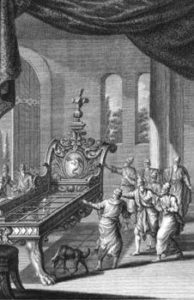
Og’s Bed, by Johann Balthasar Probst (1770)

We are later told how Og had come out to confront the children of Israel, and the Israelites defeated his army in battle. Og is said to be the last survivor of the Rephaim (3:11), which were apparently a nation of giants. His bed is described as being made of iron, and being nine cubits long, or roughly 18 feet!

Rashi provides a little more information. He tells us that Og was the last survivor of the Rephaim in the time of Abraham. It was then that the king Amraphel, together with his allies, dominated the Fertile Crescent region, and decimated many nations that inhabited it. One of these groups of victims were the Rephaim, and Og was the sole survivor among them. He was the “refugee” mentioned in Genesis 14:13 that came to Abraham to inform him of what had happened.

So, who was Og? Where did he come from? Why did he initially help Abraham, but then come out to battle Moses centuries later? And was he really a giant?

Half Man, Half Angel

The Talmud (Niddah 61a) tells us that Og was the grandson of Shemhazai. As we have written previously, Shemhazai was one of the two rebellious angels that had descended to Earth. These two angels argued before God that He should not have created man, who was so faulty and pathetic. God told the angels that had they been on Earth, and given the same challenges that man faced, they would be even worse.

The angels wanted to be tested anyway, and were thus brought down into Earthly bodies. Of course, just as God had said, they quickly fell into sin. This is what is meant by Genesis 6:2, which describes divine beings mating with human women. Their offspring, initially called Nephilim, were large and powerful, and were seen as “giants” by common people. However, during the Great Flood of Noah, all of these semi-angelic beings perished. Except for one.

The Sole Survivor

Midrashic texts famously record that Og was the only survivor of the Great Flood, aside from Noah and his family. When the torrential rains began, Og jumped onto the Ark and held on tightly (Zevachim 113b). He swore to Noah that he would be his family’s eternal servant if Noah would allow him into the Ark (Yalkut Shimoni, Noach 55). The Talmud (ibid.) states that the rain waters of the Flood were actually boiling hot. Yet, the rain that fell upon Og while he held unto the Ark was miraculously cool, allowing him to survive. Perhaps Noah saw that Og had some sort of merit (after all, his grandfather was the one angel that repented). Noah therefore had mercy on Og, and made a special niche for Og in the Ark. This is how the giant survived the Flood.

A variant account suggests that Og survived by fleeing to Israel, since the Holy Land was the only place on Earth which was not flooded.

Abraham’s Servant

As promised, Og became the servant of Noah and his descendants. The Zohar (III, 184a) says that he served Abraham as well, and as part of his household, was also circumcised. As Rashi says (on Genesis 14:13), Og informed Abraham that his nephew Lot was kidnapped, and that the armies of Amraphel and his allies were terrorizing the region. Rashi quotes the Midrash in telling us that Og hoped Abraham would go into battle and perish, so that Og would be able to marry the beautiful Sarah. For informing Abraham, Og was blessed with wealth and longevity, but for his impure intentions, he was destined to die at the hands of Abraham’s descendents (Beresheet Rabbah 42:12).

Whatever the case, the giant soon fell into immorality. The Zohar continues that although he had initially taken the Covenant upon himself (by way of the circumcision), he had later broken that very same Covenant by his licentious behaviour. He used his physical abilities to become king over 60 large, fortified cities (Deuteronomy 3:4). When the nation of Israel passed by his territory, he gathered his armies to attack them.

It is said that Moses feared Og for a number of reasons: Og had lived for centuries, and was also circumcised, so Moses figured the giant had a great deal of merit. God told Moses not to worry, and gave Moses the strength to slay Og himself. As the famous story goes, Moses used a large ten-cubit (roughly 20 foot) weapon to jump ten cubits high in the air—and was only able to strike Og’s ankle! Still, it caused Og to trip over and be impaled by a mountain peak. (On that note, there is a little-known Midrash which states Og survived the Flood simply because he was so large, and the floodwaters only reached up to his ankles! See Midrash Petirat Moshe, 1:128)

It is important to remember once more the old adage that one who believes that the Midrash is false is a heretic, yet one who believes that the Midrash is literally true is a fool. It is highly unlikely that Og was actually so immense (especially considering that this would make him bigger than the dimensions of Noah’s Ark). The Torah tells us his bed was nine cubits long, which the most conservative opinions estimate to be closer to 13 feet, a far more reasonable number.

There are many more colourful stories about Og, including one where a Talmudic sage found his thigh bone and ran through it (Niddah 24b). Another suggests that Og is actually Eliezer, Abraham’s trusty servant (Yalkut Shimoni, Chayei Sarah 109). This is an intriguing possibility, and might help explain how Abraham and Eliezer alone were able to defeat the conglomeration of four massive armies (See Genesis 14, with Rashi).

Archaeologists have even found mention of Og in ancient Phoenician and Ugaritic texts. One clay tablet from the 13th century BCE (Ugarit KTU 1.108) is believed to be referring to him as Rapiu, or the last of the Rephaim—as the Torah states. It suggests that Og’s grandeur got the better of him, and he began to consider himself a god among puny men:

May Rapiu, King of Eternity, drink [w]ine, yea, may he drink, the powerful and noble [god], the god enthroned in Ashtarat, the god who rules in Edrei, whom men hymn and honour with music on the lyre and the flute, on drum and cymbals, with castanets of ivory, among the goodly companions of Kothar…

Perhaps this hubris was Og’s fatal flaw, and brought about his ultimate downfall.

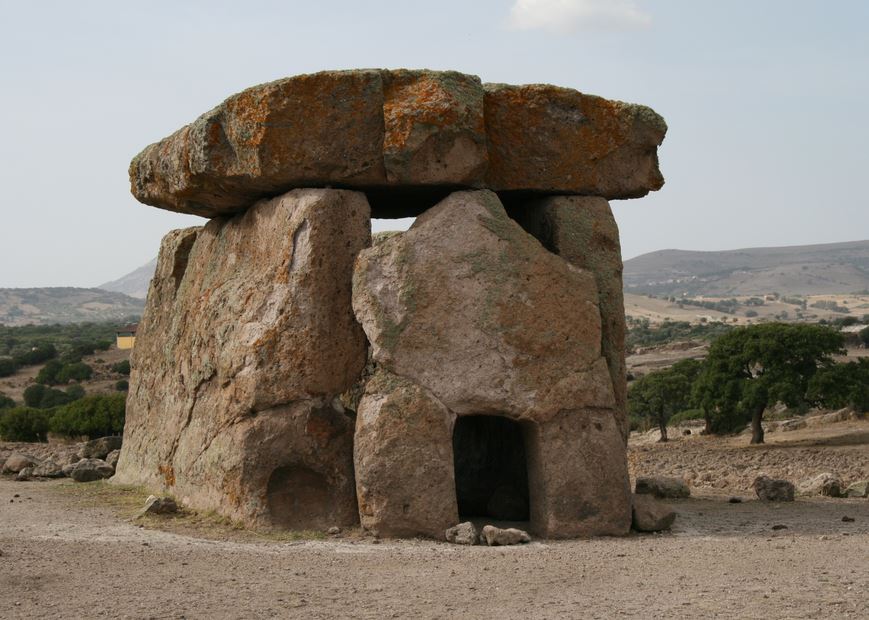
Dolmen (courtesy of www.museodeidolmen.it)

Dolmen (courtesy of www.museodeidolmen.it)

Interestingly, there are also a number of dolmen found in the modern-day area that would have been Bashan. These dolmen are massive stone structures that were erected millennia ago, with some rocks weighing many tons and perplexing scholars as to how they were put together. It is thought that dolmen served as burial tombs, and perhaps have a connection to the tradition of giants living in the Bashan area.


This is an excerpt from Garments of Light: 70 Illuminating Essays on the Weekly Torah Portion and Holidays. Click here to get the book. 

Yosef and Yuya: Does Archaeological Evidence Prove the Biblical Narrative of Joseph?

In 1905, British Egyptologist James Quibell discovered a new tomb in the famed Valley of the Kings, where many of Egypt’s greatest mummified pharaohs were found. In this tomb were the bodies of two highly-preserved mummies, one male and one female: Yuya and Tjuyu. Scholars were astounded at the grand way in which Yuya was described: “the king’s lieutenant”, “master of the horse”, “superintendent of cattle”, and even, strangely, “father of the god”. Most amazingly, though, was the fact that Yuya was buried in the Valley of the Kings, despite never having been a pharaoh! Yuya was a unique and puzzling archaeological find. Who was he?

Father of the King

Parashat Miketz (Genesis 41:1-44:17) describes how Joseph rose to power in Egypt. It begins with Pharaoh’s bizarre string of nightmares, which none of his soothsayers were able to interpret. The royal cupbearer then informs Pharaoh that while he was in prison, a “Hebrew youth” was able to precisely interpret his dreams. Pharaoh summons the Hebrew youth – Joseph – who is indeed able to properly interpret Pharaoh’s dreams. The Sages tell us that Joseph’s interpretation was unique: it not only interpreted the dreams, but simultaneously offered the ideal solution for the problems that the dreams presented. Highly impressed, Pharaoh appointed Joseph as the prime minister of Egypt:

And Pharaoh said to his servants: “Can another man like this be found, in whom the spirit of God rests?” Then Pharaoh said to Joseph, “Since God has let you know all this, there is no one as understanding and wise as you. You shall be [head] over my house, and through your command all my people shall be nourished; only [with] the throne will I be greater than you… I have appointed you over the entire land of Egypt.” And Pharaoh removed his ring from his hand and placed it on Joseph’s hand, and he clothed him with garments of fine linen, and he placed the golden chain around his neck. And he had him ride in his secondary chariot, and they called out before him, “Avrekh!” appointing him over the entire land of Egypt. (Genesis 41:39-43)

Rashi explains that the term Avrekh is a contraction of av, “father”, and rikha, “king”, in other words, Joseph was called aba malka, “father of the king”, or “father of the pharaoh”.

We are then told how Joseph stockpiled food during the seven years of plenty, carefully mapping out a strategy to survive the coming years of famine. Not only did he plan for Egypt’s survival, but he ensured that Egypt would have enough to sell to all of the neighbouring nations and kingdoms that would also be affected by the great famine. Through this, he was able to make Egypt the wealthiest empire on the planet, turning what should have been seven years of hardship into seven years of immense prosperity.

No doubt, such a person would certainly be immortalized in Egypt’s history as one of its greatest leaders. In fact, the archaeological record appears to suggest that he may have been after all.

The Mystery of Yuya

Historians have uncovered a great deal of information about Yuya since the discovery of his tomb in 1905. He lived during the Eighteenth Dynasty of Egypt (1543-1292 BCE), and was an influential minister in the Pharaoh’s court. Strangely, his name is not of Egyptian origin, nor is his appearance. Many scholars believe he must have been a foreigner. He is described as being in charge of the horses and chariots, as well as the cattle. He is also titled “father of the god”, or more accurately, “father of the pharaoh” (since the pharaohs considered themselves gods). It isn’t difficult to see that Yuya is described in terms almost identical to the way that Joseph is described in the Torah.

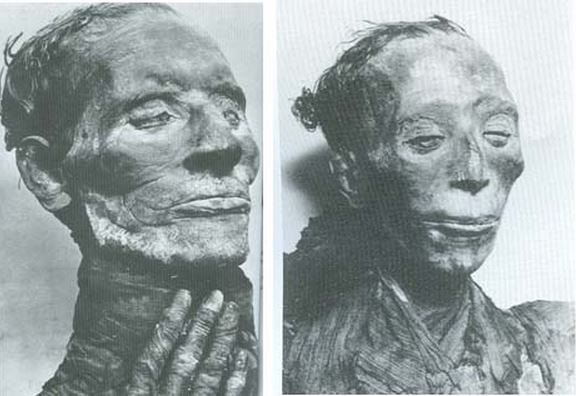
Egyptian journalist and author Ahmed Osman published a controversial book in 1987 about Yuya’s identification with Joseph, titled Stranger in the Valley of the Kings. He pointed out how Yuya’s mummy has Semitic features, evidence of a beard worn in the Hebrew style, and is the only mummy found to have its hands under its chin as opposed to across its chest. Moreover, the description of “father of the god/pharaoh” parallels Joseph’s description as Avrekh. Could the two really be the same person?

The mummies of Yuya and Tjuyu

The mummies of Yuya and Tjuyu

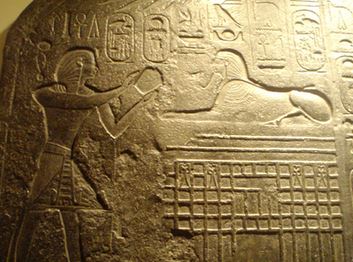
The historical record suggests that Yuya was the minister of the Pharaoh Thutmose IV, who reigned around 1400 BCE. This is not too far from the lifetime of Joseph. More amazingly, archaeologists have found a stele (an inscribed stone) commissioned by Thutmose IV that describes one of his dreams! Like Joseph’s pharaoh in the Torah, Yuya’s pharaoh Thutmose also derived great significance from his dreams.

It is further interesting to point out that Yuya was found entombed with his wife Tjuyu, who is known to have come from a royal family with priestly origins. Similarly, the Torah states that Joseph married the daughter of an Egyptian priest (Genesis 41:45).

And what of Yuya being a mummy? The Torah states: “And Joseph died at the age of one hundred and ten years, and they embalmed him and placed him in a sarcophagus in Egypt.” (Genesis 50:26) Joseph, too, was mummified!

The "Dream Stele" of Pharaoh Thutmose IV

The “Dream Stele” of Pharaoh Thutmose IV

Having said all that, the Torah also states that Joseph’s tomb was later taken out during the Exodus from Egypt (Exodus 13:19), and eventually brought to rest in Israel. This would make it very difficult for his mummy to be found in the Valley of the Kings. On top of this, historians have presented a number of other issues with the identification of Yuya with Joseph. So, perhaps Yuya is not Joseph after all.

Whatever the case may be, the amazing archaeological find of Yuya does give us proof that a foreigner could rise up through the highest ranks of Egyptian royalty, and even become “father to the pharaoh”. It gives us proof that the Torah’s account is quite accurate in its details, and in its terminology. And it certainly makes a compelling case for historical evidence of the Biblical narrative of Joseph.

The Origins of Monotheism

There are two more points that make the connection between Yuya and Joseph all the more fascinating. Historians see the root of the name “Yuya” as yw, which means “reed-leaf” in Ancient Egyptian. Meanwhile, Joseph’s name is יוסף, sharing a root with סוף, which also means “reeds” in Hebrew! The presence of “Ya”, a common appendage in Hebrew names to denote God’s name, makes it even more interesting.

Finally, the historical record shows that Yuya’s daughter married the pharaoh. They had a son, who became the pharaoh Akhenaten. Akhenaten was Yuya’s grandson. And he went down in history for doing one major thing for Egypt: destroying all of its idolatry to make the nation monotheistic. Unfortunately, his attempt to turn Egyptian society and religion monotheistic ultimately failed, and the kingdom reverted to its idolatry. But it wasn’t long after that the Jewish people left Egypt, beginning the spread of monotheism to the entire world.


The above is an excerpt from Garments of Light: 70 Illuminating Essays on the Weekly Torah Portion and Holidays. Click here to get the book!