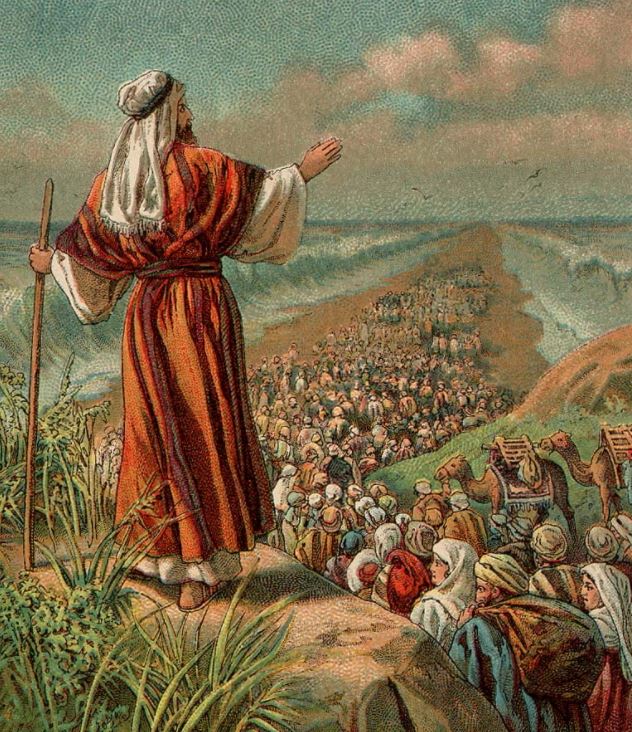
1907 Illustration of the Exodus from the Providence Lithograph Company
This week we begin reading Shemot, the second book of the Torah. Commenting on Israel’s rapid population growth (Exodus 1:7), Rashi famously cites the Midrash that each woman gave birth to six children in a single pregnancy! This is a classic Midrash in the sense that it probably should not be taken literally. One way to make sense of it is to suggest that perhaps each woman produced six Jewish souls per pregnancy. We know that while there was a limited number of Israelites physically present in Egypt and at the Exodus, we maintain that all Jewish souls that ever lived or will live (including those of converts) were there spiritually. Jewish souls from across history were liberated from slavery in Egypt and experienced the Revelation at Sinai. That’s one reason the Passover Haggadah reminds us that each and every Jew at the seder should feel like he or she personally came out of Egypt. You did!
Back in Egypt, the physical Jewish population did indeed grow rapidly. However, when we read the detailed genealogical lists in the Torah, we find that family sizes were not disproportionally large. Amram and Yocheved had three children, Aaron had four, Moses just two. In fact, throughout the Torah family sizes seem relatively small. Isaac had two sons, and Joseph had two as well (that we know of). Abraham was one of three sons. He went on to have a single child with Sarah, one with Hagar, and six more with Keturah (who may or may not be the same person as Hagar). There’s a tradition that Abraham had a daughter, too. Jacob had two children from Rachel, two from Bilhah, two from Zilpah, and seven from Leah—six boys and a girl (like Abraham). The reason for this, from a mystical perspective, is quite evident.
When it comes to the Sefirot, six are described as “masculine”, and the seventh is the feminine Nukva. Higher above, the Sefirah of Binah is called Ima, the “mother”, while Chokhmah is called Aba, the “father”. In this arrangement, the first and highest Sefirah of Keter symbolizes God Above. So, there’s God, father, mother, the six sons, and the daughter. This is a complete mystical “family”. Is this, then, the ideal family on the physical plane as well?
Not exactly. Continue reading