Tag Archives: Egypt

Did the Jews Build the Pyramids?

The second book of the Torah, Shemot, begins by recounting the Israelite bondage in Egypt, and the Exodus that followed. One often overlooked question is: when did all of this actually happen? The Torah itself never gives any years or specific dates for its events. The accepted Jewish tradition is that the Exodus took place in the Hebrew year 2448, which corresponds to roughly 1312 BCE. What might archaeology and the historical record reveal?

City of Ramses

The Torah tells us that one of the major cities that the Israelites built was Ramses (Exodus 1:11). The historical record shows that this city was, not surprisingly, built by the pharaoh Ramses II (the Great). However, his reign spanned 1279-1213 BCE, too late for the Jewish dating of the Exodus. Perhaps it was Ramses’ grandfather, Ramses I – the founder of Egypt’s famous 19th dynasty – that began building a new capital city to be named after him. Ramses I reigned 1292-1290 BCE; still too late to coincide with Jewish tradition.

The Torah never identifies the names of any pharaohs it mentions. It describes at least three different ones: the pharaoh that dealt with Abraham, and the one that appointed Joseph many decades later, as well as the “new pharaoh” that forgot about Joseph’s contributions (Exodus 1:8). The pharaoh at the time of the Exodus was likely a different pharaoh altogether, too. The description we have of Ramses II actually parallels the Torah’s Exodus pharaoh quite well.
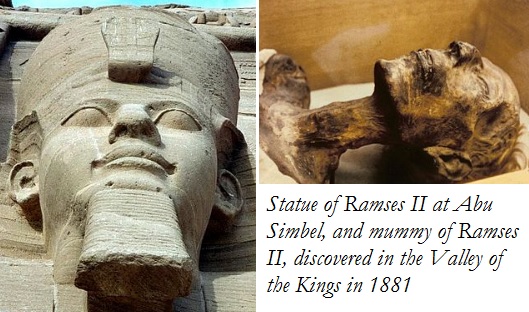
Ramses II was Egypt’s longest-reigning monarch (66 years!) and had over 100 children. He vastly expanded Egypt’s wealth, and stretched its territory and influence as far as the lands of Canaan and Syria. We see that he was a prolific builder, commissioning – among many other projects – a massive temple complex known as the Ramesseum, which still stood over 1000 years later when it marvelled the Greek historian Diodorus. His city of Ramses (or Pi-Ramses) was located in northeastern Egypt, in the land of Goshen, precisely where the Torah says the Israelites dwelled.

The Hyksos
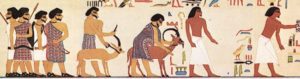
Images of Semites in Egypt, discovered in a Twelvth Dynasty tomb, dated to c. 1900 BCE

The historical record shows that a few centuries before Ramses, a mysterious Semitic tribe migrated to Egypt en masse and ended up taking over the kingdom. They were called heqa khaseshet, “foreign rulers”, which gave rise to the term “Hyksos”. Eventually, the Egyptians fought back and regained control from the foreigners. Most were expelled, many were killed, and it is likely that some were enslaved.

The ancient Jewish historian Josephus wrote that “Hyksos” comes from hekw shasu, “shepherd kings”. Of course, the Torah describes in detail how the Hebrews came down to Egypt and made sure everyone knew they were shepherds, a trade frowned upon in Egypt. Josephus cites historical sources suggesting that 480,000 Hyksos were ultimately expelled, and he concludes that these were the ancient Israelites!
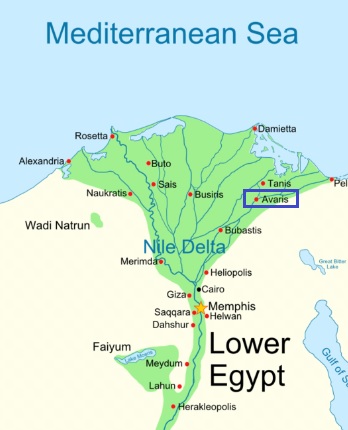
The city of Ramses was discovered 30 kilometres south of Tanis, which is right by Avaris!

It is interesting to point out that the Hyksos’s capital city was also in the northeastern region of Goshen. The city was named Avaris, or Hawara. These sound quite similar to the way the Egyptians refer to the Hebrews in the Torah: ivri.

Historians date the Hyksos period from 1638 to 1530 BCE, totalling just about 110 years. Amazingly, the Zohar (I, 212a-b) states that the Israelites ruled over Egypt for 110 years, then spent the remaining 290 years of their time in Egypt as slaves. This would mean that the Exodus happened 290 years after the end of the Hyksos period. Doing the math, 290 years after 1530 BCE takes us to 1240 BCE – right in the heart of the reign of Ramses II!

Solar Eclipse
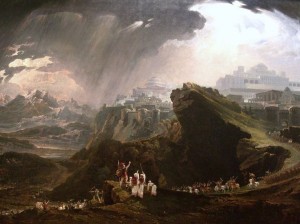
‘Joshua Commanding the Sun to Stand Still upon Gibeon’ by John Martin

All of the above suggests that the Exodus happened closer to the middle of the 13th century BCE. Recently, Israeli scientists discovered what may have been Joshua’s famous “stopping of the Sun” at the Battle of Gibeon (as described in the Book of Joshua, chapter 10). Interpreting this event as a solar eclipse, scientists at Ben Gurion University used NASA data to find any solar eclipses that may have been seen in the area between 1500 and 1000 BCE. They found exactly one, which took place on October 30, 1207 BCE.

This is incredible because the Battle of Gibeon would have happened roughly 40 years after the Exodus (since the Israelites spent 40 years in the Wilderness before Joshua led them to the Promised Land). If the Exodus took place around 1240 BCE, as we suggested above, then the dating of Joshua’s battle and the solar eclipse is right on target!

Reconciliation

The major issue now is that 1240 BCE seems to contradict the traditional Jewish dating of 1312 BCE. The truth is that Ancient Egyptian chronology is notoriously inaccurate. Scholars admit that discrepancies do exist, and are off by anywhere from 30 to 300 years. The discrepancy in our case is only about 70 years, well within the margins of errors.

Compared to the many foggy lists that scholars use to put together Egyptian chronology, the Torah’s chronology is fairly consistent and straight-forward. The years are added up based on peoples’ lifespans and the ages at which they had children, which are explicitly recorded. Historians might therefore want to take another look at Jewish chronology (as brought down in Seder Olam) if they wish to resolve some of their own conflicts.

And did the Jews build the pyramids? They may have built some pyramids (although by that time, pyramids had gone out of style). However, the famous Great Pyramid of Giza was completed by the middle of the third millennium BCE, long before any Israelites were on the scene.


The above article is adapted from Garments of Light: 70 Illuminating Essays on the Weekly Torah Portion and Holidays. Click here to get the book! 

How Jewish History Confirms God’s Promise to Abraham

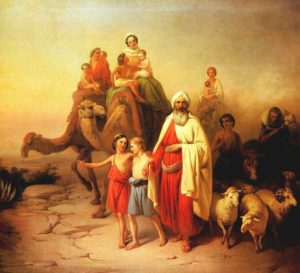
Abraham's Journey to Canaan, by Jozsef Molnar (1850)

Abraham’s Journey to Canaan, by Jozsef Molnar (1850)

Lech Lecha begins with God’s famous command to Abraham to leave the comforts of his home and journey forth to a new beginning in the Holy Land. God promises Abraham (at that point still known as “Abram”) that he will become a great nation, and that God will “bless those who bless you, and the ones who curse you I will curse” (Genesis 12:3). God’s covenant with Abraham passed down to his son Isaac, and then to Isaac’s son Jacob, who fathered twelve sons that became the twelve tribes of Israel. God confirmed his promise to the twelve tribes through the prophet Bilaam, who saw “Israel dwelling tribe by tribe, and the spirit of God came upon him” and he famously remarked, “how goodly are your tents, oh Jacob, your dwellings, oh Israel!” before prophesying that “blessed be those who bless you, and cursed be those who curse you.” (Numbers 24:2-9)

Over three millennia have passed since that time, and as we look back though history, we can see how accurately this prediction has been realized. It began with the twelve sons of Jacob, whom the Ancient Egyptians welcomed to their land and initially treated exceedingly well (thanks to Joseph, who saved Egypt from seven years of extreme famine, and then made the kingdom very rich). As time went on, the Israelites multiplied and prospered in Egypt. In a pattern that would repeat itself countless times throughout history, the natives started to become a little weary (and jealous) of the foreigners. Israel was soon subjugated and enslaved. This brought God’s plagues upon Egypt, and the empire was destroyed. Ancient Egypt’s decline steadily continued from that point, and it would never restore its former glory.

Historians recognize three great ages within Ancient Egypt’s past; the last “golden age” was in the New Kingdom period (1549-1069 BCE), approximately when the Israelites would have been dwelling there. Once Israel left, Egypt’s greatness would soon evaporate, and it would be nothing more than a vassal for the rest of its history – to Assyria, Babylonia, Persia, Greece, and Rome.

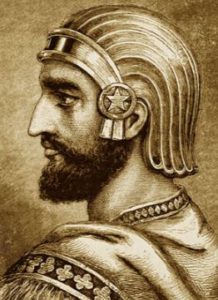
Cyrus the Great

Cyrus the Great

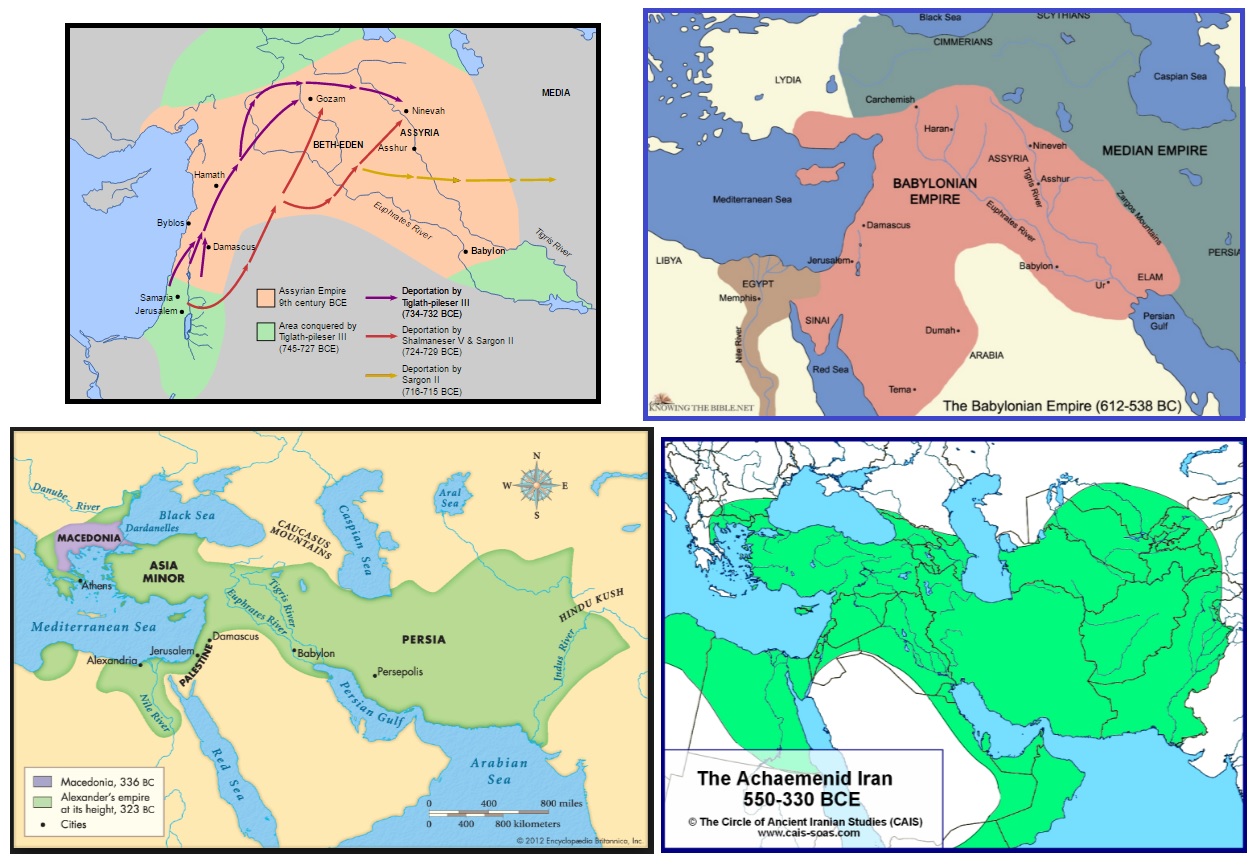
The next major oppressors of Israel were the Assyrians, who destroyed the northern Israelite Kingdom and exiled its tribes. It wasn’t long before the Babylonians overtook the Assyrians. Once the Babylonians themselves destroyed the southern Kingdom of Judah (and the Holy Temple), their own fate was sealed, and it was just 70 years before the Persians took over. The Persian emperor Cyrus treated the Jews very well, allowing them to return to Israel and rebuild the Temple. He was so good that he is described in the Tanakh as God’s anointed – mashiach! (Isaiah 45:1)

When Persian attitudes towards Israel started to turn sour, the Greeks under Alexander the Great quickly became the new rulers. Jews and Hellenists enjoyed very good relations for some two centuries. In the 2nd century BCE, the Seleucids (Syrian-Greeks) attempted to totally assimilate the Jews into their culture. They failed miserably – as celebrated during Chanukah – and soon disappeared from history, being overtaken by the Romans from the West and the Parthians from the East.

Ancient Empires, clockwise from top left: Assyrian Empire (with deportations of Israelites), Babylonian Empire at its height, the Persian Empire under Cyrus and his Achaemenid dynasty, empire of Alexander the Macedonian (Alexander the Great)

Ancient Empires, clockwise from top left: Assyrian Empire (with deportations of Israelites); Babylonian Empire at its height; the Persian Empire under Cyrus and his Achaemenid dynasty; empire of Alexander the Macedonian (Alexander the Great)

Relations with Rome were good, too, at first. During this time, Rome experienced its own golden age, beginning with the emperor Augustus. Unfortunately, Rome was soon busy quelling the province of Judea and destroying the Second Temple in Jerusalem. At the very same time, Rome was thrust into a difficult period of civil war. In the same year that the Temple was destroyed, Rome had its “Year of Four Emperors”.

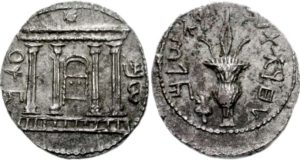
Coins minted by Bar Kochva

Coins minted by Bar Kochva

In 132-135 CE, Rome and Israel were at war again, with the latter lead by Shimon Bar Kochva. After mounting an impressive resistance, Bar Kochva’s rebellion was put down. Just 45 years later, Rome enjoyed the last of its “Five Good Emperors” (Marcus Aurelius Antoninus, who some identify with the Talmud’s “Antoninus”, the close friend of Rabbi Yehuda haNasi). Marcus Aurelius’ successor, Commodus, was a madman who ushered in Rome’s slow decline (as depicted pseudo-historically in the film Gladiator). The ancient historian Dio Cassius marked the year 180 CE – when Commodus took power – as the point at which the Roman Empire began to change “from a kingdom of gold to one of rust and iron.”

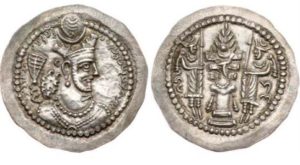
Silver coins minted by Bahram V

Silver coins minted by Bahram V

Many of the Jews who fled the Roman Empire moved to the Sasanian (or Sassanid) Persian Empire. The Sasanians treated Jews remarkably well, and were in turn blessed with prosperity and riches. It was during this time, in the “Babylon” of the Sasanians, that the Talmud was compiled. Jews were granted semi-autonomy within the empire and had their own representative to the government, known as the Reish Galuta, or exilarch. Sasanian kings even married Jewish women, and one of the most famous of Sasanian kings, the legendary Bahram V (r. 421-438 CE), was the son of the Jewish princess Shushandukht. Unfortunately, his successor, Yazdegerd II (r. 438-457), started persecuting religious minorities within the empire and force-fed the state religion of Zoroastrianism. (Some say he was motivated to persecute Jews because of a prophecy that Mashiach would come on the 400th anniversary of the Temple’s destruction.)

Sasanian and Eastern Roman (Byzantine) Empires before the rise of Islam

Sasanian and Eastern Roman (Byzantine) Empires before the rise of Islam

At the beginning of the sixth century, a Zoroastrian priest named Mazdak gained a large following and created a new religious sect that even attracted the king, Kavadh I. This thrust the empire into all sorts of religious turmoil, within which the Reish Galuta, Mar Zutra II, led his own rebellion and managed to establish an independent Jewish city-state in Mahoza. This did not last long, as the king captured Mar Zutra and had him crucified. The office of the Reish Galuta was disbanded at this point. Not surprisingly, the Sasanian Empire wouldn’t last very long after this. The office of the Reish Galuta would soon be re-established by the invading Muslim Arabs, who completely overran the Sasanian Empire.

The same pattern then occurred with the Muslims themselves, who initially treated the Jews of their domain quite well. Jews welcomed the Arab conquerors and saw them as “liberators”. Over time, persecution of Jews became more common. In 1040, the last Reish Galuta (and last of the Gaonim, “geniuses”) Hezekiah, was tortured and killed, and the position of the exilarch was abolished permanently. Hezekiah’s sons fled to Spain, where the Muslim rulers were more tolerant.

As is well known, Jews in Spain experienced a “golden age” of their own during this time. But here, too, they would be victimized by the Muslim rulers. The Muslims were soon driven out of the peninsula by the Christian kingdoms. The expulsion of the Jews by King Ferdinand and Queen Isabella followed shortly after.

Sultan Bayezid II

Sultan Bayezid II

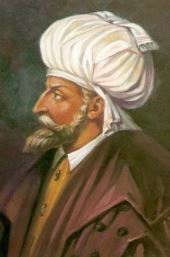
A large majority of the Jews settled in the Ottoman Empire, where the Sultan Bayezid II welcomed them. In fact, with regards to this the Sultan said, “They tell me that Ferdinand of Spain is a wise man but he is a fool. For he takes his treasure and sends it all to me.” Assisted by the influx of Jews, the Ottoman Empire flourished. Meanwhile in Spain, Isabella died and Ferdinand was unable to hold onto the kingdom. It was soon taken over by the Austrian Habsburgs.

In 1656, Jews were permitted to return to England, and it wasn’t long before the British Empire became the greatest the world has ever known. A similar fate awaited the United States, where many Jews found refuge. (And were instrumental in its founding and success. In fact, one of the main financiers of the American Revolution was a Jew named Haym Solomon.) It isn’t difficult to understand why the Soviet Union lost the Cold War against the U.S. so quickly and so dramatically, as Russia and the USSR never had much tolerance for its Jews, while the United States was just about always a safe place for them.

fuguOf course, history is far more complex than the simple narrative presented above, and there are many factors in the rise and fall of empires. However, there is indeed a clear pattern: Where Jews are treated well, the state flourishes and prospers; when Jews are persecuted and expelled, the very same state rapidly declines. This pattern is so obvious that in the 1930s, the Japanese came up with their “Fugu Plan” to strengthen their empire by settling Jews within its lands!

In analyzing the pattern, some scholars see it in simply practical terms, as Jews would bring their wisdom and wealth, skills, expertise, and business acumen wherever they would go, and thus contribute immensely to the success of the places where they lived. Others see far more powerful spiritual reasons, propelled by Biblical prophecy. Whatever the case, history undeniably confirms God’s promise to Abraham and Israel: “I will bless those who bless you, and the ones who curse you I will curse.”


The above is an excerpt from Garments of Light: 70 Illuminating Essays on the Weekly Torah Portion and Holidays. Click here to get the book! 
How Long Were the Israelites Actually In Egypt?

Bo chronicles the final events in the exodus from Egypt. We read about the final three plagues (locust, darkness, and the smiting of the firstborn), the first Passover night, and at last, the liberation of the Israelites. Here, we are told that the Israelites left Egypt after having dwelled there for 430 years (Exodus 12:40). However, Jewish tradition (based on counting up all the years mentioned in the Torah) holds that the Israelites were only in Egypt for 210 years! To further complicate things, God had prophesized to Abraham that his descendants would be slaves in a foreign land for 400 years (Genesis 15:13). So, which is it? Were the Israelites in Egypt for 430 years, 210 years, or 400 years? There appears to be a simple answer to this question, and is the one most commonly cited. However, upon closer examination, this explanation breaks down entirely, and the real answer becomes much harder to find.

The Simple Answer

Let’s begin with the simple answer. Rashi’s commentary on the verse in question is that the Israelites were indeed in Egypt for only 210 years, since this is the sum one comes to when counting the lifespans of Jacob, Levi, Kohath, Amram, and Moses. According to this chronology, the Israelites lived prosperously in Egypt for 116 years. By this point, Jacob and his sons (the original immigrants) had all passed away, and a new pharaoh ascended to power in Egypt. Envious of Israelite prosperity and success, and suspicious of their populous numbers, the new pharaoh began instituting various anti-Semitic laws. Tradition holds that this period of segregation and persecution lasted thirty years, after which the Israelites were formally enslaved. Thus, the Israelites were slaves for 86 years. The year of their enslavement corresponds to the year of Miriam’s birth, hence her name, which (according to one explanation) literally means “very bitter”.* Moses was born six years later, and liberated the Israelites when he was eighty.

Rashi states that since 400 or 430 years in Egypt is impossible, one must assume that by “dwelling” and “sojourning”, the Torah refers to all the dwellings and sojourning since the time of Abraham. Rashi points out that if one counts back 400 years from the Exodus, one comes to the year that Isaac was born. Another thirty years before that was when Abraham beheld the “Covenant of the Parts”, and received the prophecy that his descendants will be slaves and foreigners for 400 years. Therefore, when the Torah states that the Israelites were in Egypt for 430 years, it is going all the way back to Abraham’s Covenant, which happened exactly 430 years earlier. And when God told Abraham his descendants would be slaves for 400 years, He literally meant all of Abraham’s descendants, starting with his first son, Isaac, born thirty years later. This explanation seems to work, at least when reinterpreting the definition of what it means to be “enslaved” and what it means to be “in Egypt”.

However, even Rashi is unhappy with this answer. He says that one has no choice but to accept this explanation al karchacha, literally “against one’s will”. He finishes by saying that this was one of the things that the Sages edited when translating the Torah into Greek for King Ptolemy. (Recall that over two millennia ago, Ptolemy gathered seventy rabbis, put them in separate guarded rooms, and forced them to translate the Torah into Greek. Despite their separation, all seventy rabbis produced the exact same translation, making the exact same amendments where necessary, to make the text more palatable to the Greeks. This text became known as the Septuagint, because of the seventy rabbis. According to Yalkut Shimoni, there were seventy-two rabbis, and they made fifteen changes to the text, one of which is the duration of the Israelites’ dwelling in Egypt.)

The Problem with the Simple Answer

Aside from the fact that the Israelites were slaves for 86 years, not 400, and that the Torah states that they dwelled specifically in Egypt for 430 years, and not elsewhere, there is a much more pronounced problem with the simple answer. If we say that the 430 figure comes from the moment when Abraham first received the prophecy, that means that Abraham got it thirty years before Isaac was born, which means Abraham was seventy years old at the time (since Isaac was born when Abraham was 100). However, the Torah tells us that Abraham only came to the land of Israel for the first time when he was 75 (Genesis 12:4). Sometime after this, he descended to Egypt because of a famine, then returned to Israel. Years later, he participated in the war against the Mesopotamian kings (Genesis 14). It is only following this war that the Torah states, “After these things the word of Hashem came to Abram in a vision…” (Genesis 15:1). And it was in this vision that Abraham received the prophecy of 400 years. It is therefore impossible that he was seventy years old at that time! In fact, the very next chapter speaks of the birth of Ishmael, Abraham’s first son through Hagar, who was born when Abraham was 86. Based on this, some commentaries suggest the Covenant of the Parts happened when Abraham was 85 or 86 years old.

So, we may accept the figure of 400 years starting with Isaac, but where did 430 come from? In lieu of a historical answer, we may have to delve into more mystical literature.


The above is an excerpt from Garments of Light, Volume Two. To continue reading, get the book here