
This essay was meant to be for last week’s parasha, Massei, but the insight only came to me on Shabbat as I was reading the parasha and wandering, once again, what is the deeper significance of the Torah listing all 42 stops of the Israelites in the Wilderness? As I was going over the list, a few of the location names jumped out at me for being of great historical significance. What if, I thought, the 42 stops represent a historical timeline for all the major events in Jewish history, from the Exodus to the End of Days? Could it be that the Torah was encoding all the key national “journeys” of Israel in the future? As I went through them, it made more and more sense, and a neat picture of Jewish history emerged. I decided to write about it this week instead of saving it for next year because some of the “stops” on the Israelite journey are particularly relevant now, both in light of what is happening around the world and in the Holy Land, and as we get ready to commemorate Tisha b’Av this Sunday. Let’s take a deeper look at the 42 stops of the Israelite journey. Continue reading
Tag Archives: Herod Agrippa I
The Jews Who Destroyed the Temple
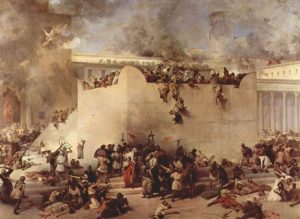
‘Destruction of the Temple of Jerusalem’ by Francesco Hayez (1867)
On Tisha b’Av we commemorate numerous tragedies in Jewish history, most notably the destruction of the First and Second Temples in Jerusalem. The Tanakh outlines quite clearly the events that led to the destruction of the First Temple. When it comes to the Second Temple, however, little is generally spoken of even though we have a lot more historical information about what was going on at the time. We tend to greatly simplify things by reducing it to the same old adage that “the Temple was destroyed because of sinat chinam”, baseless hatred. How did the destruction of the Temple really come about? What were the events that led to the Great Revolt and the first Jewish-Roman War? And who, exactly, were those Jews that harboured such immense hatred for each other?
Why is Adar Lucky?
Today is the first day of Adar, the happiest month on the Jewish calendar. The Talmud (Ta’anit 29a-b) famously states that “when Adar enters, we increase in joy” and that this is the month when a Jew’s fortune is especially “healthy” and good. However, no clear explanation is given as to why this is the case. Presumably it is because the holiday of Purim is in Adar, with Purim being particularly joyous, and associated with luck (Purim means “lotteries”). Yet, the same Talmudic tractate suggests that Tu b’Av and Yom Kippur were the most joyous days of the Jewish calendar, not Purim. How did Adar become so happy and lucky?