Tag Archives: Isaiah

Body Piercings in Judaism

In the first of this week’s double parasha, Matot, we read about the tribute and offerings that the Israelite warriors brought to Moses and Elazar the Kohen Gadol following their wars of conquest. Among the jewellery we find “armlets, bracelets, rings, earrings, and pendants” (Numbers 31:50). Although the final word in this list, khumaz (כומז), is typically translated as “pendant”, its meaning is far more mysterious. Rashi says here that the khumaz was apparently a pendant in the shape of a womb, and by offering up these ornaments, the Israelites were atoning for the sexual sin previously committed with the Midianites.
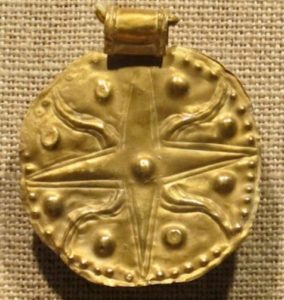
Canaanite Jewellery from the Late Bronze Age, c. 13th century BCE (Credit: factsanddetails.com)

Long before this sin, in Exodus 35:22, we already saw how the Israelites donated their own jewellery for the construction of the Mishkan, and the khumaz appears there also as something offered by the righteous Israelite women. Rashi’s comment there is different, citing the Talmud (Shabbat 64a) that khumaz stands for kan makom zimah (כָּאן מְקוֹם זִמָּה), meaning that this jewellery was something placed on the reproductive organ and was used for “lewdness”! The shocking implication seems to be that this was a piercing in the nether regions.

Interestingly, the Talmud here also presents an opinion that ‘agil (עגיל), typically translated as an “earring”, was actually worn on the breasts, perhaps as a nipple ring, or a golden breastplate of some sort designed to accentuate a woman’s features for lewd purposes. The Talmud concludes the passage with Rav Sheshet saying that the Torah lists exposed ornaments (like bracelets and rings) with concealed ones (like the ‘agil and khumaz) to teach you that there is really no difference: a man that ogles at a woman’s exposed features and ornaments (even just a pinky finger!) is equated with one who ogles at her concealed features and is just as wicked.

The Riva (Rabbi Isaac ben Asher haLevi, c. 11th century), a disciple of Rashi and one of the Tosafists, asks how it is possible that a piercing or ornament of lewdness could be donated for a holy purpose? Similar objections were understandably shared by other commentators. This is why the Ibn Ezra says (on Exodus 35:22) the khumaz must simply be a bracelet for the upper arm. Another possibility was that it was indeed placed over the reproductive organ as the Talmud states, though not for lewdness, but for chastity. Perhaps the khumaz was like a “chastity belt” purportedly used in the Middle Ages to ensure a woman remains a virgin and/or to protect her from sexual harassment. The reality, however, is that there is no physical evidence that such belts ever existed, nor can anyone explain how they might have been comfortably worn or how they would have been kept locked in place without the option of easily removing them. Scholars relegate chastity belts to the realm of myth.

The best explanation is probably that the Israelite women only had those types of lewd ornaments and pieces of jewellery because they were taken from the Egyptians. Recall that the Israelites received gifts and riches from the Egyptians as they left (Exodus 12:35-36). So, it is these pagan ornaments that they repurposed for use in the holy Mishkan. (We might conclude that, in so doing, they were able to affect a tikkun, a spiritual rectification.) The Israelite women themselves probably never wore them. And if they did, it begs the question: what is actually permitted halakhically today when it comes to bodily piercings?

The first piercing that comes to mind is earrings, which we know must be fine. Then come nose rings, which we might assume are not fine. Yet, the reality in ancient Israel may very well have been the opposite. We read, for instance, how Eliezer brought Rebecca a nose ring as a gift (Genesis 24:22 and 47). For those who might argue that this was before the giving of the Torah, and since then nose rings are no longer permissible, the Talmud (Sotah 7b) states that a sotah who was suspected of being an adulteress had to remove her nose ring, meaning they were common among Israelite women at least up to the Talmudic era.

The Talmud there mentions three specific types of ornaments: finger rings, nose rings, and necklaces or “chokers” worn close around the neck. Note how earrings are strangely not mentioned, suggesting that nose rings were more popular among Israelite women at the time. Indeed, the Torah suggests that earrings may have been associated with slavery, as we read how one who wished to be a permanent slave needed to have their ear punctured with an awl (Exodus 21:6). There is a big question if the slave actually had to wear an earring afterwards, or if he only required to have his ear punctured once symbolically. Most likely, he did have to wear an earring to identify him as a permanent slave, and the earring may have even identified to whom he belonged. The Talmud (Kiddushin 21b) has an opinion that the puncturing was done specifically in the upper ear, so perhaps there is a difference between an earring on the earlobe for beauty, versus an earing on the upper ear cartilage to indicate slavery.

The 24 Ornaments of a Jewish Bride

As explored in the past, the Torah gives us 24 ornaments that an Israelite bride would be adorned with in ancient times. The prophet Isaiah lists them in the third chapter of his book, and they are:

  1. anklets [‘achasim] עֲכָסִ֛ים
  2. ribbons (or headbands) [shvisim] שְּׁבִיסִ֖ים
  3. crescents [saharonim] שַּׂהֲרֹנִֽים
  4. pendants (or earrings) [netifot] נְּטִפ֥וֹת
  5. bracelets [sheyrot] שֵּׁיר֖וֹת
  6. veils [ra’alot] רְעָלֽוֹת
  7. headdresses [pe’erim] פְּאֵרִ֤ים
  8. armlets [tza’adot] צְּעָדוֹת֙
  9. sashes [kishurim] קִּשֻּׁרִ֔ים
  10. corselettes (or talismans) [batei hanefesh] בָתֵּ֥י הַנֶּ֖פֶשׁ
  11. amulets [lehashim] לְּחָשִֽׁים
  12. rings [taba’ot] טַּבָּע֖וֹת
  13. nose-rings [nizmei ha’af] נִזְמֵ֥י הָאָֽף
  14. aprons (or festive robes) [mahalatzot] מַּֽחֲלָצוֹת֙
  15. shawls [ma’atafot] מַּ֣עֲטָפ֔וֹת
  16. hair-coverings [mitpachot] מִּטְפָּח֖וֹת
  17. girdles (or purses) [charitim] חֲרִיטִֽים
  18. robes (or gowns) [gilyonim] גִּלְיֹנִים֙
  19. fine linen (or linen vests) [sadinim] סְּדִינִ֔ים
  20. headscarves (or kerchiefs) [tzenifot] צְּנִיפ֖וֹת
  21. mantles (or capes) [redimim] רְדִידִֽים
  22. perfume [bosem] בֹּ֜שֶׂם
  23. belt (or apron) [chagorah] חֲגוֹרָ֤ה
  24. hair curls or braids [petigil] פְּתִיגִ֖יל

In this list, we see no mention of the ‘agil or khumaz, lending further evidence that these really were inappropriate piercings. We do have netifot, literally “drops”, which some interpret to mean earrings that are like droplets hanging from the earlobes. The only other piercing mentioned is, once again, the nose ring. The term used is nezem af, with the second word seemingly superfluous. If nezem already means a “nose ring” then why add af, “nose”?

This dilemma might be solved by looking at the Golden Calf incident. Recall that Aaron had told the men to “take off the gold rings that are on the ears of your wives…” (Exodus 32:2) The term for “gold rings” is nizmei hazahav (נִזְמֵ֣י הַזָּהָ֔ב), but Aaron says to remove them off of their ears! So, a nezem might be referring to any piercing, whether on the nose, ears, or otherwise. Finally, in Ezekiel 16:11 (which parallels Isaiah 3, above) we read that God bedecked the Jewish people with “a ring in your nose, and earrings in your ears, and a splendid tiara on your head.” Here, a nezem is clearly a nose ring and ‘agilim are undoubtedly earrings. So, a Jewish women could sport a modest nose ring and earrings, but other piercings are unlikely to be kosher.

On the whole, there are three major things to consider regarding piercings: first is tzniut, that the piercing should be elegant and modest. Second is darkei Emori, the prohibition of imitating pagan practices. If the piercing is a type that is widely acceptable and universal, like earrings or nose rings, then it is most likely okay, while if it is clearly associated with pagan or gentile practices, then it is not okay. Lastly, there is the issue of beged ishah, that men cannot adorn themselves in the manner of women. Since piercings are generally considered a woman’s form of adornment, they would be entirely prohibited for Jewish men. This is all the more important today, when secular society seeks to completely blur the gender gaps, so we should be all the more punctilious in clearly defining and differentiating between men and women.

Shabbat Shalom!

Mashiach’s Ancestry

In this week’s parasha, Vayechi, we read how Jacob gives a final blessing to his children before his passing. In concluding Dan’s blessing, Jacob says that he is eagerly awaiting God’s salvation, liyeshuatkha kiviti Hashem (Genesis 49:18). What is this referring to? We would think that the salvation will come through Judah, progenitor of David and Mashiach, not through Dan! Indeed, when Jacob blesses Judah (49:10), he says that the royal scepter will remain in his hands all the way until the coming of Shiloh, traditionally interpreted as a name for Mashiach.

On Dan’s blessing, Rashi comments that Jacob foresaw the rise of Samson—from the tribe of Dan—and was praying that Samson would be successful. In fact, as we’ve discussed before, Samson was the potential Mashiach of his generation. (This is first brought down in the Midrash, Beresheet Rabbah 98:14.) Upon closer examination, there is actually a profound connection between the tribes of Judah and Dan.

Our Sages taught that Judah was the most illustrious of the tribes, while Dan was the lowliest. In the Wilderness, the tribe of Judah led the way, while Dan was at the back of the camp. Dan was tasked with being the “lost and found”, and picking up all the things left behind by the other tribes ahead of them. This brought them tremendous merit. On a mystical level, Dan’s role is really symbolic of our mission in “finding” and restoring the lost sparks of Creation to rectify the cosmos. Although people saw Judah as the greatest and Dan as the lowliest, God saw them both as equal, and declared that He will bring representatives from the two together to build His house (Shemot Rabbah 40:4).

As such, God chose Betzalel from the tribe of Judah, and Oholiav from the tribe of Dan to build the Mishkan. The same happened with the Temple in Jerusalem, built by King Solomon from the tribe of Judah, by using resources and labour from King Hiram, whose mother was from the tribe of Dan! (Midrash Tanchuma, Ki Tisa 13) And finally, in the same vein, Mashiach will come from the tribe of Judah paternally, but from the tribe of Dan through his maternal line. (Interestingly, it is possible that King David himself had this lineage, since some hold that his mother, Nitzevet bat Ada’el, was from the tribe of Dan, too.) The root of Yehudah is lehodot, to “thank” and be “grateful”, which is partly an aspect of Chessed, the right pole of “kindness”. The root of Dan is din, “judgement”, representing Gevurah, the left side of “severity”. It is fitting that we need both aspects, right and left, in balance to bring about rectification in the universe. Mashiach is an embodiment of that balance.

Jerusalem’s Coat of Arms

Another Midrash ties this to the reason why both Judah and Dan are described in the Torah as gur aryeh, a “lion cub”, the lion being the symbol of David and of Jerusalem. In Jacob’s finally blessing in this week’s parasha, it is Judah who is called gur aryeh, but in Moses’ final blessing (Deuteronomy 33), it is Dan who is the gur aryeh. The Midrash concludes that Mashiach will come from these two tribes, “his father from Judah and his mother from Dan” (Yalkut Shimoni I, 160). There is also an allusion to it in last week’s parasha, where we read the names of the 70 members of Jacob’s family that came down to Egypt. The only progeny of Dan is Chushim (חשים), an exact anagram of “Mashiach” (משיח)! According to a well-known tradition, it was Chushim who finally put an end to Esau, and so too will Mashiach put an end to the oppression of Edom.

While Dan is called a “lion” by Moses, in this week’s parasha he is called a “snake” by Jacob. This is because the lion was the symbol of the Davidic dynasty, but more specifically, the symbol of Mashiach himself is a snake (as explored in depth here). The famous gematria of “snake” (נחש) is equal to “Mashiach” (משיח), both being 358. This really goes all the way back to Eden, where the Serpent caused man’s downfall, and so it will be the “serpentine” Mashiach who reverses that event. In Kabbalistic sources, this is the meaning of Isaiah’s description of the great final battle between the nachash bariach and the nachash ‘akalaton, the “straight serpent” and the “twisted serpent” (Isaiah 27:1). The former is Mashiach, and the latter is the embodiment of evil that will be destroyed at the End of Days.

Mashiach’s Complex Lineage

When it comes to the specific lineage of Mashiach, we know that he is a direct descendant of King David, but do we have more exact information about his lineage? The pre-Davidic lineage is somewhat clear. It begins with Abraham, from whom there are 14 generations up to David (alluded to by the value of “David”, דוד, being 14!) The key figures in between are Judah, Peretz, and Boaz. Meanwhile, Abraham’s nephew Lot plays a big role, too. Following the destruction of Sodom and Gomorrah, Lot ended up being seduced by his own daughters—who assumed the whole world was destroyed and they had to repopulate the planet—giving birth to Moab and Ben-Ammi, the progenitors of the Moabite and Ammonite nations. From Moab came forth the princess Ruth, wife of Boaz and great-grandmother of King David. From Ammon came Na’amah, wife of King Solomon and mother of Rehoboam, who continued the Davidic dynasty in its third generation.

While we would assume that Mashiach is a direct descendant of David through his son Solomon, there is actually another opinion. The Zohar (III, 173b), for instance, notes that Mashiach might actually come not from Solomon, but from David and Batsheva’s third son, Nathan. (It appears that the Christians wanted to satisfy both rabbinic opinions when providing two different, contradictory genealogies for Jesus in the New Testament: one going through Solomon and one going through Nathan! The irony, of course, is that Christians think Jesus is the literal son of God, so what use is a human lineage anyway?) The dilemma gets more puzzling:

The Zohar says Nathan’s wife was called Heftzibah, and their son was Menachem ben Amiel, an epithet for Mashiach. The problem is that we also know King Hezekiah’s wife was named Heftzibah. Hezekiah was the most righteous king since his forefather David, and is certainly a progenitor in the line of Mashiach. The Talmud (Sanhedrin 98b) states that Hezekiah himself should have been Mashiach, and despite being totally righteous, had one missing quality (for more, see ‘Who is Mashiach?’). The son of Hezekiah and Heftzibah was Menashe, Judah’s longest-serving monarch. Menashe had the potential to be Mashiach, too (and did merit the longest royal reign) but fell to idolatry and wickedness. King Menashe was yet another failed messiah. Some have argued that Menachem ben Amiel and Menashe must be referring to the same person (at least spiritually). Yet Menashe comes from Solomon, and Menachem is supposed to come from Nathan. How do we solve this dilemma?

Pirkei d’Rabbi Eliezer comes in and, at first glance, complicates the problem further. It states (in Ch. 19) that Menachem ben Amiel is a descendant of Joseph, so he is more likely Mashiach ben Yosef, not Mashiach ben David. We might therefore conclude two things: That both Mashiach ben David and Mashiach ben Yosef are actually descendants of King David, the former through Solomon and the latter through Nathan. And, perhaps, just as the former is maternally descended from the tribe of Dan, the latter is maternally descended from the tribe of Joseph. (Maybe Heftzibah the wife of Nathan was a descendant of Joseph?)

The reality is that a person can be a direct descendant of multiple figures, especially after so many generations and so many marriages in between. Today, all Jews are Yehudim, and by default “Judeans”—even Kohanim and Levi’im are Yehudim! So, there is no reason why Mashiach ben Yosef cannot be a descendant both of Joseph and of David. He would undoubtedly be a Yehudi after all! Intriguingly, even David is called an Efrati, apparently with Ephraimite lineage in his past (see I Samuel 17:12, which begins וְדָוִד בֶּן־אִישׁ אֶפְרָתִי).

As it stands today, all the tribes have long thoroughly intermixed, and the exact lineage is no longer of significance (nor is it even traceable). What’s important are the key qualities that Mashiach must possess, and the ability for inspiring leadership and for dignified kingship, as well as, most significantly, to accomplish the tasks set out in the Tanakh (and as codified by the Rambam in Hilkhot Melakhim).

When Mashiach does come, he will merit to wield the serpentine Staff of Moses—that special tool fashioned by God at the twilight of the Sixth Day of Creation (Avot 5:6). And who will provide him with that staff? None other than the returning Heftzibah, the Mevaseret Tzion, and a fierce warrior in her own right who has the power to “slay kings”, as described in the little-known ancient Sefer Zerubavel:

“…the staff of Aaron and Moses and David king of Israel, the staff which flowered in the Tent of Meeting, and brought forth blossoms and produced almonds. And Eliyahu son of Elazar hid it in Raqat [in the territory of Naftali], which is Tiberias, and there was hidden Mashiach ben Ephraim.”

And Zerubavel ben She’altiel said to Michael [the angel]: “If it please my Lord, when will come the light of Israel? And what will be after all this?” And he said to me: “Mashiach ben Yosef will come five years after Heftzibah, and will gather all Israel as one man, and then the king of Persia will come up against Israel and there will be great distress in Israel. And Heftzibah the wife of the prophet Nathan will go out with the staff which the Lord will give her, and the Lord will make a spirit of confusion enter them, and they will slay one another, and there the wicked will die…”

Liyeshuatkha kiviti Hashem!

The Origins and Meaning of ‘Lecha Dodi’

The Haftarah for this week’s parasha, Shoftim, has several phrases that are very familiar from our prayers, such as hit’oreri hit’oreri (התעוררי התעוררי), uri uri (עורי עורי), and hitna’ari m’afar kumi (התנערי מעפר קומי). We recognize these words, of course, from the Friday evening Kabbalat Shabbat song of ‘Lecha Dodi’—but they are originally adapted from the prophecies of Isaiah. The first letters of the eight main stanzas of ‘Lecha Dodi’ spell Shlomo haLevi (שלמה הלוי), alluding to the author of the song, Rabbi Shlomo haLevi Alkabetz (c. 1500-1576).

Rabbi Alkabetz was born in Salonica (present-day Thessaloniki, Greece) to a Sephardic family. He was a student of the great Rabbi Yosef Taitazak (1465-1546), who was among the Spanish Jewish exiles of 1492 and settled in Salonica. Rabbi Taitazak would become the “father” of the Tzfat Kabbalists, for many of his students (including Rabbi Yosef Karo, 1488-1575) were from, or settled in, Tzfat and transformed it into the capital of Jewish mysticism. Another one of Rabbi Taitazak’s students was Rabbi Moshe Cordovero (the “Ramak”, 1522-1570), who was the brother-in-law of Rabbi Alkabetz. Together, the Ramak and Rabbi Alkabetz famously popularized the ancient mystical practice of staying up all night to study Torah on Shavuot.

Tzfat in the 19th Century

Rabbi Alkabetz settled in Tzfat in 1535. One of the notable practices of the Tzfat Kabbalists was to go out into the fields on Friday evening to welcome the “Sabbath Queen”. This is based on the Talmud (Shabbat 119a), which says that Rabbi Chanina would do so, as did Rabbi Yannai, who would also call out bo’i kallah, bo’i kallah. In another place, the Talmud (Bava Kamma 32b) adds that some would say to go out likrat Shabbat, kallah, malkata, to welcome the Sabbath Bride and Queen. The Tzfat Kabbalists resurrected this ancient practice. Rabbi Chaim Vital (1543-1620), the preeminent student and scribe of the great Arizal (Rabbi Isaac Luria, 1534-1572), records in his Pri Etz Chaim (Sha’ar Shabbat) the Arizal’s precise procedure for Kabbalat Shabbat:

He would go out into the fields and first recite Psalm 29 (‘Mizmor l’David’). Then he would say bo’i kallah three times, followed by Psalm 92 (‘Mizmor Shir l’Yom haShabbat’). That was it! The Arizal would then return home, and had another set of rituals around the meal table. One of these was to recite the words Zachor v’shamor b’dibbur echad ne’emru, to recall the mitzvah of Shabbat in the Ten Commandments. Recall that in the first passage of the Ten Commandments in the Book of Exodus, God says zachor et yom haShabbat, to “commemorate” the Sabbath day, while in the second passage of the Ten Commandments in the Book of Deuteronomy, Moses recorded it as shamor et yom haShabbat, to “safeguard” the Sabbath day. Our Sages explained that God had said both words simultaneously—the people heard zachor v’shamor b’dibbur echad, to “commemorate” and “safeguard” in a single utterance.

The Arizal passed away in 1572, while Rabbi Alkabetz outlived him and passed away in 1576 (or 1580 according to alternate sources). We do not know for certain when Rabbi Alkabetz wrote ‘Lecha Dodi’, but it is quite possible that it was composed in his final years, as the Kabbalah of the Arizal was already spreading. A major clue is that Rabbi Alkabetz incorporated the Arizal’s practice of reciting Zachor v’shamor b’dibbur echad into his song (though it is possible that the Arizal had himself adopted the practice from earlier Tzfat Kabbalists). Rabbi Alkabetz also included the key words from the Talmud, and the phrases from this week’s Haftarah about the Final Redemption and rebuilding of Jerusalem, among other Biblical verses. Encrypted into the popular song are some fundamental and profound ideas. Let’s take a deeper look into what the verses of ‘Lecha Dodi’ really mean. Continue reading