Tag Archives: Jacob

Is the Lubavitcher Rebbe Mashiach?

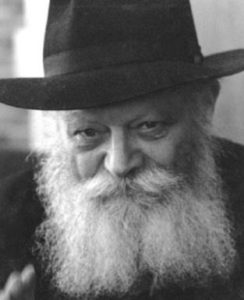
The Lubavitcher Rebbe (Photo Credit: Shlomo Vishinsky and Zev Markowitz/ chaiartgallery.com)

Today is the third of Tammuz, the yahrzeit of Rabbi Menachem Mendel Schneerson, better known as the Lubavitcher Rebbe. There is no doubt that the Rebbe was among the greatest sages of the last century (if not of all time). From the moment he took up the leadership of Chabad, the Rebbe began to make waves in the Jewish world, and quickly transformed Lubavitch into an international powerhouse. Today, Chabad finds itself in 81 countries, operating 3500 institutions.

The Rebbe himself inspired countless souls, both Jewish and non-Jewish. One of the latter was Congresswoman Shirley Chisholm (the first black woman in Congress). When Chisholm was first elected to the House of Representatives, she met fierce opposition and outright racism. Shortly after, she received a call from the Rebbe, who quelled her concerns and offered her advice on how to make the most of her situation. Chisholm went on to create programs that benefited millions of poor people, including the expansion of food stamps across the US. At her retirement breakfast, she said: “If poor babies have milk and poor children have food, it’s because this rabbi in Crown Heights had vision.”

With such vision, along with tremendous wisdom, righteousness, and charisma, it isn’t very surprising that a messianic movement would develop around the Rebbe. Despite the fact that he passed away in 1994, many within the Chabad movement continue to believe that he is Mashiach. Is there substance to this belief?

Mashiach Resurrected

One of the major arguments used by the so-called Mashichistim is a verse in the Talmud (Sanhedrin 98b) that states Mashiach can come from “among the living” or from “among the dead”. The Talmud states that if Mashiach is of the living, it would certainly be Rabbi Yehuda haNasi (who was also called, simply, Rebbi), the great compiler of the Mishnah; if of the dead, it would be the Biblical Daniel. Within Chabad, this passage is used to support the fact that despite the Rebbe’s passing, he may still return to be the messiah.

However, other texts state that Mashiach cannot be from the dead. For example, Midrash Rabbah (on Genesis 49:18) writes how Jacob saw a vision of Samson—who had the potential to be Mashiach—but when Jacob saw Samson’s death, he was saddened that Samson wouldn’t be the messiah and said, “I await Your salvation, Hashem!”

Some believe the Rebbe is not really dead (besides, if Mashiach is from “among the dead”, the Talmud already told us it would be Daniel!) but he is only “concealed”. Multiple Jewish sources state that Mashiach will come, then disappear for a certain amount of time, and then return again. For example, Midrash Rabbah (on Numbers 11:3), writes:

Just like the first redeemer, Moses, revealed himself to the Jews and then concealed himself… similarly, the final redeemer will reveal himself, then conceal himself… and then return and reveal himself again.

Thus, the Rebbe is said to only be “hidden”, and will imminently return. Of course, this isn’t very different from the Christian belief in Jesus’ eventual “second coming” (although it should be noted that Christians believe Jesus actually died, and was not simply “hidden”). Christians have been waiting eagerly for two millennia—much like some in Chabad have been waiting eagerly for over two decades.

In reality, when ancient Jewish sources speak of Mashiach’s concealment and return, they do not mean that Mashiach will disappear for millennia, or even decades. The Midrash cited above itself says that Moses was hidden from the Israelites for three months, and Mashiach would be hidden for only 45 days (though there are other opinions). And so, the potential for the Rebbe being Mashiach appears to have long expired.

The Rebbe on Being Mashiach

One of the things that the Rebbe was adamant about was studying and following the teachings of the Rambam. The Rambam makes it clear who Mashiach is: a Jewish leader who, among other things, successfully reunites the entire nation in Israel (ending the exile), defeats the nation’s enemies, and rebuilds the Temple in Jerusalem. Only one who has successfully accomplished these tasks can be titled “Mashiach”. The Rambam writes that if a person was on his way to fulfilling these, but died in the process, he is clearly not the messiah. The Rambam brings Shimon bar Kochva as an example. Although Bar Kochva was able to push the Romans out of Israel, reclaim the Temple Mount and start rebuilding the Temple, and was even proclaimed the messiah by Rabbi Akiva, he died and his messianic potential died with him.

Although the Rebbe did hint to himself possibly being the messiah in some of his talks (and his followers use those encoded statements as proof), he also said in one of his talks that one is only confirmed to be Mashiach when the Third Temple is built. Obviously, since the Rebbe did not build the Third Temple in his lifetime, he cannot be the messiah. If it turns out that the Rebbe does return somehow in the future, and accomplishes all the messianic tasks, then and only then can he be titled “Mashiach”. To do so now is premature and naïve, if not altogether wrong.

In fact, the Rebbe publicly made clear that he is not Mashiach. In his monumental biography of the Rebbe, Joseph Telushkin devotes a chapter to this question, and writes:

In 1965, Rabbi Avraham Parizh, an elder Chasid who had been with the movement from the time of the Fifth Rebbe, printed letters stating: “With great joy, we can inform you that King Messiah, for whom we have waited so many years, is already among us. He is the holy Lubavitcher Rebbe, Rabbi Menachem Mendel Schneerson, the King Messiah. His address is 770 Eastern Parkway, Brooklyn, New York. He does not need us to choose him since God has chosen him.” Rabbi Parizh printed up many of these letters and started handing them out in Israel. According to one account, Parizh also distributed these letters by dropping them out of a helicopter.

When the Rebbe learned of the letter, he instructed his secretariat to immediately dispatch a telegram to Parizh, dated June 24, 1965: “We were shocked by the letter [you wrote and handed out] and ask that you immediately cease distributing it. Gather and send to the secretariat all copies of the letter, every last one, and please confirm immediately that you have fulfilled this instruction.” Chasidim tell how Parizh spent several weeks scrounging around the streets of Tel Aviv looking for every such sheet he could find…

In 1991, Rabbi Aharon Dov Halprin, the editor of Chabad’s Israeli magazine, Kfar Chabad, wanted to print an article explaining why the Rebbe was worthy of being considered the presumed Messiah. When the Rebbe learned of this he responded sharply, “If you, God forbid, [plan to write] anything even remotely similar, it is preferable that you shut down the periodical completely.”

In an urgent audience to which the Rebbe summoned Chabad activist Rabbi Tuvia Peles, the Rebbe rebuked those who were making Messianic claims about him, saying, “They are taking a knife to my heart” and “they are tearing off parts of me.”

… Some months later, and shortly before the Rebbe’s stroke, the Alaska-based shliach, Rabbi Yosef Greenberg (author of Y’mei Bereishit), brought a letter to be given to the Rebbe in which he referred to him as “King Messiah”. Later that same day, Rabbi Groner told Greenberg that the Rebbe had looked at the letter, thrown it down in frustration, and then wrote on it, “Tell him that when the Moshiach comes, I will give him the letter.”

An even more definitive statement of the Rebbe on this same issue occurred at around the same time. An Israeli journalist, Sarah Davidowitz of the Kol Ha’ir newspaper, approached the Rebbe and said, “We appreciate you very much, we want to see you in Israel; you said soon you will be in Israel, so when will you come?” The Rebbe responded: “That depends on the Moshiach, not on me.” The journalist persisted, “You are the Moshiach!,” to which the Rebbe responded: “I am not”.

In light of this, to call the Rebbe “Mashiach” is highly inappropriate, and against his own wishes. More dangerously, it risks turning Chabad into a religion of its own. After all, Christianity developed in the very same way; in its first decades, it was nearly indistinguishable from Judaism, and was followed almost entirely by Jews. It took a couple of centuries before the divide between Judaism and Christianity was complete, and by that point, Jesus had become a God-like figure.

The same may very well happen with the Rebbe and Chabad in coming decades. Already, there are elements within Chabad who have taken to equating the Rebbe with some kind of god on Earth. Many in Chabad still write letters to the Rebbe, adorn their homes with countless images and elaborate paintings of him, and read out the Rebbe’s letters at important public events (while everyone is asked to rise in honour of the Rebbe’s “presence”, of course). It isn’t uncommon to see children saluting the Rebbe’s empty chair at 770, while worshippers ecstatically chant “long live our master, teacher, and rabbi, the king Mashiach” (see video here). If Chabad’s leaders do not rein in such activity soon, there is little doubt Lubavitch will morph into a religion of its own. And for the Rebbe—who worked so tirelessly to unite all Jews—that would be a most devastating legacy.


For a more detailed analysis of the Rebbe’s messianism, please see here

Embracing Converts, and the Seeds of Amalek

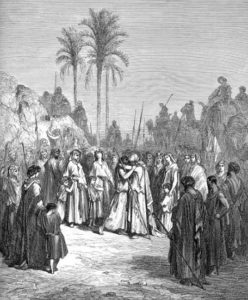
'The Meeting of Jacob and Esau' by Gustav Doré

‘The Meeting of Jacob and Esau’ by Gustav Doré

This week’s parasha is Vayishlach, which recounts Jacob’s return and settlement in the Holy Land after twenty years of living in Charan. At the end of the parasha is a long list of the genealogies of Jacob’s brother, Esau. The list seems unnecessary, and many Sages have wondered why the Torah bothers to spend so much time recounting Esau’s descendants. There have even been debates on whether the entire text of the Torah is equally holy, or if passages like the Ten Commandments are holier than passages such as this list of Esau’s genealogies. Meanwhile, the Arizal states that many of the deepest secrets of Creation are embedded particularly in this seemingly boring and superfluous passage. He draws particular significance from the list of the kings of Edom. The Arizal says these kings are codenames for the Sefirot, and a careful reading of the text reveals the cosmological rectifications (tikkunim) required to repair all of Creation and restore the world to perfection.

About half way through the list we are told that “… the sister of Lotan was Timna” (Genesis 36:22). Again, the Sages are baffled at this extra addition. We already care little enough that there was once an Edomite chief named Lotan – who cares that he had a sister named Timna? The Talmud (Sanhedrin 99b) notes how there were those who scoffed at such verses, saying: “Did Moses have nothing better to write?” And then, the same page of Talmud comes in to explain its tremendous significance:

Timna was a royal princess… Desiring to become a proselyte, she went to Abraham, Isaac and Jacob, but they did not accept her. So she went and became a concubine to Eliphaz the son of Esau, saying, “I’d rather be a servant to this people than a mistress of another nation.” From her, Amalek was descended, who afflicted Israel. Why so? Because they should not have repulsed her!

The Talmud combines the verse in question – which states that Timna was the royal sister of the chief, or prince, Lotan – with an earlier verse (36:12) that says she married Esau’s son Eliphaz and bore Amalek. She wished to convert to Judaism and approached the Patriarchs. All three rebuffed her. So, she ended up with Eliphaz – the closest she could get to being part of the nation. This union gave rise to the evil Amalek, that antagonizing force which has been oppressing Israel for millennia. The Sages state that the Patriarchs should have embraced this potential convert, instead of pushing her away. Their failure to open their arms led to centuries of Jewish suffering. The Talmud sends a pretty clear message: gentiles and converts should not be turned away, and doing so only breeds more resentment against Jews, bringing out all of the world’s “Amaleks”.

Soulmates of Jacob and Moses

The Arizal comments on the Timna passage and points out something even more amazing. He taught (Sha’ar HaMitzvot, Shoftim) that Timna was actually the soulmate of Jacob! Timna contained a great deal of holiness, and Jacob was meant to convert her and marry her, thereby elevating her spiritual sparks. That would have been a massive tikkun of its own, and would have hastened the coming of Mashiach. Instead, Jacob rejected her, and she went on to produce Amalek, bringing evermore evil into the world, and further delaying the coming of Mashiach.

The Arizal highlights that Moses made a similar mistake in not consummating his marriage to the Cushite (Ethiopian) woman. Both Tzipporah and the Cushite woman were Moses’ soulmates, and while Moses did the right thing in converting the Cushite, he never properly married her. Her sparks of holiness were not fully elevated, and the tikkun was left incomplete. This is why Aaron and Miriam were upset with their brother, as we read later in Numbers 12:1, “And Miriam and Aaron spoke against Moses because of the Cushite woman whom he had married…”

Rabbi Akiva’s 24,000 Students in Shechem

In this week’s parasha, too, we read how the people of Shechem genuinely wished to unite with Jacob’s family, agreed to circumcise themselves, and converted en masse. However, Jacob’s sons Shimon and Levi rejected them and resorted to violence in avenging what was done to their sister Dinah. Jacob was horrified at the actions of his sons, and later did not bless the two on his deathbed. It appears their sin was never forgiven, as hundreds of years later the tribes of Shimon and Levi were not given set borders within the Holy Land, but only a handful of cities interspersed among the other tribes. Kabbalistic texts reveal that Shimon and Levi killed 24,000 people in Shechem, and these 24,000 converted souls later reincarnated as the 24,000 students of Rabbi Akiva!

Did You Know These Famous People Converted to Judaism?

All of these narratives point to the same lesson: converts should be welcomed and accepted wholeheartedly. They have the potential for great holiness. The Talmud (Bava Kamma 38a) states that a gentile who occupies himself with Torah is equal to a kohen gadol, a High Priest! The Arizal describes five types of Jewish souls, and the souls of converts are among the purest. (The other types are “Old Souls”, “New Souls”, “True New Souls”, and the “Souls of Cain and Abel”. Of these, the most impure are Old Souls.) It goes without saying that there is no place for racism of any kind within Judaism – Moses himself married a black woman, and was reprimanded for not being diligent in consummating that union.

Historically, Jews were never the proselytizing kind. There are no Jewish missionaries that go out knocking on the doors of gentiles to seek converts. At the same time, Judaism was rarely a popular religion to convert in to. But this will change very soon, and we have to be ready for that day, for the prophet Zechariah (8:23) predicted:

It shall come to pass that ten men shall take hold – from all the languages of the nations – shall take hold of the corners of a Jew’s clothes, saying: “We will go with you, for we have heard that God is with you…”


The above essay is an excerpt from Garments of Light, Volume One. Get the book here!

Jacob’s Sheep: Genetics and Epigenetics in the Torah

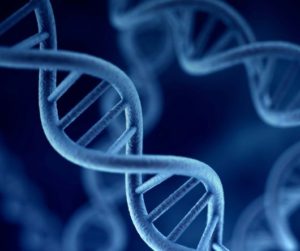
geneticsThis week’s parasha is Vayetze, where we read of Jacob’s arrival in Charan and the details of his twenty-year sojourn there. During this time, Jacob married (twice), had a dozen children, and toiled for his cruel father-in-law Laban. Laban recognized that he had been blessed exceedingly on account of Jacob’s presence, and offered him a new wage for his labour. By this point, Jacob knew not to trust the sly Laban, and asked simply for ownership of all the speckled and spotted sheep. Since these imperfect-looking sheep were few in number, Laban readily agreed. It appears that both Laban and Jacob were well aware of the basic principles of genetics. Today, we know that sheep have 17 or so different colour alleles, and white colour is the dominant one.
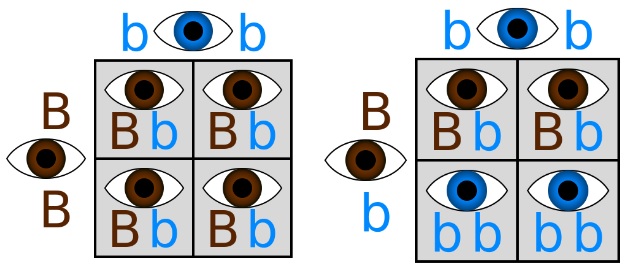
For those who have forgotten high school biology: An allele is a variation of a gene. So, for example, all humans have a gene for eye colour, but have different alleles that code for the varying colours: some have alleles for blue eyes, while others have brown eyes, etc. Each person has two alleles for every gene – one from their mother, and one from their father. Certain alleles are “dominant”, while others are “recessive”. Dominant alleles are far more likely to be expressed. In humans, brown eye colour is dominant to blue eye colour, which is why some 55% of people have brown eyes, while only about 8% have blue eyes.

Basic "Punnet squares" showing the probabilities of eye colour for the children of fully brown-eyed and blue-eyed parents, and a brown-eyed parent who carries a blue allele.

Basic “Punnet squares” showing the probabilities of eye colour for the children of fully brown-eyed and blue-eyed parents, and a brown-eyed parent who carries a blue allele. (Courtesy: The University of North Carolina at Chapel Hill)

White is the dominant allele for sheep colour, so Laban assumed he was getting a terrific deal from Jacob, who was apparently ignorant of sheep genetics. In reality, Jacob knew sheep genetics quite well, and had something else up his sleeve. He only offered Laban this deal because he knew the greedy Laban would readily agree to it. So, how would Jacob outwit his father-in-law?

A Brief Introduction to Epigenetics

Jacob was evidently a far more knowledgeable geneticist than Laban, as he was aware of a concept that has only come to light in recent decades, called epigenetics. Epigenetics refers to various layers of heritability and genetic effects which are above, or outside of (hence the Greek prefix epi), the actual genetic code. In 2008, scientists defined an epigenetic trait as “stably heritable phenotype resulting from changes in a chromosome without alterations in the DNA sequence.” In simple terms: the chromosome that contains the genes is altered in some way without affecting the DNA sequence (the genetic code) itself. That alteration is heritable, too, and passed down from one generation to the next.

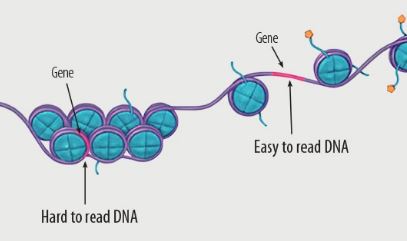
A number of epigenetic mechanisms have been discovered. The most common are methylations and acetylations, where small molecules are attached or removed from the DNA strand, causing it to coil either more tightly or less tightly. When the DNA coils more tightly, the gene is rendered inaccessible, and cannot be expressed. If uncoiled, the gene is exposed, and can be translated into the protein it codes for, thus expressing the trait.

Coiling of DNA and gene expression. (Courtesy: National Institutes of Health)

Coiling of DNA and gene expression. (Courtesy: National Institutes of Health)

While epigenetics is quite complicated, its implications are tremendous. What it means in practical terms is that even though a person has a certain gene, that gene does not necessarily have to be expressed, as it can be silenced through epigenetic mechanisms. For example, a person who has a gene that predisposes them to cancer, God forbid, could potentially have that gene suppressed, thus eliminating their increased cancer risk. (Though they don’t work in this precise fashion, epigenetic cancer drugs are now available.) This also applies to people who might be genetically predisposed to obesity, diabetes, Alzheimer’s, or theoretically, any trait at all. A person who has both brown and blue alleles does not necessarily have to have brown eyes (which is what we would expect based on principles of classical, or Mendelian, genetics). The brown eye allele can be silenced, allowing the blue allele to be expressed fully.

The same is true for Jacob’s sheep. While the alleles for speckled and spotted sheep are recessive, the dominant white allele can be suppressed, resulting in more speckled and spotted sheep. In the Torah, we read how Jacob took tree branches and stripped away some of their bark to expose the inner white layers so that their pattern resembled that of the speckled and spotted sheep. He then placed these branches in front of the white sheep that were mating, and this resulted in the white sheep producing more speckled and spotted offspring. In this way, Jacob was quickly able to multiply the number of irregular-looking sheep in the flocks, increasing his own wealth, and leaving Laban in utter surprise.

What does science have to say about this? Is it really possible for the white sheep to produce speckled and spotted offspring just by looking at speckled and spotted tree branches? Which factors actually affect epigenetics?

The Epigenetics Revolution

In northern Sweden lies a small, isolated town called Överkalix. This town kept detailed historical records, including births, illnesses, and deaths, as well as harvests and food prices. Researchers started poring over this data and noted a number of emerging patterns. Surprisingly, those who grew up in times of relative abundance tended to live shorter and sicker lives, while those who grew up in times of relative famine were healthier and lived longer! Even more shocking was that these traits passed on to their children and grandchildren. The grandsons of those who grew up in times of abundance lived roughly six years less than grandsons of those who grew up in times of famine!

The Överkalix study opened the door to much more research on the subject, and today we know that not only does food impact our epigenetics, but so does smoking, alcohol, exercise, and just about every lifestyle choice we make. Moreover, recent studies find that not only do our actions impact our epigenetics, but even our thoughts do! In 2013, scientists discovered that meditation affects epigenetic mechanisms and results in, among other things, less inflammation in the body, better stress responses, and faster mental processes.

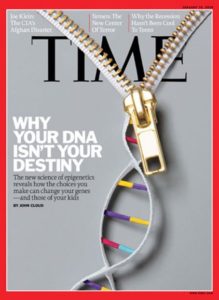
TIME Magazine Feature on Epigenetics

TIME Magazine Feature on Epigenetics

Epigenetics has brought about a revolution in biology, and a new realization that we are not slaves to our genome. We are very much in control of how our genes operate, and seemingly every choice we make affects our health and wellbeing, as well as the health and wellbeing of our children and grandchildren, since these epigenetic patterns are heritable. This is one of the most enlightening and liberating scientific findings, putting each person in the driver’s seat of their biological fate. It should also motivate us to make healthy lifestyle choices because, even if we might not care so much about our own health, the health of our offspring is directly impacted by our choices.

The Return of Jacob’s Sheep

If meditation plays a role in how our genes are expressed, there is no reason why other mental processes cannot do the same. By visually exposing his sheep to speckled and spotted images, Jacob may very well have triggered an epigenetic change resulting in suppression of white alleles. Neurologists have long known that there is essentially no difference in brain patterns when a person is literally seeing something versus when they are simply visualizing the same thing. If mental visualizations like meditation can affect the epigenome, then why not actual visual displays? Armed with this knowledge, Jacob outwitted his father-in-law and became an exceedingly wealthy man.

Of course, one cannot deny God’s role in the process, as Jacob himself explained to his wives (Genesis 31:7-9):

…your father mocked me and changed my wages ten times, but God did not permit him to harm me. If he would say, “Speckled ones shall be your wages,” all the animals would bear speckled ones, and if he would say, “Ringed ones shall be your wages,” all the animals would bear ringed ones. Thus, God separated your father’s livestock and gave it to me…

Changing one’s epigenetics is not so simple! As with everything else, a little help from Above is always needed. Jacob put in his effort by exposing the animals to stimulating sights, and God took care of the rest.

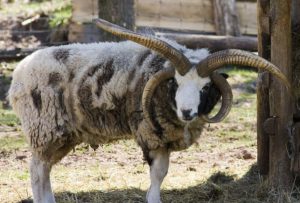
Jacob's sheep are unique not only in their colour, but also in that the rams have extra horns.

Jacob’s sheep are unique not only in their colour, but also in that the rams have extra horns.

Interestingly, this week saw the arrival of 119 “Jacob’s sheep” to Israel. This ancient breed of sheep originated in the Middle East approximately 5000 years ago. They were extirpated from the land of Israel long ago, but thankfully some survived and were brought across North Africa to Europe and finally America. The rare speckled and spotted sheep are in the Holy Land once more, perhaps a sign of the forthcoming return of all of Jacob’s children to their ancestral home.


The above is an excerpt from Garments of Light: 70 Illuminating Essays on the Weekly Torah Portion and Holidays. Click here to get the book!