Tag Archives: Jerusalem

Who Was the First Rabbi in History?

Chanukah is the only major Jewish holiday without an explicit basis from the Tanakh. However, there does exist an ancient Book of Maccabees—which recounts the history of Chanukah and the chronicles of Matityahu, Judah and the Hashmonean brothers—but it was not included in the Tanakh. Some say it was not included because by that point (2nd century BCE), the Tanakh had already been compiled by the Knesset haGedolah, the “Great Assembly” which re-established Israel after the Babylonian Exile. Others argue that the Tanakh was not completely sealed by the Knesset, since it appears that the Book of Daniel may have been put together around the same time as the Book of Maccabees, but was included in the Tanakh. This may be why Daniel was included in the Ketuvim, and not in the Nevi’im where we might expect it to be. Later still, the Sages of the Talmud debate whether certain books (such as Kohelet, “Ecclesiastes”, and Shir HaShirim, the “Song of Songs”) should be included in the Tanakh.

The simplest reason as to why the Book of Maccabees was not added to the Tanakh is probably because it is not a prophetic work, but simply a historical one. Another reason is that the original Hebrew text had been lost, and only Greek translations survived. It is also possible that the Book of Maccabees was not included for the same reason why there is no Talmudic tractate for Chanukah, even though there is a tractate for every other major holiday. (Chanukah is discussed in the Talmud in the tractate of Shabbat). Some argue that the events of Chanukah were so recent at the time that everyone knew them well, so having a large tractate for Chanukah was simply unnecessary. The other, more likely, reason is that although the Hashmonean Maccabees were heroes in the Chanukah period, they soon took over the Jewish monarchy (legally forbidden to them since they were kohanim) and actually adopted the Hellenism that they originally fought so valiantly against!
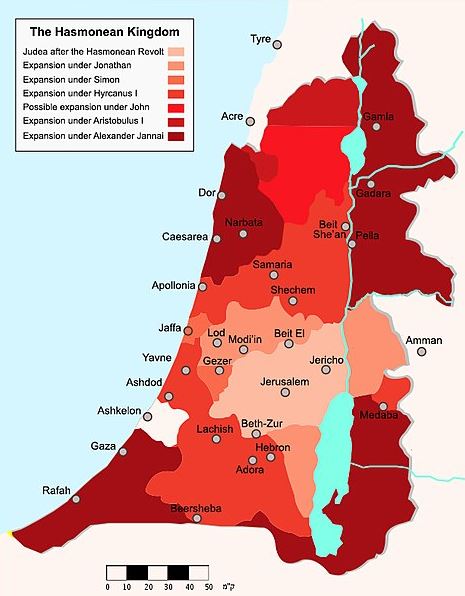
The first Hashmonean to rule was Shimon, one of the five sons of Matityahu. He was the only son to survive the wars with the Seleucid Greeks. He became the kohen gadol (high priest), and took the title of nasi, “leader” or “prince”, though not a king. Despite being a successful ruler, Shimon was soon assassinated along with his two elder sons. His third son, Yochanan, took over as kohen gadol.

Yochanan saw himself as a Greek-style king, and took on the regnal name Hyrcanus. His son, Aristobulus (no longer having a Jewish name at all!) declared himself basileus, the Greek term for a king, after cruelly starving his own mother to death. Aristobulus’ brother, Alexander Jannaeus (known in Jewish texts as Alexander Yannai) was even worse, starting a campaign to persecute rabbis, including his brother-in-law, the great Shimon ben Shetach. Ultimately, Yannai’s righteous wife Salome (Shlomtzion) Alexandra ended the persecution, brought her brother Shimon and other sages back from exile in Egypt, and ushered in a decade of prosperity. It was Salome that re-established the Sanhedrin, opened up a public school system, and mandated the ketubah, a marriage document to protect Jewish brides. After her death, the kingdom fell apart and was soon absorbed by Rome.
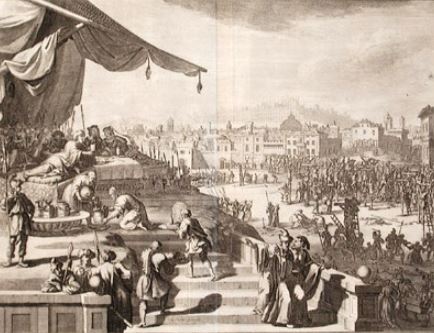
‘Alexander Jannaeus feasting during the crucifixion of the Pharisees’ by Willem Swidde (c. 1690)

Sadducees and Pharisees

While Alexander Yannai was aligned with the Sadducees, Salome Alexandra was, like her brother Shimon ben Shetach, a Pharisee. The Sadducees (Tzdukim) and Pharisees (Perushim) were the two major movements or political parties in Israel at the time. The former only accepted the written Torah as divine, while the latter believed in an Oral Tradition dating back to the revelation at Sinai. Thus, “Rabbinic Judaism” as we know it today is said to have developed from Pharisee Judaism, though this is not quite certain. The Sages of the Talmud didn’t speak so highly of the Pharisees in general, and Judaism also includes key elements from another major group that flourished at the time, the Essenes.

Because the Sadducees only accepted the written Torah, their observance was highly dependent on the Temple and the land of Israel, since most of the Torah is concerned with sacrificial and agricultural laws. When the Romans ultimately destroyed the Temple and the majority of Jews went into exile, Sadducee Judaism simply could not survive. (Later, a similar movement based solely on the written Torah, Karaite Judaism, would develop.) Meanwhile, the Pharisees and their Oral Tradition continued to develop, adapt, and flourish in exile and, together with Essene practices, gave rise to the Judaism of today.

Avot d’Rabbi Natan states that the Sadducees get their name from one Tzadok, a student of the sage Antigonus. Antigonus famously taught (Pirkei Avot 1:3) that one should serve God simply for the sake of serving God, and not in order to receive a reward in the afterlife. It is this teaching that led to Tzadok’s apostasy. Indeed, we know that the Sadducees did not believe in the Resurrection of the Dead or apparently any kind of afterlife at all. This makes sense, since the Sadducees only accepted the Chumash as law, and the Chumash itself never mentions an afterlife explicitly.

In that same first chapter of Pirkei Avot, we read that Antigonus was the student of Shimon haTzadik, the last survivor of the Knesset HaGedolah. Antigonus passed down the tradition to Yose ben Yoezer and Yose ben Yochanan, who passed it down to Yehoshua ben Perachiah and Nitai haArbeli, who passed it down to Shimon ben Shetach and Yehuda ben Tabai. This means that Shimon ben Shetach, brother of Queen Salome Alexandra, lived only three generations after Shimon haTzadik, the last of the Great Assembly. This presents a problem since, according to traditional Jewish dating, the Great Assembly was about 300 years before the rule of Salome. (It is even more problematic according to secular dating, which calculates nearly 500 years!) It is highly unlikely that three generations of consecutive sages could span over 300 years.

The rabbinic tradition really starts with Shimon haTzadik, the earliest sage to be cited in the Talmud. He is said to have received the tradition from the last of the prophets in the Great Assembly, thus tying together the rabbinic period with the Biblical period of prophets. Yet, Shimon haTzadik himself is not called a “rabbi”, and neither is his student Antigonus, or Antigonus’ students, or even Hillel and Shammai. The title “rabban” is later used to refer to the nasi of the Sanhedrin, while the first sages to properly be called “rabbi” are the students of Rabban Yochanan ben Zakkai, the leader at the time of the Temple’s destruction by the Romans.

Despite this, the title “rabbi” is often applied retroactively to earlier sages, including Shimon ben Shetach, Yehoshua ben Perachiah, and others, all the way back to Shimon haTzadik, the first link in the rabbinic chain. Who was Shimon haTzadik?

The Mystery of Shimon haTzadik

The most famous story of Shimon haTzadik is recounted in the Talmud (Yoma 69a). In this story, Alexander the Great is marching towards Jerusalem, intent on destroying the Temple (due to the activism of a group of Kutim), so Shimon goes out to meet him in his priestly garments (he was the kohen gadol). When Alexander sees him, he halts, gets off his horse, and bows down to the priest. Alexander’s shocked generals ask why he would do such a thing, to which Alexander responds that he would see the face of Shimon before each successful battle.
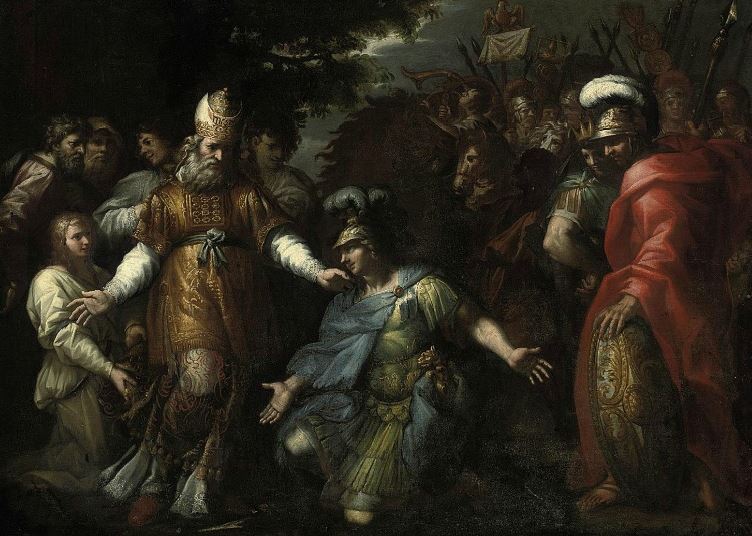
‘Alexander the Great and Jaddus the High Priest of Jerusalem’ by Pietro da Cortona (1596-1669)

While it is highly doubtful that the egomaniacal Alexander (who had himself declared a god) would ever bow down to anyone, this story is preserved in a number of texts, including that of Josephus, the first-century historian who was an eye-witness to the Temple’s destruction. In Josephus, however, it is not Shimon who meets Alexander, but another priest called Yaddua. Yaddua is actually mentioned in the Tanakh (Nehemiah 12:22), which suggests he was a priest in the days of the Persian emperor Darius. Of course, it was Darius III whom Alexander the Great defeated. It seems Josephus’ account is more accurate historically in this case.

In fact, in Sotah 33a, the Talmud tells another story of Shimon haTzadik, this one during the reign of the Roman emperor Caligula. We know that Caligula reigned between 37 and 41 CE—over three centuries after Alexander the Great! The Talmud thus gives us three different time periods for the life of Shimon haTzadik: a few generations before Shimon ben Shetach, or a few centuries before in the time of Alexander the Great, or centuries after in the time of Caligula. Which is correct?

The First Rabbi

The Book of Maccabees (I, 2:1-2) introduces the five sons of Matityahu in this way:

In those days, Matityahu ben Yochanan ben Shimon, a priest of the descendants of Yoariv, left Jerusalem and settled in Modi’in. He had five sons: Yochanan, called Gaddi; Shimon, called Thassi; Yehuda, called Maccabee; Elazar, called Avaran; and Yonatan, called Apphus.

Each of the five sons of Matityahu has a nickname. The second son, Shimon, is called “Thassi” (or “Tharsi”). This literally means “the wise” or “the righteous”, aka. HaTzadik. It was Shimon who survived the Chanukah wars and re-established an independent Jewish state. In fact, the Book of Maccabees (I, 14:41-46) tells us:

And the Jews and their priests resolved that Shimon should be their leader and high priest forever until a true prophet should appear… And all the people agreed to decree that they should do these things to Shimon, and Shimon accepted them and agreed to be high priest and general and governor of the Jews…

Apparently, Shimon was appointed to lead the Jews by a “great assembly” of sorts, which nominated him and, after his acceptance, decreed that he is the undisputed leader. The Book of Maccabees therefore tells us that Shimon the Maccabee was a righteous and wise sage, a high priest, and leader of Israel that headed an assembly. This is precisely the Talmud’s description of Shimon haTzadik!

Perhaps over time the “great assembly” of Shimon was confused with the Great Assembly of the early Second Temple period. This may be why Pirkei Avot begins by stating that Shimon haTzadik was of the Knesset haGedolah. In terms of chronology, it makes far more sense that Shimon haTzadik was Shimon Thassi—“Simon Maccabeus”—who died in 135 BCE. This fits neatly with Shimon ben Shetach and Salome Alexandra being active a few generations later, in the 60s BCE as the historical record attests. It also makes sense that Shimon haTzadik’s student is Antigonus, who carries a Greek name, just as we saw earlier that following Shimon the leaders of Israel were adopting Greek names.

Thus, of the three main descriptions of Shimon haTzadik in the Talmud, it is the one in Avot that is historically most accurate, and not so much the one in Yoma (where he is placed nearly three centuries before Shimon ben Shetach) or the one in Sotah (where he is in the future Roman era). Thankfully, there is actually one more brief mention of Shimon haTzadik in the Talmud (Megillah 11a) which says Shimon haTzadik was one of the heroes of Chanukah! This is certainly the most accurate reference to the mysterious Shimon haTzadik in the Talmud, and puts him exactly in the right era! This Talmud confirms that Shimon haTzadik was “Shimon Thassi”, the Maccabee.
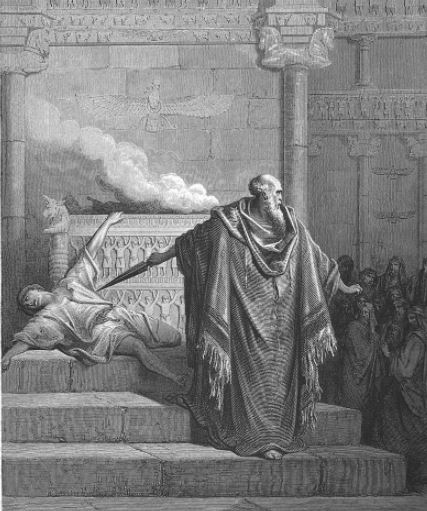
‘Mattathias of Modi’in killing a Jewish apostate’ by Gustav Doré

Lastly, we must not forget that Shimon the Maccabee was one of the instigators of the revolt against the Greeks and their Hellenism. He was the son of Matityahu, a religious, traditional priest, who fled Jerusalem when it was taken over by Hellenizers (as we quoted above, I Maccabees 2:1). Shimon was certainly aligned with the traditional Pharisees, and it was only his grandson Alexander Yannai who turned entirely to the more Hellenized Sadducees and began persecuting the Pharisees. As Rabbinic Judaism came out of Pharisee Judaism, it makes sense that the tradition begins with Shimon the Maccabee, or Simon Thassi, ie. Shimon haTzadik.

Interestingly, the Book of Maccabees states that Matityahu was a descendent of Yoariv. This name is mentioned in the Tanakh. I Chronicles 24:7 lists Yoariv as the head of one of the 24 divisions of kohanim, as established in the days of King David. The same chapter states that Yoariv was himself a descendent of Elazar, the son of Aaron the first kohen. Thus, there is a fairly clear chain of transmission from Aaron, all the way down to Matityahu, and his son Shimon.

Shimon continued to pass down the tradition, not to his son Yochanan—who was swayed by the Greeks and became John Hyrcanus—but to his student Antigonus. (Depending on how one reads Avot, it is possible that Yose ben Yoezer and Yose ben Yochanan were also direct students of Shimon haTzadik.) It appears we have found the historical Shimon haTzadik, and closed the gap on the proper chronology of the Oral Tradition dating back to Sinai.

If this is the case, then Chanukah is a celebration of not only a miraculous victory over the Syrian Greeks, but of the very beginnings of Rabbinic Judaism as we know it, with one of Chanuka’s central heroes being none other than history’s first official rabbi.

Chag sameach!


The above essay is adapted from Garments of Light, Volume Three.
Get the book here! 
The Incredible History and Absurd Politics of Rachel’s Tomb

In this week’s parasha, Vayishlach, we read about Jacob’s return to the Holy Land after twenty years in Charan. After some time, Jacob and the family make a stop in Beit El, where Jacob first encountered God decades earlier. God appears to Jacob once more, and promises that “the land which I gave to Abraham and to Isaac, I will give to you and to your seed after you” (Genesis 35:12). God makes it clear that the Holy Land is designated solely for the descendants of Jacob—not the descendants of Esau, and not the descendants of Ishmael, or any other of Abraham’s concubine sons. It is the land of Israel, the new name that Jacob receives in this week’s parasha.

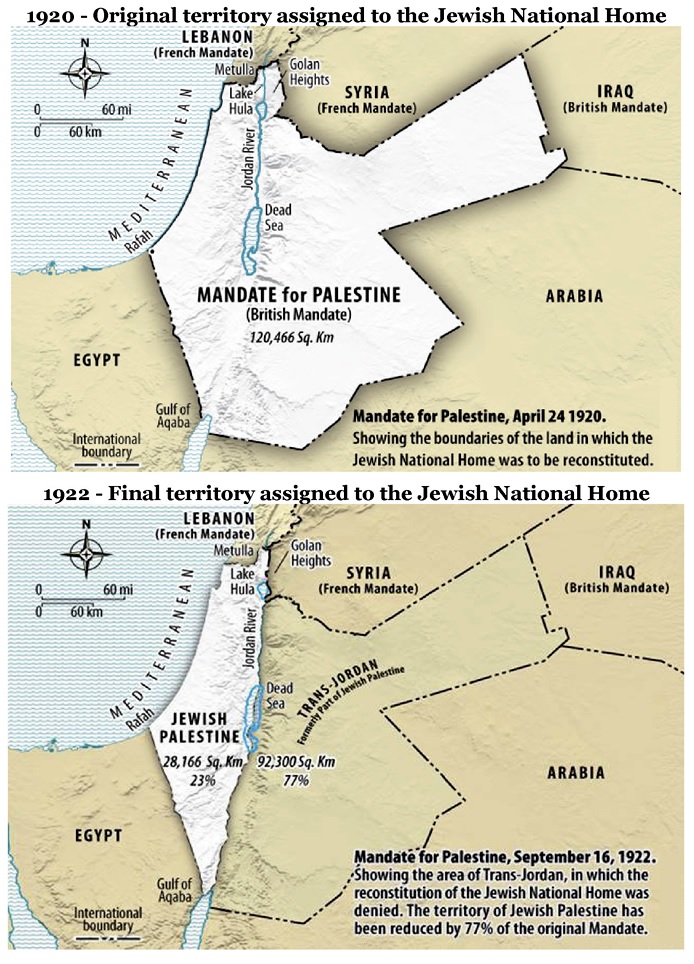
In fact, in this parasha we see mention of many Israelite sites, both ancient and modern, such as Hebron and Bethlehem. In our day, all of these are unfortunately within the political entity typically referred to as the “West Bank”. This title comes from the fact that the area is geographically on the west side of the Jordan River. Initially, the British Mandate for Palestine included both sides of the Jordan River, before the British gave the east to the Arabs to create the state of Jordan. This was the original “partition plan” for Palestine, with the eastern half meant to serve as the Arab state and the western half to become a Jewish one. Many have forgotten this important detail.

British Mandate for Palestine – Before and After (Credit: Eli E. Hertz)

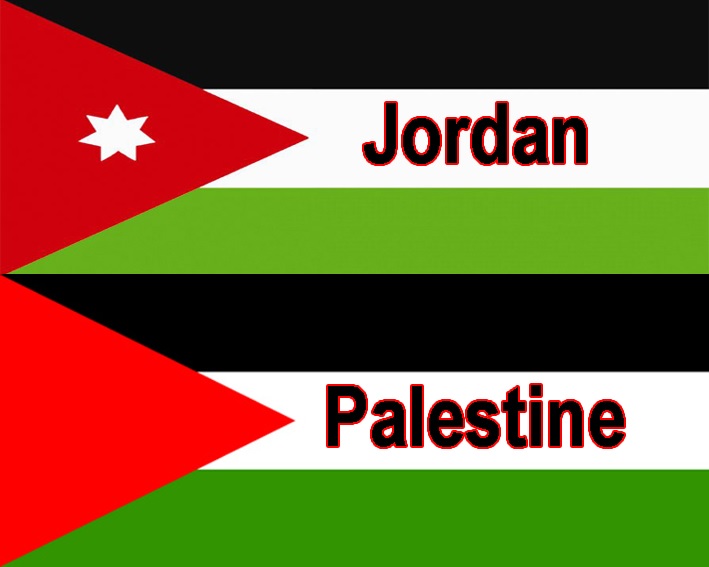
The current flags of the state of Jordan and the Palestinian movement. It is estimated that about half of Jordan’s current population of 9.5 million is Palestinian Arab.

Nonetheless, the unsuitable title of “West Bank” has stuck ever since. Some rightly avoid using the term in favour of the more appropriate “Judea and Samaria”. Truthfully, even this title is not entirely accurate, for the region is nothing less than the very heartland of Israel, the location of the vast majority of Biblical events, and the home of a plethora of Jewish holy sites. Among them is the tomb of Rachel, as we read in this week’s parasha (Genesis 35:16-20):

And they journeyed from Beit El, and there was still some distance to come to Ephrath, and Rachel gave birth, and her labor was difficult… So Rachel died, and she was buried on the road to Ephrath, which is Bethlehem. And Jacob erected a monument on her grave; that is the tombstone of Rachel until this day.

Throughout history, Rachel’s tomb was one of the most venerated sites in Judaism, and is often described as the Jewish people’s third-most holiest site (after the Temple Mount/Western Wall and Cave of the Patriarchs). As early as the 4th century CE the historian Eusebius already wrote of Rachel’s tomb being a holy site for Jews and Christians. Keep in mind that this is two centuries before anyone even whispered Islam. Not that it really matters, since Islam does not consider this a particularly special place. The Arab-Muslim historian and geographer of the 10th century, Al-Muqaddasi, doesn’t even mention Rachel’s tomb in his descriptions of Muslim-controlled Israel and its holy sites.

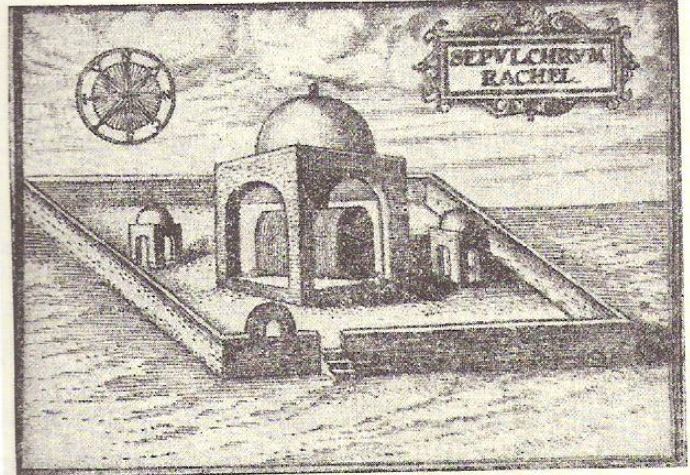
1585 Illustration of Rachel’s Tomb

Meanwhile, the Jewish traveler and historian Benjamin of Tudela (1130-1173) describes Rachel’s tomb in detail as being a domed structure resting upon four pillars, with Jewish pilgrims regularly visiting and inscribing their names on the surrounding eleven stones (representing the Tribes of Israel, less the tribe of Benjamin, as Rachel died giving birth to him). The earliest Muslim connection to the tomb is in 1421, when Zosimos mentions a small mosque at the site. (“Zosimos the Bearded” was a Russian Orthodox deacon famous for proposing the Moscow-Third Rome principle—which may be of great significance for calculating the time of Mashiach’s coming, as we’ve written in the past.)

The Ottomans originally transferred ownership of the site to the Jewish community (in 1615) but later reneged on the promise and even built walls to prevent Jews from going there, according to the British priest and anthropologist Richard Pococke (1704-1765). Pococke writes that the Ottomans used the area as a cemetery. Nonetheless, Jews could not be kept away from their millennia-old holy site, and continue to make pilgrimages. Christian writers G. Fleming and W.F. Geddes note in their 1824 report that “the inner wall of the building and the sides of the tomb are covered with Hebrew names, inscribed by Jews.”

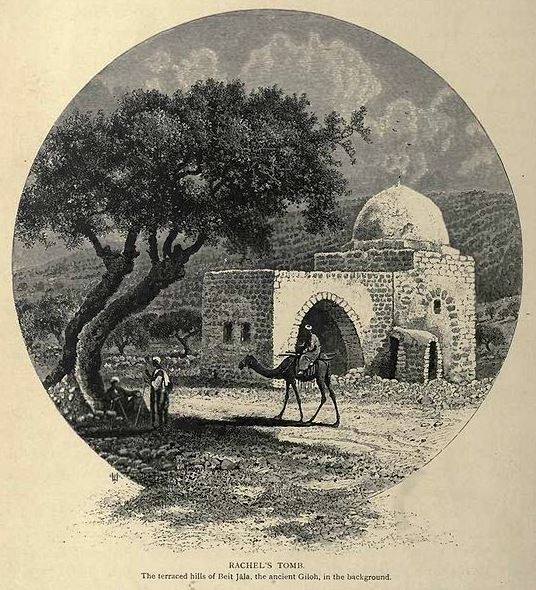
1880 Illustration of Rachel’s Tomb

Six years later, the Ottomans officially recognized Rachel’s tomb as a Jewish holy site again, and ten years later the site was purchased by famous Sephardic Jewish financier and philanthropist Moses Montefiore. Montefiore rebuilt the crumbling tomb, and even constructed a small adjacent mosque to appease the local Muslims. Around this time, British writer Elizabeth Anne Finn, who lived in Jerusalem while her husband was the consul there, wrote that Jerusalem’s Sephardic Jews never left the Old City unless to pray at Rachel’s tomb. Similarly, the Missionary Society of Saint Paul the Apostle wrote in 1868 that Rachel’s tomb

has always been held in respect by the Jews and Christians, and even now the former go there every Thursday, to pray and read the old, old history of this mother of their race. When leaving Bethlehem for the fourth and last time, after we had passed the tomb of Rachel, on our way to Jerusalem, Father Luigi and I met a hundred or more Jews on their weekly visit to the venerated spot.

Later, Jewish businessman Nathan Straus (of Macy’s fame) purchased even more land around the site that Montefiore had purchased. (Interestingly, Montefiore’s own tomb in England is a replica of Rachel’s tomb.)

Under the British Mandate, Jewish groups applied on multiple occasions for permission to repair the site, but were denied because of Muslim opposition. The Muslims themselves didn’t bother repairing it, of course. Conversely, many of them were (and still are) happy to attack the site whenever an opportunity presents itself:

Throughout the 1800s, the local e-Ta’amreh Arab clan had blackmailed the Jews to pay up 30 pounds a year or else they would destroy the tomb. In 1995, Arabs—led by a Palestinian Authority governor—attacked Rachel’s tomb and tried to burn it down. In 2000, they laid a 41-day siege on the site during the Second Intifada. In light of this, it made total sense when UNESCO declared in 2015 that Rachel’s tomb is a Muslim holy site that is “an integral part of Palestine”. The laughable resolution only confirms the senselessness and irrelevance of the United Nations.

Had they bothered to look at the historical record, they would have seen that Rachel’s tomb is, was, and always will be a Jewish holy site of immeasurable significance. Countless Jewish pilgrims have experienced miracles there, particularly for health and fertility. According to tradition, Rachel is the only matriarch to be buried outside of the Cave of the Patriarchs so that her spirit can weep and pray for her children in exile. Her prayers are successful, for we are in the midst of the exile’s final end, as prophesied by Jeremiah (31:14-16):

Thus said Hashem: “A voice is heard in Ramah, in lamentation and bitter weeping.” It is Rachel, weeping for her children. She refuses to be comforted for her children, because they are not. Thus said Hashem: “Refrain your voice from weeping, and your eyes from tears, for your work shall be rewarded,” said Hashem. “And they shall return from enemy lands. And there is hope for your future,” said Hashem. “And the children shall return to their borders…”


The above essay is adapted from Garments of Light, Volume Three.
Get the book here! 
Tisha B’Av: The Untold Story of Napoleon and the Jews

Tisha b’Av is the saddest day on the Jewish calendar. This holiday commemorates many historical tragedies, most significantly the destruction of both Holy Temples in Jerusalem. One of the most common stories heard on Tisha b’Av is about Napoleon walking by a Paris synagogue on this day, hearing the lamentations and loud weeping of the Jews. In the story, he asks what the Jews are crying about, and after being told about the destruction of the Temple nearly two millennia ago, apparently remarks something along the lines of: “A nation that cries and fasts for 2,000 years for their land and Temple will surely be rewarded with their Temple.”

Hearing this story immediately sets off some alarms. Firstly, Napoleon was no ignoramus, and was certainly well aware of the destruction of the Temple (after all, the Temple is featured in the “New Testament” and plays an important role in Christian history as well). More notably, Napoleon was a military man his entire life; his biography is the very definition of a tough guy. This man lived by the sword—it is highly unlikely that he would praise people for sitting and crying about something.

In fact, the myth of Napoleon and Tisha b’Av has been debunked multiple times. One of the earliest known sources of the legend is a Yiddish article from 1912, later included in the 1924 American Jewish Yearbook, and similarly appearing in a 1942 book called Napoleon in Jewish Folklore. Here, we are given a far more logical version of the story: After hearing the weeping of the Jews in a synagogue in Vilnius, Napoleon points to his sword and says, “This is how to redeem Palestine.”

Napoleon and the Jews

An 1806 depiction of Napoleon emancipating the Jews

Napoleon would actually play a tremendous role in Jewish history, and might even be credited with starting the process of “redeeming Palestine”. It was Napoleon that ushered in the “emancipation” of Jews in Europe. Wherever he conquered, he would free the Jews from the ghettos, and give them equal rights. In France, he went so far as to declare Judaism one of the state’s official religions in 1807. Napoleon also famously sought (and failed) to re-establish the Sanhedrin.

These actions brought upon him the ire of many of his contemporaries, especially Czar Alexander of Russia, who branded Napoleon the “Anti-Christ” for liberating the despised Jews. Moscow’s religious authority at the time proclaimed:

In order to destroy the foundations of the Churches of Christendom, the Emperor of the French has invited into his capital all the Judaic synagogues and he furthermore intends to found a new Hebrew Sanhedrin—the same council that the Christian Bible states condemned to death (by crucifixion) the revered figure, Jesus of Nazareth.

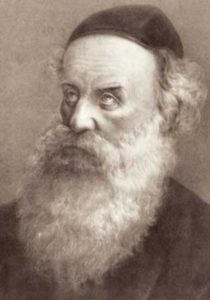
Rabbi Schneur Zalman of Liadi, the “Alter Rebbe” (1745-1812)

Of course, most Jews were ecstatic, and relished their newly acquired liberties. It became common for Jews to name their children “Napoleon”, or adopt the last name “Schöntheil”, the German translation of “Bonaparte”. Yet, not all Jews were happy about this development. The Alter Rebbe—founder of Chabad, who lived during the times of Napoleon—wrote the following in one of his letters:

If Bonaparte will be victorious, Jewish wealth will increase, and the prestige of the Jewish people will be raised; but their hearts will disintegrate and be distanced from their Father in Heaven. But if Alexander will be victorious, although Israel’s poverty will increase and their prestige will be lowered, their hearts will be joined, bound and unified with their Father in Heaven…

The Alter Rebbe thus fled from the approaching French forces, inspired his followers to do the same, and even supported the Russian military. He was right about Bonaparte. Napoleon had no interest whatsoever in seeing the Jews flourish as Jews, or practice their religion proudly. His intentions were clear: the complete assimilation of the Jews into European society. It was Napoleon that first permitted Jews to serve in the military, openly stating that “Once part of their youth will take its place in our armies, they will cease to have Jewish interests and sentiments; their interests and sentiments will be French.”

As it turned out, opening the doors for Jews to serve in the French military would lead to the proliferation of the Zionist movement, and the establishment of the State of Israel.

France and Israel

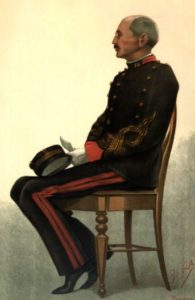
1899 Guth painting of Alfred Dreyfus for Vanity Fair

In 1894, Theodor Herzl was a young journalist working in Paris. He was covering the infamous “Dreyfus affair”, where a Jewish captain in the French military, Alfred Dreyfus, was wrongly accused of treason. During this time, Herzl witnessed the extreme anti-Semitism of the French firsthand. He realized that no matter how much the Jews assimilate, they would still never be accepted into European society, and reasoned that the Jews must have their own free state. Thus, it was a Jewish soldier in the French military—what Napoleon so dearly wanted—which catapulted the Zionist movement.

Interestingly, Napoleon himself seemed to have supported the notion of a Jewish state in Israel. In 1799, before he was emperor, and while besieging the city of Acre in Israel, Napoleon issued a proclamation inviting “all the Jews of Asia and Africa to gather under his flag in order to re-establish the ancient Jerusalem. He has already given arms to a great number, and their battalions threaten Aleppo.” Ultimately, the British defeated Napoleon’s forces, and the plan never materialized.

Nonetheless, Napoleon’s role in igniting the flames of Zionism cannot be overlooked. Zionism was primarily a secular movement, its most fervent supporters being assimilated European Jews who, like Herzl, were frustrated that they were still hated and unwanted in European society. This secularism was a direct result of Napoleon’s campaigns. Without his spearheading of the Jewish “emancipation”, it is doubtful that there would have ever been a Zionist movement to begin with.

And although there is much to criticize about Zionism, these mostly secular European Jews succeeded in re-establishing a free Jewish state in the Holy Land after two very long millennia. Yes, the Israeli government is unfortunately secular, and Mashiach has not yet come, and there is a great deal of work to do to restore a proper Jewish kingdom as God intended. However, the State of Israel allowed for the majority of Jews to return to their homeland, escape persecution, live openly as Jews, fulfil mitzvot only possible in the Holy Land, and travel freely to Jerusalem. Israel is undoubtedly paving the way for the Final Redemption, which is why many great rabbis of recent times have described it as reshit tzmichat geulatenu, the first steps of the redemption.

It is therefore fitting that the gematria of “France” (צרפת), where the whole process began, is 770, a number very much associated with redemption as it is equivalent to בית משיח, the “House of Mashiach”. Ironically, this number is most special for Chabad—the same Chabad that so resisted Napoleon and the French! (And at the same time, adopted the tune of Napoleon’s military band as their own niggun, still known as “Napoleon’s March” and traditionally sung on Yom Kippur!)

Most beautifully, it appears to have all been predicted long ago by the Biblical prophet Ovadia, who prophesied (v. 17-21):

And Mount Zion shall be a refuge, and it shall be holy; and the house of Jacob shall possess their heritage… And they shall possess the Negev, the mount of Esau, and the Lowland, with the [land of the] Philistines; and they shall possess the field of Ephraim, and the field of Samaria; and Benjamin with Gilead. And the great exile of the children of Israel, that are wandering as far as צרפת [France], and the exile of Jerusalem that is in Sepharad, shall possess the cities of the Negev. And saviours shall come upon Mount Zion to judge the mount of Esau; and the kingdom shall be God’s.


The article above is an excerpt from Garments of Light: 70 Illuminating Essays on the Weekly Torah Portion and Holidays. Click here to get the book!