
Tag Archives: Nachash

Understanding Hair Covering for Women in Jewish Law

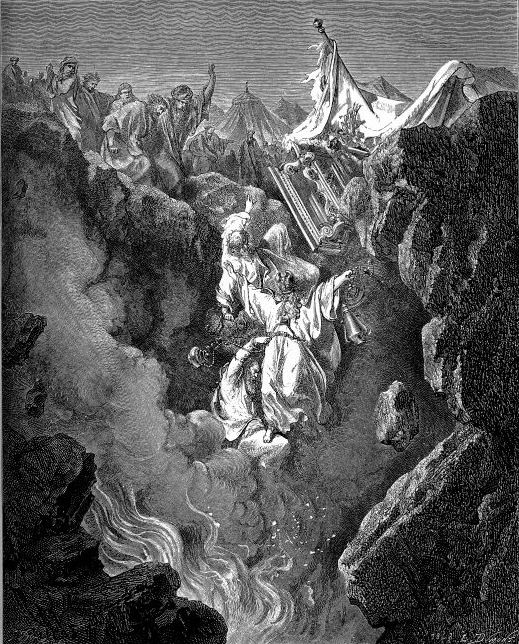
“Death of Korah, Dathan, and Abiram” by Gustave Doré

This week’s parasha, Korach, has a hidden theme: hair. In fact, the name of the villain himself, Korach (קרח), is spelled exactly the same way as kere’ach, “bald”. As we shall see below, Korach’s rebellion began when he saw himself bald-headed following his initiation ritual as a Levite. Hair comes up again in the famous story of one of Korach’s co-conspirators, a man named On ben Pelet. On is strangely mentioned right at the beginning of the parasha (Numbers 16:1), and never again. The Talmud (Sanhedrin 109b-110a) explains that he was saved thanks to his wife: She told her husband that he had nothing to gain from joining the rebellion; now he was subservient to Moses, and if the rebellion would be successful he would just become subservient to Korach!

On understood, but worried that he had already agreed to join the group. So, his clever wife got him drunk and sleepy, and On passed out in bed. Meanwhile, she went out to the entrance of their tent and “exposed her hair”. When Korach’s collaborators approached, the Talmud says they turned away due to the immodest sight of the woman. By the time On recovered from his drunken stupor, the whole episode was over, and he was spared. This story implies that Jewish women cover their hair, and for a woman to expose her hair publicly is immodest. Yet, nowhere in the Torah is there an explicit command for a Jew to cover their hair at all times (male or female). Hair-covering is not listed among the 613 mitzvot! If it isn’t a Torah mitzvah, where did it come from? Continue reading
Not in Heaven: The Snake-Oven of Akhnai

‘The Death of Moses’ (Illustration from the Providence Lithograph Company)

In this week’s double parasha, Nitzavim-Vayelekh, Moses relays the famous words lo bashamayim hi, that the Torah “is not in Heaven”. It comes within Moses’ final inspiring speech to the nation. He tells his people, again, to serve God “with all your heart and all your soul”, and to always remember that Torah law is “not concealed from you, nor is it far away. It is not in Heaven, that you should say ‘Who will go up to Heaven for us and fetch it for us, to relay it to us, so that we can fulfill it?’ Nor is it across the ocean…” (Deuteronomy 30:10-13) The Torah is right here for us, available to all, clear and straight-forward.

This notion seems somewhat at odds with what we are typically told that Jewish law is really complicated, and requires rabbis and scholars to elucidate it for us. Indeed, the Torah does also say that Moses appointed wisemen to help him adjudicate cases and interpret Torah law for the nation (Exodus 18), and that Moses gathered seventy elders to guide the people (Numbers 11)—the basis for the Sanhedrin. And one of the most famous disputes in the Sanhedrin of the 2nd Century CE ended with Rabbi Yehoshua quoting Moses’ words from this week’s parasha: “It is not in Heaven!”

The Talmudic passage in question begins at the bottom of Bava Metzia 59a. Continue reading

The Dragon, the Snake, and the Messiah

Kundalini, Kukulkan, Leviathan, and Nachash: Why do cultures and religions from all over the world use similar serpentine imagery? What is so special about the snake symbol and how does it tie into spiritual elevation and enlightenment? And what does it have to do with Mashiach and the End of Days? Find out in this class where we explore the origins of the mystical snake from the first verses of Genesis, and see how it manifests in the cosmos, the constellations, and the current war in Gaza.

For more on the Ophiuchus constellation, see ‘Mashiach and the Mysterious 13th Zodiac Sign’. For the class on dinosaurs and evolution, see here.
For more on Kundalini in Judaism, see ‘Judaism vs. Hinduism’.