As we celebrate the festive holiday of Chanukah, it is important to remember that not all of the Greeks were wicked and immoral. The enemies of the Chanukah narrative were the Seleucids, or Syrian-Greeks, not the mainland Greeks of Europe. In fact, the Book of Maccabees (I, 12:6-18) records an alliance between Jonathan Maccabee—the kohen gadol and righteous leader of Israel after the deaths of Matityahu and Judah Maccabee—and the famous Spartans of mainland Greece:
Jonathan, the high priest, and the council of the nation and the priests and the rest of the Jewish people send greetings to their brothers, the Spartans. In former times, a letter was sent to the high priest Onias, from Areus who was then king among you, to say that you are our kinsman… And Onias showed honour to the man who was sent to him, and accepted the letter, which contained a declaration of alliance and friendliness.
So, although we are in no need of these, since we find our encouragement in the sacred books that are in our keeping, we have undertaken to send to renew relations of brotherhood and friendliness with you, so that we may not become entirely estranged from you…
Jonathan points out that Israel does not need the help of the Spartans to defeat the Seleucids, as God’s help is all they need. Nonetheless, Israel and Sparta were always good friends, and Israel wants to keep it that way. In his letter, Jonathan mentions an earlier letter sent by King Areus of Sparta to Onias the kohen gadol (Onias is the Hellenized name for Choniyahu or Chonio, the son of Yadua the high priest, mentioned in Nehemiah 12:11). This letter is recorded in the Book of Maccabees (I, 12:20-23), as well as in the writings of Josephus, opening with the words:
Areus, king of the Spartans, sends greetings to Onias the high priest. It is found in writing that the Spartans and Jews are kinsman, and that they are both of the stock of Abraham…
Incredibly, the Spartan king suggests that the Spartans are descendants of Abraham, too! Where does this bizarre belief come from?
Greek Sons of Abraham
Sometime in the 2nd century BCE lived a Greek historian and sage named Cleodemus, sometimes referred to as Cleodemus the Prophet. He also went by the name Malchus which, because of its Semitic origins, makes some scholars believe he could have been Jewish. Cleodemus wrote an entire history of the Jewish people in Greek. While this text appears to have been lost, it is cited by others, including Josephus (Antiquities, i. 15).
Cleodemus commented on Abraham’s marriage to Keturah (typically identified with Hagar), and their children. This is recorded in Genesis 25, which begins:
And Abraham took another wife, and her name was Keturah. And she bore him Zimran, and Yokshan, and Medan, and Midian, and Ishbak, and Shuach. And Yokshan begot Sheva and Dedan. And the sons of Dedan were Ashurim, and Letushim, and Leumim. And the sons of Midian were Ephah, and Epher, and Chanokh, and Avidah, and Elda’ah. All these were the children of Keturah. And Abraham gave all that he had to Isaac, while to the sons of the concubines that Abraham had, Abraham gave gifts, and he sent them away from Isaac, while he was still alive, to the east country.
Abraham had six children with Keturah, from which came at least seven grandchildren, and three great-grandchildren which the Torah names explicitly. The Torah then makes it clear that Abraham gave everything that he had to Isaac—including the Covenant with God and the land of Israel—while the others received gifts and were sent away from the Holy Land.
Cleodemus suggests that Epher (or another child named Yaphran), the great-grandson of Abraham, migrated to Africa—which is where the term “Africa” comes from! (This is particularly interesting because Epher was the son of Midian, and Tziporah the wife of Moses was a Midianite, and is described as a Cushite, or African/Ethiopian.) Cleodemus states that Epher, Yaphran, and Ashurim assisted the Greek hero Hercules in one of his battles. Following this, Hercules married one of their daughters—a great granddaughter of Abraham—and had a son with her. This son was Diodorus, one of the legendary founders of Sparta!
It appears that the Spartan king Areus was aware of this possible historical connection, and accepted it as fact. This connection may explain why the Spartans were so similar to ancient Israelites. (Others have suggested that because the Israelite tribe of Shimon—known for being fierce warriors—did not receive a set portion in the Holy Land, many of them moved elsewhere and ended up in Sparta, or ended up in Sparta after being expelled from Israel by the Assyrians alongside the other lost tribes.) In his book Sparta, renowned historian Hugo Jones writes that the Spartans held in the highest regard a certain ancient law-giver, much like Moses the law-giver of Israel. The Spartans celebrated new moons (Rosh Chodesh), and unlike their Greek counterparts, even a seventh day of rest! Of course, the Spartans themselves were very different from other Greeks, particularly those in Athens, whom Sparta often battled. The Spartan form of government was different, too, not an Athenian-style democracy but a monarchy that governed alongside a “council of elders”, much like Israel’s king and Sanhedrin.
Perhaps most similarly, the Spartans were known for their “stoic” way of life. The later Greek school of stoicism was modeled on the ancient way of the Spartans. This meant living simply and modestly, being happy with what one has, and most importantly, putting mind above body, and logic above emotion. This almost sounds like something out of Pirkei Avot, and is a teaching echoed across Jewish texts both ancient and modern. In fact, when Josephus tried to explain who the rabbis were to his Roman audience, he said that they were Jewish stoic philosophers!
Gideon and Leonidas
Undoubtedly, the most famous story of the Spartans is the Battle of Thermopylae. Around 480 BCE, the Persian emperor Xerxes invaded Greece with a massive force. Xerxes first sent messengers to the Greek city-states to offer peaceful surrender. According to the historian Herodotus, Sparta’s King Leonidas told the messenger:
A slave’s life is all you understand, you know nothing of freedom. For if you did, you would have encouraged us to fight on, not only with our spear, but with everything we have.
Spoken like a true Maccabee. The messenger then told Leonidas and his men to bow down, to which Leonidas, like his historical contemporary Mordechai, said: “We bow down before no man.” Later, when the Persian boasted that his empire was the wealthiest in the world, with gold reserves the likes of which Leonidas could only dream of, Leonidas replied: “Ares is lord. Greece has no fear of gold.”
This statement almost makes Leonidas seem like a monotheist. Indeed, the Spartans worshiped Ares—the god of war—above all others. Interestingly, the Torah commonly describes Hashem in similar military terms, like a great warrior riding a merkavah or chariot, as a “God of Legions” (Hashem Tzva’ot), and even as a “Man of War” (Ish Milchamah, see Exodus 15:3). Of course, the Spartans had their abominable statues and idols, which is perhaps the greatest distinction (and a critical one) between them and ancient Israel.
King Leonidas went on to assemble just three hundred brave men to face off against the massive Persian invasion. Although they ultimately lost, the Spartans fought valiantly, inspired their fellow Greeks, and did enough damage to hamper Persian victory. This story of three hundred, too, has a Biblical parallel. The Book of Judges records a nearly-identical narrative, with the judge Gideon assembling three hundred brave men and miraculously defeating a massive foreign invasion.
Which came first? The earliest complete Greek mythological texts date back only to the 3rd century BCE. By then, the Tanakh had long been completed, and in that same century was first translated into the Greek Septuagint. It isn’t hard to imagine Greek scholars and historians of the 3rd century getting their hands on the first Greek copies of Tanakh and incorporating those narratives into their own. In fact, the Greek-Jewish philosopher Aristobulus of Alexandria (181-124 BCE) admitted that all of Greek wisdom comes from earlier Jewish sources. The later Greek philosopher Numenius of Apamea said it best: “What is Plato but Moses speaking Greek?”
Greece and the Exodus
The similarities between Greek myth and more ancient Jewish texts are uncanny. Hercules was a mighty warrior whose first task (of twelve) was to slay a lion, like the mighty Shimshon who first slays a lion in Judges. Deucalion survives a great flood that engulfs the whole world as punishment from an angry Zeus. Like Noah before him, Deucalion has a wife and three sons, and like Noah, Deucalion is associated with wine-making (the root of his name, deukos). Pandora’s curiosity brings about evil just like Eve’s, while Asclepius carries a healing serpent-staff like Moses. Aristophanes even taught that Zeus first made man as male and female in one body, and later split them in half, just as the Torah and Talmud do.
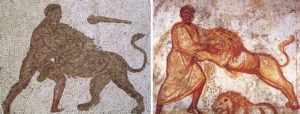
Roman mosaic of Hercules and the Nemean Lion, and a Roman fresco of Samson and the lion, from the same time period.
In Jewish tradition, the Greeks come from the Biblical Yavan, son of Yafet (or Yefet or Japheth), son of Noah (Genesis 10:2). Yavan is the same as the Greek Ion (or Iawones), one of the Greek gods, and Ionia, referring to one of its most important regions, and the dialect of the great Greek poets Homer and Hesiod, as well as the scholars Herodotus and Hippocrates. Meanwhile, the Greeks worshipped Iapetus (same as Yafet) as a major god. Iapetus was the father of Prometheus, the god who supposedly fashioned man from the mud of the earth. So, not surprisingly, the Biblical Yavan and Yafet are firmly in the Greek tradition as well.
In his Was Achilles a Jew? (pgs. 465-468), Larry S. Milner points out many other similarities between Greek myth and the narratives of the Torah. The Greek story of Orion, where his birth was a gift from three deities to an old, childless couple, is nearly identical to the prophesied birth of Isaac, which came with the arrival of three angels. Key aspects of the tales of Odysseus resemble the adventures of Jacob, while the legend of Orpheus and Eurydice is reminiscent of Lot and his wife. The abduction of Helen (leading to the destruction of Troy through an infamous ruse) is strangely similar to the abduction of Dinah (leading to the decimation of Shechem through an infamous ruse). And there are many more.
The Greeks held that the ancient heroes and founders Danaus and Cadmus originally came from Egypt. Milner posits, and eloquently argues, that Danaus and Cadmus were not Egyptians, but Hebrews who had been enslaved in Egypt! They escaped Egypt and settled in Greece. Their names have Semitic origins, and it is possible they were the ones that introduced the Semitic alphabet to the Greeks, as scholars have long ago concluded that the Greeks adapted their alphabet from the Semitic one. The only question among scholars is whether it was the Phoenicians or Hebrews who introduced the alphabet to the Greeks. Milner strongly argues on behalf of the latter. Finally, he notes how ancient Greece was organized by an amphictyony, a “league of neighbours” that consisted of twelve city-states in a loose confederacy. The amphictyony very closely mirrored the organization of, and relationship between, the Twelve Tribes of Israel. In short, we find that not only did the Greeks adopt many of our Biblical narratives and ideas, but even our ancient written language and political structure, too.
In Volume One of Garments of Light (‘Did the Jews Really Defeat the Greeks?’), we saw how Greece had a huge influence on Judaism. Now, we see how tremendous an influence Judaism had on Greece. The two civilizations go hand-in-hand, and between them gave rise to the world we live in. Indeed, this was prophesied by Noah, who blessed his sons: “May God make Yefet great, and he will dwell in the tents of Shem” (Genesis 9:27). Shem is the earliest forefather of Israel, and Yefet of Greece. The two dwell in one tent.
On Chanukah, we celebrate the Jewish victory over the Seleucids. Not of the Greeks as a whole, but of a relatively small faction of Syrian Greeks, far from the Greek heartland which enjoyed a good relationship with Israel, starting with Alexander the Great and through to the Spartans and Maccabees.
[This is part two of a three-part series. See here for part one, and here for part three.]
The above is an excerpt from Garments of Light, Volume Two. Get the book here!