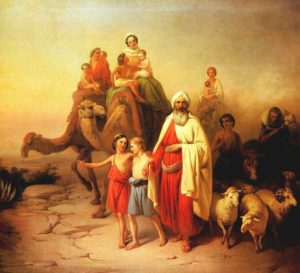
Abraham’s Journey to Canaan, by Jozsef Molnar (1850)
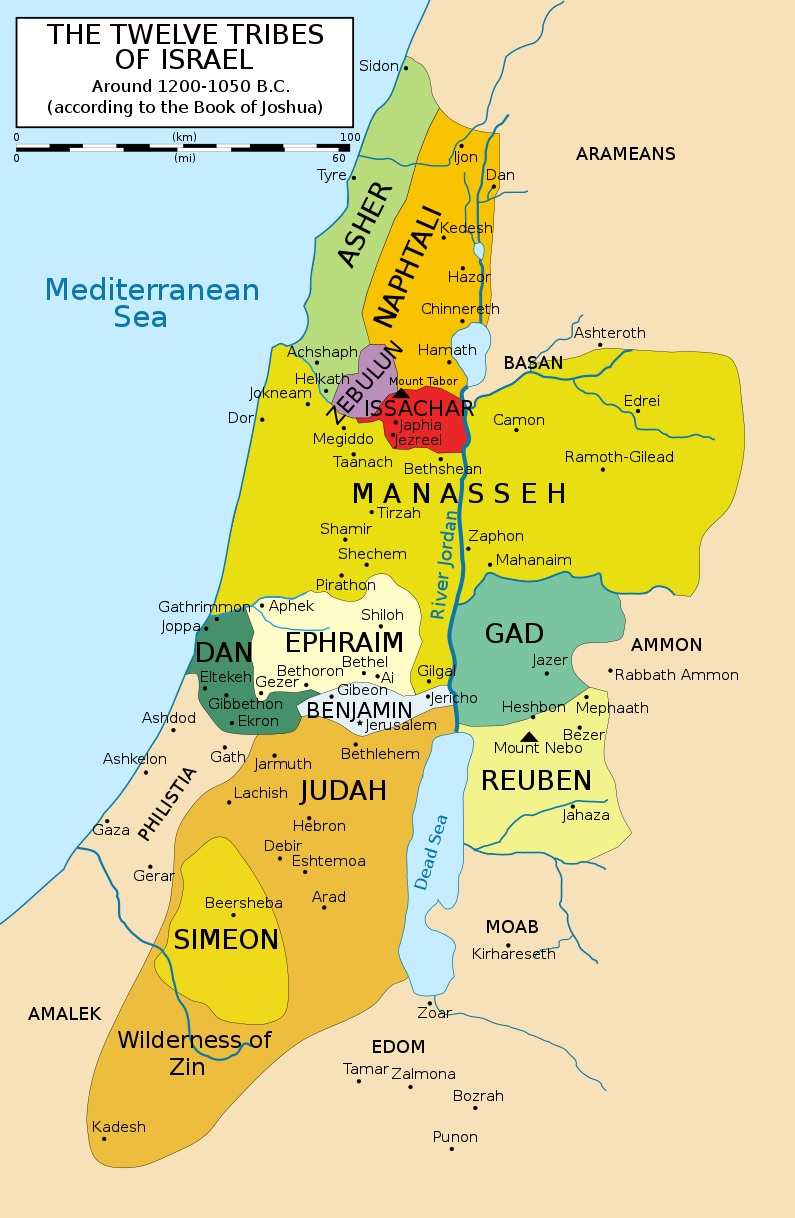
Lech Lecha begins with God’s famous command to Abraham to leave the comforts of his home and journey forth to a new beginning in the Holy Land. God promises Abraham (at that point still known as “Abram”) that he will become a great nation, and that God will “bless those who bless you, and the ones who curse you I will curse” (Genesis 12:3). God’s covenant with Abraham passed down to his son Isaac, and then to Isaac’s son Jacob, who fathered twelve sons that became the twelve tribes of Israel. God confirmed his promise to the twelve tribes through the prophet Bilaam, who saw “Israel dwelling tribe by tribe, and the spirit of God came upon him” and he famously remarked, “how goodly are your tents, oh Jacob, your dwellings, oh Israel!” before prophesying that “blessed be those who bless you, and cursed be those who curse you.” (Numbers 24:2-9)
Over three millennia have passed since that time, and as we look back though history, we can see how accurately this prediction has been realized. It began with the twelve sons of Jacob, whom the Ancient Egyptians welcomed to their land and initially treated exceedingly well (thanks to Joseph, who saved Egypt from seven years of extreme famine, and then made the kingdom very rich). As time went on, the Israelites multiplied and prospered in Egypt. In a pattern that would repeat itself countless times throughout history, the natives started to become a little weary (and jealous) of the foreigners. Israel was soon subjugated and enslaved. This brought God’s plagues upon Egypt, and the empire was destroyed. Ancient Egypt’s decline steadily continued from that point, and it would never restore its former glory.
Historians recognize three great ages within Ancient Egypt’s past; the last “golden age” was in the New Kingdom period (1549-1069 BCE), approximately when the Israelites would have been dwelling there. Once Israel left, Egypt’s greatness would soon evaporate, and it would be nothing more than a vassal for the rest of its history – to Assyria, Babylonia, Persia, Greece, and Rome.
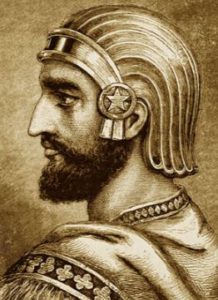
Cyrus the Great
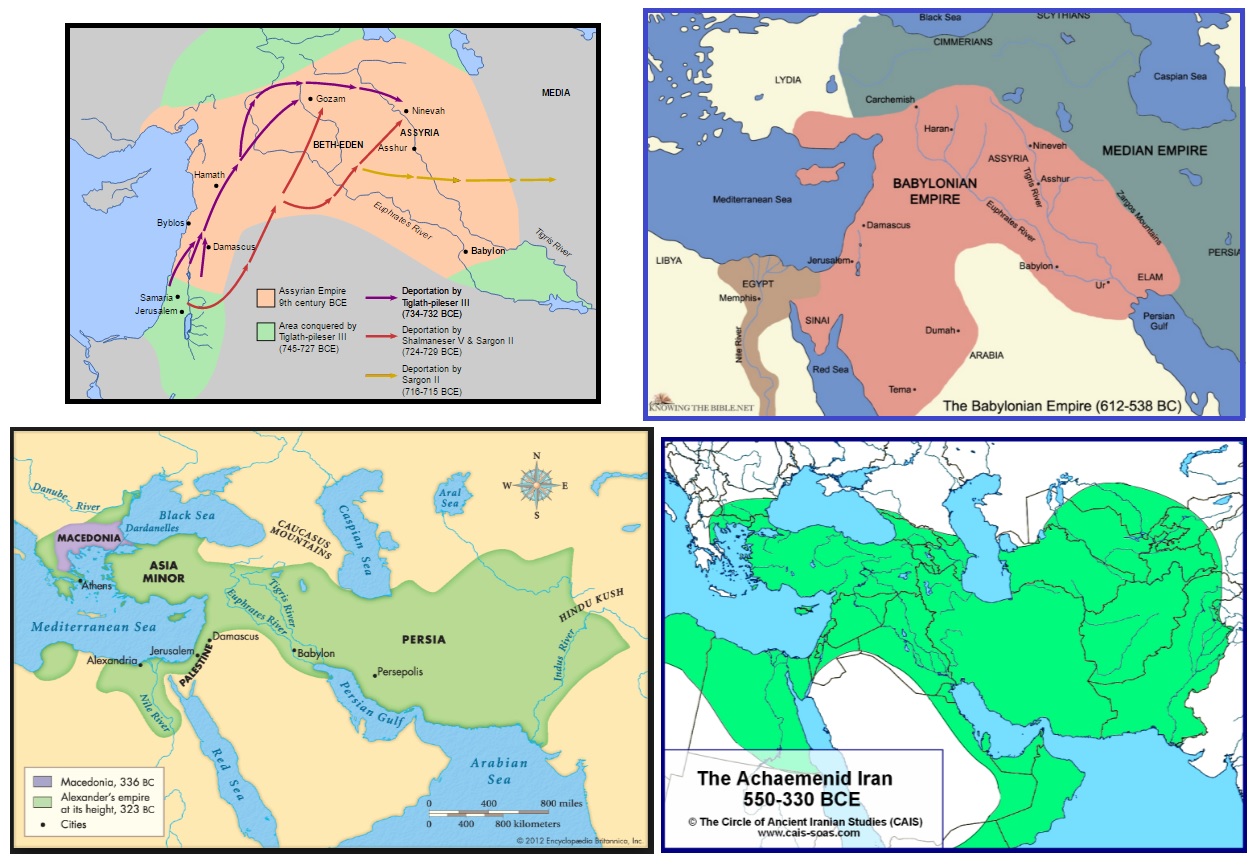
The next major oppressors of Israel were the Assyrians, who destroyed the northern Israelite Kingdom and exiled its tribes. It wasn’t long before the Babylonians overtook the Assyrians. Once the Babylonians themselves destroyed the southern Kingdom of Judah (and the Holy Temple), their own fate was sealed, and it was just 70 years before the Persians took over. The Persian emperor Cyrus treated the Jews very well, allowing them to return to Israel and rebuild the Temple. He was so good that he is described in the Tanakh as God’s anointed – mashiach! (Isaiah 45:1)
When Persian attitudes towards Israel started to turn sour, the Greeks under Alexander the Great quickly became the new rulers. Jews and Hellenists enjoyed very good relations for some two centuries. In the 2nd century BCE, the Seleucids (Syrian-Greeks) attempted to totally assimilate the Jews into their culture. They failed miserably – as celebrated during Chanukah – and soon disappeared from history, being overtaken by the Romans from the West and the Parthians from the East.
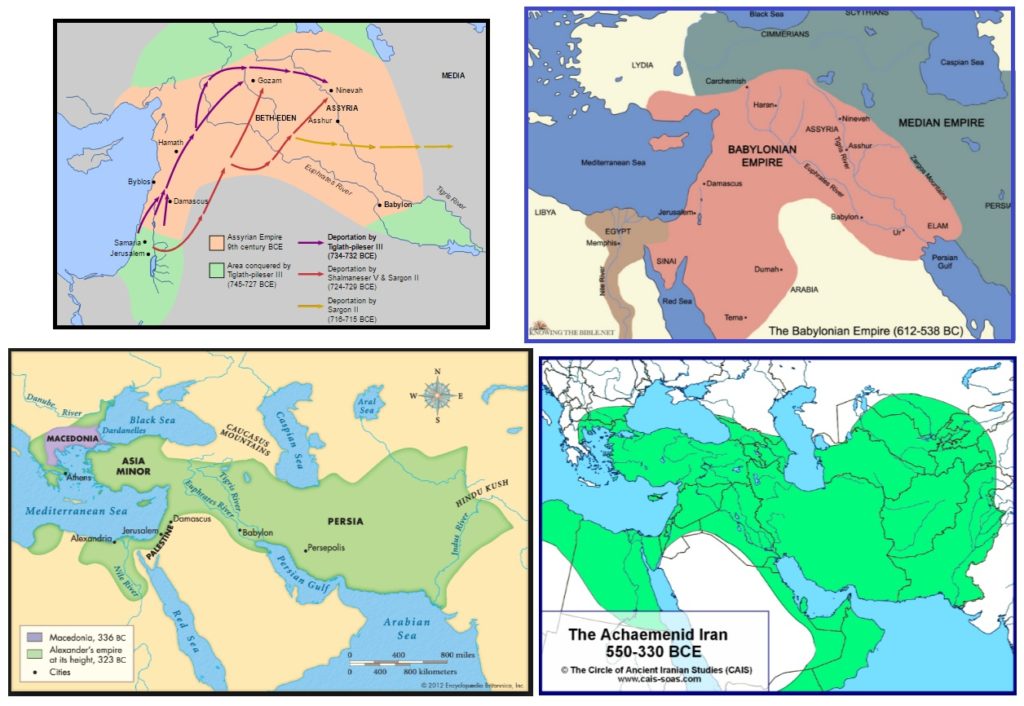
Ancient Empires, clockwise from top left: Assyrian Empire (with deportations of Israelites); Babylonian Empire at its height; the Persian Empire under Cyrus and his Achaemenid dynasty; empire of Alexander the Macedonian (Alexander the Great)
Relations with Rome were good, too, at first. During this time, Rome experienced its own golden age, beginning with the emperor Augustus. Unfortunately, Rome was soon busy quelling the province of Judea and destroying the Second Temple in Jerusalem. At the very same time, Rome was thrust into a difficult period of civil war. In the same year that the Temple was destroyed, Rome had its “Year of Four Emperors”.
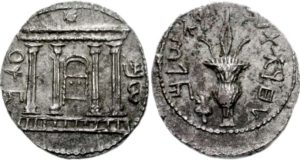
Coins minted by Bar Kochva
In 132-135 CE, Rome and Israel were at war again, with the latter lead by Shimon Bar Kochva. After mounting an impressive resistance, Bar Kochva’s rebellion was put down. Just 45 years later, Rome enjoyed the last of its “Five Good Emperors” (Marcus Aurelius Antoninus, who some identify with the Talmud’s “Antoninus”, the close friend of Rabbi Yehuda haNasi). Marcus Aurelius’ successor, Commodus, was a madman who ushered in Rome’s slow decline (as depicted pseudo-historically in the film Gladiator). The ancient historian Dio Cassius marked the year 180 CE – when Commodus took power – as the point at which the Roman Empire began to change “from a kingdom of gold to one of rust and iron.”
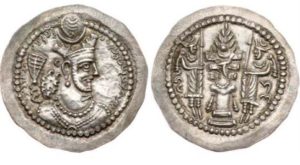
Silver coins minted by Bahram V
Many of the Jews who fled the Roman Empire moved to the Sasanian (or Sassanid) Persian Empire. The Sasanians treated Jews remarkably well, and were in turn blessed with prosperity and riches. It was during this time, in the “Babylon” of the Sasanians, that the Talmud was compiled. Jews were granted semi-autonomy within the empire and had their own representative to the government, known as the Reish Galuta, or exilarch. Sasanian kings even married Jewish women, and one of the most famous of Sasanian kings, the legendary Bahram V (r. 421-438 CE), was the son of the Jewish princess Shushandukht. Unfortunately, his successor, Yazdegerd II (r. 438-457), started persecuting religious minorities within the empire and force-fed the state religion of Zoroastrianism. (Some say he was motivated to persecute Jews because of a prophecy that Mashiach would come on the 400th anniversary of the Temple’s destruction.)
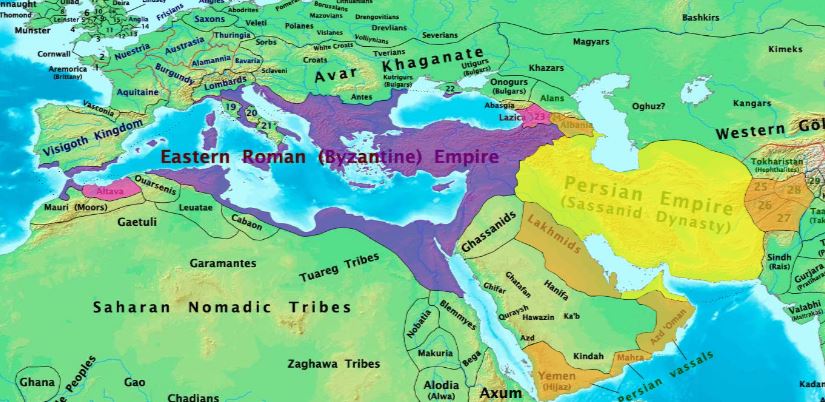
Sasanian and Eastern Roman (Byzantine) Empires before the rise of Islam
At the beginning of the sixth century, a Zoroastrian priest named Mazdak gained a large following and created a new religious sect that even attracted the king, Kavadh I. This thrust the empire into all sorts of religious turmoil, within which the Reish Galuta, Mar Zutra II, led his own rebellion and managed to establish an independent Jewish city-state in Mahoza. This did not last long, as the king captured Mar Zutra and had him crucified. The office of the Reish Galuta was disbanded at this point. Not surprisingly, the Sasanian Empire wouldn’t last very long after this. The office of the Reish Galuta would soon be re-established by the invading Muslim Arabs, who completely overran the Sasanian Empire.
The same pattern then occurred with the Muslims themselves, who initially treated the Jews of their domain quite well. Jews welcomed the Arab conquerors and saw them as “liberators”. Over time, persecution of Jews became more common. In 1040, the last Reish Galuta (and last of the Gaonim, “geniuses”) Hezekiah, was tortured and killed, and the position of the exilarch was abolished permanently. Hezekiah’s sons fled to Spain, where the Muslim rulers were more tolerant.
As is well known, Jews in Spain experienced a “golden age” of their own during this time. But here, too, they would be victimized by the Muslim rulers. The Muslims were soon driven out of the peninsula by the Christian kingdoms. The expulsion of the Jews by King Ferdinand and Queen Isabella followed shortly after.
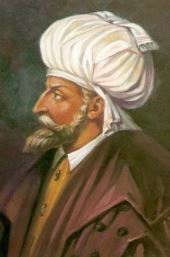
Sultan Bayezid II
A large majority of the Jews settled in the Ottoman Empire, where the Sultan Bayezid II welcomed them. In fact, with regards to this the Sultan said, “They tell me that Ferdinand of Spain is a wise man but he is a fool. For he takes his treasure and sends it all to me.” Assisted by the influx of Jews, the Ottoman Empire flourished. Meanwhile in Spain, Isabella died and Ferdinand was unable to hold onto the kingdom. It was soon taken over by the Austrian Habsburgs.
In 1656, Jews were permitted to return to England, and it wasn’t long before the British Empire became the greatest the world has ever known. A similar fate awaited the United States, where many Jews found refuge. (And were instrumental in its founding and success. In fact, one of the main financiers of the American Revolution was a Jew named Haym Solomon.) It isn’t difficult to understand why the Soviet Union lost the Cold War against the U.S. so quickly and so dramatically, as Russia and the USSR never had much tolerance for its Jews, while the United States was just about always a safe place for them.
 Of course, history is far more complex than the simple narrative presented above, and there are many factors in the rise and fall of empires. However, there is indeed a clear pattern: Where Jews are treated well, the state flourishes and prospers; when Jews are persecuted and expelled, the very same state rapidly declines. This pattern is so obvious that in the 1930s, the Japanese came up with their “Fugu Plan” to strengthen their empire by settling Jews within its lands!
In analyzing the pattern, some scholars see it in simply practical terms, as Jews would bring their wisdom and wealth, skills, expertise, and business acumen wherever they would go, and thus contribute immensely to the success of the places where they lived. Others see far more powerful spiritual reasons, propelled by Biblical prophecy. Whatever the case, history undeniably confirms God’s promise to Abraham and Israel: “I will bless those who bless you, and the ones who curse you I will curse.”
The above is an excerpt from Garments of Light: 70 Illuminating Essays on the Weekly Torah Portion and Holidays. Click here to get the book!