
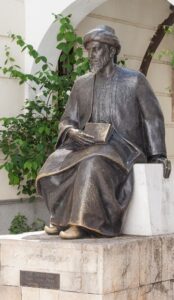
Rambam Monument in Cordoba, Spain
This Friday, the 20th of Tevet, is the yahrzeit of Rabbi Moshe ben Maimon (1138-1204), better known as the “Rambam”, or “Maimonides”. Rambam is one of the most fascinating figures in Jewish history, and also one of the most mysterious, multi-faceted, and complex. His impact on the course of Judaism cannot be overstated. Eight hundred years later, scholars, historians, and rabbis continue to debate his true views, positions, and beliefs. Rabbi Dr. Leon Stitskin (1911-1978), philosophy professor at Yeshiva University, described the Rambam as one who “reveals the truth by stating it, and hides it by contradicting it.” (Letters of Maimonides, pg. 18) More recently, Rabbi Dr. Aaron Adler (in his Al Kanfei Nesharim) noted a whopping 749 places where the Rambam’s early work, his Commentary on the Mishnah, appears to contradict his later works! And when it comes to the Rambam’s Moreh Nevukhim, the “Guide for the Perplexed”, some rabbis were so uncomfortable with it they denied that the Rambam ever wrote it! Who exactly was the Rambam, and what did he truly believe and teach?
Physician & Philosopher
Rambam was born in Cordoba, Spain to Rabbi Maimon, a student of Rabbi Yosef ibn Migash, who was a student of the famous Rif, Rabbi Isaac Alfasi (1013-1103). When he was around 10 years old, the extremist Almohads conquered Cordoba and forced all non-Muslims to convert, die, or flee. The Rambam’s family fled to North Africa. Settling in Morocco, the Rambam became a rabbi, but also studied at the University of Fez to become a physician. Meanwhile, he was deeply immersed in Greek philosophy, and came to embrace the school of Aristotle above the others. He is well-known for his work in integrating Aristotelian philosophy with Torah and Judaism. This set the stage for others around the world to do the same, most notably Thomas Aquinas (1225-1274), a Catholic theologian and saint who integrated Aristotle with Catholicism, and cited Maimonides in his works. The Rambam believed that Aristotle was the greatest Gentile of all time, and wrote in his letter to Shmuel ibn Tibbon: Continue reading