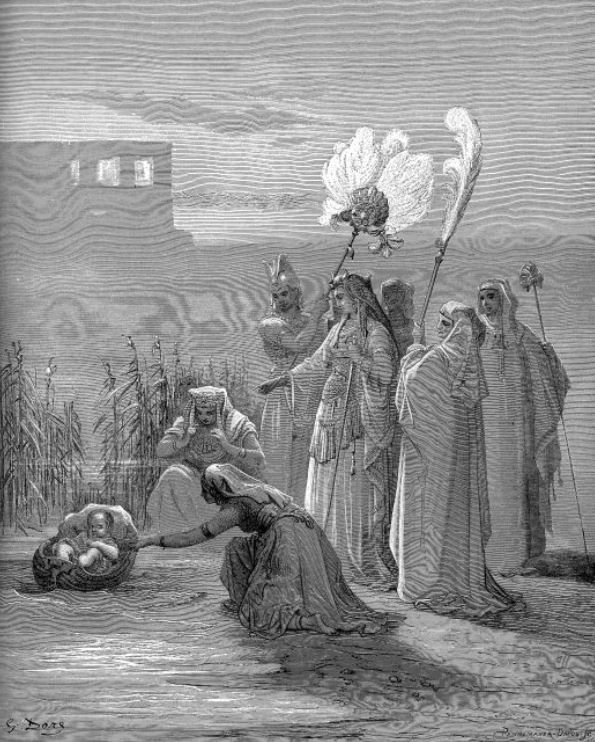
‘The Finding of Moses’ by Gustav Doré
This week we begin reading the second book of the Torah, Shemot, and the account of the Exodus. Yocheved gives birth to a baby boy, “and when she saw how good [tov] he was, she hid him for three months.” (Exodus 2:2) Based on this, the Talmud explains that Yocheved named her baby “Tov” or “Tuviah” (Sotah 12a). The Talmud adds that she “saw” that he was good because the entire room filled with light when he was born, and that he was actually born without a foreskin, just as Adam was originally created. Yocheved hid the baby from the authorities for three months, and when “she could hide him no longer, she got a wicker basket for him…” (Exodus 2:3) The daughter of Pharaoh discovers him in the Nile and calls him “Moshe”, Moses.
The fact that baby Moses was concealed for three months is significant. The Sages teach that just as the First Redeemer (Moses) was concealed for a period of time, so too the Final Redeemer (Mashiach) will be concealed. The Midrash (Bamidbar Rabbah 11:2) explains:
How long was he concealed from them? Rabbi Tanhuma said: Three months; as it is written: “They encountered Moses and Aaron…” (Exodus 5:20). The Final Redeemer, too, will appear to them and will then be concealed from them. How long will he be concealed from them? Rabbi Tanhuma said in the name of Rabbi Hama ben Rabbi Hoshaya: Forty-five days. That is what is written: “From the time of the abolishing of the daily offering and the setting up of the abomination of desolation there will be one thousand two hundred and ninety days” (Daniel 12:11), and it is written: “Happy is one who waits, and reaches one thousand three hundred and thirty-five days” (Daniel 12:12). How many are these extra days? They are the forty-five days that he will be concealed from them and will then reappear to them.
Rabbi Tanhuma states that Moses was concealed for three months—not those three months as a baby when he was born, but rather after his return to Egypt around age 80. Apparently, three months had elapsed between the time Moses first returned to Egypt and revealed himself to be God’s chosen one (and first appeared before Pharaoh, Exodus 5), and the second time he appeared before Pharaoh and turned his staff into a serpent (Exodus 7). During these three months, Moses was “concealed” and the Israelites were perplexed.
Rabbi Tanhuma continues to suggest that when it comes to the Final Redeemer, the period of concealment will not be three months as was with the First Redeemer, but rather 45 days (approximately half the time). This is based on a famous verse in the Book of Daniel. Rashi (Rabbi Shlomo Itzchaki, 1040-1105) comments on that same verse (Daniel 12:12) and expands the 45 days to 45 years. This is because Daniel’s “days” are indeed often interpreted as years, and the 1290 years play an important role in later texts. In fact, the Zohar was published specifically in the year 1290 CE, and the reason it was published then after so many centuries in hidden manuscripts is partly connected to Daniel’s 1290 years. (For lots more on this, see ‘When & Why Was the Zohar Published?’ in Volume Three of Garments of Light. See also the recent class on ‘The Spiritual Significance of 2025.’) Interestingly, in its exploration of this week’s parasha, the Zohar (II, 8b) suggests that Mashiach’s concealment will not have a duration of years, but rather 40 days, followed by another period of 30 days, for a total of 70 days. We therefore seem to have three possibilities: a concealment of 45 days (Midrash), or 70 days (Zohar), or as much as 45 years (Rashi). Continue reading