Tag Archives: Rebecca

Is Your Brain a Quantum Computer? (A Scientific Explanation for the Soul and Afterlife)

This week’s parasha, Chayei Sarah, begins with the passing of the matriarch Sarah. The Torah states that “the lives of Sarah were one hundred years, and twenty years, and seven years…” Traditionally, two big questions were asked of this verse: the first is why the Torah describes her life as one hundred, twenty, and seven years instead of simply saying that she was 127 years old when she died. The second is why the Torah says these were the lives of Sarah, instead of life in the singular, especially in light of the fact that the parasha actually describes her death, not life!

The classic answer to the first question is that Sarah was as beautiful at 100 as she was at 20, and she was as pure at 20 as she was at 7 years old. The answer to the second question, as we’ve explored in the past (see ‘A Mystical Journey through the Lives of Sarah’ in Garments of Light), is that Sarah – or at least a part of her soul – was immediately reincarnated in Rebecca, and thus Sarah’s life and life’s work continued with her future daughter-in-law. In general, the word for “life” in Hebrew is in plural, chaim, which alludes to the fact that there are really two lives: the transient life in this current physical world, and the everlasting life of the soul.

Today, many question (or outright reject) the possibility of an afterlife. Such people argue that there is no evidence or scientifically plausible explanation for such things. When the body dies, the person dies with it, and that’s it. In reality, there is a great deal of evidence to support the notion of a soul and an afterlife, and even one solid scientific explanation that is slowly gaining popularity and acceptance.

The Quantum Brain

Although there have been millions of cases of “near death experiences” and medically-induced “clinical deaths”—many of which end with the victim or patient describing other worlds and relating accurate information that would have been impossible for them to know—these are all relegated to “anecdotal evidence” and generally not taken seriously in the scientific community. We can put all of that aside (together with countless people’s personal stories of prophetic dreams and premonitions, “out-of-body” experiences, miraculous occurrences, and other inexplicable phenomena), and focus strictly on accepted science.

In recent decades, neurologists studying the human brain have sought to uncover what it is that generates consciousness and actually makes the brain work. Why and how is it that this network of cells produces a “mind”? Biology and chemistry have given us the general mechanisms of electrical signals and neurotransmitters, but have not been able to answer the real fundamental questions. To solve the mystery actually requires the most complex of sciences: quantum physics.

In 1989, world-renowned physicist Sir Roger Penrose published The Emperor’s New Mind in which he argued that classical physics simply cannot explain consciousness, nor can the brain be compared in any way to a typical computer, or be explained with familiar algorithms. Penrose suggested that the only plausible explanation for consciousness can come from quantum physics.

To go into the major principles of quantum physics is far beyond our scope. Indeed, one of the great quantum physicists, Richard Feynman, once noted: “I think I can safely say that nobody understands quantum mechanics.” Suffice it to say that quantum physics has completely revolutionized science and our entire understanding of reality. It has turned the universe into a funky place where just about anything is possible, and where things at the sub-atomic level behave in totally bizarre ways. Niels Bohr, one of the early quantum physicists (and a Nobel Prize winner) offered that “If quantum mechanics hasn’t profoundly shocked you, you haven’t understood it yet.” Meanwhile, the man who is often called “the father of quantum physics”, Max Planck, stated:

As a man who has devoted his whole life to the most clear headed science, to the study of matter, I can tell you as a result of my research about atoms this much: There is no matter as such. All matter originates and exists only by virtue of a force which brings the particle of an atom to vibration and holds this most minute solar system of the atom together. We must assume behind this force the existence of a conscious and intelligent mind. This mind is the matrix of all matter.

From his lifetime of studies, Planck concluded that reality as we know it doesn’t exist, and all of matter is held together by some kind of universal mind or consciousness. Building on these ideas, and the complex math and science behind them, Penrose proposed that the brain is a “quantum computer” of sorts, and may be intricately linked to the very fabric of the universe.

Quantum Biology and the Soul

Penrose’s hypothesis inspired a psychology professor in Arizona named Stuart Hameroff. As a practicing anesthesiologist, Hameroff knew that anesthesia works by shutting down small proteins inside neurons called microtubules, and this shuts off a person’s consciousness. Penrose and Hameroff teamed up to continue researching the possibility of the brain as quantum computer. Incredibly, their conclusions suggest that the brain can actually store its quantum information in the universe itself, so that even if the brain was to die, its information would not die with it. That information can be held indefinitely in the universe, and can return to a revived brain, or even into another brain. This would explain near death experiences and clinical deaths, and provides a scientific explanation for reincarnation and a life after death. The death of the body does not at all mean the death of the person, or that person’s memories and thoughts.

While there are those who are quick to criticize the theory and reject it, no one has been able to actually refute it. In fact, since the theory was first proposed, more and more evidence has accumulated to support it. In 2014, quantum biologist Anirban Bandyopadhyay (based in Japan’s National Institute for Materials Science and a visiting professor at MIT) successfully demonstrated the quantum activity of microtubules.

It appears that science has finally discovered the soul. There are now valid, empirical evidence-based theories to explain the existence of an eternal mind or spirit, a universal consciousness, the possibility of an afterlife and reincarnation. The scientific community needs to stop aggressively denying anything that seems “spiritual”, and instead delve deeper into this exciting and promising new field. This sentiment was already expressed long ago by Nikola Tesla, considered by many to be the greatest scientist of all time: “The day science begins to study non-physical phenomena, it will make more progress in one decade than in all the previous centuries of its existence.” It was the genius Tesla who first noted that his brain “is only a receiver,” and stated that “In the Universe there is a core from which we obtain knowledge, strength, inspiration. I have not penetrated into the secrets of this core, but I know it exists.”


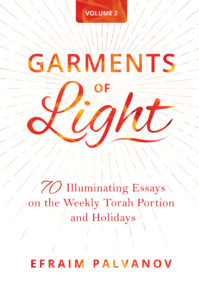
The above is an excerpt from Garments of Light, Volume Two. Get the book here

What It Really Means to Be “Israel”

This week’s parasha, Vayishlach, begins with Jacob’s return to the Holy Land following a twenty-year stay in Charan. The most famous passage of this parasha is Jacob’s battle with a certain angel. After its defeat, the angel gives Jacob a blessing and renames him Israel. What is the meaning of “Israel”? What was the purpose of this battle to begin with? And what does it all have to do with Jacob’s difficult twenty years in servitude to his deceiving father-in-law Laban?

Jacob vs. Esau

The Torah describes in quite some detail the conception, birth, and early lives of the twins Jacob and Esau. We see that Jacob was an “innocent man, sitting in tents” while Esau was a “hunter, a man of the field.” As twins, and the only children of Isaac and Rebecca, they were meant to work together in carrying on the divine mission started by their grandfather Abraham. The mission was to rectify the world, and fill it with true Godliness and righteousness. Such work mainly consists of educating others, doing good, and spreading the light. However, when that doesn’t work, it is also necessary to fight evil head-on. This was exemplified well by Abraham, who was both a wonderful preacher and, occasionally, a fearless warrior (as in the “War of the Kings” in Genesis 14).

Jacob and Esau were meant to take this to the next level. Thus, Jacob was blessed with extra intellect, wit, and spirituality, while Esau was blessed with extra strength, physical abilities, and ambition. In an ideal world, Jacob would have acted as the peaceful teacher, while Esau would defeat any remaining evil in battle. As partners, they would have been unstoppable in bringing light, morality, and a new God-consciousness to the world.

Unfortunately, the two couldn’t channel their blessings in the right direction. Esau’s physicality got the better of him, and he descended into a never-ending spiral of materialism. At the same time, Jacob used his cunning to take Esau’s birthright instead of using his intellect to put his brother back on the right path. Nonetheless, Jacob remained dedicated to fulfilling his divine mission, while Esau “despised his birthright” (Genesis 25:34).

By taking Esau’s birthright and blessing, what Jacob had done was to take Esau’s mission upon himself. He, too, would have to become a fighter. However, Jacob was born soft and meek—not fit for battle—while Esau was the one born muscular and hairy, as if already a grown man (hence his name Esav, literally “complete”). Could Jacob really become that holy warrior that Esau was meant to be? Jacob had to be put to the test.

Becoming Israel

Right after receiving Esau’s blessings, Jacob was told that his brother was out to get him. The soft Jacob immediately fled the Holy Land, as far away from his brother as he could. This was true to his character as a docile man, “sitting in tents”. But this was clearly not what a holy warrior would do.

Jacob ended up in the home of his uncle and future father-in-law, Laban. He instantly fell in love with Laban’s younger daughter Rachel, and agreed to work for Laban for seven years to be able to marry her. After seven years, Jacob was tricked into marrying the elder Leah instead of his beloved Rachel. It is hard to miss the irony of it all: Jacob, the one who tricked his father into getting his older brother’s blessing, is now tricked by his father-in-law into marrying his beloved’s older sister!

Laban forces Jacob to work for another seven years. This is, of course, completely unjust. A man such as Esau would have surely taken on Laban in combat, but the spineless Jacob simply agrees, and slaves away for seven more years. Following this, Laban finds more ways to trick Jacob out of an honest wage. Thankfully, Jacob is starting to learn, and begins to counter Laban’s wits with his own, soon building even greater wealth than his father-in-law.

At this point, Jacob hears that Laban is not very pleased with Jacob, and Jacob fears for himself and his family once again. As he did twenty years earlier, he decides to flee. While Laban was away shearing his sheep, Jacob takes the opportunity to run, taking the whole family with him. It appears that Jacob fails the test yet again, and is unable to confront his evil enemies.

Ten days later, Laban and his men find Jacob, and everything begins to change. Laban waltzes in to Jacob’s camp and begins threatening his son-in-law as he’d always done in the past. But this time Jacob has had enough, and realizes he can’t run away anymore. “And Jacob was angered, and battled with Laban” (Genesis 31:36). Jacob succeeds, and Laban seeks a peace treaty (v. 44). The two make a pact and part ways, never to see each other again. Jacob is becoming a fighter.

Jacob vs. Israel

This sets up parashat Vayishlach, where Jacob has to face off with Esau twenty years after running away from him. The night before, Jacob goes off on his own and is confronted by a mysterious figure (see ‘With Whom Did Jacob Wrestle? in Volume One of Garments of Light). The two battle it out all night long, and Jacob finally prevails. He is certainly no longer that weak, passive man he was two decades earlier. He has earned his badge of being a holy warrior. And with this, he is given a new name: Israel, one who “battles with God”; not against God, but alongside God, to defeat evil and make the world a better place. Jacob finally proves that he can indeed be Esau, and is worthy of having taking Esau’s birthright and blessing.

The Sages tell us that this is the real reason why Jacob had to marry both Rachel and Leah. Originally, since Rebecca had two sons and Laban had two daughters, the plan was for the younger Jacob to marry the younger Rachel, while the older Esau would marry the older Leah (Bava Batra 123a). Truly, these two couples were soulmates. However, Esau lost his spiritual essence to Jacob, and with it, his spiritual counterpart, Leah. The problem is that the Torah forbids a man from marrying two sisters! The Arizal (Sha’ar HaPesukim on Vayetze) tells us that, in fact, Rachel and Leah did not marry one man, for Jacob and Israel were really two souls in one body, and while Jacob married Rachel, it was Israel that married Leah. After all, Israel was the new Esau, the part of Jacob that wasn’t just “sitting in tents” but was capable of being a “man of the field”, too.

We later see that Israel was Jacob’s true self, his more-elevated inner being, and what he was really meant to be all along. God confirms this with a prophetic blessing (Genesis 35:10): “‘You shall no longer be called Jacob, but Israel shall be your name.’ And He named him Israel.”

This brings a tremendous lesson for all of us: we are not meant to be the weak Jacob, passively sitting in tents and being pushed around. Rather, we are meant to be Israel, who can balance study and prayer with strength and might; who can balance the physical with the spiritual, science with religion, and who knows both when to seek peace and when to pursue war. It is most fitting that the founders of the modern Jewish State decided to call it “Israel”. (In fact, they had originally planned to call it “Judah”, then “Zion”, and even “Tzabar”, before voting 7 to 3 in favour of “Israel”). If Israel is to fulfill its divine task, it should live up to its name: battling alongside God, as holy, righteous warriors, to repair the world—physically and spiritually—restoring it to its original, perfected state.


The above is an excerpt from Garments of Light, Volume Two. Get the book here