Tag Archives: Sacrifices

The Problem With Kapparot

In the early morning hours before Yom Kippur, many Jews will seek to perform the custom of kapparot, which involves taking a live rooster (or chicken), swinging it over one’s head, and then having it slaughtered. In the process, the person states how the rooster will be their “atonement”, and while the rooster will die, the person will go on to live a good life. The rooster’s meat is typically donated. Others swing money over their heads instead of a rooster, and then donate the money to charity. Of course, this strange-sounding custom is not mentioned anywhere in the Torah or Talmud. In fact, throughout history many Jewish Sages tried hard to extinguish this custom, for a number of important reasons.
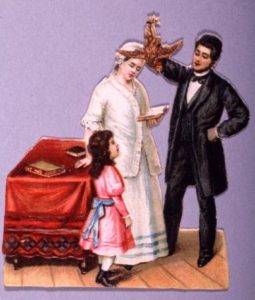
19th Century Lithograph of Kapparot

19th Century Lithograph of Kapparot

First of all, kapparot sounds much too similar to a korban, a sacrificial offering. In the days of the Temple, the kohanim sacrificed animals in order to atone for the people. The kapparot ritual explicitly states that the rooster serves as atonement, and the rooster is then killed. Despite some people’s claims that kapparot is not a true sacrifice, it clearly mimics the Temple’s sacrificial procedures, and intends to accomplish the same goal. The Mishnah Berurah (605:2) openly admits this, saying that kapparot is basically like a sacrifice. Indeed, an outsider would hardly be able to tell the difference. The problem is that the Torah forbids bringing sacrifices anywhere other than the place that God specifically designates (Deut. 12:5-6), which was the Temple Mount in Jerusalem. The Torah also commands that only kohanim are allowed to oversee sacrificial procedures. From this perspective alone, kapparot is contrary to the Torah.

Thirteen Years of Pain

Secondly, kapparot fits squarely under the category of unnecessary cruelty to animals. Commenting on the verse in Psalms (145:9) which states that God has mercy and compassion upon all of His creations, Rav Shimshon Raphael Hirsch wrote:

Here you are faced with God’s teaching which obliges you not only to refrain from inflicting unnecessary pain on any animal, but to help and, when you can, to lessen the pain whenever you see an animal suffering, even through no fault of yours.
(Horeb, Chapter 60, Section 416)

The Jewish Sages have always been concerned about animal welfare. The Talmud considers it a Torah mitzvah to treat animals with respect and prevent any harm to them (Bava Metzia 32b), so much so that one is allowed to violate various Shabbat prohibitions to help a suffering animal (Shabbat 128b). Let us not forget the story of Rabbi Yehuda HaNasi, who suffered excruciating pains for thirteen years. Why was he afflicted with such pain?

A calf was being taken to the slaughter when it broke away, hid its head under [Rabbi Yehuda’s] clothes, and lowed [in terror]. “Go”, he said, “for this you were created.” Thereupon it was said [in Heaven], “Since he has no pity, let us bring suffering upon him.”
(Bava Metzia 85a)

The great Rabbi Yehuda – the compiler of the Mishnah – made one uncompassionate remark to a fearful calf that was about to be slaughtered. For this, Heaven rained upon him tremendous pain – six years of kidney stones, and seven of scurvy, so unbearable that his cries could be heard over three miles away. When did his suffering end?

One day [Rabbi Yehuda’s] maidservant was sweeping the house; [seeing] some young weasels lying there, she made to sweep them away. “Let them be,” he said to her; “It is written, ‘And his tender mercies are over all his works.’” It was said [in Heaven], “Since he is compassionate, let us be compassionate to him.”

Rabbi Yehuda quotes the same verse (Psalms 145:9) that Rav Hirsch expounded upon, and has mercy on the young animals in his home. For this, his suffering is finally taken away. If even one little remark to an animal is worth thirteen years of suffering, how much more so if an animal is swung around wildly, then slaughtered needlessly – which is precisely what happens with kapparot. (It has also been pointed out that chickens used in kapparot are usually starving and thirsty, and often have their limbs dislocated or bones broken during the procedure.)

Idolatrous Practices

Lastly, kapparot appears to be connected with various idolatrous practices and non-Jewish customs. The Ramban, among others, considered it darkei emori, the way of idolaters. The Shulchan Arukh, the central halachic text of Judaism, is also staunchly opposed to kapparot, and its author, Rabbi Yosef Karo, called it a “foolish custom”.

Many modern-day authorities, too, from across the Torah-observant world, have been vocally against kapparot. Rabbi Joseph B. Soloveitchik and the entire Brisker rabbinic lineage before him opposed the custom, considering it irrational. The rabbi of Beit El and rosh yeshiva of Ateret Yerushalaim, Shlomo Chaim Aviner, a prominent authority within the Dati Leumi community, has described it as a “superstition”. And the former Sephardic Chief Rabbi of Tel Aviv, Chaim David HaLevy, beautifully wrote in his Aseh Lekha Rav:

Why should we, specifically on the eve of the holy day of Yom Kippur, be cruel to animals for no reason, and slaughter them without mercy, just as we are about to request compassion for ourselves from the living God?

Kapparot with Money

While it is clearly evident that one should completely avoid kapparot with chickens, some might argue that it is still worth doing kapparot with money. The problem is that the procedure and text are still the same: waving coins or bills over one’s head, stating that the money serves as an atonement, and that donating it will save one’s life.

The truth is that there is no need to do this at all, since any giving to charity automatically fulfils a mitzvah, assists in one’s repentance and atonement, and is said to be life-saving. The Talmud famously tells us (Bava Batra 10a) that charity is the greatest of all forces, and quotes the verse in Proverbs that “charity saves from death” (10:2).

Thus, any charitable contribution, at any time of the year, already does what kapparot claims to do. And so, awkwardly waving money around one’s head and reciting the kapparot verses is nothing more than a funny-looking waste of time, associated with a cruel, idolatrous, nonsensical, and nonJewish custom.

In his list of the 613 Torah mitzvot, the Rambam (who was also opposed to kapparot) lists the 185th positive commandment of the Torah as eradicating any traces of idolatry from Israel. Since many great Sages held the view that kapparot is associated with idolatrous ways, including the Ramban, Rashba, and the authoritative Shulchan Arukh, it is undoubtedly a mitzvah to not only avoid kapparot, but to encourage others to abandon this practice, and to expunge it from Judaism.


The article above is adapted from Garments of Light – 70 Illuminating Essays on the Weekly Torah Portion and Holidays. Click here to get the book!

Will There Be Sacrifices in the Third Temple?

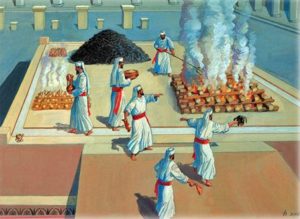
Offerings on the Altar (Courtesy: Temple Institute)

Offerings on the Altar (Courtesy: Temple Institute)

This week’s Torah reading is Acharei, focusing on the details of the priestly procedure performed on Yom Kippur in the Temple (or Tabernacle). God instructs Aaron to take two goats and one bull. One of the goats is to be sacrificed, while the other is to be sent to “Azazel” (the identity of which we have discussed in the past). Meanwhile, the bull is also to be sacrificed, and its blood sprinkled on the Holy Vessels within the innermost chamber of the Temple, the Holy of Holies. The third book of the Torah, Vayikra (Leviticus), often details such lengthy sacrificial procedures. To the modern reader, these passages tend to be quite difficult to read, with rituals that seem unnecessarily bloody and distasteful. Does God really want us to sacrifice animals? And when the Third Temple is rebuilt, will we once again be responsible for performing such rituals?

Back to the Garden of Eden

When God initially created the world, he placed man in a perfect environment where there was absolutely no death or bloodshed of any kind. Man was instructed only to consume fruits and plant matter. In fact, it wasn’t until the time of Noach that God reluctantly agreed to allow mankind to consume meat.

From a Kabbalistic perspective, this was done only for the purposes of tikkun, spiritual rectification (see Sha’ar HaMitzvot on parashat Ekev, and Sha’ar HaPesukim on Beresheet). The sinful souls of the flood generation were reincarnated into animals, and through their slaughter and consumption, those souls could be rectified and returned to the Heavenly domain. This is clearly hinted to in the phrasing of the Torah’s text: the animals that Noach took unto the Ark to be saved were initially described as zachar v’nekeva, “male and female” (Genesis 6:19). However, we are later told that some of the animals, particularly those to be slaughtered following the flood, were ish v’ishto, literally “man and woman”, or “husband and wife” (Genesis 7:2)!

We can deduce from this that sacrifices—and the consumption of meat in general—is a temporary phenomenon, for the purposes of tikkun, and not what God intended in His ideal conception of the world. Indeed, God often states in Scripture that He neither wants, nor requires, any sacrifices. He even states, perplexingly, that He never commanded them to begin with:

So said Hashem, Lord of Hosts, the God of Israel: “You add burnt offerings onto your sacrifices, and eat flesh, which I did not speak unto your forefathers, nor did I command them on the day that I took them out of Egypt, concerning burnt offerings and sacrifices. Rather, it is this that I commanded them: Listen to My voice, and I shall be for you a God, and you shall be for me a people, and you shall walk in all my ways that I shall command you, that it may be well for you.” (Jeremiah 7:21-23)

The Rambam explains that when taking the Israelites out of Egypt, God could not forbid them from offering sacrifices. This is because in that time period, offering sacrifices was the most common form of divine worship among the masses, and this is what the Israelites were familiar with. Thus, God allow the Israelites to bring sacrifices temporarily, as a means to slowly wean them off the practice:

The Israelites were commanded to devote themselves to His service… But the custom which was in those days general among all men, and the general mode of worship in which the Israelites were brought up, consisted in sacrificing animals in those temples which contained certain images, to bow down to those images, and to bum incense before them; religious and ascetic persons were in those days the persons that were devoted to the service in the temples erected to the stars, as has been explained by us. It was in accordance with the wisdom and plan of God, as displayed in the whole of Creation, that He did not command us to give up and to discontinue all these manners of service; for to obey such a commandment it would have been contrary to the nature of man, who generally cleaves to that which he is used to; it would in those days have made the same impression as a prophet would make at present if he called us to the service of God and told us in His name, that we should not pray to Him, not fast, not seek His help in time of trouble; that we should serve Him in thought, and not by any action. For this reason God allowed these kinds of service to continue; He transferred to His service that which had formerly served as a worship of created beings, and of things imaginary and unreal, and commanded us to serve Him in the same manner; namely, to build unto Him a temple; “And they shall make unto me a sanctuary” (Exodus 25:8); to have the altar erected to His name; “An altar of earth you shall make me” (Exodus 20:21); to offer the sacrifices to Him; “If any man of you bring an offering unto the Lord” (Leviticus 1:2), to bow down to Him and to bum incense before Him… By this Divine plan it was affected that the traces of idolatry were blotted out, and the truly great principle of our faith, the Existence and Unity of God, was firmly established. This result was thus obtained without deterring or confusing the minds of the people by the abolition of the service to which they were accustomed and which alone was familiar to them…

The Rambam goes on to elaborate on this point in more detail, and to thoroughly prove his argument, which is quite a fascinating read (Guide for the Perplexed, Part III, Ch. 32). He is clear on the fact that sacrifices were not God’s original intention, as we see in the Garden of Eden and through the words of the Prophet Jeremiah, but only a temporary necessity.

Sacrifices in the Third Temple?

Having said that, the Rambam does, somewhat paradoxically, write in his Mishneh Torah that sacrifices will resume in the Third Temple. It appears that the Rambam publicly went with the mainstream Orthodox approach but, in private, held that sacrifices will not be performed ever again. The Rambam writes that prayer is a far greater mode of worship than sacrifice, an idea that goes back to the prophet Hoshea, who declared “…we shall offer the cows with our lips.” (Hoshea 14:3)

More recently, Rabbi Avraham Itzchak Kook, the first Ashkenazi Chief Rabbi of Israel, similarly appeared to vacillate on the issue. In one place, he suggests that only grain offerings will be reinstated, and not animal offerings. (This is based on Malachi 3:4, which only mentions a restoration of grain offerings.) The Midrash suggests that only one type of offering will return, the voluntary Todah, or “thanksgiving” offering (see Vayikra Rabbah 9:7). Others propose that sacrifices will return for a short period of time only before being permanently abolished.

Ultimately, if God intended a perfect world with no death—as was His original plan for the Garden of Eden—and the future Redemption is essentially a global return to a state of Eden, then we certainly shouldn’t expect any more (animal) sacrifices in the future. It should be mentioned that the Sages teach that Adam did bring an animal sacrifice to God (Avodah Zarah 8a). However, this was not inside the Garden of Eden, but after he had already been banished, and due to his fear that the previously-decreed death sentence was upon him. Within Eden itself there could not be any death whatsoever. And so, if the world is set to return to an idyllic Eden-like state, there will certainly be no place for sacrifices.


The above is adapted from Garments of Light, Volume Two. Get the book here