
Tag Archives: King Solomon

Bilaam: The Last Prophet

This week’s Torah portion, Balak, is named after the Moabite king who sought to curse the Jewish people in the Wilderness. Seeing how the Hebrew nation had grown so large and powerful, and had earned God’s favour, Balak feared the Jews. He knew that taking them on physically would fail, so he decided on a spiritual solution to his problem. He summoned Bilaam (or Balaam), the greatest prophet among the gentiles, to curse the Jewish people in return for vast riches. Bilaam, however, refused the generous offer, knowing that there was no way he could curse the Jews if God did not wish it. Bilaam admitted that as a genuine prophet, he could only pronounce what Hashem would put in his mouth, and nothing more. Nonetheless, Balak continued to entice Bilaam until the prophet acquiesced, and agreed to give it a shot. Every single one of his attempts failed, and each time that Bilaam would open his mouth to curse the Jews, a blessing would emerge instead. Frustrated, Balak and Bilaam give up.

The story does not end there, though. Having failed to curse the Jews, Balak and Bilaam come up with another plan. Knowing that God’s favour only rests upon the Jews when they act righteously and in a holy manner, the two realized that they could tempt the Jews towards sin. Once the people are mired in sin, God’s divine protection would be lost, and the nation would in effect be cursed. This time, their plan worked like a charm.
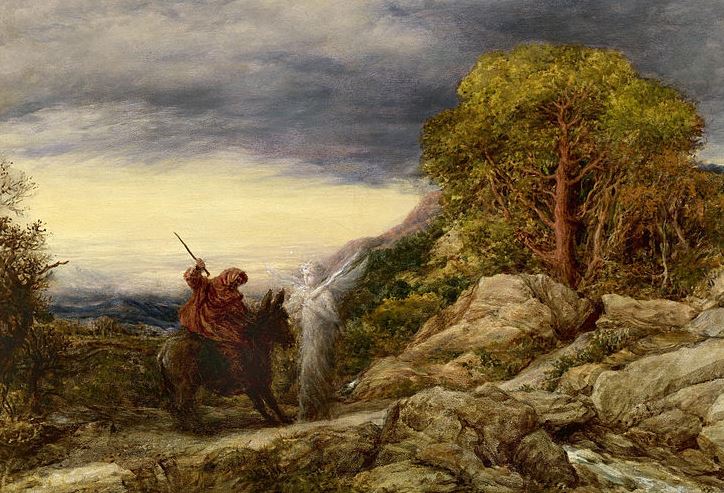
'Balaam and the Angel' by John Linnell

‘Balaam and the Angel’ by John Linnell

Balak and Bilaam sent a great number of gentile women to bring the Jewish men into sexual immorality and licentiousness. From there, they enticed them further into idolatry. Everything spins out of control, and Moses seems powerless to stop the endless cycle of sin. This reaches a climax when Zimri, the prince of the tribe of Shimon, publicly engages in sexual acts with a Midianite woman.

It is Pinchas, the grandson of Aaron, who finally steps in to end the tragedy. He slays Zimri, shocking the nation and waking the people. Pinchas is given an everlasting blessing for bringing an end to the immorality. According to some opinions, he later slays Bilaam as well. The Talmud (Sanhedrin 106a) states that it was precisely when Bilaam went to redeem his reward that he was killed.

Interestingly, all of the ancient texts agree that Bilaam was a true prophet, and was even equal in prophecy to Moses! How did Bilaam attain the merit for prophecy, and how did he fail so miserably?

The Origins of Bilaam

The Midrash relates how the gentiles brought a complaint against God. They argued that had God given them a leader like Moses, they too would have surely become holy and righteous nations. So, God did indeed send them a prophet like Moses. This was Bilaam.

In fact, the Arizal states that Moses and Bilaam stem from the same spiritual root: they were both reincarnations of Abel, the son of Adam (Sha’ar HaGilgulim, ch. 29). The spiritual spark corresponding to the letter Hei in Abel’s name (הבל) was given to Moses (משה), while the sparks corresponding to the letters Bet and Lamed in Abel’s name (הבל) were given to Bilaam (בלעם). So, it isn’t surprising that the two are often described as being of equal greatness in prophecy.

Unfortunately, the gentiles’ request for a prophet did not bring the result they had expected. Instead of using their prophet as a leader for goodness, they adopted him to further their own evil ends.  And this began long before Balak summoned him.

The Talmud (ibid.) recounts how Bilaam was once one of the three main advisors and soothsayers to the Pharaoh in Egypt. The other two were Iyov (Job) and Yitro (Jethro). When Pharaoh’s astrologers saw that the Redeemer of the Hebrews would soon be born, it was Bilaam who advised that all the male firstborn be drowned. Job was against the idea, but remained silent. For this, he was so severely punished (as described in the Book of Job). Jethro was the only one who spoke up and tried to avert the decree. For his opposition to the Pharaoh, he was forced to flee the kingdom. In poetic fashion, the very redeemer he was trying to save at birth ended up being his own son-in-law! Bilaam, meanwhile, ended up working with Balak to try and finish the job he started over a century earlier. Once again, he failed.

A Balance in the Universe

The Midrash (Tanchuma on Balak, Passage 1) elaborates that for every great leader, king, or prophet that God had sent the Jews, he equally sent one to the non-Jews. King Solomon’s counterpart was Nebuchadnezzar. While the former used his talents to build the First Temple, a House for God and a place of holiness and unity, the latter used those same talents to destroy that very same holy place. King David’s counterpart was Haman. Both were blessed with wealth and success. The former used these resources to bring the people together and unify all the tribes, bringing peace to the region; the latter used his resources to incite a genocide. Moses’ counterpart was Bilaam. The former used his prophecy to bring God’s message of holiness, peace and goodness; the latter used his prophecy for idolatry, destruction, and immorality. The passage in the Midrash concludes that God subsequently took away all forms of prophecy from non-Jews. Bilaam was the last true prophet among the gentiles.
The Guardian Angels and Hybrid Beasts Known as Cherubs

Terumah relays God’s instructions to the Israelites for constructing the Mishkan, the Holy Tabernacle. The most important part of this elaborate structure was undoubtedly the Aron HaKodesh, the Ark of the Covenant. Throughout the centuries, this gold-plated Ark has often been depicted in art, history, and even film (most notably with Indiana Jones in Raiders of the Lost Ark). However, what the Ark actually looked like is hard to discern. The Ark disappeared two and a half thousand years ago when the First Temple was destroyed. Since then, many different versions and interpretations for its appearance have been proposed, both by Jewish Sages and secular scholars.

The issue is not so much with the Ark itself, since the Torah is pretty clear on its description: a box two and a half cubits long, one and a half cubits wide, and one and a half cubits high, made of wood and plated with gold from the inside and out. (A cubit is roughly two feet long.) What’s not so clear is the Ark’s cover, with its two golden Cherubs.

What is a “Cherub” (kruv, in Hebrew)? The only descriptor the Torah gives is that the Cherubs had wings. Rashi, drawing from the Talmud, comments on Exodus 25:18 that they had the face of a child. The Torah describes the two as being set on the cover ish el echav, literally “a man facing his brother”. This suggests a human form to the Cherubs, along with their child-like face and wings. Indeed, this is how the Cherubs are generally depicted. The reality may be quite different, though. A look at the historical and Biblical evidence may shed some more light as to the true identity of the Cherubs.

The Evidence

A similar word for the Hebrew term kruv is found across the languages of the Ancient Near East: kuribu in Akkadian, karabu or kirubu in Babylonian and Assyrian. These refer to very large statues placed at entrances to important venues which served as guardians. They had the body of a bull or lion, with wings, and a human head. At times, they were worshipped as guardian deities.

This parallels the Torah’s original description of Cherubs. The very first time Cherubs appear is in Genesis 3:24. Following Adam and Eve’s banishment from the Garden of Eden, God placed Cherubs to guard the entrance to Eden so that man could not return. Like the Mesopotamian kuribu, the Cherubs are guarding an entrance.

All of this is reminiscent of a famous passage in the Tanakh: Ezekiel’s Vision of the Chariot.This could be why the Cherubs were placed atop the Ark, again as guardians of the holy vessel. When the Tanakh describes how King Solomon built the Temple in Jerusalem (I Kings, chapter 6), it states that Solomon had two massive ten-cubit high Cherubs placed at the entrance to the Holy of Holies (the room in which the Ark of the Covenant was kept). The following chapter describes them as kruvim arayot, “Cherub-Lions” (7:36). Not only do we once again see the Cherubs as guarding an entrance, but we now have some evidence that the Cherubs had a lion-like appearance, just as the Mesopotamian kuribu (or lamassu) often had.

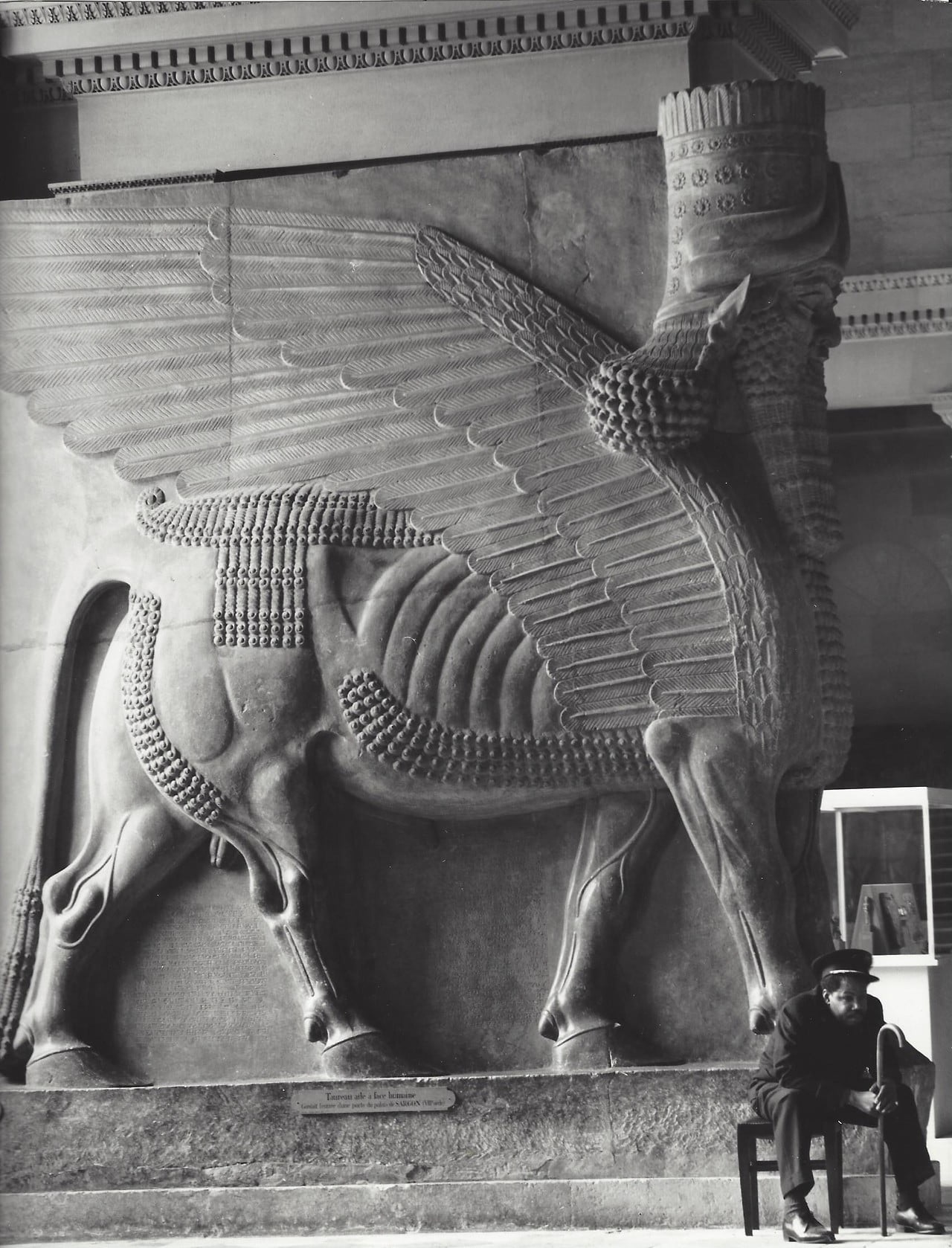
Kuribu were also known as lamassu. This is a photo by Kees Scherer, taken in the Louvre Museum in 1968, of a massive lamassu statue from King Sargon II’s palace, dated back to the 8th century BCE. It is from nearly the same time period as King Solomon’s giant Cherubs, which would have been about the same size.

Ezekiel’s Chariot

In the first chapter of the Book of Ezekiel, we are given a detailed description of the Merkavah, the Divine Chariot:

And I looked, and, behold, a stormy wind came out of the north, a great cloud, with a fire flashing up, a brightness was all around it; and from within the appearance of electrum, out of the midst of the fire. And from within it came the likeness of four living creatures. And this was their appearance: they had the likeness of a man. And every one had four faces, and every one of them had four wings. And their feet were straight feet; and the sole of their feet was like the sole of a calf’s foot… As for the likeness of their faces, they had the face of a man; and all four had the face of a lion on the right side; and all four had the face of an ox on the left side; all four had also the face of an eagle.”
(Ezekiel 1:4-10)

Ezekiel describes his angelic vision, with winged figures that have attributes of a lion, an ox, an eagle, and the appearance of a man. The figures are part of the Divine Chariot, again serving as sentries or guardians.

This description allows us to potentially synthesize the Torah’s description of Cherubs with the historical and Biblical evidence: human-like winged creatures with aspects of a lion and a bull or ox. Although Cherubs are not explicitly mentioned in Ezekiel’s account, the Merkavah shares the same root letters (k-r-v or r-k-v) as Cherubs, kruvim.

We can draw further proof from the Psalms 18:11, which states that God “rode upon a Cherub, and flew, and swooped down upon the wings of the wind,” as well as from II Samuel 22:11, which says God “rode upon a Cherub, and flew, and was seen upon the wings of the wind.” Clearly, the Cherubs are associated with the Divine Chariot upon which God rides, as described by Ezekiel.

So, are the Cherubs innocent child-like, winged angels—as commonly depicted in artwork—or are they powerful Heavenly guardians with the hybrid qualities of various majestic beasts?


The above is an excerpt from Garments of Light, Volume Two. Get the book here