
Tag Archives: Temple Mount

Rambam, In His Own Words

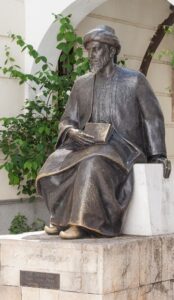
Rambam Monument in Cordoba, Spain

This Friday, the 20th of Tevet, is the yahrzeit of Rabbi Moshe ben Maimon (1138-1204), better known as the “Rambam”, or “Maimonides”. Rambam is one of the most fascinating figures in Jewish history, and also one of the most mysterious, multi-faceted, and complex. His impact on the course of Judaism cannot be overstated. Eight hundred years later, scholars, historians, and rabbis continue to debate his true views, positions, and beliefs. Rabbi Dr. Leon Stitskin (1911-1978), philosophy professor at Yeshiva University, described the Rambam as one who “reveals the truth by stating it, and hides it by contradicting it.” (Letters of Maimonides, pg. 18) More recently, Rabbi Dr. Aaron Adler (in his Al Kanfei Nesharim) noted a whopping 749 places where the Rambam’s early work, his Commentary on the Mishnah, appears to contradict his later works! And when it comes to the Rambam’s Moreh Nevukhim, the “Guide for the Perplexed”, some rabbis were so uncomfortable with it they denied that the Rambam ever wrote it! Who exactly was the Rambam, and what did he truly believe and teach?

Physician & Philosopher

Rambam was born in Cordoba, Spain to Rabbi Maimon, a student of Rabbi Yosef ibn Migash, who was a student of the famous Rif, Rabbi Isaac Alfasi (1013-1103). When he was around 10 years old, the extremist Almohads conquered Cordoba and forced all non-Muslims to convert, die, or flee. The Rambam’s family fled to North Africa. Settling in Morocco, the Rambam became a rabbi, but also studied at the University of Fez to become a physician. Meanwhile, he was deeply immersed in Greek philosophy, and came to embrace the school of Aristotle above the others. He is well-known for his work in integrating Aristotelian philosophy with Torah and Judaism. This set the stage for others around the world to do the same, most notably Thomas Aquinas (1225-1274), a Catholic theologian and saint who integrated Aristotle with Catholicism, and cited Maimonides in his works. The Rambam believed that Aristotle was the greatest Gentile of all time, and wrote in his letter to Shmuel ibn Tibbon: Continue reading
The 30 Noahide Laws, Part 2: Revolution

In the second installment of the series, we address the big questions: Can Noahides keep Shabbat? Can Noahides learn Talmud and Zohar? Have a mezuzah on their door? And why do we say there are “seven” Noahide Laws if there are actually thirty? Plus: What is a Ger Toshav and is it equivalent to a Noahide? What is the right way to learn and master Torah? And understanding Rabbi Meir, the “potential Mashiach” of his generation.

For Part 1 of the series, see here.
On the rapidly growing movement of Noahides and Jewish converts, see here.

Rabbi Goren & the Threshing Floor of Thorns

In this week’s parasha, Vayechi, we read about the passing and burial of Jacob. We are told that all of Egypt mourned his death for seventy days, after which Joseph requested permission to take leave and bury his father in the Holy Land. The whole family went along for the journey (except the youngest infants), together with many high-ranking Egyptian officials and dignitaries (Genesis 50:7). Then the Torah tells us that

they came to Goren haAtad, which is beyond the Jordan, they held there a very great and solemn lamentation; and he observed a mourning period of seven days for his father. And when the Canaanite inhabitants of the land saw the mourning at Goren haAtad, they said, “This is a solemn mourning on the part of the Egyptians.” That is why it was named Avel-Mitzraim, which is beyond the Jordan. (50:10-11)

The commentators are puzzled by these perplexing verses. What is meant by Goren haAtad? Why did they bother traveling “beyond the Jordan” if they were coming up from Egypt? Why did the family mourn again, for another seven days (especially since Jacob had not even been buried yet)? Why did the Canaanites suddenly show up?

Rashi (Rabbi Shlomo Itzchaki, 1040-1105) says goren means a “threshing floor” and atad means “thorns”. But why would anyone thresh thorns? Rashi explains that the Canaanites and Ishmaelites came to wage war when they saw the massive procession coming up out of Egypt. They then saw Jacob’s coffin, and Joseph’s crown resting atop, and each of their leaders came to pay their respects, too, and hung their own crowns around the coffin. The Talmud (Sotah 13a) that Rashi quotes from says that the leaders of Esau were there, too, and altogether there were 36 crowns hung around Jacob’s coffin. This gave the whole thing an appearance like a “threshing floor surrounded by thorns”.

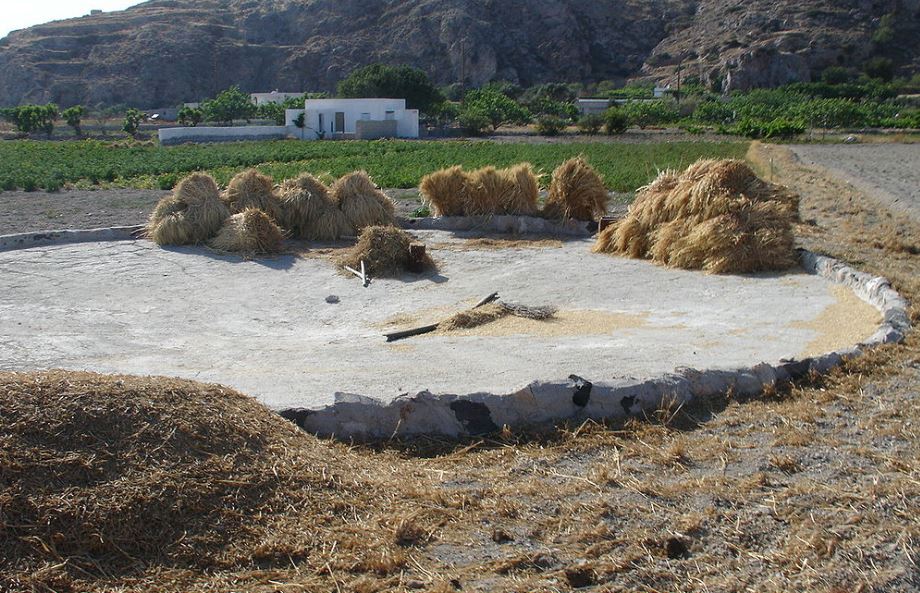
If we look at the design of ancient threshing floors, we find a circular flat surface, usually surrounded by rocks or a low-lying fence. The outer barrier was probably to keep away wild animals from consuming the grain that was being threshed, or to keep the oxen doing the threshing from wandering away. Instead of rocks or a fence, one could plant thorny bushes around the threshing floor for the same reason. That might explain the appearance of Jacob’s coffin in the centre, surrounded by “thorny” crowns all around.

A threshing floor in Santorini, Greece

The Kli Yakar (Rabbi Shlomo Ephraim Luntschitz, 1550-1619) isn’t too happy with this explanation. He points out that if it was common to surround threshing floors with thorns back then, why is this particular one called “the threshing floor of thorns”? He provides some alternate explanations: one has to do with the death of Jacob bringing about another famine in Egypt, while the other sees “thorns” as symbolic of wicked people whose fate is to be “threshed” and destroyed. The Torah is indeed speaking about threshing thorns here! We know that every verse in the Torah is encoding much deeper information, mystical, prophetic, and relevant for all time. So, what is the Torah really trying to tell us here? What might the “threshing floor for thorns”, this Goren haAtad, really be? Continue reading