Tag Archives: Temple

Why Tu B’Av Is More Important Than Yom Kippur

This week’s Torah portion is Va’etchanan, which begins with Moses’ many prayers to God, and famously includes both an account of the Ten Commandments, and the Shema. It also happens that this Friday we celebrate the little-known holiday of Tu B’Av (literally, the fifteenth day of the month of Av). Upon closer examination, the parasha and the holiday are quite deeply related.

The Talmud (Ta’anit 26b) states:

Rabban Shimon ben Gamaliel said: there were no days more joyful in Israel than the fifteenth of Av and Yom Kippur. On these days, the daughters of Jerusalem used to go out in white garments, which they borrowed in order not to put to shame anyone who had none… The daughters of Jerusalem came out and danced in the vineyards exclaiming at the same time, “Young man, lift up your eyes and see what you choose for yourself. Do not set your eyes on beauty, but set your eyes on [good] family…”
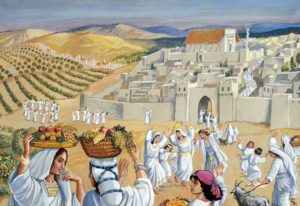
Young Girls Dancing on Tu B'Av (Courtesy: Temple Institute)

Young Ladies Dancing on Tu B’Av (Courtesy: Temple Institute)

In ancient times, Tu B’Av was a day of speed-dating, matchmaking, and engagements. It is easy to see why Tu B’Av has become associated with love and romance, and is often referred to today as a “Jewish Valentine’s Day”. While this is true, a careful reading will reveal that the holiday actually has far more to do with the fact that the daughters of Jerusalem loved one another, going out in the same white garments to avoid shaming each other. Tu B’Av celebrates a much greater power of love, one that holds the cure for the ails of the solemn Tisha B’Av that was commemorated just days earlier.

Why is Tu B’Av Special?

The Talmud (Ta’anit 30b-31a) asks: why does the Mishnah above compare Tu B’Av to Yom Kippur? We can understand why Yom Kippur is a special day – since it was then that God forgave the Israelites for the sin of the Golden Calf and gave a new set of Tablets – but why Tu B’Av? The question is answered with a list of significant historical events that happened on the 15th of Av.

First among them is the day when the prohibition for people of different Israelite tribes to marry each other was repealed. Initially, during the settlement of the Holy Land, people married only within their own tribe to avoid situations where parcels of land might unfairly be transferred to a different tribe. Eventually, this ban was lifted, allowing anyone to marry whomever they wanted. Once again, we see the theme of love associated with Tu B’Av.

The Talmud goes on to list a number of other events, the most salient of which is that on this day, the “generation of the Wilderness ceased to die out.” After the sin of the Spies, God decreed that the Israelites would wander in the Wilderness for forty years until the entire adult male generation passed away. In the fortieth year, the last of that generation passed away on the fifteenth of Av, allowing the nation to finally move on from the sin of the Spies. (Some say the last group of men was actually spared from death on Tu B’Av, turning that day into a celebration.)

Here, the Talmud cites a teaching that ever since the sin of the Spies, God had stopped speaking to Moses directly. Instead, Moses received visions from God just like any other prophet. On Tu B’Av, after nearly forty years, God once more resumed speaking to Moses “face-to-face”. Tu B’Av was the day Moses reclaimed his status as the greatest of prophets, the only one who spoke to God in a fully conscious state.

Where in the Torah do we see that God resumed speaking to Moses in this way? The Pnei Yehoshua comments that this happened in our weekly parasha, Va’etchanan. After Moses’ incessant prayers, God finally reappeared to him. And so, we see yet again the theme of love on Tu B’Av; this time, though, not love between people, but between God and man.

One Love

It is in this week’s parasha that we are commanded to “love Hashem, your God, with all of your heart…” Earlier in Leviticus we were given the mitzvah to “love your fellow as yourself.” While the latter is understandable, how exactly is one supposed to love God? God is the eternal, all-encompassing, omnipotent, omniscient, omnipresent force within all of Creation, and everything that infinitely lies beyond. The Kotzker Rebbe once rightly observed that “one who does not see God everywhere, does not see God anywhere.” How does one love such a transcendent Being?

Our Sages teach something incredible. The full verse in Leviticus states, “And you shall love your fellow as yourself, I am Hashem.” Why finish with “I am Hashem”? The verse would have stood well on its own without that last part! The juxtaposition of words can teach us that that loving your fellow is loving Hashem. In fact, the numerical value of the whole verse (ואהבת לרעך כמוך אני יי) is 907, equivalent to “love Hashem, your God” (ואהבת את יי אלהיך)! If God is found within each person, and within each creation, then loving every person and every creation is loving God.

This is all the more important on Tu B’Av which, not coincidentally, comes immediately after Tisha B’Av, a day commemorating a Temple destroyed because of sinat chinam, baseless hatred, and absence of love between fellows. When the Jews of the Second Temple period stopped loving each other, it was clear that they had stopped loving God, and God destroyed His Temple.

Tu B’Av is the antidote to Tisha B’Av. It is quite ironic that while many mourn and wail on Tisha B’Av, few pay much attention to the far more significant message of Tu B’Av. It is Tu B’Av that should be carefully observed and loudly celebrated. After all, the Mishnah goes so far as to place Tu B’Av on the same pedestal as Yom Kippur! That makes it even more ironic, as the majority of Jews observe Yom Kippur in some way, yet have little knowledge of Tu B’Av which, in reality, is just as important as Yom Kippur, and perhaps even more so:

The Mishnah ends by suggesting that while the Temple was destroyed on Tisha B’Av, it will be rebuilt on Tu B’Av, for just as the “daughters of Zion” would go out on Tu B’Av, they will go out once more in the “day of the building of the Temple, may it be rebuilt speedily and in our days.”


The article above is adapted from Garments of Light – 70 Illuminating Essays on the Weekly Torah Portion and Holidays. Click here to get the book!

Yom Ha’Atzmaut: Uniting the Secular and the Religious

The 5th of Iyar is Yom Ha’Atzmaut, Israel’s Independence Day. It was on this day in 1948 that David Ben-Gurion proclaimed the establishment of the State of Israel. Immediately, the armies of three neighbouring Arab states—Egypt, Jordan, and Syria—declared war and invaded. Iraq and Saudi Arabia sent in additional forces. Lebanon assisted them, too. Yemen, Pakistan, and Sudan sent even more fighters. On top of that, there were fighters of the Holy War Army, essentially a local Arab militia composed of over 1,300 troops, as well as the Arab Liberation Army, with over 6,000 troops from various Arab states. Despite being completely surrounded, outnumbered, and outgunned, the nascent State of Israel miraculously destroyed its enemies in just under ten months.

The miracles did not stop there. In 1967, Egypt, Syria, Jordan, and Iraq amassed 550,000 troops to “drive Israel into the sea.” With less than half of those numbers, Israel launched a pre-emptive strike that decimated the Arab forces in six days. Jerusalem was reclaimed, allowing Jews to visit their most holy sites for the first time in centuries. The miracles continued through the Yom Kippur War of 1973, and even through the 1991 Gulf War (which Israel did not directly take part in), and continue to this day. Ben-Gurion’s famous words are fitting: “In Israel, in order to be a realist, you must believe in miracles.”

Despite the fact that Jews once more have an independent state that is strong and prosperous (for the first time since the Maccabees defeated the Greeks and established the Hasmonean kingdom over 2000 years ago) there have been some, particularly in the Ultra-Orthodox Jewish world, that have opposed the State. This opposition comes in various degrees, from those that simply don’t support the secular government; to those that refuse to participate in state programs, military or national service, and the like; to those that completely side with anti-Israel groups bent on annihilating the State. Although, of course, the State of Israel is far from perfect, and its secularization often takes reprehensible forms, opposing the State makes little sense, particularly in light of what Jewish holy texts tell us.

Meanwhile, the ultra-secular elements in Israel, who strive to expunge Judaism, make even less sense, considering that the only claim Jews have to the land is tied to the Torah—the fact that God gave us this land, and we are its indigenous people, inhabiting it since Biblical times. Without the Tanakh, what claim does a secular person have to live in Israel? Moreover, many secular Israelis are blinding themselves to the miracle that is Israel, failing to see God’s hand in every step of its history.

By properly exploring Israel’s miraculous existence, perhaps the gap between the secular and the religious may be bridged. The former can come to see the validity and truth of God and His Torah, while the latter can come to see the State of Israel as a fulfilment of Biblical prophecy.

Prophecy Fulfilled

A look through history makes it clear: if it were not for God’s incredible miracles, the State of Israel would have never gotten off its feet, nor would it have survived to this day. God promises us in the Torah that “five of you shall chase a hundred, and a hundred of you shall chase ten thousand; and your enemies shall fall before you by the sword.” (Leviticus 26:8) This is precisely what has happened in every single war that Israel has participated in. In 1948, Israel tragically suffered 6,000 casualties, while the Arabs suffered over 20,000. In 1967, Israel suffered as many as 983, but the Arabs over 24,000. In 1973, Israel was surprise-attacked on Yom Kippur, completely unprepared for battle, faced with an invasion that had over one million troops from literally all over the world, including nearly 4,000 from Cuba! In comparison, Israel had 400,000 at best, reservists included. The highest estimates place 2,800 Israeli casualties, compared to 20,000 for the attackers.

In one well-known incident from this war, 150 Syrian tanks went up against just 7 remaining Israeli tanks left with no ammo in the “Valley of Tears” of the Golan Heights. Just as Israeli commander Avigdor Ben-Gal prepared to send a message saying his forces could no longer hold on, the Syrians suddenly retreated in a panic. All in all, Israel lost around 60 tanks in the Valley of Tears; the Syrians lost over 500. To this day, military analysts are puzzled by the Syrian withdrawal. Many theories have been proposed, including that the Syrians thought it must be an ambush, or even that higher up in the government Israel had threatened Syria with a nuclear strike. One Syrian soldier would later reveal what may have been the real reason: they thought they had been swarmed by an army of angels!

It isn’t just in military victories that God has clearly blessed the State. In under 70 years, Israel has flourished and is among the most developed and prosperous countries in the world. Isaiah prophesized:

The wilderness and the parched land shall be glad; and the desert shall rejoice, and blossom as the rose. It shall blossom abundantly, and rejoice… they shall see the glory of Hashem, the excellency of our God. (Isaiah 35:1-2)

Indeed, Israel and its once-parched lands have blossomed abundantly. Israel is now self-sufficient in its food production (meaning no one will starve if Israel stops all imports of food) and exports over $1.3 billion in food every year.

Israel famously exports a great deal of innovation and technology, too, and is a global leader in science. Its high-tech sector, nicknamed “Silicon Wadi”, is second only to Silicon Valley. Despite its short existence, Israel ranks 12th in per capita Nobel Prizes—higher than Canada and the US, Germany, France, and the entire European Union for that matter. There are nearly 400 million Muslim Arabs across 22 countries, and altogether they account for just 7 Nobel Prizes (of which two were “peace” prizes for terrorist-sponsors Anwar Sadat and Yasser Arafat!) while some 6 million Jews in Israel alone have won 12 Nobel Prizes. There is no doubt that Israel, with God’s blessing, has lived up to the Biblical ideal of being a “light unto the nations.” (Isaiah 42:6)

History makes it clear that the establishment and survival of the State of Israel is nothing short of a divine miracle, and would not happen were it not for God’s support and supervision. Before Moses passed away, he sang his final song to the people, and told them: “Remember the days of old, understand the years of past generations.” (Deuteronomy 32:7) Consider the historical facts: does history not make it so plainly obvious? “How could one chase away a thousand… if not for Hashem who delivers them up?” (Deuteronomy 32:30) Is it logical that 7 tanks can scare off 150? That a million invaders can be subdued by mere thousands? That a nation so soon back from the brink can rebuild such a prosperous state in a barren desert so quickly? And that it was all prophesied long ago, as Ezekiel foresaw that “in the End of Years” the Jews people shall return to their land, coming back from “the sword, gathered from among many peoples, [returning] upon the mountains of Israel, which have been a continual waste…” (Ezekiel 38:8) Is it not obvious that God is pulling the strings?

Uniting in Righteousness

Finally, the Torah also tells us a well-known principle: the land of Israel is holy, and “vomits out” anyone who does not deserve to live there. In light of this, the great Moroccan sage Rabbi Avraham Azulai (c. 1570-1643) wrote in his Chessed L’Avraham (Ma’ayan 3, Nahar 12):

And you should know, every person who lives in the Land of Israel is considered a tzadik, including those who do not appear to be tzadikim. For if he was not righteous, the land would expel him, as it says “a land that vomits out its inhabitants.” (Leviticus 18:25) Since the land did not vomit him out, he is certainly righteous, even though he appears to be wicked.

Thus, as a general rule, all Israelis—secular and religious—are deemed righteous in their own way, and for any one side to label the other as “wicked” is incorrect. We mustn’t forget that the Holy Temple was destroyed because of sinat hinam, baseless hatred and incessant infighting. Instead of opposing one another, we should all strive to support one another, to understand each other, and make Israel—the one homeland that we all have—the best that it can be. Then we will be able to realize the prophecy of Isaiah:

I will set your stones in fair colours, and lay your foundations with sapphires. And I will make your pinnacles of rubies, and your gates of carbuncles, and all your border of precious stones. And all your children shall be disciples of God, and great shall be the peace of your children… (Isaiah 54:11-13)


The above is an excerpt from Garments of Light, Volume Two. Get the book here

Will There Be Sacrifices in the Third Temple?

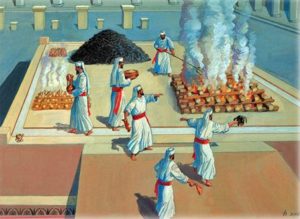
Offerings on the Altar (Courtesy: Temple Institute)

Offerings on the Altar (Courtesy: Temple Institute)

This week’s Torah reading is Acharei, focusing on the details of the priestly procedure performed on Yom Kippur in the Temple (or Tabernacle). God instructs Aaron to take two goats and one bull. One of the goats is to be sacrificed, while the other is to be sent to “Azazel” (the identity of which we have discussed in the past). Meanwhile, the bull is also to be sacrificed, and its blood sprinkled on the Holy Vessels within the innermost chamber of the Temple, the Holy of Holies. The third book of the Torah, Vayikra (Leviticus), often details such lengthy sacrificial procedures. To the modern reader, these passages tend to be quite difficult to read, with rituals that seem unnecessarily bloody and distasteful. Does God really want us to sacrifice animals? And when the Third Temple is rebuilt, will we once again be responsible for performing such rituals?

Back to the Garden of Eden

When God initially created the world, he placed man in a perfect environment where there was absolutely no death or bloodshed of any kind. Man was instructed only to consume fruits and plant matter. In fact, it wasn’t until the time of Noach that God reluctantly agreed to allow mankind to consume meat.

From a Kabbalistic perspective, this was done only for the purposes of tikkun, spiritual rectification (see Sha’ar HaMitzvot on parashat Ekev, and Sha’ar HaPesukim on Beresheet). The sinful souls of the flood generation were reincarnated into animals, and through their slaughter and consumption, those souls could be rectified and returned to the Heavenly domain. This is clearly hinted to in the phrasing of the Torah’s text: the animals that Noach took unto the Ark to be saved were initially described as zachar v’nekeva, “male and female” (Genesis 6:19). However, we are later told that some of the animals, particularly those to be slaughtered following the flood, were ish v’ishto, literally “man and woman”, or “husband and wife” (Genesis 7:2)!

We can deduce from this that sacrifices—and the consumption of meat in general—is a temporary phenomenon, for the purposes of tikkun, and not what God intended in His ideal conception of the world. Indeed, God often states in Scripture that He neither wants, nor requires, any sacrifices. He even states, perplexingly, that He never commanded them to begin with:

So said Hashem, Lord of Hosts, the God of Israel: “You add burnt offerings onto your sacrifices, and eat flesh, which I did not speak unto your forefathers, nor did I command them on the day that I took them out of Egypt, concerning burnt offerings and sacrifices. Rather, it is this that I commanded them: Listen to My voice, and I shall be for you a God, and you shall be for me a people, and you shall walk in all my ways that I shall command you, that it may be well for you.” (Jeremiah 7:21-23)

The Rambam explains that when taking the Israelites out of Egypt, God could not forbid them from offering sacrifices. This is because in that time period, offering sacrifices was the most common form of divine worship among the masses, and this is what the Israelites were familiar with. Thus, God allow the Israelites to bring sacrifices temporarily, as a means to slowly wean them off the practice:

The Israelites were commanded to devote themselves to His service… But the custom which was in those days general among all men, and the general mode of worship in which the Israelites were brought up, consisted in sacrificing animals in those temples which contained certain images, to bow down to those images, and to bum incense before them; religious and ascetic persons were in those days the persons that were devoted to the service in the temples erected to the stars, as has been explained by us. It was in accordance with the wisdom and plan of God, as displayed in the whole of Creation, that He did not command us to give up and to discontinue all these manners of service; for to obey such a commandment it would have been contrary to the nature of man, who generally cleaves to that which he is used to; it would in those days have made the same impression as a prophet would make at present if he called us to the service of God and told us in His name, that we should not pray to Him, not fast, not seek His help in time of trouble; that we should serve Him in thought, and not by any action. For this reason God allowed these kinds of service to continue; He transferred to His service that which had formerly served as a worship of created beings, and of things imaginary and unreal, and commanded us to serve Him in the same manner; namely, to build unto Him a temple; “And they shall make unto me a sanctuary” (Exodus 25:8); to have the altar erected to His name; “An altar of earth you shall make me” (Exodus 20:21); to offer the sacrifices to Him; “If any man of you bring an offering unto the Lord” (Leviticus 1:2), to bow down to Him and to bum incense before Him… By this Divine plan it was affected that the traces of idolatry were blotted out, and the truly great principle of our faith, the Existence and Unity of God, was firmly established. This result was thus obtained without deterring or confusing the minds of the people by the abolition of the service to which they were accustomed and which alone was familiar to them…

The Rambam goes on to elaborate on this point in more detail, and to thoroughly prove his argument, which is quite a fascinating read (Guide for the Perplexed, Part III, Ch. 32). He is clear on the fact that sacrifices were not God’s original intention, as we see in the Garden of Eden and through the words of the Prophet Jeremiah, but only a temporary necessity.

Sacrifices in the Third Temple?

Having said that, the Rambam does, somewhat paradoxically, write in his Mishneh Torah that sacrifices will resume in the Third Temple. It appears that the Rambam publicly went with the mainstream Orthodox approach but, in private, held that sacrifices will not be performed ever again. The Rambam writes that prayer is a far greater mode of worship than sacrifice, an idea that goes back to the prophet Hoshea, who declared “…we shall offer the cows with our lips.” (Hoshea 14:3)

More recently, Rabbi Avraham Itzchak Kook, the first Ashkenazi Chief Rabbi of Israel, similarly appeared to vacillate on the issue. In one place, he suggests that only grain offerings will be reinstated, and not animal offerings. (This is based on Malachi 3:4, which only mentions a restoration of grain offerings.) The Midrash suggests that only one type of offering will return, the voluntary Todah, or “thanksgiving” offering (see Vayikra Rabbah 9:7). Others propose that sacrifices will return for a short period of time only before being permanently abolished.

Ultimately, if God intended a perfect world with no death—as was His original plan for the Garden of Eden—and the future Redemption is essentially a global return to a state of Eden, then we certainly shouldn’t expect any more (animal) sacrifices in the future. It should be mentioned that the Sages teach that Adam did bring an animal sacrifice to God (Avodah Zarah 8a). However, this was not inside the Garden of Eden, but after he had already been banished, and due to his fear that the previously-decreed death sentence was upon him. Within Eden itself there could not be any death whatsoever. And so, if the world is set to return to an idyllic Eden-like state, there will certainly be no place for sacrifices.


The above is adapted from Garments of Light, Volume Two. Get the book here