Tag Archives: Tikkun

Embracing Converts, and the Seeds of Amalek

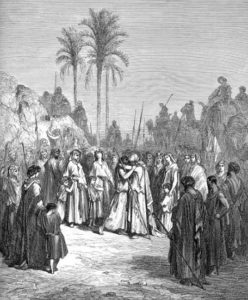
'The Meeting of Jacob and Esau' by Gustav Doré

‘The Meeting of Jacob and Esau’ by Gustav Doré

This week’s parasha is Vayishlach, which recounts Jacob’s return and settlement in the Holy Land after twenty years of living in Charan. At the end of the parasha is a long list of the genealogies of Jacob’s brother, Esau. The list seems unnecessary, and many Sages have wondered why the Torah bothers to spend so much time recounting Esau’s descendants. There have even been debates on whether the entire text of the Torah is equally holy, or if passages like the Ten Commandments are holier than passages such as this list of Esau’s genealogies. Meanwhile, the Arizal states that many of the deepest secrets of Creation are embedded particularly in this seemingly boring and superfluous passage. He draws particular significance from the list of the kings of Edom. The Arizal says these kings are codenames for the Sefirot, and a careful reading of the text reveals the cosmological rectifications (tikkunim) required to repair all of Creation and restore the world to perfection.

About half way through the list we are told that “… the sister of Lotan was Timna” (Genesis 36:22). Again, the Sages are baffled at this extra addition. We already care little enough that there was once an Edomite chief named Lotan – who cares that he had a sister named Timna? The Talmud (Sanhedrin 99b) notes how there were those who scoffed at such verses, saying: “Did Moses have nothing better to write?” And then, the same page of Talmud comes in to explain its tremendous significance:

Timna was a royal princess… Desiring to become a proselyte, she went to Abraham, Isaac and Jacob, but they did not accept her. So she went and became a concubine to Eliphaz the son of Esau, saying, “I’d rather be a servant to this people than a mistress of another nation.” From her, Amalek was descended, who afflicted Israel. Why so? Because they should not have repulsed her!

The Talmud combines the verse in question – which states that Timna was the royal sister of the chief, or prince, Lotan – with an earlier verse (36:12) that says she married Esau’s son Eliphaz and bore Amalek. She wished to convert to Judaism and approached the Patriarchs. All three rebuffed her. So, she ended up with Eliphaz – the closest she could get to being part of the nation. This union gave rise to the evil Amalek, that antagonizing force which has been oppressing Israel for millennia. The Sages state that the Patriarchs should have embraced this potential convert, instead of pushing her away. Their failure to open their arms led to centuries of Jewish suffering. The Talmud sends a pretty clear message: gentiles and converts should not be turned away, and doing so only breeds more resentment against Jews, bringing out all of the world’s “Amaleks”.

Soulmates of Jacob and Moses

The Arizal comments on the Timna passage and points out something even more amazing. He taught (Sha’ar HaMitzvot, Shoftim) that Timna was actually the soulmate of Jacob! Timna contained a great deal of holiness, and Jacob was meant to convert her and marry her, thereby elevating her spiritual sparks. That would have been a massive tikkun of its own, and would have hastened the coming of Mashiach. Instead, Jacob rejected her, and she went on to produce Amalek, bringing evermore evil into the world, and further delaying the coming of Mashiach.

The Arizal highlights that Moses made a similar mistake in not consummating his marriage to the Cushite (Ethiopian) woman. Both Tzipporah and the Cushite woman were Moses’ soulmates, and while Moses did the right thing in converting the Cushite, he never properly married her. Her sparks of holiness were not fully elevated, and the tikkun was left incomplete. This is why Aaron and Miriam were upset with their brother, as we read later in Numbers 12:1, “And Miriam and Aaron spoke against Moses because of the Cushite woman whom he had married…”

Rabbi Akiva’s 24,000 Students in Shechem

In this week’s parasha, too, we read how the people of Shechem genuinely wished to unite with Jacob’s family, agreed to circumcise themselves, and converted en masse. However, Jacob’s sons Shimon and Levi rejected them and resorted to violence in avenging what was done to their sister Dinah. Jacob was horrified at the actions of his sons, and later did not bless the two on his deathbed. It appears their sin was never forgiven, as hundreds of years later the tribes of Shimon and Levi were not given set borders within the Holy Land, but only a handful of cities interspersed among the other tribes. Kabbalistic texts reveal that Shimon and Levi killed 24,000 people in Shechem, and these 24,000 converted souls later reincarnated as the 24,000 students of Rabbi Akiva!

Did You Know These Famous People Converted to Judaism?

All of these narratives point to the same lesson: converts should be welcomed and accepted wholeheartedly. They have the potential for great holiness. The Talmud (Bava Kamma 38a) states that a gentile who occupies himself with Torah is equal to a kohen gadol, a High Priest! The Arizal describes five types of Jewish souls, and the souls of converts are among the purest. (The other types are “Old Souls”, “New Souls”, “True New Souls”, and the “Souls of Cain and Abel”. Of these, the most impure are Old Souls.) It goes without saying that there is no place for racism of any kind within Judaism – Moses himself married a black woman, and was reprimanded for not being diligent in consummating that union.

Historically, Jews were never the proselytizing kind. There are no Jewish missionaries that go out knocking on the doors of gentiles to seek converts. At the same time, Judaism was rarely a popular religion to convert in to. But this will change very soon, and we have to be ready for that day, for the prophet Zechariah (8:23) predicted:

It shall come to pass that ten men shall take hold – from all the languages of the nations – shall take hold of the corners of a Jew’s clothes, saying: “We will go with you, for we have heard that God is with you…”


The above essay is an excerpt from Garments of Light, Volume One. Get the book here!

Will There Be Sacrifices in the Third Temple?

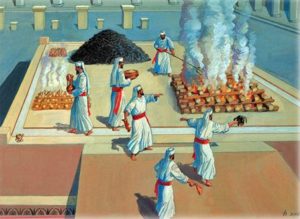
Offerings on the Altar (Courtesy: Temple Institute)

Offerings on the Altar (Courtesy: Temple Institute)

This week’s Torah reading is Acharei, focusing on the details of the priestly procedure performed on Yom Kippur in the Temple (or Tabernacle). God instructs Aaron to take two goats and one bull. One of the goats is to be sacrificed, while the other is to be sent to “Azazel” (the identity of which we have discussed in the past). Meanwhile, the bull is also to be sacrificed, and its blood sprinkled on the Holy Vessels within the innermost chamber of the Temple, the Holy of Holies. The third book of the Torah, Vayikra (Leviticus), often details such lengthy sacrificial procedures. To the modern reader, these passages tend to be quite difficult to read, with rituals that seem unnecessarily bloody and distasteful. Does God really want us to sacrifice animals? And when the Third Temple is rebuilt, will we once again be responsible for performing such rituals?

Back to the Garden of Eden

When God initially created the world, he placed man in a perfect environment where there was absolutely no death or bloodshed of any kind. Man was instructed only to consume fruits and plant matter. In fact, it wasn’t until the time of Noach that God reluctantly agreed to allow mankind to consume meat.

From a Kabbalistic perspective, this was done only for the purposes of tikkun, spiritual rectification (see Sha’ar HaMitzvot on parashat Ekev, and Sha’ar HaPesukim on Beresheet). The sinful souls of the flood generation were reincarnated into animals, and through their slaughter and consumption, those souls could be rectified and returned to the Heavenly domain. This is clearly hinted to in the phrasing of the Torah’s text: the animals that Noach took unto the Ark to be saved were initially described as zachar v’nekeva, “male and female” (Genesis 6:19). However, we are later told that some of the animals, particularly those to be slaughtered following the flood, were ish v’ishto, literally “man and woman”, or “husband and wife” (Genesis 7:2)!

We can deduce from this that sacrifices—and the consumption of meat in general—is a temporary phenomenon, for the purposes of tikkun, and not what God intended in His ideal conception of the world. Indeed, God often states in Scripture that He neither wants, nor requires, any sacrifices. He even states, perplexingly, that He never commanded them to begin with:

So said Hashem, Lord of Hosts, the God of Israel: “You add burnt offerings onto your sacrifices, and eat flesh, which I did not speak unto your forefathers, nor did I command them on the day that I took them out of Egypt, concerning burnt offerings and sacrifices. Rather, it is this that I commanded them: Listen to My voice, and I shall be for you a God, and you shall be for me a people, and you shall walk in all my ways that I shall command you, that it may be well for you.” (Jeremiah 7:21-23)

The Rambam explains that when taking the Israelites out of Egypt, God could not forbid them from offering sacrifices. This is because in that time period, offering sacrifices was the most common form of divine worship among the masses, and this is what the Israelites were familiar with. Thus, God allow the Israelites to bring sacrifices temporarily, as a means to slowly wean them off the practice:

The Israelites were commanded to devote themselves to His service… But the custom which was in those days general among all men, and the general mode of worship in which the Israelites were brought up, consisted in sacrificing animals in those temples which contained certain images, to bow down to those images, and to bum incense before them; religious and ascetic persons were in those days the persons that were devoted to the service in the temples erected to the stars, as has been explained by us. It was in accordance with the wisdom and plan of God, as displayed in the whole of Creation, that He did not command us to give up and to discontinue all these manners of service; for to obey such a commandment it would have been contrary to the nature of man, who generally cleaves to that which he is used to; it would in those days have made the same impression as a prophet would make at present if he called us to the service of God and told us in His name, that we should not pray to Him, not fast, not seek His help in time of trouble; that we should serve Him in thought, and not by any action. For this reason God allowed these kinds of service to continue; He transferred to His service that which had formerly served as a worship of created beings, and of things imaginary and unreal, and commanded us to serve Him in the same manner; namely, to build unto Him a temple; “And they shall make unto me a sanctuary” (Exodus 25:8); to have the altar erected to His name; “An altar of earth you shall make me” (Exodus 20:21); to offer the sacrifices to Him; “If any man of you bring an offering unto the Lord” (Leviticus 1:2), to bow down to Him and to bum incense before Him… By this Divine plan it was affected that the traces of idolatry were blotted out, and the truly great principle of our faith, the Existence and Unity of God, was firmly established. This result was thus obtained without deterring or confusing the minds of the people by the abolition of the service to which they were accustomed and which alone was familiar to them…

The Rambam goes on to elaborate on this point in more detail, and to thoroughly prove his argument, which is quite a fascinating read (Guide for the Perplexed, Part III, Ch. 32). He is clear on the fact that sacrifices were not God’s original intention, as we see in the Garden of Eden and through the words of the Prophet Jeremiah, but only a temporary necessity.

Sacrifices in the Third Temple?

Having said that, the Rambam does, somewhat paradoxically, write in his Mishneh Torah that sacrifices will resume in the Third Temple. It appears that the Rambam publicly went with the mainstream Orthodox approach but, in private, held that sacrifices will not be performed ever again. The Rambam writes that prayer is a far greater mode of worship than sacrifice, an idea that goes back to the prophet Hoshea, who declared “…we shall offer the cows with our lips.” (Hoshea 14:3)

More recently, Rabbi Avraham Itzchak Kook, the first Ashkenazi Chief Rabbi of Israel, similarly appeared to vacillate on the issue. In one place, he suggests that only grain offerings will be reinstated, and not animal offerings. (This is based on Malachi 3:4, which only mentions a restoration of grain offerings.) The Midrash suggests that only one type of offering will return, the voluntary Todah, or “thanksgiving” offering (see Vayikra Rabbah 9:7). Others propose that sacrifices will return for a short period of time only before being permanently abolished.

Ultimately, if God intended a perfect world with no death—as was His original plan for the Garden of Eden—and the future Redemption is essentially a global return to a state of Eden, then we certainly shouldn’t expect any more (animal) sacrifices in the future. It should be mentioned that the Sages teach that Adam did bring an animal sacrifice to God (Avodah Zarah 8a). However, this was not inside the Garden of Eden, but after he had already been banished, and due to his fear that the previously-decreed death sentence was upon him. Within Eden itself there could not be any death whatsoever. And so, if the world is set to return to an idyllic Eden-like state, there will certainly be no place for sacrifices.


The above is adapted from Garments of Light, Volume Two. Get the book here

Abraham’s Revolution & the Purpose of the Jewish People

This week in the parasha of Lech Lecha we begin reading the story of Abraham, the principal forefather of the Jewish people. Abraham is considered history’s first Jew, being the one to whom the covenant of circumcision was first given, together with the Promised Land. The most pertinent question to ask is: why Abraham? What exactly was it that Abraham did to merit being the first Jew? What was so unique about him that made him the forefather of an entire nation, not to mention a multitude of other nations, too? (This is the meaning of his Hebrew name, as Rashi explains on verse 17:5 that Avraham stands for Av Hamon Goyim – “father of many nations”.)

The most common answer that is suggested is that Abraham was the first monotheist, and introduced monotheism to the world. A quick look through the Torah negates this argument very quickly. For instance, we know that Abraham’s life overlapped with that of Noah, who was obviously a monotheist, having communicated directly with God. Jewish tradition holds that Noah’s son Shem had a yeshiva, together with his grandson Ever, where our forefathers studied, and which long pre-existed Abraham’s arrival onto the scene. Earlier, we see that Enoch “walked with God”, too. There are many more examples we can bring to show that Abraham was certainly not the first monotheist, nor was he the first to teach monotheism to the world.

We must find another answer then, and to do this it may be easier to begin with another question: why is there a Jewish people at all? Why is there a need for a “Chosen People”, and what exactly are the Jewish people chosen for?

Back to the Garden of Eden

Originally, God had created man in a perfect world of no evil. There was no Judaism in the Garden of Eden; Adam and Eve were certainly not Jews. They chose to introduce evil into the world, and man was thus “expelled” from the Garden. Henceforth, it has been our mission to return to a perfect world—to repair the damage that was done, to remove evil from our midst, and to restore Godliness to the universe. We are in the world of tikkun, “repair”, and since the time of Adam, it has been man’s mission to recreate an immaculate world of pure goodness.

Unfortunately, Adam and Eve were unsuccessful in this task, and so were their immediate descendants. By the third generation, the Torah tells us that people began to profane the name of God. By the tenth, the world was full of corruption and immorality. Instead of repairing the world, people were only damaging it further. In last week’s parasha, we read how God essentially hit the “restart” button, yet promised to never do so again. The reason for this is fairly plain: God created the world for us; an infinite God requires nothing for Himself. It makes little sense for God to continue recreating the world if Man will keep destroying it. In effect, God was saying that henceforth it is up to man to take care of our own world.

Another ten generations after the Flood, the world was corrupt once more. Since God wouldn’t be destroying it again, from where would the solution come? Who would rise to the challenge? This is where Abraham comes into the picture.

Abraham’s Revolution

From a very young age, Abraham recognized the cruelty that permeates the planet, and made it his life mission to make the world a better place. He quickly deduced that there must be one singular God, and made the effort to find the answers to life’s big questions. But it didn’t end there.

Unlike Shem, Ever, and their kind, Abraham actually wanted to do something about it. Shem and Ever could not confront the rampant idolatry and corruption of their society, so they fled and opened their own secluded yeshiva. All who were interested were welcome to join, but otherwise Shem and Ever were silent.

Abraham, meanwhile, was far more proactive. He understood that man’s mission is to perfect the world. He understood that there is nothing to wait for. Abraham actively entered the battle, fighting the immorality of the day head-on and starting a massive education campaign. Jewish tradition teaches that Abraham built his home along a busy intersection, with a door on each side to make it as easy as possible for people to enter. Food and drink were both abundant and free of charge for all who were willing to listen. Abraham is even said to have written a book of several hundred chapters outlining his arguments against idolatry, immorality, and corruption, while presenting a summary answering the biggest questions of life. Abraham was so passionate about his work that he even risked his life for it. It came to a point where his movement threatened King Nimrod, and the latter threw him into a flaming furnace.

It was only at this point that God stepped in. It is incredible that until this moment, Abraham had done all of that without ever having communicated directly with Hashem. Until then, he was in the same boat as all of us are today—in a world with no prophecy or revealed Godliness; in a world full of immorality and atheism. Nonetheless, his knowledge and faithfulness in God never wavered, nor did he abandon his mission. This is precisely why God chose Abraham. In many ways, it is more appropriate to say that Abraham chose God.

The Chosen People

And this is the true purpose of the Jewish people. We are meant to continue the work that Abraham started nearly four thousand years ago. Like Abraham, the Jews as a whole have always been on the side of righteousness, and morality, regardless of what society said, or how much we were persecuted. A “light unto the nations”, the Jews have revolutionized the world in each generation, moving civilization forward, and bringing it ever closer to a perfect world.

It is no surprise that roughly 25% of Nobel Prize winners are Jewish (despite being just 0.2% of the world’s population!) nor is it surprising that in 2013, the UN passed 21 out of 25 resolutions against Israel. One of the world’s tiniest countries, with a population that makes up just 0.1% of the planet, somehow earns 84% of the world’s resolutions! The world’s eyes are constantly focused on Israel. The Jewish State is held to a far higher standard than any other. The world looks to us for moral guidance, and for higher consciousness (and they are rightly upset when we fail to uphold this ideal).

This is our task as Jews, just as it was the task of Abraham. This is why Abraham was different, and why Abraham was chosen. We are continuing his work in repairing this world and bringing it closer to the primordial state of Eden. And we are finally living in a time where this is no longer just a dream. Technology has brought the world together in a way that was never possible before. Jewish teachings say that every person on Earth will one day hear the shofar of Mashiach. This was once relegated to the category of miracles. Today, it is possible for anyone with a smartphone and an internet connection. The prophets Isaiah (11:9) and Habakkuk (2:14) both state how the era of Mashiach will be one where the world is saturated with knowledge. We are indeed living in a world where we are constantly bombarded with information, and any question can be answered within seconds by a simple Web search. In other words, we are now living these ancient prophecies.

The fulfilment of man’s original mission—the one that Abraham took upon himself, and that the Jewish people have continued throughout the millennia—is nearly upon us.


The above essay is adapted from Garments of Light, Volume Three.
Get the book here!