Category Archives: Holidays

The Passover Seder and the Order of Creation

This Friday night we will be gathering to celebrate the holiday of Pesach. It will also be Shabbat, which is highly appropriate because Pesach and Shabbat are deeply intertwined. While Shabbat is mentioned multiple times in the Torah, there are two places in particular where Shabbat is commanded and explained: the two times that the Torah records the Ten Commandments. These two passages are nearly identical except for, primarily, the description of Shabbat. In the first account, Exodus 20, we read:

Remember the Sabbath day to keep it holy. Six days shall you labour, and do all your work; but the seventh day is a Sabbath unto Hashem, your God, in it you shall not do any manner of work; you, your son, your daughter, your servant, your maid, your cattle, and the stranger that is within your gates; for in six days Hashem made Heaven and Earth, the sea, and all that is in them, and He rested on the seventh day; therefore Hashem blessed the Sabbath day, and sanctified it.

In the second account, Deuteronomy 5, we read:

Observe the Sabbath day to keep it holy, as Hashem your God commanded you. Six days shall you labour, and do all your work; but the seventh day is a Sabbath unto Hashem your God, in it you shall not do any manner of work; you, your son, your daughter, your servant, your maid, your ox, your donkey, your cattle, and the stranger that is within your gates; that your servant and your maid may rest as well as you. And you shall remember that you were a slave in the land of Egypt, and Hashem your God brought you out from there by a mighty hand and by an outstretched arm; therefore Hashem your God commanded you to keep the Sabbath day.

There is one striking difference between the two passages. In the first, the reason for keeping Shabbat is to remember Creation, since God created the universe in six days and rested on the seventh. In the second, the reason for keeping Shabbat is to remember the Exodus, and that we were once slaves that worked tirelessly seven days a week, and now that God has freed us from slavery we should make sure to take a day off. We must never be slaves again, nor are we allowed to enslave others, with God insisting that even our servants and maids “rest as well as you”.

From this alone, we see a strong link between Pesach and Shabbat. In fact, each Shabbat when we recite Kiddush we mention how it is both to commemorate maase Beresheet and yetziat Mitzrayim, both Creation and the Exodus. In the Talmud (Rosh Hashanah 10b), the Sages even debate when God had created the world: was it in Tishrei, or in Nissan, the month of the Exodus? And just as Shabbat is a “mini-Pesach”, Pesach is a “mini-Shabbat”. When the Torah commands counting the Omer, it says to being the count mimachorat haShabbat, “from the day after Shabbat”, which is actually referring to Pesach, when we begin the count (on the second night).

The Kabbalists explain that the events of Pesach and the Exodus rectified all of Creation. The Ten Plagues corresponded to the Ten Utterances of Creation, and each one was meant to repair a level of Creation that the Egyptians had tarnished. (See ‘The Ten Plagues: Destroying the Idols of Egypt’ in Garments of Light.) On a mystical level, the Pesach seder reflects this, too.

The Hand of God

The seder has a total of fourteen distinct steps, easily remembered by the classic rhyme: Kadesh, Urchatz; Karpas, Yachatz; Maggid, Rochtza; Motzi Matzah; Maror, Korech; Shulchan Orekh; Tzafun, Barech; Hallel, Nirtzah. (Note that it is sometimes said that there are 15 steps to the seder, with Motzi and Matzah separated as two, even though they are one mitzvah of eating the matzah.) The fact that there are fourteen parts to the seder is not coincidental. The most common way, by far, that the Torah describes the Exodus is by saying God took us out of Egypt b’Yad chazakah, “with a strong Hand”. The term appears twelve times throughout the Tanakh. Additionally, we read of “God’s Hand” during the plague of pestilence (Exodus 9:3), and at the end of the account of the Splitting of the Sea:

And God saved Israel from the hand of Egypt [mi’yad Mitzrayim], and Israel saw the Egyptians dead upon the sea shore. And Israel saw the great Hand [haYad hagedolah] with which God acted in Egypt, and the people feared God; and they believed in God and in His servant Moses. (Exodus 14:31)

Altogether, we see the word yad used in metaphorical fashion fourteen times with regards to the Exodus, particularly in relation to God’s great “Hand”. And the gematria of yad (יד) itself is 14. I believe this is why the Sages specifically wanted to immortalize the seder with 14 steps.

Similarly, God created His universe with that same great “Hand”. When we look closer at the account of Creation, we find that there are a total of fourteen distinct actions associated with Creation itself:

First there’s “Beresheet”, which the Sages identify as the first Divine Utterance, the origin of time. Then God “hovered over the waters”, said to refer to the formation of the soul of Mashiach (see Ba’al HaTurim on Genesis 1:2, and Beresheet Rabbah 2:4). Then came (3) the creation of light, followed by (4) the division of the waters on the Second Day. On that same day, God created (5) various spiritual worlds, including the heavenly Gan Eden and Gehinnom, and populated them with all the Heavenly hosts and angels (See Yalkut Shimoni, chapter 1, passage 5, and Beresheet Rabbah 1:3). On the Third Day, God (6) gathered all the waters below, and (7) made the dry land appear, before (8) filling the earth with vegetation. Next came (9) the stars on Day Four, followed by (10) fish and birds on the Fifth Day. That day, there was an additional creation described in and of itself (11): “And God created the taninim hagedolim…” (Genesis 1:21). Then came the (12) land animals, (13) mankind, and lastly, (14) Shabbat.

All in all, we see fourteen clear steps in the account of Creation. It is worth mentioning here that in Hebrew the account of Creation (Genesis 1:1-2:4) was traditionally referred to as Seder Beresheet Bara. Creation is a “seder”, too. And we find very clear parallels between the fourteen parts of the Pesach seder and the fourteen steps of the Creation seder.

The Seder of the First Day

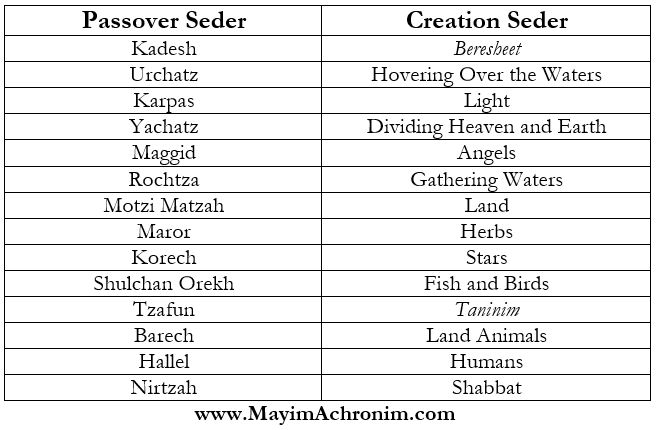
The first step of the seder is Kadesh, when we recite Kiddush and drink the first cup of wine. This officially ushers in the holiday and begins the seder process, just as the first act of Creation, Beresheet, officially started time and began the Creation process.

The next step is Urchatz, washing the hands with a cup of water. This first washing is done without saying the blessing al netilat yadayim. In Creation, the second verse tells us that God’s spirit “hovered over the waters.” The connection is self-explanatory.

Eating a vegetable (Karpas) is the third step and parallels the creation of light. As we’ve written in the past, the word “karpas” appears just once in the Tanakh, in describing the great banquet of King Achashverosh at the start of Megillat Esther. It refers to a certain fabric used in the drapery of the banquet. Mystically, it alludes to the fabric of Joseph’s special coat, which was dipped in blood and presented before Jacob to “confirm” the youth’s death. Jacob hence plunged into inconsolable grief and tears. We symbolically dip the karpas into salt water “tears”. That event—the sale of Joseph—led to the young man’s rise to power in Egypt, followed by his family’s settlement there, and then their enslavement, and finally the Exodus. So, that coat—karpas—set the events of the Exodus in motion. While the sale of Joseph was a sad and tragic event, Joseph himself insisted at the end that it was meant to be and all is well.

Joseph is credited for possessing a good eye, and for always being able to see the good within each situation, no matter how terrible (this is why the Sages state that, in turn, the evil eye did not affect Joseph at all). This is the secret of the Light of the First Day. It is called Or HaGanuz, the “hidden light”, and is the light through which Tzadikim see the world. On a deeper level, it represents that hidden divine light concealed within all things. A person like Joseph can see beyond the external into the Godly light inside. Ultimately, the light of the First Day of Creation was preserved for the righteous in the World to Come (Chagigah 12a), who will bask in this divine light in their own Heavenly “banquet”, draped with hur karpas u’techelet, “white, pure, and blue fabrics” (Esther 1:6).

Becoming Angels

Step four in the seder is Yachatz, when the middle matzah is divided in half. This clearly corresponds to the next act of Creation, the division of the waters on the Second Day. On this day, God made a permanent separation between the “upper waters” (Heaven, or Shamayim in Hebrew, literally “waters there”) and the “lower waters” that cover over 70% of the Earth. The larger waters, the Heavens, were concealed by God, just as the larger piece of matzah from the Yachatz is concealed for the afikoman.

Next comes Maggid, when we relate the Exodus story. This corresponds to the other major event of the Second Day. Though not mentioned explicitly in the Torah, the Sages state that God populated the Heavens with angels on this day. Appropriately, the term maggid is actually used to refer to angels that communicate with people. Throughout history, multiple rabbis described how they received mystical secrets from Heaven through a “speaking angel”, a Maggid. The most famous example of this is Rabbi Yosef Karo (1488-1575), the compiler of the Shulchan Arukh, who was visited by a Maggid and recorded some of these teachings in a book called Maggid Mesharim. An angel is first and foremost a messenger, and our job during the Maggid portion of the seder is to act as messengers in relaying the Exodus experience to our children.

Water, Land, and Passover Stars

After Maggid, we get up to wash netilat yadayim, this time with a blessing, because we then sit down to eat the matzah. We say the regular blessing of hamotzi lechem min ha’aretz, as well as the extra blessing al achilat matzah. These two steps, Rochtza and Motzi Matzah, parallel the next two steps of Creation (Genesis 1:9-10):

And God said: “Let the waters under the Heavens be gathered together unto one place, and let the dry land appear.” And it was so. And God called the dry land “Earth” [eretz], and the gathering together of the waters He called “Seas” [yamim]; and God saw that it was good.

Washing the hands is an allusion to the gathering of the waters, and eating the “bread of the earth” (lechem min ha’aretz) alludes to the formation of the earth, eretz.

Right after this, still on the Third Day, God seeded the earth with various grasses, herbs, and vegetation. Needless to say, this corresponds to the next part of the seder, Maror, eating the bitter herbs.

Then comes the “sandwich”, Korech, a combination of matzah, maror, and charoset. As we read in the Haggadah, this step was instituted by Hillel, who would make a sandwich from the matzah, maror, and korban pesach, the Passover lamb, since the Torah explicitly states that the lamb should be eating al matzot u’merorim. Today, we don’t have the Passover lamb, but we do still make a korech. What does the Passover lamb have to do with the next act of Creation, the formation of stars?
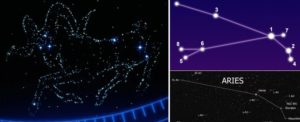
Images of the constellation Ares, including a stylized version in the shape of a ram.

The Sages teach that God’s command to take sheep specifically was not without meaning. This is because the Egyptians were idol worshippers and astrologers, and the sheep was one of their main idols and astrological signs. In fact, this bit of astrology remains with us to this day, for the astrological sign of the month of Nissan (or April) is Ares, a constellation in the shape of a ram or sheep. God wanted us to barbeque sheep in particular to once again show the folly of the Egyptians’ idolatrous beliefs. God created the stars as chronological markers for “the holidays, days, and years” (Genesis 1:14), not for them to be worshipped.

Completing the Seder, Completing Creation

We now enter Shulchan Orekh, the great feast. We traditionally begin with eggs and fish. In fact, in olden days some had the custom to place an egg and fish on the seder plate itself (today we retain the egg, but not the fish). These represent what was created next, on the Fifth Day: fish and birds.

The Torah then states that God created taninim gedolim. There is much discussion about the identity of these mysterious creatures. Is the Torah speaking about whales (which, though in the seas, are not fish so they are listed as a separate creation)? Perhaps they are dinosaurs, since the most literal translation would be “large reptiles”? The Sages say that these actually refer to two great monsters or dragons (see Rashi on Genesis 1:21). God created a pair of them, male and female, but they were so terrible that He slayed one immediately afterwards so that the two wouldn’t reproduce. The remaining Leviathan is hidden away, perhaps prowling the deep seas.
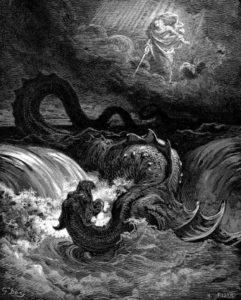
‘Destruction of Leviathan’ by Gustav Doré

The taninim correspond to Tzafun, the consumption of the afikoman. The hidden half of the matzah is finally revealed and eaten to end the meal. This alludes to the meal at the End of Days, the so-called “Feast of Leviathan”, where the righteous will join Mashiach in partaking of the Leviathan’s flesh. (For more on the connection between Mashiach and the afikoman, see here.)

With the meal officially over, we recite Birkat Hamazon, and drink the third cup of wine with it. Our rabbis state that on holiday feasts one should especially partake of meat, which is the centrepiece of the holiday meal. (There is even a halachic debate whether one fulfils the mitzvah of a holiday meal if they did not consume meat, and another discussion of whether poultry is okay.) In Temple times, the major part of the meal was the roasted lamb itself. Having consumed our fill of meat, we say Barech to thank Hashem for it. This corresponds to the creation of land animals on the Sixth Day, without which we wouldn’t have the meat to begin with.

We then recite Hallel, to literally “praise” God. This corresponds to the creation of man, who was made for this very purpose. Unlike all other creations, man alone is capable of contemplating Hashem, serving Him, and connecting to Him.

Finally, there’s Nirtzah, where we declare our hope for the Final Redemption, and that next year we will be able to celebrate our complete freedom in Jerusalem. This is a wish for the coming of the great age at the End of Days that will be kulo Shabbat, an everlasting “Sabbath”. Of course, it parallels the final act of Creation: Shabbat.

In these ways, the Passover seder neatly parallels the seder of Creation. To summarize:
Chag Pesach Kasher v’Sameach!


The above essay is adapted from Garments of Light, Volume Three.
Get the book here! 
Secrets of the Mishkan

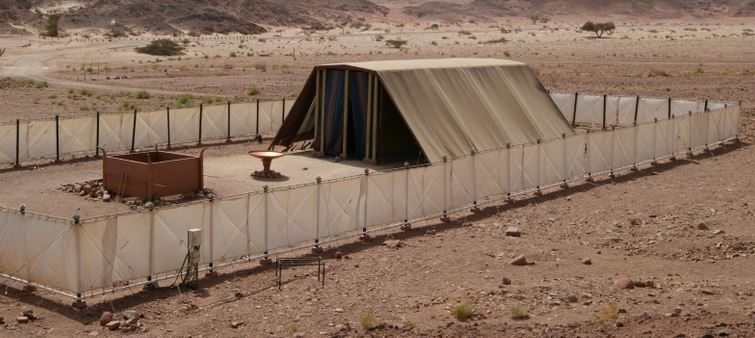
A Modern Replica of the Mishkan in Timna, Israel

This week’s parasha, Terumah, begins with God’s command for the Israelites to build a Mishkan, an Earthly “dwelling place” for the Divine. God tells Moses (Exodus 25:2-8):

Speak to the children of Israel, and have them take for Me an offering; from every person whose heart inspires him to generosity, you shall take My offering. And this is the offering that you shall take from them: gold, silver, and copper; blue, purple, and crimson wool; linen and goat hair; ram skins dyed red, tachash skins, and acacia wood; oil for lighting, spices for the anointing oil and for the incense; shoham stones and filling stones for the ephod and for the choshen. And they shall make Me a sanctuary and I will dwell in their midst…

God requests that each person donate as much as they wish to construct a Holy Tabernacle. He concludes by stating that when the sanctuary is built, He shall dwell among them. The Sages famously point out that the Torah does not say that God will dwell in it, but in them. The sanctuary was not a literal abode for the Infinite God—that’s impossible. Rather, it is a conduit between the physical and spiritual worlds, and a channel through which holiness and spirituality can imbue our planet.

In mystical texts, we learn that the Mishkan was far more than just a temple. Every piece of the Mishkan—every pillar and curtain, altar and basin, even the littlest vessel used inside of it—held tremendous significance and represented something greater in the cosmos. In fact, the whole Mishkan was a microcosm of Creation. This is the deeper reason for why the prohibitions of Shabbat are derived from the construction of the Mishkan. The passage we cited above appears one more time in the Torah, in almost the exact same wording, ten chapters later. In that passage, we read the same command for each Israelite to donate the above ingredients to build a sanctuary. The only difference is that in the second passage, the construction of the Mishkan is juxtaposed with (Exodus 35:1-2):

Moses called the whole community of the children of Israel to assemble, and he said to them: “These are the things that God commanded to make. Six days work may be done, but on the seventh day you shall have sanctity, a day of complete rest to God; whoever performs work on this day shall be put to death…”

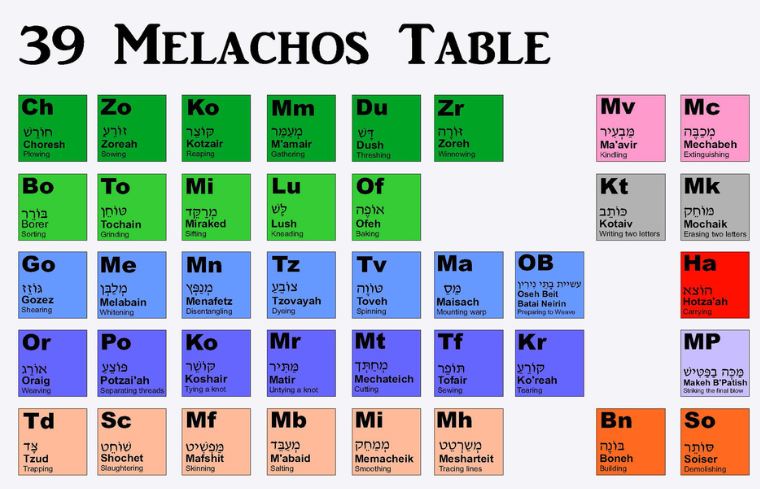
From this clear connection, the Sages learn that the actions required to construct and maintain the Mishkan are the same ones we must abstain from on the Sabbath. There are 39 such melakhot in all. On a more mystical level, these 39 works are said to be those same actions performed by God in creating the universe! For example, the first prohibited work (see Shabbat 7:2) is zorea, “sowing”, or seeding the earth, just as we read in the account of Creation that God said (Genesis 1:11) “Let the earth bring forth grass, herb-yielding seed, and fruit-tree bearing fruit after its kind, in which its seed is found on the earth.” Perhaps the most famous prohibition, mav’ir, “lighting” a flame, parallels God’s most famous Utterance, “Let there be light” (Genesis 1:3). Such is the case with all 39 prohibited works. In this way, when a Jew rests on the seventh day from such actions, he is mirroring the Divine Who rested from these works on the original Seventh Day.

A Periodic Table of the 39 Melachos, by Anshie Kagan

The Mishkan and the Holidays

The Zohar (II, 135a) comments on this week’s parasha that the ingredients of the Mishkan symbolize the Jewish holidays. The first ingredient is gold, and this corresponds to the first holiday of the year, Rosh Hashanah. The second ingredient, silver, corresponds to Yom Kippur. This is because silver and gold represent the two sefirot of Chessed, “kindness”, and Gevurah, “restraint”. The latter is more commonly known as Din, “judgement”. In mystical texts, silver and gold (both the metals and the colours) always represents Chessed and Gevurah. Rosh Hashanah is judgement day, which is gold, and Yom Kippur is the day of forgiveness, silver.

The third ingredient, copper, corresponds to the next holiday, Sukkot. The Zohar reminds us that on Sukkot, the Torah commands the Israelites to sacrifice a total of seventy bulls, corresponding to the seventy root nations of the world. This is why the prophet Zechariah (14:16) states that in the End of Days, representatives from all nations of the world will come to Jerusalem specifically during Sukkot to worship God together with the Jews.

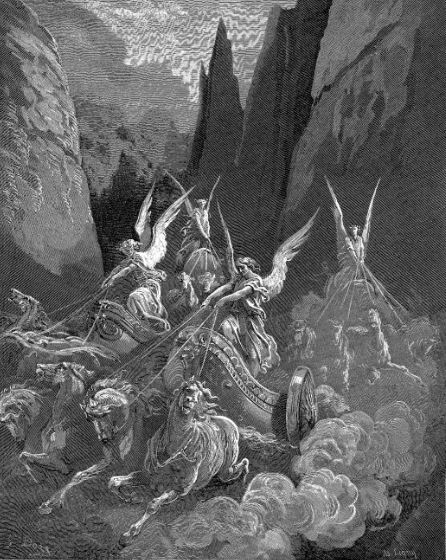
‘Vision of the Four Chariots’ by Gustave Doré

The Zohar explains that copper is Sukkot because copper (at least in those days) was the main implement of war, which the gentiles use to build their chariots and fight their battles. This, the Zohar explains, is the meaning of another verse in Zechariah (6:1), which states that “…there came four chariots out from between the two mountains; and the mountains were mountains of copper.” The Zohar concludes that the Torah prescribes the sacrifices to be brought in decreasing order (thirteen on the first day, twelve on the second, eleven on the third, etc.) to weaken the drive for war among the gentile nations.

The next ingredient is the special blue dye called techelet, which corresponds to Pesach. As the Talmud (Sotah 17a) states, techelet symbolizes the sea, and the climax of the Exodus was, of course, the Splitting of the Sea. Only at this point, the Torah states, did the Israelites believe wholeheartedly in God, and his servant Moses (Exodus 14:31). The Zohar therefore states that techelet holds the very essence of faith.

Following this is the purple dye called argaman, which is Shavuot. It isn’t quite clear why the Zohar relates these two. It speaks of purple being a fusion of right and left, perhaps referring to the fact that purple (or more accurately, magenta) is a result of a mixing of red and blue. This relates to the dual nature of Shavuot, having received on that day the two parts of the Torah (Written and Oral), and later the Two Tablets, in the month whose astrological sign is the dual Gemini. There is a theme of twos, of rights and lefts coming together. We might add that Shavuot is traditionally seen as a sort of “wedding” between God and the Jewish people, with the Torah being the ketubah, and Mt. Sinai serving as the chuppah.

The sixth ingredient, tola’at shani, red or “crimson” wool, corresponds to the little-known holiday of Tu b’Av. Although the Mishnah (Ta’anit 4:8) states that on Tu b’Av the young single ladies of Israel would go out in white dresses to meet their soulmates, the Zohar suggests that they also wore crimson wool, based on another Scriptural verse (Lamentations 4:5).

Tu b’Av is actually the last holiday that the Zohar mentions. The remaining nine ingredients correspond to the nine days after Rosh Hashanah, through Yom Kippur, ie. the “Days of Repentance”. This brings up a big question: The Zohar relates the ingredients of the Mishkan to the major Torah holidays: Rosh Hashanah and Yom Kippur, and the three Pilgrimage festivals (Pesach, Shavuot, Sukkot). Naturally, it omits Chanukah, Purim, the fasts and minor holidays, which are not explicitly spoken of in the Torah. So, why does it mention Tu b’Av? Before we even begin to answer this question, we should already recognize the huge significance of Tu b’Av, strangely one of the most oft-forgotten holidays on the Jewish calendar.

Tu b’Av: a Torah Holiday

The holidays that are not explicitly commanded by God in the Torah were all instituted by future Sages. Purim was instituted by Esther and Mordechai, and first celebrated in Persia. Yet, the Talmud tells us that the majority of the Sages in the times of Esther and Mordechai initially rejected their call to establish Purim as a holiday! (See Yerushalmi, Megillah 6b-7a.) Interestingly, historians and archaeologists have not found a single Megillat Esther among the thousands of Dead Sea Scrolls and fragments, suggesting that the Jews who lived in Qumran did not commemorate Purim. Clearly, it was still a point of contention as late as two thousand years ago.

Chanukah, meanwhile, is not found in the Tanakh at all. Although two Books of Maccabees exist, the Sages did not include them in the final compilation of the Tanakh. Similarly, the later Sages of the Mishnaic and Talmudic era did not find it fit to have a separate tractate for Chanukah, even though there is a separate tractate for every other big holiday.

The fast days are not festivals, but sad memorial days instituted by the Sages to commemorate tragic events. Tu b’Shevat appears to have no Scriptural origins. Yet, Tu b’Av does. The Talmud (Ta’anit 30b) tells us that one of the historical events that we commemorate on Tu b’Av is the fact that the tribe of Benjamin was permitted to “rejoin the congregation of Israel”. In the final chapters of the Book of Judges, we read how a civil war emerged in Israel, pitting all the tribes against Benjamin because of the horrible incident where a woman was brutally raped in Gibeah. The tribe of Benjamin was subsequently cut off from Israel, with their men forbidden from marrying women of other tribes. The ban was eventually lifted on Tu b’Av. The men of Benjamin were told:

“Behold, there is a festival of God from year to year in Shiloh, which is on the north of Bethel, on the east side of the highway that goes up from Bethel to Shechem, and on the south of Lebonah.” And they commanded the children of Benjamin, saying: “Go and lie in wait in the vineyards; and see, and, behold, if the daughters of Shiloh come out to dance in the dances, then come out of the vineyards, and take every man his wife of the daughters of Shiloh, and go to the land of Benjamin…” (Judges 21:19-21)

The Tanakh is clearly describing what the Talmud says would happen on Tu b’Av, when the young ladies would go out to dance in the vineyards to find their soulmates. The exact Scriptural wording is that this day is a chag Adonai, “festival of God”. This is precisely the term used by Moses during the Exodus (Exodus 10:9), possibly referring to Pesach, or more likely to Shavuot (as Rabbeinu Bechaye comments). It is also the term used later in the Torah to describe Sukkot (Leviticus 23:39). Thus, Tu b’Av is evidently a Torah festival, too! And this is why the Zohar singles it out from all the other, “minor” holidays. It seems Tu b’Av is not so minor after all.

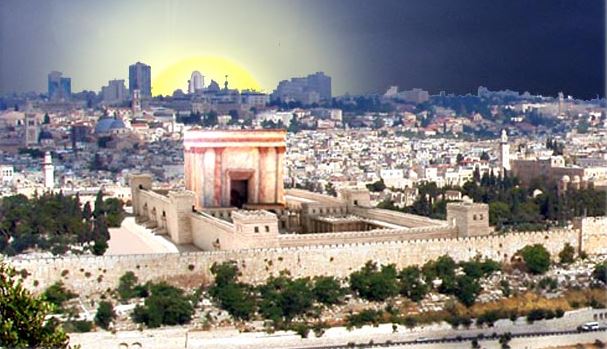
The Zohar concludes its passage on Terumah by saying that although we do not have the ability to offer Terumah today, and there is no Mishkan for us to build, we nonetheless have an opportunity to spiritually offer up these ingredients when we celebrate the holidays associated with them. When one wholeheartedly observes Rosh Hashanah, it is as if they offered up gold in the Heavenly Temple, and during Yom Kippur one’s soul brings up silver. Over the days of Sukkot, there is an offering of copper up Above, and on Pesach it is techelet; on Shavuot, argaman, on Tu b’Av, tola’at shani, and on the Days of Repentance the remaining ingredients. On these special days, we help to construct the Heavenly Abode. And this is all the more amazing when we remember that Jewish tradition maintains the Third Temple will not need to physically be built as were the first two, but will descend entirely whole from Heaven.

Courtesy: Temple Institute

Chanukah & the Light of Creation

As we begin celebrating Chanukah, we are reminded that Jewish law forbids using the light of the Chanukah candles for mundane purposes. At first thought, this is strange since all other holiday candles which we light may be used for mundane purposes. One can have a candle-lit dinner with the Shabbat candles on the table, yet the same cannot be done with Chanukah candles. This is actually why we light an additional (“ninth”) candle called the shamash, whose job is to “protect” the light of the Chanukah candles so that we do not inadvertently make use of them. Why is it that the Chanukah lights must not be used? To answer this question, one must go all the way back, long before the Maccabees, to the very beginnings of the universe.

The Light of Creation

When we open the Torah we read that God’s first act of Creation within an empty universe was light. God said “Let there be light”, and so it was. A few paragraphs later, we read that on the fourth day God created various luminaries to “give light”, including the sun, moon, and stars. If the things that naturally give off light were only created on the fourth day, what was the light of the first day? The Sages (Chagigah 12a) grappled with this apparent contradiction:

But was the light created on the first day? …This is [to be explained] according to Rabbi Elazar, for Rabbi Elazar said: “The light which the Holy One, blessed be He, created on the first day, one could see thereby from one end of the universe to the other; but as soon as the Holy One, blessed be He, beheld the generation of the Flood and the generation of the Dispersion, and saw that their actions were corrupt, He arose and hid it from them…”

Now the Tannaim [differ on the point]: “The light which the Holy One, blessed be He, created on the first day one could see and look thereby from one end of the universe to the other,” this is the view of Rabbi Yakov. But the Sages say: It is identical with the luminaries; for they were created on the first day, but they were not “hung up” until the fourth day.

On the simple level, the Sages agreed that the light of the First and Fourth Days were really the same thing: while God created the luminaries on the First Day, He only set them in their specific locations and orbits on the Fourth Day. This is in line with another opinion that God really created everything in one instant, on the First Day, and on the subsequent “days” He simply put everything in its place. (For an explanation of this, see Pardes Rimonim 13:5.)

On a deeper level, as expounded by Rabbi Elazar and Rabbi Yakov, the light of the First Day was an entirely different entity. Unlike the familiar, physical light of the Fourth Day, the light of the First Day was a special, mystical light which contained the power for one to see across the universe, through all of time and space. According to the Zohar, this is the special radiance of Creation, from which all things were fashioned (see ‘The Big Bang and the Age of the Universe’ in Volume One of Garments of Light). This idea is already noted in the Midrash (Beresheet Rabbah 12:6) which adds that “the light with which God created the universe [was given] to Adam, and with it he stood and gazed from one end of the universe to the other.”

Adam and Eve were given this Divine Light as a gift. However, once they consumed the Forbidden Fruit, that light disappeared. In fact, the Kabbalists explain that initially Adam and Eve saw the world entirely through this Divine Light, and themselves glowed with this light. When they looked upon each other, they saw only each other’s light, which is why they were unashamed. After consuming the Fruit, that light disappeared, and when they looked upon each other they saw frail skin, and all of its lustful trappings. This is why they were suddenly ashamed and wanted to hide.

The Kabbalists explain that this is the mystical meaning of the interplay between the words for “light”, or (אור), and “skin”, ‘or (עור), words that sound the same and are written with just one substitution: The singular, holy aleph replaced with the ‘ayin, which literally means “eye” and represents this illusory physical world. Before the Fruit, Adam and Eve saw light; afterwards they saw only skin. (See Beresheet Rabbah 20:12, Zohar I, 22b, and Pardes Rimonim 13:3)

This is the deeper meaning behind God’s first word to Adam and Eve after their fall: “Ayeka?” The term literally means “Where are you?” referring to the fact that Adam and Eve were hiding because they were ashamed. Of course, God knew exactly where they were. So what did He mean by Ayeka?

Ayeka

The Sages explain that the original Divine Light, called Or HaGanuz, the “hidden light”, only shone for 36 hours. There are two opinions as to how one reaches this number. The first (as in Beresheet Rabbah cited above) is that the Light shone for the entire 24 hours of the first Shabbat, as well as the 12 hours preceding that Shabbat, from the moment that Adam and Eve were created on the sixth day. The light disappeared at Shabbat’s conclusion, which is one reason why we perform Havdallah at the end of Shabbat, symbolizing our hope for the restoration of that Light. Alternatively, the Light shone for the first three days of Creation, before those physical luminaries were created on the fourth day. Since each day had 12 hours of light and 12 hours of dark, that means each of the three days had 12 hours of this Divine Light, totalling up to 36.

In reality, both opinions are correct. The Divine Light initially shone for those first three days—36 hours—and was then concealed by the new physical luminaries. On the sixth day, when God created Adam and Eve, He entrusted them with that Light, and they possessed it for 36 hours until the conclusion of the first Sabbath, neatly mirroring those 36 hours of the first three days. When Adam and Eve consumed the Fruit, the Light disappeared from them, and was taken back up to Heaven, stored beneath God’s Throne (Yalkut Shimoni, Isaiah 499). This brings us back to Ayeka. The gematria of that word (איכה) happens to be 36. When God called out to Adam and Eve and said Ayeka, what He meant was not “where are you?” but “where is the Light?”

Restoring the Light

While the Or HaGanuz has been hidden for now, it reveals itself in this world through several channels. We find that same number 36 in a number of important places. Most notably, when we look at the actual number of texts in our Holy Scriptures, we find that there are 36: Genesis, Exodus, Leviticus, Numbers, Deuteronomy, Joshua, Judges, Samuel, Kings, Isaiah, Jeremiah, Ezekiel, Hoshea, Yoel, Amos, Ovadiah, Yonah, Micah, Nahum, Habakkuk, Tzephaniah, Haggai, Zechariah, Malachi, Psalms, Proverbs, Job, Song of Songs, Ruth, Lamentations, Ecclesiastes, Esther, Daniel, Ezra, Nehemiah, and Chronicles. While we generally group these texts into 24 “books” of the Tanakh for convenience, there are exactly 36 independent works. This reminds us that the Holy Scriptures contain within them the Divine Light, and through the study of these texts we can receive a glimpse of it.

Similarly, the Bnei Issachar (Rabbi Tzvi Elimelech Shapiro, c. 1783-1841) points out that there are 36 tractates to the Talmud. Study of Torah—whether Written (Tanakh) or Oral (Talmud)—serves to restore that Divine Light little by little. Naturally, this parallels the idea of the 36 Perfect Tzaddikim. The Sages state that in every generation there are exactly 36 perfectly righteous people alive, and the world only continues to exist in their merit (Sanhedrin 97b). They contain a spark of that Divine Light within them. And on the calendar, too, there is a month in which finding the Or HaGanuz is particularly auspicious. This is the month of Kislev which, the Bnei Issachar points out, is a contraction of kis (כס) and lev (לו), the former meaning “hidden” and the latter having the value of 36.

That brings us right back to Chanukah, which begins on the 25th of Kislev. We light one candle on the first day, two on the second, and so on. The total number of candles lit over the course of eight days just happens to be 36. The Chanukah lights are symbolic of that special holy light of Creation. One should not for a moment think that these are just mundane, physical lights. And this is the mystical reason for why Jewish law forbids using the Chanukah lights for any purpose. One should constantly meditate on the fact that the light of the Menorah represents the Or HaGanuz, the light of Creation, the holy light with which Adam and Eve “saw from one end of the universe to the other.”

Jewish law also requires one to place their Menorah in a widely visible spot. We must “publicize the miracle” as much as possible, hence the many public Menorah-lighting ceremonies that take place around the world, and the many electronic chanukiahs found outside synagogues, in shopping malls, and on the roofs of cars. We are not just commemorating the Chanukah miracle, but the Jewish mission to bring light into the world (as Isaiah 42:6 famously states).

From a mystical perspective, we light 36 candles to remind ourselves that our mission is to rectify the cosmos and reveal the primordial holy light of God. We remind ourselves that we should strive to return to being like the original Adam and Eve, who glowed with this light, and who looked past the deceptive skin to see the pure light within each other. When we learn to recognize each other’s inner glow, then we will merit a return to the luminous Garden of Eden.


The above is an excerpt from Garments of Light, Volume Two. Get the book here