
What are the deeper meanings behind the various names of God, such as YHWH, El, and Elohim? Where do we find God’s fingerprints across the cosmos, and what is His blueprint for Creation? What might recent findings in science and archaeology reveal? And what are God’s 32 Paths of Wisdom? Find out in this eye-opening class as we being a journey into understanding the mysterious names of God.
Category Archives: Kabbalah & Mysticism
Understanding Hair Covering for Women in Jewish Law
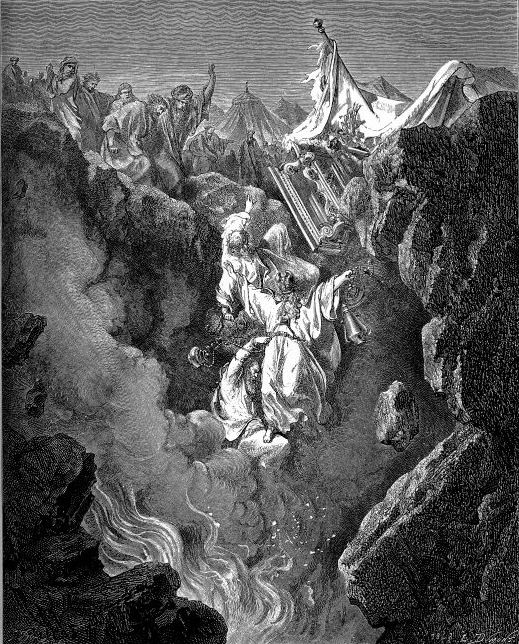
“Death of Korah, Dathan, and Abiram” by Gustave Doré
This week’s parasha, Korach, has a hidden theme: hair. In fact, the name of the villain himself, Korach (קרח), is spelled exactly the same way as kere’ach, “bald”. As we shall see below, Korach’s rebellion began when he saw himself bald-headed following his initiation ritual as a Levite. Hair comes up again in the famous story of one of Korach’s co-conspirators, a man named On ben Pelet. On is strangely mentioned right at the beginning of the parasha (Numbers 16:1), and never again. The Talmud (Sanhedrin 109b-110a) explains that he was saved thanks to his wife: She told her husband that he had nothing to gain from joining the rebellion; now he was subservient to Moses, and if the rebellion would be successful he would just become subservient to Korach!
On understood, but worried that he had already agreed to join the group. So, his clever wife got him drunk and sleepy, and On passed out in bed. Meanwhile, she went out to the entrance of their tent and “exposed her hair”. When Korach’s collaborators approached, the Talmud says they turned away due to the immodest sight of the woman. By the time On recovered from his drunken stupor, the whole episode was over, and he was spared. This story implies that Jewish women cover their hair, and for a woman to expose her hair publicly is immodest. Yet, nowhere in the Torah is there an explicit command for a Jew to cover their hair at all times (male or female). Hair-covering is not listed among the 613 mitzvot! If it isn’t a Torah mitzvah, where did it come from? Continue reading
The Cosmic Jubilee (Video)
How do we make sense of archaeological evidence of advanced ancient civilizations going back 12,000 years? Who really built the Pyramids and the Sphinx? And who produced the Lascaux Cave Paintings that date back 20,000 years? Find out in this eye-opening class where we explore the mystical notion of cosmic Sabbaticals and Jubilee cycles. Plus: revealing the incredible secret concealed in the first letter of the Torah, and where in the Cosmic Jubilee are we currently situated?