
Category Archives: Jewish Law & Life Cycle

The Kabbalah of Hillel and Shammai

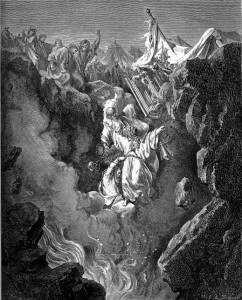
“Death of Korah, Dathan, and Abiram” by Gustave Doré

In parashat Korach, the Torah recounts the eponymous leader’s rebellion against Moses and Aaron. Korach’s rebellion was two-fold: both against the leadership of Moses, and against the priesthood of Aaron. Regarding the latter, Korach tried to bring the holy incense offering that only a kohen was allowed to do, and he failed miserably. The tremendous sin of Korach and his several hundred followers—along with the many Israelites that they had, at least temporarily, won over to their side—left a stain on the Jewish people for centuries afterwards. This stain was only rectified by another great dispute between two Jewish leaders and their schools: Hillel and Shammai. In fact, the Zohar says some incredible things about these disputes, which originate all the way back on the Second Day of Creation. Continue reading
A Brief Summary of Tithes and Charity

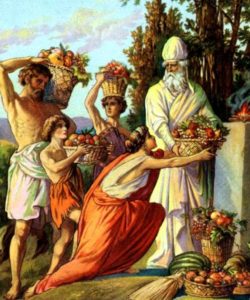
An illustration of bringing bikkurim to the kohen (from the Providence Lithograph Company)

This week’s double parasha, Behar and Bechukotai, begins with the laws of Sabbaticals and Jubilees, and ends with some laws related to tithes. We see here the Torah’s incredible concern for public welfare and social justice—far ahead of its time. The Torah outlines a lengthy system of rules to ensure that the impoverished and the disadvantaged are taken care of, that people have equal opportunities, and that both wealth and land is redistributed to address the disparity between rich and poor, which inevitably results in most societies.

We see, for instance, that at the Jubilee year (every 50th), all lands reverted to their original owners. In Biblical times, when a person purchased land, they were really only leasing it for a number of years, no more than the number of years left until the next Jubilee. So, even if a family had become destitute in the intervening years, and had to sell off all of their land, they could rest assured knowing that they would eventually get their ancestral plot of land back, and have an opportunity to rebuild their wealth. This would ensure that the mega-rich do not swallow up land and grow ever richer (as we unfortunately see all too often today, such as Bill Gates being the largest owner of farmland in America, and Mark Zuckerberg buying nearly an entire Hawaiian island despite the protest of locals). Continue reading

Making Babies: Is it Possible to Influence Gender?

Note: for the purposes of this article, the terms “gender” and “sex” are used interchangeably.

This week’s double parasha, Tazria-Metzora, begins with the laws of when “a woman conceives and gives birth to a male…” (Leviticus 12:2) The actual Hebrew wording here is ishah ki tazria, literally “when a woman gives seed”. Based on this, our Sages taught that if a woman “gives seed” first, the child will likely be male, whereas if a man “gives seed” first, the child will likely be female (Niddah 31a). How exactly is this to be understood? Continue reading