
Category Archives: Mashiach & End of Days

The Hidden Connection Between Lag b’Omer and Yom Yerushalayim

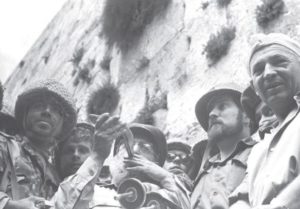
Rabbi Shlomo Goren blows the shofar by the Western Wall during the 1967 liberation of Jerusalem.

This Thursday evening, the 18th of Iyar, we mark the mystical holiday of Lag b’Omer. Ten days later, on the 28th of Iyar, we commemorate Yom Yerushalayim, when Jerusalem was liberated and reunified in 1967 during the miraculous Six-Day War. At first glance, these two events may seem completely unrelated. However, upon deeper examination, there is actually a profound and fascinating connection between the two. To get to the bottom of it, we must first clarify what actually happened on these dates in history to uncover their true spiritual significance. Continue reading

What are the True Borders of Israel?

This week we read another double portion, Acharei Mot and Kedoshim. The latter, literally meaning “holies”, instructs us on the key mitzvot that make us especially holy. Of course, while all of the Torah’s mitzvot serve to make us holier, the ones in Kedoshim particularly have special merits. The list starts with revering one’s parents and observing the Sabbath (Leviticus 19:3). It peaks with the famous mitzvot of judging others favourably (v. 15), not gossiping (v. 16) nor bearing a grudge (v. 18), and loving your fellow as yourself. Other big mitzvot include not wearing shaatnez (v. 19, a mixture of wool and linen), and not getting tattooed (v. 28). Finally, there is a list of prohibited sexual relationships, before God says: Continue reading

Unicorns in the Torah

Yesterday was my daughter’s birthday, and her favourite thing in the world is unicorns. Perhaps this is because the unicorn makes a hidden appearance in her parasha, this week’s parasha, Vayak’hel-Pekudei. In summarizing the construction of the Mishkan, the Torah notes that it was made with the skins of the tachash (Exodus 35:7). The tachash is a mysterious animal whose true identity is entirely unknown. The Talmud (Shabbat 28b) states that it was a unique mammal species, wild and undomesticated, with a singular horn on its head. It came specifically in the time of Moses to be used for the Mishkan, and has since disappeared. The Talmud goes on to suggest that it was probably the same animal that was brought by Adam as a sacrifice in the Garden of Eden. This ties to another passage in the Talmud (Avodah Zarah 8a) that explains how Adam brought a thanksgiving offering to God, of a unique animal with a single horn, as it states in Psalms 69:32 that “it shall please God better than an ox with horn and hooves.” Elsewhere (Chullin 60a), the Talmud adds that this special animal emerged fully formed, horn-first, from the Earth. The Sages hold that having horn and hooves means it was probably kosher! Continue reading